
ItInsightsWorld General: Fraunhofer IDMT lokalRAIN vs Rain Gauges — What Solar-Panel Rain Sensing Can and Cannot Prove
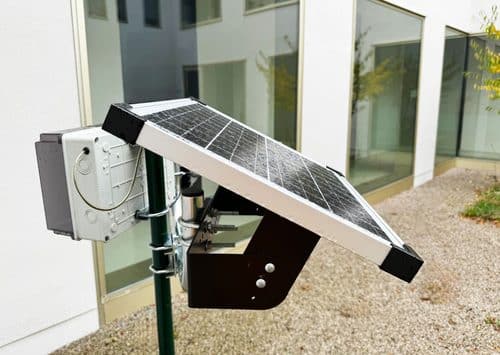
The test setup for precipitation measurement in the courtyard of the Fraunhofer IDMT (image: Fraunhofer IDMT)
Short answer: The Fraunhofer IDMT lokalRAIN prototype uses vibration sensors on solar panels to infer rainfall, and it reported a mean absolute deviation of 1.88 mm/h for light rain between 2 and 5 mm/h. That is useful for denser local readings, but it is not yet a certified replacement for conventional gauges because heavy-rain accuracy has not been established.
A flood-operations team usually faces a practical bind: it can install a few calibrated rain gauges at known stations, or it can watch roofs, car parks, and other sun-exposed surfaces that receive rainfall directly but never report it. lokalRAIN tries to make the second option useful by attaching compact acoustic sensor nodes to photovoltaic modules and turning the sound of falling drops into local rainfall estimates.
What does lokalRAIN actually measure?
It measures rain-induced vibration, not accumulated water depth. A research team at the Fraunhofer Institute for Digital Media Technology (IDMT) in Ilmenau mounted structure-borne sound sensors on solar modules, then let machine learning on a low-power microcontroller infer rainfall. The data path is edge-first: each node processes locally and sends only compact measurements wirelessly.
Pan Acoustics, a project partner based in Wolfenbüttel, built the sensor-node hardware and the wireless transmission layer. Fraunhofer IDMT then aggregates readings from several sites to form a more granular local rainfall picture. The proof-of-concept used three outdoor measurement systems: the IDMT courtyard, Pan Acoustics, and the weather garden of the Technical University of Ilmenau. Before fieldwork, the lab used a rain simulator across different rainfall rates, drop sizes, and photovoltaic modules.
Fraunhofer IDMT also describes the broader sensing idea as acoustic sensors, AI, and edge computing that can be integrated into existing surfaces such as solar panels, vehicle roofs, or skylights, as shown on its smart rain sensor use-case page.
Solar panels vs rain gauges: what each is good at
The comparison is not a simple new-versus-old verdict. It is a trade between measurement confidence and measurement density. A calibrated gauge is still the safer choice when an official record, engineering design, or legal claim depends on exact rainfall totals. A vibration-based solar-panel sensor is more interesting when a city needs many extra points and can accept a supplement with known limits.
| Decision question | Fraunhofer IDMT vibration method | Conventional rain gauge | ItInsightsWorld read |
|---|---|---|---|
| Where can it be deployed? | Can be added to PV modules and other surfaces. | Needs a proper installation site, often with clearance and maintenance access. | Best as a dense supplemental network. |
| Light-rain performance | 1.88 mm/h mean absolute deviation between 2 and 5 mm/h. | Accuracy depends on model, calibration, and exposure. | The prototype met Class C for low rainfall intensities. |
| Heavy-rain performance | Not established yet. | Certified instruments are usually specified across an intensity range. | Do not move flood alarms to vibration data alone. |
| Maintenance | No moving parts, so upkeep may be lower. | Funnel, float, tipping bucket, or weighing element still needs checking. | Lower mechanical maintenance is not zero maintenance. |
| Network reach | Field trials reached four kilometers in urban settings and over 35 kilometers where rural line of sight was available. | Site location and communications drive reach. | Useful when a city already has PV roofs or other assets in place. |
What has the project proved so far?
The strongest evidence is for light rain. Fraunhofer states that, for low-intensity conditions, the mean absolute deviation was 1.88 mm/h and that the result meets Class C of the World Meteorological Organization (WMO) accuracy classification, which permits a maximum deviation of 2 mm/h for low rainfall intensities. Jakob Bergner, group leader for Smart Acoustic Solutions at IDMT and scientific head of the project, kept the claim narrow: “We have proven the feasibility of our approach for light rain,” he said.
The project also showed a practical communication pattern. Each sensor node processes data before transmission, so the system sends compact results instead of raw vibration streams. That matters for battery-operated edge devices and for sites where backhaul is not trivial.
What remains unproven?
Heavy rain is the main gap. The team has not collected enough training and test data for high rainfall intensities, so accuracy under those conditions is not established. That limitation is important for urban drainage, flood warning, and firefighting support, where the data that matters most is often the worst weather, not the drizzle.
The product gap is also visible. lokalRAIN produced a prototype, not a marketable product. The next engineering work still includes better housing for the sensor and its electronics, plus system-level quality assurance. Without those steps, a buyer should treat it as a sensing experiment that may become a procurement option.
How did lokalRAIN start, and why does the timeline matter?
Project lokalRAIN ran between October 2024 and June 2026 as part of the Central Innovation Program for SMEs (ZIM) in Germany. The October 2024 start and June 2026 finish frame the work as a funded research prototype, not a mature off-the-shelf device. For readers comparing vendors, that distinction affects warranty expectations, support response, and the strength of calibration claims.
Who should pilot it, and who should wait?
Use this as a pilot list, not a replacement list:
- Urban digital-twin teams: test where a few known blind spots matter more than certified totals.
- Municipal control rooms: use vibration readings to add context to existing weather stations.
- Flood monitoring groups: compare against reference gauges before using any alert threshold.
- PV asset owners: verify that added nodes do not create roof, wiring, or warranty issues.
- Firefighting and municipal infrastructure operators: watch the project because they have already expressed interest, but require QA evidence before operational reliance.
Common misconceptions
- “If the sensor is on a solar panel, it is an energy product.” It is primarily a rainfall-sensing layer placed on an existing surface.
- “A 1.88 mm/h error means the system is generally accurate.” The reported result applies to light rain between 2 and 5 mm/h, not every storm type.
- “No moving parts means no calibration.” The system still needs training data, housing improvement, and quality assurance before it can behave like an instrument.
Next step: what to ask before running a pilot
For buyers, the practical route is a short side-by-side test, not a full network build.
- Define the decision. Is the pilot for drainage response, asset awareness, or research? The answer sets acceptable error.
- Install a reference gauge. Compare local readings against a known instrument, not just against nearby PV output.
- Run at least 30 rainfall events. Include light rain and, if possible, heavy rain; note where the model is weakest.
- Check the whole chain. Sensor housing, wireless uptime, data aggregation, and calibration procedure all need evidence.
The safer framing is that lokalRAIN is a laboratory result, not a consumer product until field quality assurance exists. It may become useful for hyperlocal rainfall awareness, especially where solar panels already exist, but it still needs the evidence that turns a research demo into dependable public-infrastructure data.
Frequently asked questions
Can solar panels replace rain gauges after this trial?
Not yet. The method showed useful performance for light rain, while heavy-rain accuracy remains unproven because sufficient high-intensity training and test data are missing.
Why is 1.88 mm/h the number everyone cites?
It is the mean absolute deviation measured against reference readings for light rain between 2 and 5 mm/h. Fraunhofer links that result to Class C of the World Meteorological Organization (WMO) accuracy classification for low rainfall intensities.
Who built the hardware?
Pan Acoustics, based in Wolfenbüttel, supplied the sensor-node hardware and wireless transmission technology, while Fraunhofer IDMT led the research and central data analysis.
Is this product already sold?
No. lokalRAIN produced a prototype. The next steps include improving housing for the sensor and electronics and completing quality assurance for the full system.