
ItInsightsWorld General Report: Snapdragon X2 Elite GPU Regression in Premiere Pro and Local AI Tops 87% under Adreno 32.0.181.0
A recently issued Qualcomm driver update for Windows on Arm systems based on Snapdragon X and Snapdragon X2 series processors has become a focus point after community reports said Snapdragon X2 Elite machines suffered declines of up to 87% in Adobe Premiere Pro and local AI workflows after the Adreno 32.0.181.0 release.
Reddit forum testing narrows the impact to rendering and LLM inference
User results circulating on the Reddit forum centered on two workload types: Adobe Premiere Pro video rendering and local large language model execution on Snapdragon X2 Elite hardware. One ASUS Zenbook A16 owner said an export that had previously completed in 1 minute 40 seconds for an about 7 minutes 1080p timeline took about 10 minutes after the driver moved to 32.0.181.0, a slowdown close to 6x. The report made Premiere Pro one of the clearest warning signs for creative software users.
llama.cpp and OpenCL benchmarks show token-generation losses
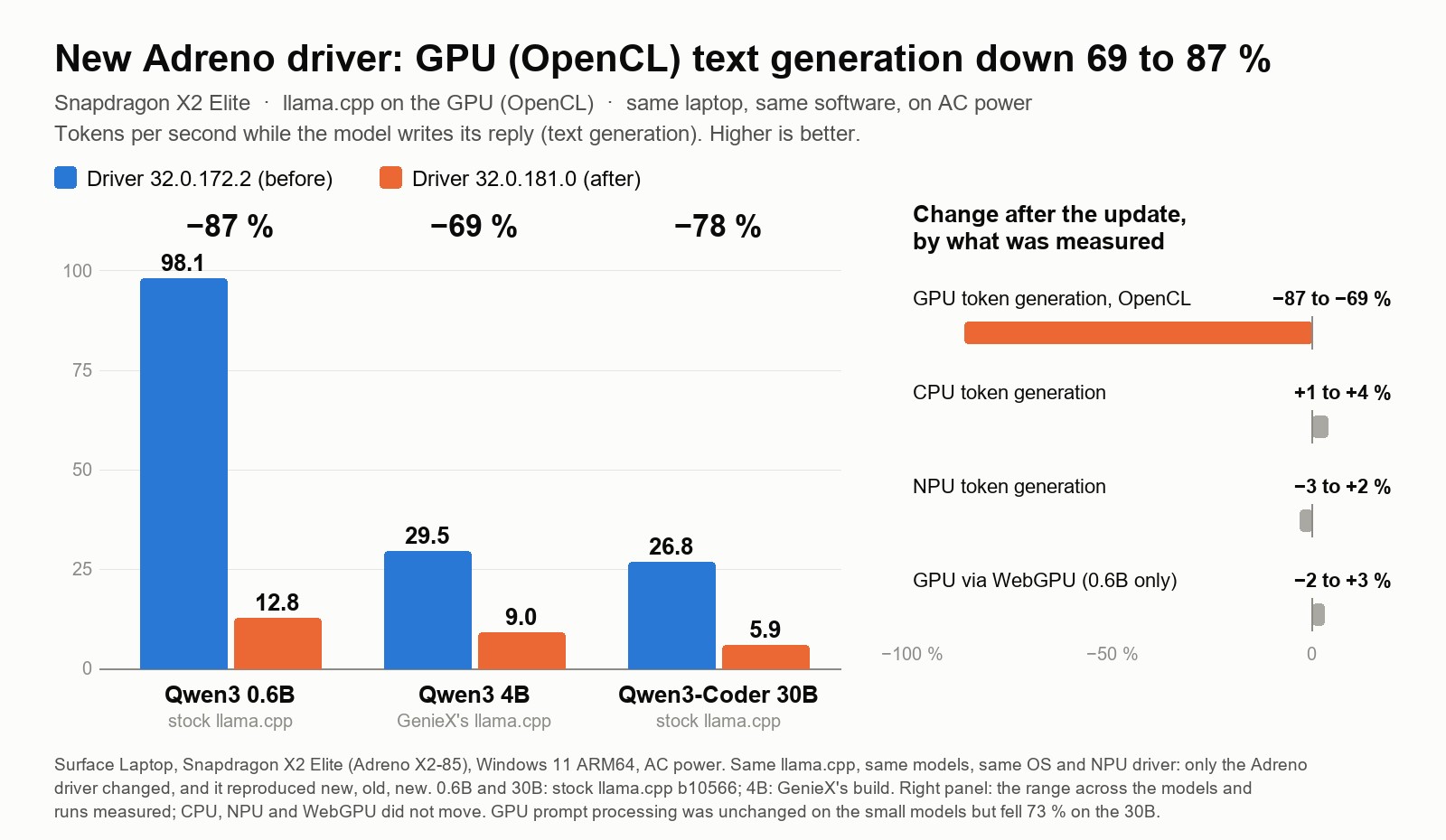
A second tester used a Microsoft Surface Laptop eighth generation machine with Snapdragon X2 Elite and an Adreno X2-85 GPU, running llama.cpp with an OpenCL backend across several Qwen3 series models. Compared with the previous 32.0.172.2 driver, 32.0.181.0 reduced text generation speed in the following results.
| Model | 32.0.172.2 | 32.0.181.0 |
|---|---|---|
| Qwen3-0.6B model | 98.1 tokens per second | 12.8 tokens per second |
| Qwen3-4B model | 29.5 tokens per second | 9.0 tokens per second |
| Qwen3-Coder-30B-A3B-Instruct model | 26.8 tokens per second | 5.9 tokens per second |
The size of the regression varied by model and workload, but the highest reported drop reached 87%.
Rollback restores performance and points toward GPU compute paths
The tester also repeated the comparison by removing 32.0.181.0 and restoring an older Adreno GPU driver, after which the speed returned to normal; installing the newer package again reproduced the decline. During these checks, the hardware configuration, operating system version, software environment, and model files were kept consistent, and the laptop remained connected to power, helping isolate the change as the likely variable.
The feedback suggests that the issue is concentrated in GPU-accelerated work. CPU and NPU behavior on Snapdragon X2 Elite did not appear materially affected in the reported cases, while tasks that rely on the Adreno GPU for local AI inference and video rendering did show losses, pointing to OpenCL or GPU compute behavior inside the updated driver rather than a defect in the processor itself.
Qualcomm has not issued an official explanation, and older drivers remain the cautious choice
As of now, Qualcomm has not published an official statement or confirmed whether the 32.0.181.0 package contains a defect. For users whose workflows depend on local AI, Adobe Premiere Pro, or other GPU-intensive operations, remaining on an earlier version such as 32.0.172.2 may be the more prudent option until additional investigation is available.
This episode also highlights how driver stability can shape platform experience as Windows on Arm devices move deeper into creator and AI development use cases. The Snapdragon X2 Elite ecosystem’s broader compatibility will depend not only on silicon capabilities, but also on how consistently graphics software stacks are validated for professional workloads.