
ItInsightsWorld General: Edge AI Platform Resets Across Embedded Silicon Vendors
Embedded AI programs are no longer just about dropping a model onto a board. Teams must translate, shrink, compile, measure, and validate inference workloads across many processor families while keeping security and real-time behavior intact. To understand what is changing, this overview follows how several device makers are rebuilding developer stacks around models, toolchains, boards, and cloud access.
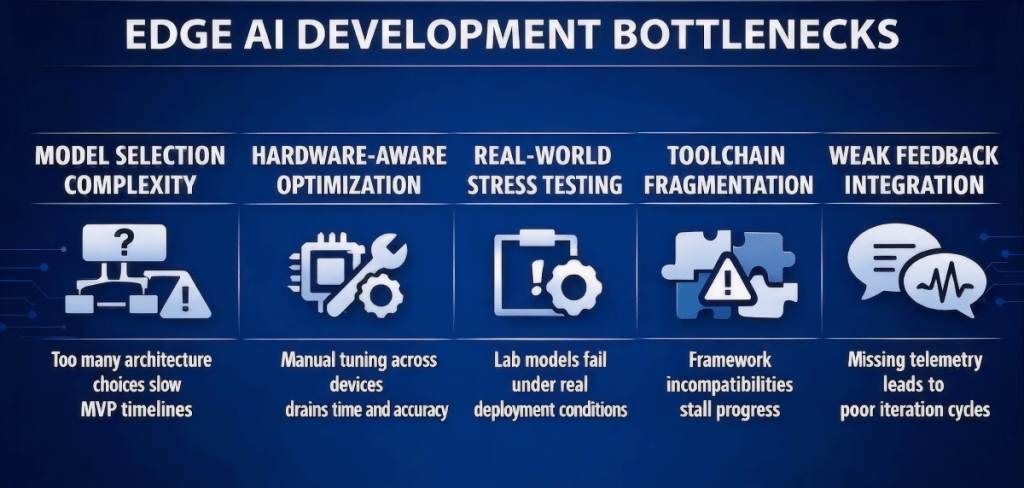
Figure 1: Recurring pinch points in edge AI programs (Source: Saumitra Jagdale)
NXP turns eIQ into a unified agentic AI environment
NXP Semiconductor first released eIQ in 2018. The platform later shifted from a heavily code-oriented inference engine compiler to a GUI-driven eIQ toolkit that profiles execution graphs and optimizes open-source TensorFlow, PyTorch, and ONNX models in one flow. Optimization methods include quantization, operator fusion, pruning, and architectural mapping. The environment also connects with the Nvidia TAO toolkit, allowing imported models.
The portfolio also includes eIQ Time Series Studio for time-series AI/ML work that supports split-second decisions at the edge. It is designed for i.MX 8 and i.MX 9 application processors, QorIQ Layerscape processors such as LS1046A, LX219, and 760A, and S32 automotive processors and microcontrollers (MCUs).
At CES 2026, NXP announced the eIQ AI hub, which brings the eIQ toolkit, eIQ Time Series Studio, eIQ GenAI Flow—a software pipeline for large language models—and an agentic AI framework into one cloud-based workspace. Teams can perform functional simulations, hardware-farm models, and run benchmarking tests, then move from cloud use to on-premises operation when needed.
The added agentic AI framework is intended to bring similar acceleration to edge agent workloads as earlier eIQ tools provided for other development stages. It is also compatible with Ara discrete neural processing units (NPUs). Because constrained edge products often run multiple models, NXP designed the framework to spread inference tasks across Ara NPUs, i.MX CPU cores, and integrated GPU acceleration.
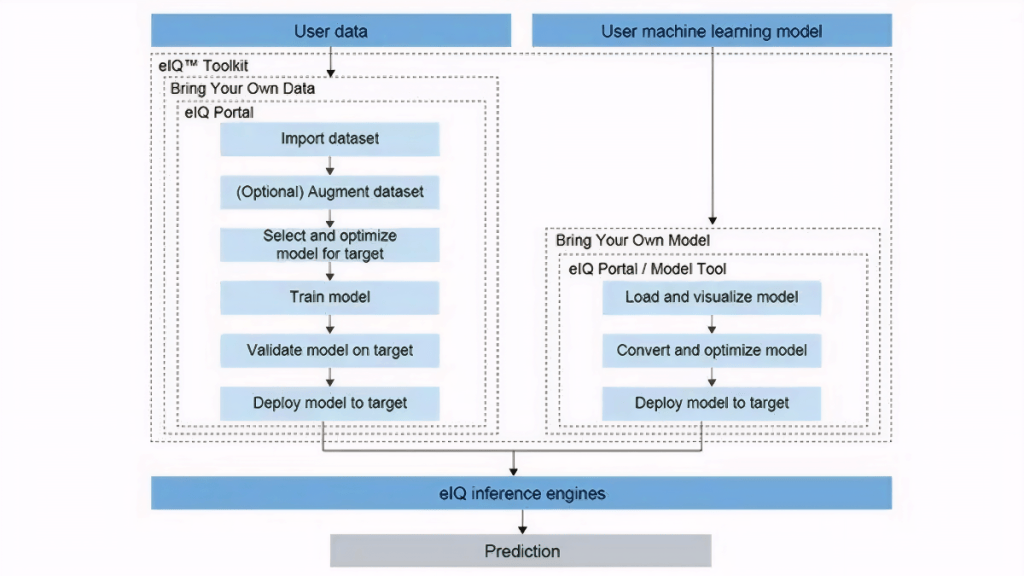
Figure 2: The machine-learning flow inside the NXP eIQ Toolkit pipeline (Source: NXP Semiconductors)
TI centralizes automotive and silicon tools around CCStudio
Texas Instruments Inc. (TI) positions CCStudio as a single development ecosystem for consolidating toolchains. Its stated goal is to connect hardware architectures, graphical configuration utilities, compilers, and edge AI deployment inside one workflow.
The supporting toolset covers data capture, model training, optimization, and deployment for families such as MSPM0, C2000, MSP430, SimpleLink, Hercules, Sitara, Jacinto, mmWave, C6000, and C7x.
Model Zoo stores over 200 pretrained and hardware-optimized neural-network models using PyTorch, TensorFlow, and ONNX for vision, audio, time-series, and radar tasks. The source describes these deployments as heavily based on advanced data signaling. Model Analyzer lets developers benchmark networks on TI hardware remotely over the cloud, mirroring the cloud access pattern introduced by NXP's eIQ AI hub. CCStudio also includes AI agents for code generation, system configuration, and debugging.
A Synopsys collaboration produced a Virtualizer Development Kit to digitally twin the TA5 system-on-chip (SoC) and create software-defined hardware for automotive targets. TDA5, combined with the C7 NPU launched in January 2026, is positioned for cross-domain fusion across advanced driver-assistance systems, gateway control, and infotainment hosting on one device.
Renesas 365 broadens the workflow beyond deployment software
Renesas Electronics Corp. has extended Renesas 365 beyond a deployment suite. It groups Altium Designer and e2 studio—the company's integrated development environment—under one umbrella to encourage hardware-software co-design at a higher level.
At the center is the System Data Model. By organizing tools around that shared data structure, Renesas 365 can join board-level hardware design, system-level simulation, component sourcing, and embedded software compilation into one ecosystem, aided by an integrated suite of AI-driven tools.
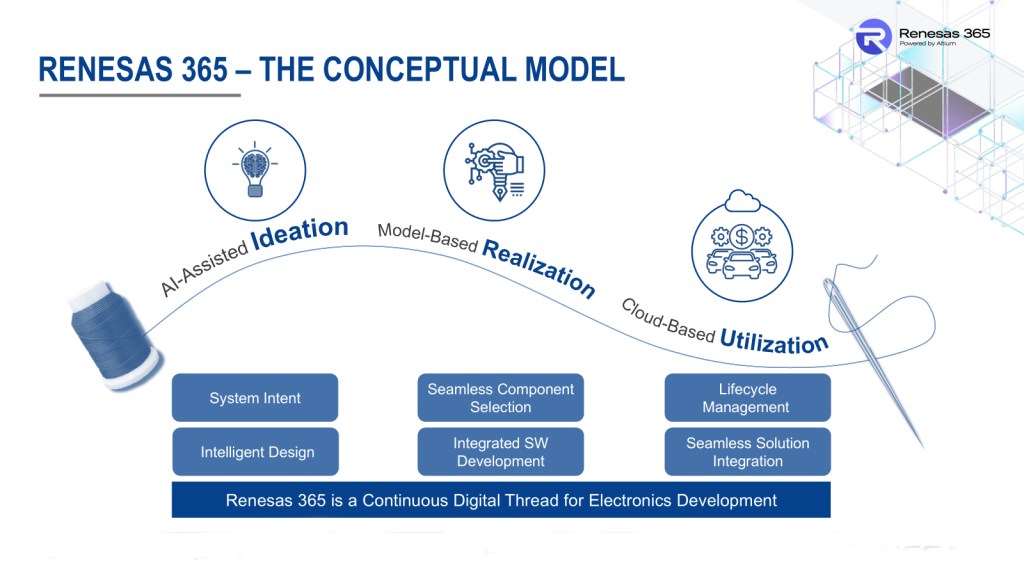
Figure 3: The Renesas 365 architecture addresses gaps in embedded systems development (Source: Renesas Electronics Corp.)
Reality AI tools are now folded into the cloud-based Renesas 365 to simplify model training, optimization, and deployment. The workflow starts by analyzing sensor data, producing a purpose-built model, and then keeping training and optimization inside a single end-to-end path.
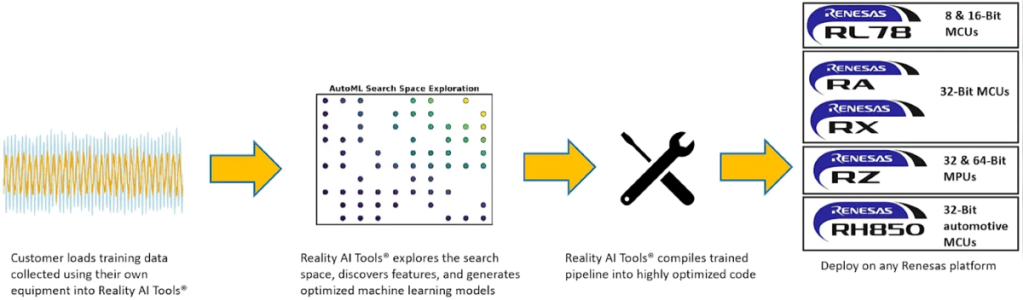
Figure 4: Reality AI workflow inside the Renesas 365 environment (Source: Renesas Electronics Corp.)
Another potential accelerator is the Pictorus code generator for behavioral modeling. Renesas purchased Pictorus in June 2026. Once the Rust-based tool is fully incorporated into Renesas 365, it is expected to speed algorithm validation, virtual prototypes, and edge application deployment.
Microchip removes cost gates from compiler and ML tools
Microchip Technology Inc. markets an Edge AI Development Suite that links silicon, software, and tools for edge AI and IoT work across its MCU and MPU lines. The portfolio includes MPLAB XC Pro Compilers and MPLAB ML Development Suite, now provided free of charge.
Removing licensing barriers exposes optimization capabilities—such as reducing code size and increasing execution speed—that belong to the MPLAB XC PRO Compiler. The new licensing terms allow unlimited installs for individuals and teams, and they open compiler optimization and ML development features across supported MCU and MPU platforms.
The MPLAB ML Development Suite can deploy models on products including the dsPIC33 family, PIC32 MCUs, and SAM MPUs. Its centerpiece is Model Builder, a Microsoft VS Code extension that automatically creates code from raw sensory data. Microchip also removed the cost of this plug-in.
FPGA deployment requires a different model-placement strategy
The MCU, SoC, NPU, and GPU flows discussed so far are primarily software-driven paths on fixed-function silicon. FPGA deployment changes the task because inference needs software-hardware co-design: the hardware-accelerator matrix must match the compiled neural-network model's memory layout, data types, and layer operations.
Historically, vendors avoided low-level FPGA configuration by fixing a processing architecture and executing ML models through an abstract layer or overlay. Under resource limits, developers often split a model into layers and run them sequentially. That sequence can become a latency bottleneck in real-time edge systems.
Altera Corp. addresses the issue through tools that can build AI accelerators on Altera FPGAs and SoCs. Its FPGA AI Suite can use sequential mapping, and spatial mapping has been added.
The suite supports Agilex 5, Agilex 7, Arria 10, Cyclone 10 GX, and Stratix 10. A spatial compiler generates dedicated RTL from blocks in a pre-optimized library. Because the resulting flow is application-specific, it is intended to deliver deterministic, higher-throughput behavior for real-time computer vision, video analytics, natural language processing, and sensor fusion while reducing development time.
Microchip extends the same theme on PolarFire FPGAs. With VectorBlox SDK, developers can deploy TensorFlow, TensorFlow Lite, ONNX, and OpenVINO models.
The ecosystem shift matters more than any single tool
The announcements suggest a common lesson: edge AI progress now depends on connected environments more than isolated utilities. When vendors add open framework support, eliminate license costs, make benchmarking reachable through cloud resources, and let models run across varied hardware, the result is not just one bundled offering. It also improves multi-architecture compatibility, strengthens open communities, and nudges the industry toward more standardized development expectations.