
Siemens Swinburne Alliance Case Review: Turning the Melbourne Hub Into Asia Energy Training Nodes by end of 2026
Siemens and Swinburne University of Technology are extending a Melbourne-based energy training and innovation model across Asia through the Siemens Swinburne International Energy Transition Alliance for Industry Training and Innovation. The Alliance turns the Siemens Swinburne Energy Transition Hub into a distributed network, with Malaysia selected for the first international node and planned for completion by end of 2026. For general readers, the practical takeaway is simple: the energy transition is becoming less about one showcase site and more about repeatable training, shared technology and local capability building.
The move builds on the AU$5.2 million Hub launched in Australia in 2023. Since then, hundreds of students, teachers and industry experts have used it to learn about modern power systems, renewable energy integration and the wider energy transition. The new Alliance adds an international delivery layer: Siemens technology, Swinburne’s teaching and research, and local partners in Asia.
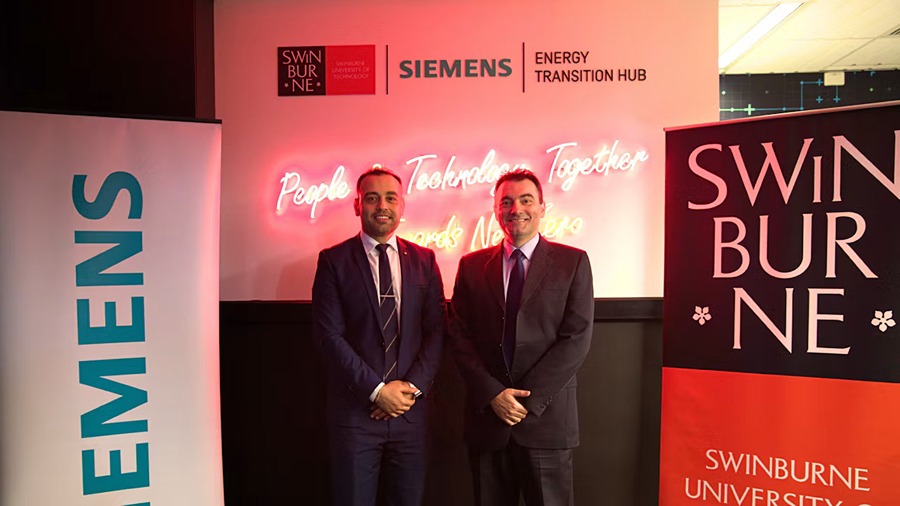
What the alliance case actually changes
Conclusion first: the change is architectural. The Melbourne Hub is not being copied building for building. It is being used as the anchor for a training and innovation network that can be extended through local institutions.
A short timeline of the model
- 2023: the Siemens Swinburne Energy Transition Hub opens in Melbourne, combining Siemens digital energy technology with Swinburne research, teaching and technical expertise.
- Since 2023: hundreds of energy students, teachers and experts from Australia and other markets have taken training through the partnership.
- Current stage: the Siemens Swinburne International Energy Transition Alliance for Industry Training and Innovation is created to spread that capability across Asia, beginning in 2026.
- end of 2026: Malaysia is scheduled to host the first international node, giving the Alliance its initial overseas delivery point.
How the network is meant to operate
Each international node is described as an extension of the existing Hub. Programs are coordinated from Australia and delivered with local institutions, so the Alliance can adapt content to national energy systems without rebuilding a Melbourne-scale facility each time.
Physical Hub versus network node
| Layer | What it holds | Reader-facing value |
|---|---|---|
| Melbourne Hub | Siemens digital energy technology, Swinburne research and teaching, access for students, academia and industry. | A working reference site for research, commercialisation and training. |
| Asia node | Local partner institution plus coordinated programs from Australia. | Lower-friction access to the same learning architecture. |
| Alliance coordination | Shared curriculum, technology pathways and expert exchanges. | A way to scale without building an identical campus in every market. |
Why Malaysia makes sense as the first node
Malaysia is undergoing a policy push that will require power-system skills, not only hardware. The Malaysian government launched the National Energy Transition Roadmap in 2023, targeting 31% renewable-energy installed capacity by 2025 and a longer route toward 70% by 2050, according to the official NETR policy material. This does not mean the Alliance will solve Malaysia’s capacity target. It does show why training in modern power systems, renewable integration and grid software can be relevant to employers, universities and regulators at the same time.
Workforce mobility is the quieter challenge
Jose Moreira, head of the Grid Software business for Siemens in Asia Pacific, said the initiative carries enormous potential. That view sits next to a practical barrier: OPITO research reported by Eco-Business found that more than 65% of Asia-Pacific energy employers require extra training, certification or assessment before workers can move between sectors or sites. For general readers, the implication is practical: cross-border training networks may matter more than individual certificates if employers still need to recheck skills.
Leadership view and the reusable lesson
Peter Halliday, managing director of Siemens Australia and New Zealand, said the move abroad shows how industry and academia can cooperate to bring Australian energy expertise to the world. In coverage by ESD News, Halliday is quoted as saying “Australia has enormous expertise in tackling this transition.” The case lesson is that universities provide systems thinking and teaching depth, vendors provide technology platforms, and local partners provide regulatory and labour-market access. Without those three layers, a hub can look impressive but stay narrow.
Common misreadings of the Siemens Swinburne expansion
- It is not a branch campus announcement. The Alliance relies on local institutions rather than a new standalone university.
- It is not only a hardware purchase. The core asset is a repeatable training and innovation operating method.
- It is not a guarantee that every node will match the Melbourne Hub physically. The stated model is network extension.
- It is not separate from commercial work. The Hub’s activities already span research, commercialisation and industry training.
Four takeaways for readers watching energy digitalisation
- Watch the coordination layer. A training network succeeds when curriculum, simulation, instructor capacity and local partner governance align.
- Watch the certification layer. If employers still require extra checks, a cross-border programme must build evidence that can be recognised by utilities and project owners.
- Watch the technology layer. Siemens digital energy technology and grid software exposure helps learners understand not only equipment, but control-room workflows and data standards.
- Watch the demand layer. Malaysia’s renewable-capacity targets and Asia’s workforce constraints give the first node a reason to exist beyond public relations.
FAQ: the alliance, the Hub and what comes next
What is the Alliance for?
It is a framework for industry training and innovation. The Alliance uses the Hub’s resources to support energy research, technology transfer and capability building with local partners across Asia.
Why does the date end of 2026 matter?
It marks the planned opening window for the first international node in Malaysia. The date gives readers a checkpoint for whether a network model can be delivered on schedule.
Does the Hub move to Malaysia?
No. The Melbourne Hub remains the anchor; the node is an extension coordinated from Australia and delivered through local institutions.
Who benefits most?
Students, energy professionals, teaching staff, regulators, grid operators and local industry partners that need practical exposure to modern power systems and renewable integration.
Final judgment
The Siemens and Swinburne University of Technology case shows how a domestic training platform can be converted into regional capability without trying to transplant every piece of physical infrastructure. Its value will depend less on the size of a new site and more on whether curricula, technology access, local credentials and employer recognition can move together. For further information, Siemens directs readers to siemens.com.