
11.11 in SG Is No Longer a Price Fight: What Shopee, Taobao and TikTok Shop Are Really Buying | ItInsightsWorld General
By Sofia Jackson, IT Insights
Short answer: none of the three platforms is buying your cart this 11.11. It is buying the reflex that opens the app first. The IAS 2026 Holiday Shopping Singapore survey found seven in 10 consumers doing most or all holiday buying online, with 71% on a phone, so the deepest discount is now the least interesting variable in the deal.
Here is the two-horn problem every shopper in Singapore recognises. You know what you need. The screen says everything else is 40% off, but only until midnight, and the same item sits on three apps at three prices with three sets of conditions attached. Platforms are spending festival-scale money on this window; my job is to tell you what that money is actually for, and what you should do with it.
Why did the discount stop being the differentiator?
Because the price layer has converged and the entry point has not. Three data points frame the season.
- Habit is already digital. The IAS 2026 Holiday Shopping Singapore report puts seven in 10 shoppers online for holiday buying and 71% on mobile as their main device.
- Retail itself is moving. Singapore's Department of Statistics estimated that online sales made up 17.7% of September 2026 retail trade value, up from 15.6% in August — roughly one dollar in six spent on a screen.
- The region is a three-horse race. Momentum Works' Ecommerce in Southeast Asia 2026 study pegged 2025 platform GMV across the region at US$157.6 billion, growing 22.8%, with Shopee at about 53% and TikTok Shop (with Tokopedia) at roughly 65.7% of Shopee's scale.
That concentration explains the tactics. When Shopee, Taobao and TikTok Shop already control almost all of the checkout, price cuts move revenue sideways. Singles' Day momentum in Southeast Asia is now won before the cart: in the commute, in the feed, and in the hall where the livestream happens. Criteo's Spark of discovery 2026 report puts the tension plainly — 60% of Singapore shoppers are open to finding something new online, while 62% would rather stick to a planned list. Six in ten can be tempted; two thirds can also be reasoned with.
What is each platform actually betting on?
Shopee: a familiar face, a longer runway
Shopee reopened its nostalgia vault. Gurmit Singh's Phua Chu Kang, the contractor character frozen for a year inside a high-security vault, fronts the newest 11.11 commercial with his usual jokes and a fresh jingle promoting what Shopee calls its lowest prices of the year. The timing is not accidental: Phua Chu Kang marks his 30th year this year and was Shopee's first brand ambassador in Singapore in 2020.
Weiyi Tay, head of marketing at Shopee Singapore, framed it as a trust play rather than a sale pitch:
“We hope the combination of the iconic character and the catchy tune brings generations together in a distinctly Singaporean moment that makes Shopee feel more familiar and, over time, builds greater affinity and trust in the brand.”
Plain translation: a local jingle costs less per impression than a celebrity and outlives the campaign weekend. Underneath it sit three mechanics:
- a full-year casting pattern — Germaine Tan and Avery Aloysius Yeo for 3.3, the Fandi family for 6.6, Tasha Low and Yung Raja for 9.9;
- the “Biggest livestream party of the year”, mixing presenters such as Ben Yeo, Lee Teng, Kim Chia, Bonnie Loo and Vivian Lai with creators including Naomi Neo and Mongabong;
- service levers — “Buy today, get today” same-day delivery on eligible orders and an extra 3% cashback for ShopeeVIP members.
Tay adds that this campaign runs longer than last year's. That matters more than any single voucher: more days to build a wishlist, more streams to compare in, more chances to catch a real price drop.
Taobao: it is buying the commute, not the click
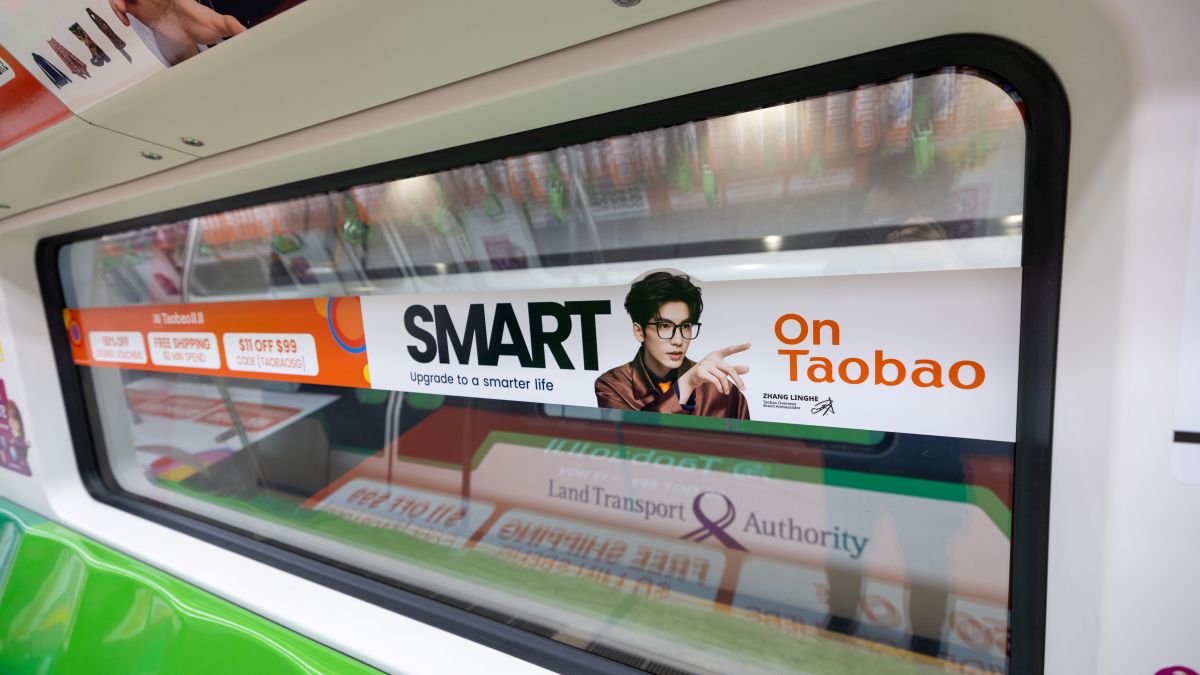
More than 100 million yuan (US$14.9 million) sits behind Taobao's Singapore 11.11 effort, covering consumer subsidies, shipping incentives and advertising, with physical advertising spend doubling year on year. Zhang Linghe carries the campaign: themed train cabins on the North-South and East-West lines, large-format boards islandwide, and QR codes that pull commuters into a daily treasure hunt inside the app. The Straits Times reported the same envelope as about S$19 million for the local push, tied to free shipping, PayNow and new AI shopping features.
Cora Cai, Singapore country head at Taobao, told MARKETING-INTERACTIVE:
“Through OOH, we want to communicate to more Singapore consumers that Taobao is a platform that helps you discover products for every kind of lifestyle.”
Structure-wise the campaign runs on six shopping experiences — quality, taste, lifestyle, smart, trend and surprise. My read: Taobao is not chasing one festival basket. It is chasing a browsing habit that survives the sale.
The unglamorous changes are the ones that change behaviour: PayNow payments, free shipping with no minimum spend, local returns, and air express delivery from SG$1.
TikTok Shop: it moved the livestream into a hall
The 17-day “11.11 Mega LIVE Fest” ran from 30 October to 15 November and partnered with Joe's Outlets Mega Beauty Festival, billed as Singapore's first offline-to-online beauty event, across two weekends at Singapore EXPO with more than 500 K-beauty, C-beauty and international prestige brands in makeup, skincare, fragrance and haircare.
Inside that hall, the platform's first Mega LIVE Beauty Showdown put more than 100 local creators and celebrities against each other for the title of top beauty livestreamer. TikTok Shop says the showdown delivered 1.8 times its target GMV. The Tech Show 2026 did the same job for electronics: inspect in person, then finish on the app with campaign vouchers and bundles.
The reason is visible in the numbers TikTok Shop shared at its Singapore Summit 2026: LIVE viewership in Singapore grew 150% year on year, while LIVE GMV rose more than 1.7 times. A TikTok spokesperson said: “One notable shift is the growing role of discovery in the shopping journey,” adding: “Alongside searching for products they’re already intending to buy, consumers are discovering products through short videos, creators, and LIVE sessions, where content can spark interest and inform purchase decisions.”
TikTok is also funding the labour side, not only demand. Its LIVE Host Academy, launched in 2025, trains hosts in Singapore, so sellers get a bench of tested talent and participants get a skill that pays.
One context point that this campaign sits inside: a standalone TikTok Shop app has appeared in Singapore, Malaysia, Thailand and the Philippines app stores, published by TikTok Pte. Ltd., separating product feed, checkout, order tracking and support from the social app (Tech in Asia, November 2026). Read that as a distribution move, not a capability jump — the same discipline we applied when we argued that India's ChatGPT weekly-user crown proves reach, not model quality. Next stops are already booked: Black Friday Cyber Monday and the 12.12 Christmas Sale, including the 12.12 period.
How do the three plays compare side by side?
| Axis | Shopee | Taobao | TikTok Shop |
|---|---|---|---|
| Where the money lands | Local characters, original jingle, creator livestreams | MRT cabins, billboards, shipping subsidies | Offline festivals, host training |
| What it wants from you | Trust and repeat app opens | Cross-border baskets beyond sale week | Discovery before intent forms |
| Concrete perk to test | Buy today, get today; extra 3% cashback for ShopeeVIP | Free shipping, PayNow, local returns, air express from SG$1 | Event-only bundles and campaign vouchers |
| Best fit | Replacement buys with a delivery deadline | Long-tail items you cannot find locally | Beauty, tech, anything you want to see running |
| Where you get hurt | Voucher stacking rules and caps | Lead time on non-air parcels | Impulse purchases at midnight in a livestream |
What do shoppers commonly get wrong?
- “The sale day is the cheapest day.” Often true for the headline SKU, irrelevant for your basket once shipping, tax and lead time are added. Compare landed cost, not the banner.
- “A livestream demo is a review.” A host selling on commission is a sales channel. Useful for seeing a product work; not a substitute for independent testing.
- “Free shipping means free exit.” Returns are the cost cross-border buying hides. Taobao's local returns and Taobao's PayNow support reduce friction, but read the window before you click.
- “The countdown is honest.” Singapore's competition and consumer regulator has made so-called dark patterns — fake urgency, false validity periods, inflated reference prices and fake reviews — an enforcement priority. Treat a ticking timer as a claim to verify.
What should you actually do before the sale weekend?
- Write the list first. The 62% who follow a planned list are the group platforms cannot easily nudge; keep that discipline.
- Pick two categories only — one with a deadline (this month), one that can wait for 12.12.
- Check price history and screenshots before the hype, so “lowest price of the year” is auditable.
- Confirm the cut-off time for same-day delivery before you assume a festival-day order arrives that day.
- Price the cross-border option end to end: shipping tier, air upgrade, return route.
- Take loyalty money only when you would buy anyway — an extra 3% cashback is not a discount on something you do not need.
What does the spending add up to?
Add the visible numbers: Taobao's more than 100 million yuan, its doubled outdoor spend, Shopee's year-long casting slate, TikTok Shop's two-weekend festival and a training academy. None of that is a price cut. It is the cost of buying a place in the front of your phone, and the cost is rising because attention is the scarce input, not inventory.
Momentum Works' live-commerce research puts Southeast Asia content commerce on track for about US$77.9 billion in 2026, up from US$49.7 billion in 2025 — nearly doubling in a year. When a discovery channel grows that fast, platforms stop competing on vouchers and start competing on the habits, faces and venues that trigger a purchase. That is the real trend line behind this 11.11, and it will outlast the sale.
FAQ: the questions readers actually search
Is 11.11 genuinely cheaper in SG this year?
Sometimes on the specific discounted SKU, rarely on the whole basket. All three platforms are pushing perks that reward planned buying — same-day delivery, cashback tiers, free shipping thresholds — so the savings concentrate in the carts shoppers built before the campaign.
Which platform is ahead?
Shopee still leads in scale, with about 53% of Southeast Asia's 2025 platform GMV per Momentum Works. TikTok Shop has closed the gap fastest, and Taobao is competing on cross-border breadth rather than share of the festival itself.
Why advertise in an MRT station when people shop on phones?
Because app opens are the bottleneck, not product availability. Taobao's QR-linked campaign turns a commute into a traffic source; the alternative — paying a marketplace for an internal search click — is the same money spent after intent already exists.
Should I be worried about buying through a livestream link?
Buy from the platform's own checkout, keep the order record inside the app, and check the return route before payment. If a deal only works off-platform, it is not a deal.
Next step, not a verdict
Do the boring thing before the festival night: two categories, one list, one price ceiling per item, screenshots taken in advance. Then judge each platform on the one thing it is actually selling you this year — whether the promise attached to the discount (delivery same day, returns locally, a product you could touch at Singapore EXPO) holds after the checkout screen closes. Whoever keeps that promise gets your 12.12. Nobody's jingle does yet.
Sources
- IAS, 2026 Holiday Shopping Singapore report (holiday buying and mobile usage figures).
- Singapore Department of Statistics, retail sales estimates for September 2026 — online share of retail trade value.
- Momentum Works, Ecommerce in Southeast Asia 2026 and content commerce outlook.
- The Straits Times on Taobao's Singapore 11.11 promotion budget and service upgrades.
- Tech in Asia on the standalone TikTok Shop app launch in four Southeast Asian markets.
- Competition and Consumer Commission of Singapore guidance on dark patterns.
- Criteo, Spark of discovery 2026 (discovery versus planned-list behaviour).