
General Report from ItInsightsWorld: SanDisk Rides Tight NAND Supply Toward 85.1% Q1 Adjusted Gross Margin
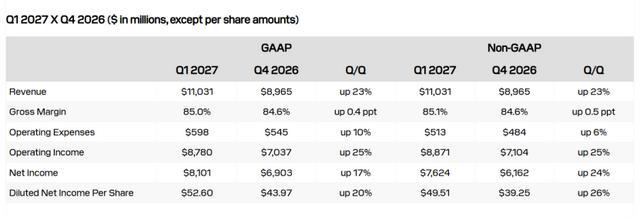
ItInsightsWorld's general industry review focuses on how SanDisk translated constrained storage supply into a sharply higher margin profile, while keeping its forward plan anchored in data-center demand and the coming HBF sample cycle.
Where the Margin Expansion Came From
SanDisk said Q1 adjusted gross margin reached 85.1%, up from the previous quarter's 84.6% and far above the 29.8% recorded in the same period last year. Management added that this quarter's revenue growth was composed of about 60% from volume and 40% from pricing.
Forward Guidance and Shareholder Cash Policy
For the second quarter of fiscal 2027, the company guided revenue to $12.2 billion to $12.6 billion, against analyst expectations of $12.1 billion, and adjusted gross margin to 84.5% to 85.5%. It reiterated a commitment to return 100% of surplus cash to shareholders and disclosed $5 billion in share repurchases during this fiscal quarter.
Data-Center Weight and Secured Capacity
Chairman and CEO David Goeckeler said ten years ago data-center business accounted for about 20% of industry volume, while it now represents nearly half; he expects more than 55% market share in 2027 and said bid demand rose by about 40% year over year. He forecast that by the end of this decade key-value cache (KV Cache) would take about one-third of the AI data-center flash market. Currently, about 50% of SanDisk's fiscal 2027 capacity is locked through new business-module projects, with that proportion rising to roughly two-thirds in 2028.
HBF Sample Schedule and End-Market Outlook
The company's first High Bandwidth Flash (HBF) memory chip has completed tape-out, with read bandwidth comparable to HBM but greater capacity; first customer samples are expected next year. Management also characterized the current two quarters as a trough for PC volume and cautioned that next year PC units may still see a single-digit decline. Even so, PC storage capacity measured in EB is expected to grow, NAND demand across sub-segments should post positive growth next year, and automotive electronics is viewed as one of the largest future market segments within edge computing.
Closing Takeaway
The through-line is clear: SanDisk's near-term profit strength is being framed by scarce supply and a rising data-center mix, while HBF samples and a capacity plan extending into 2028 shape the next phase of the story.