
ItInsightsWorld — Samsung Electronics Flags Memory Crunch: 2027 Pressure to Top 2026, Little New Supply Before 2028
A two-year procurement horizon just became harder to plan around. On its latest earnings call, Samsung Electronics told the market that tightness in global memory chips will not ease in the short term, that the squeeze may deepen in 2027, and that constrained supply is expected to persist until 2028.
The warning from Samsung's memory chief
Jaejune Kim, Executive Vice President of Samsung's memory business, framed the outlook around the demand signals the company is currently receiving: on that basis, supply pressure in 2027 is expected to be more severe than in 2026. Because a new wafer fab or an added capacity line typically needs several years from construction to full production, he noted, the industry is unlikely to see a clear release of new supply before 2028.
Buyers are pre-booking capacity they do not yet need
As the artificial-intelligence industry expands, demand for high-performance memory keeps climbing. Samsung has observed customers proactively handing over mid-to-long-term demand forecasts in order to reserve future output ahead of time. Orders that could not be satisfied this year are likely to roll into next year, widening the gap between supply and demand.
Where the product roadmap goes from here
- HBM4: all 2027 high-bandwidth memory capacity is already sold out, with the related orders locked in by customers in advance.
- HBM4E: the next-generation part is scheduled to start mass production in the first half of 2027, with shipment volume ramping up in the second half.
- DDR5: demand from server customers is equally robust, particularly for specifications of 8000MT/s and above.
- NAND flash: Samsung is accelerating development of products aimed at artificial-intelligence workloads, including PCIe Gen6 enterprise SSDs, high-density QLC SSDs and other storage solutions for AI infrastructure.
The record quarter behind the message
| Indicator (third quarter of 2026) | Reported result | Change |
|---|---|---|
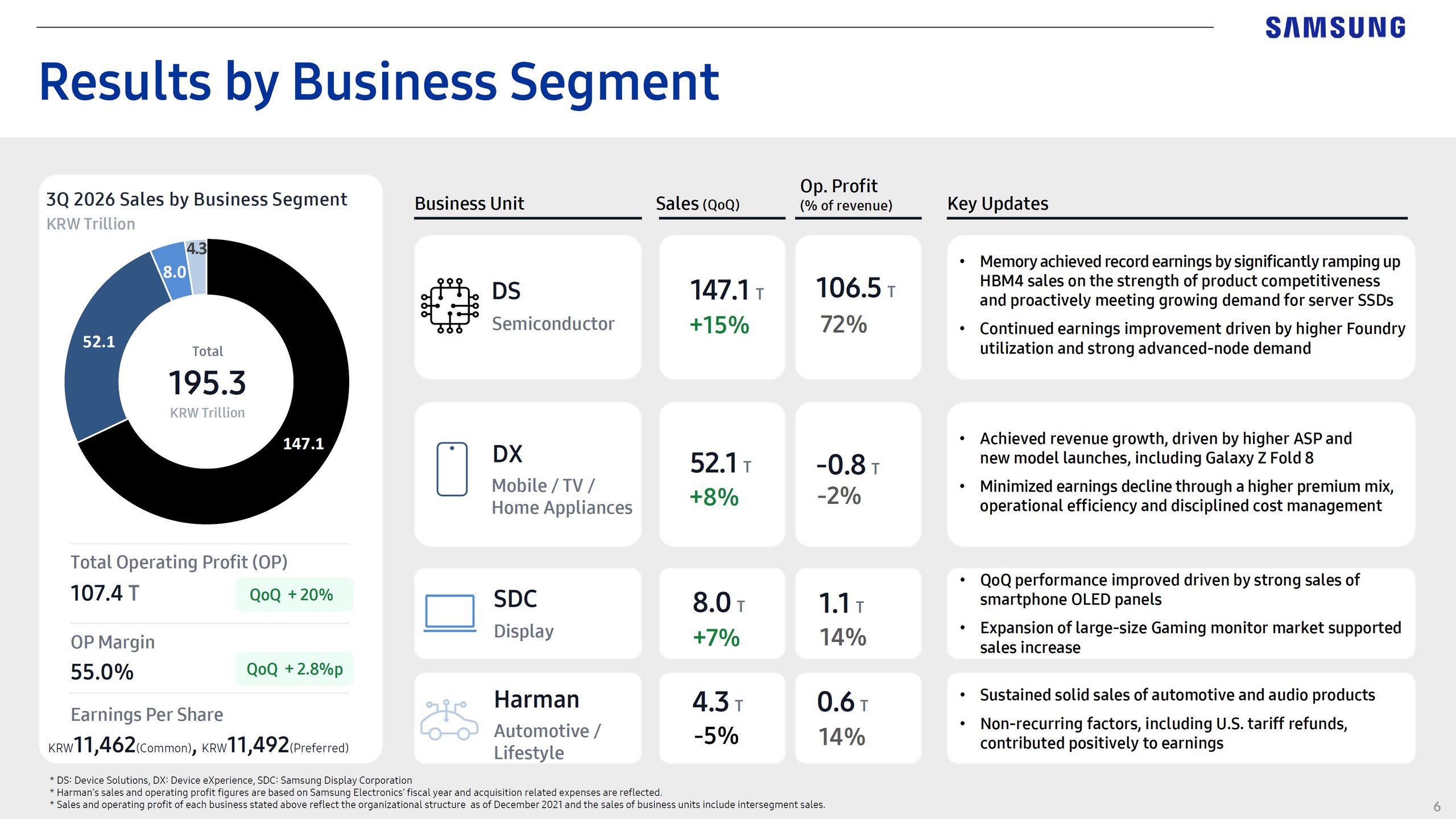
| Revenue | 195.3 trillion won | +127% year on year, +14% quarter on quarter |
| Operating profit | tops 100 trillion won, making Samsung the first global technology company to cross that mark | +783% year on year, +20% quarter on quarter |
| R&D spending | 14.4 trillion won, channelled mainly into capacity expansion, next-generation memory technology and new production facilities | +63% year on year |
| Samsung DS division (semiconductors) | lifted by HBM, DRAM and SSD demand | operating profit +72%, revenue +15% |
Long-term contracts decide who gets the wafers
Samsung also disclosed that a growing number of large AI companies and data-centre operators are pushing for multi-year supply contracts to guarantee future access to memory chips. To blunt market volatility, the company plans to place about 60% to 70% of its capacity inside a long-term supply agreement framework, and will grant higher-priority shipment assurance to customers willing to sign long-term purchase contracts.
Read that as a distribution signal for the next several years: advanced memory will keep flowing first to the artificial-intelligence data-centre market, while the share of capacity available to consumer electronics may end up relatively limited. Smartphones, personal computers, graphics cards and consumer-grade storage products are all likely to face continued cost pressure.
Foundry: 2nm orders set to more than double
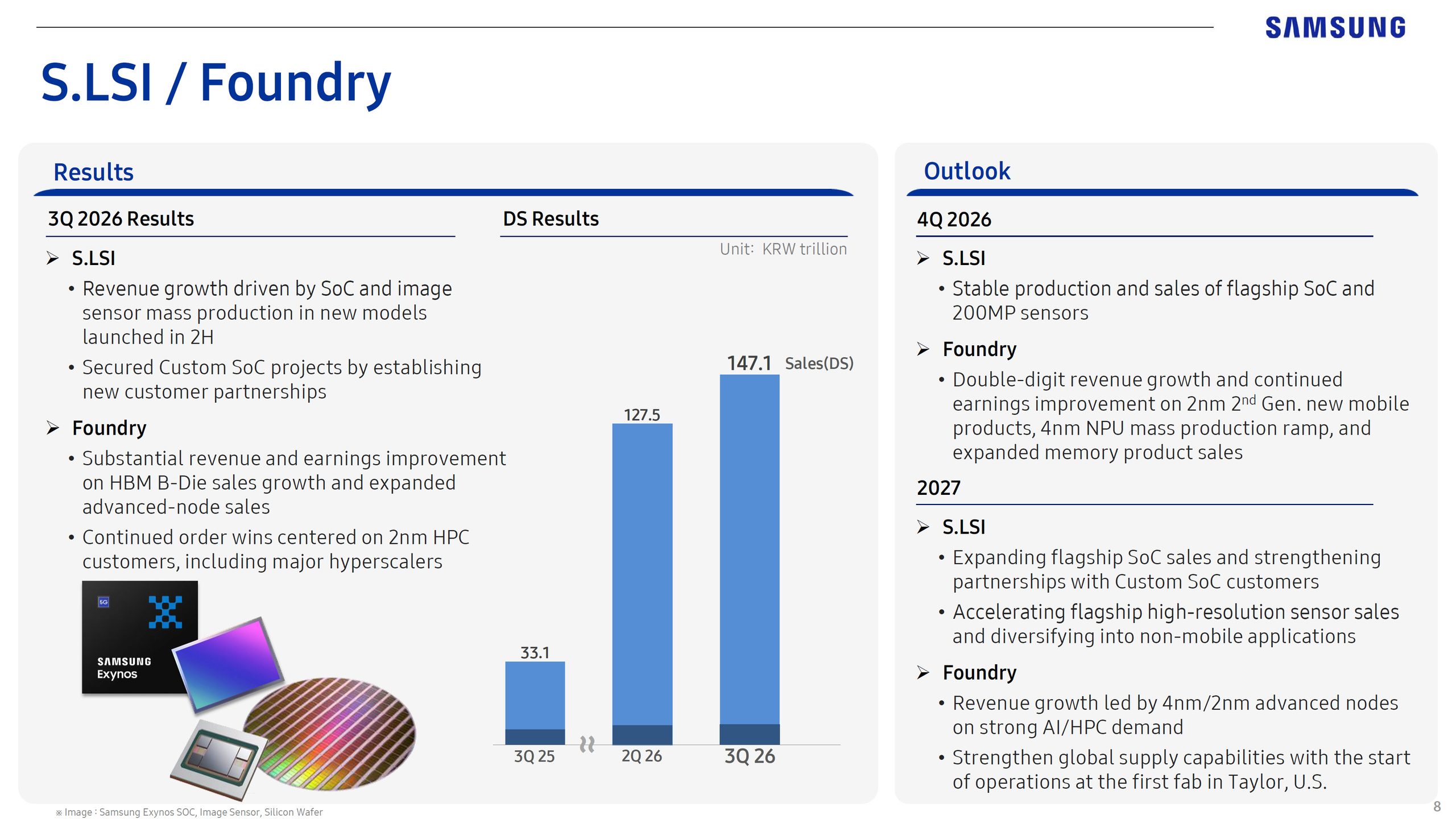
On the foundry side, Samsung expects 2nm order volume to grow by more than twofold this year. Rising demand from AI-chip customers means the 2nm and 4nm advanced processes will keep generating new growth for the company; 4nm has already been adopted by several major US AI customers, and products for the main 2nm customers are planned to enter mass production in the second half of this year.
What the disclosures add up to
Taken together, the information Samsung released points to AI-driven memory demand still sitting in a rapid expansion phase. Vendors are expanding capacity aggressively, but long construction cycles — combined with a large share of output already committed under long-term agreements — mean the undersupplied state of the global memory market is unlikely to change in any fundamental way, and 2027 may turn out to be the year with the heaviest supply pressure.
For teams planning server refreshes, accelerator clusters or endpoint fleets, the conclusion implied by the above disclosures is to treat availability as constrained rather than price alone as the deciding variable, and to weigh contract structure when securing memory across the product categories named.