
Where AI Has Not Paid Off Yet: The S&P 493 Story
An early scorecard for artificial intelligence spending
Although the latest breakthroughs in large language model research have drawn enormous capital and generated a great deal of attention, Slok, writing in the Daily Spark column, argues that companies outside the United States technology sector have not yet received a financial return from artificial intelligence. A handful of technology-related firms have captured substantial benefits, while most constituents of the S&P 500 index show little measurable payoff from generative artificial intelligence or large language model spending.
Why the Magnificent Seven result does not describe the index
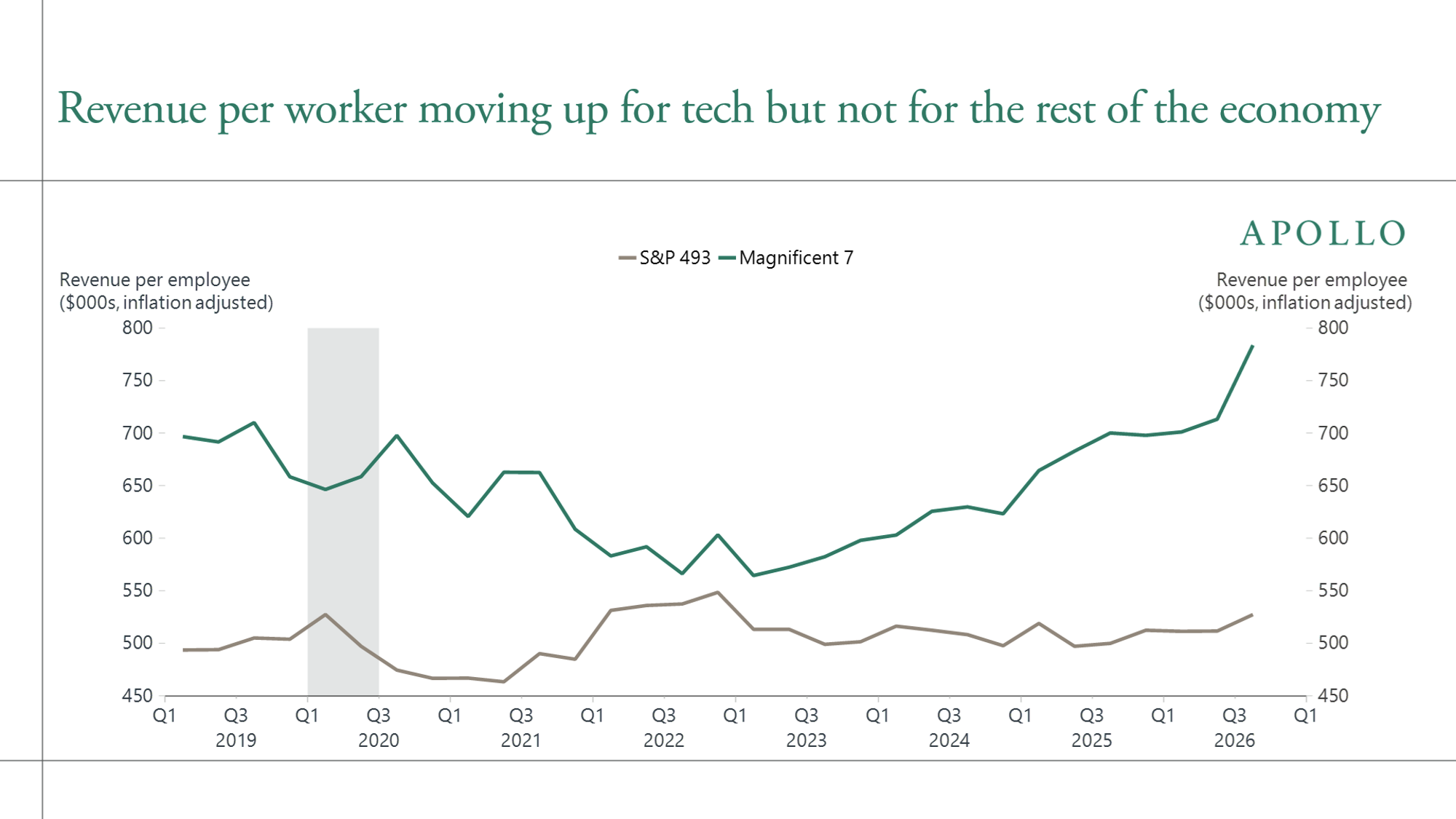
He notes that only the Magnificent Seven, or the seven big technology giants, show rising revenue per employee after inflation adjustment. That group is the most technology-weighted part of the S&P 500 and includes Nvidia, Tesla, Amazon, Microsoft, Google’s parent Alphabet, Apple and Meta; their margins have also moved higher. For the rest of the index, the companies Slok calls the S&P 493, both revenue per employee and profit margins have remained flat.
Productivity expectations versus enterprise cost reality
The Apollo economist has also found no clear sign that artificial intelligence is driving productivity growth. In other words, generative artificial intelligence and large language models have not lifted profits at companies outside technology. Without visible results, mainstream S&P 500 companies have begun to cut huge artificial intelligence-related expenditures and treat token consumption as a margin-dragging cost rather than a possible source of future growth.
Venture-backed companies continue to raise artificial intelligence token spending, but mainstream companies neither need the newest models nor want to pay for them. Slok says that if artificial intelligence ultimately covers only a small share of the wider economy, its macroeconomic effect will remain limited.
The long-run bull case is not the short-run balance sheet
Artificial intelligence models could eventually become more commoditized, and tokens might become cheap enough to support revenue growth and margin expansion. Even so, Slok believes achieving that broader outcome may be far harder than outsiders imagine. He compares artificial intelligence to a powerful calculator and stresses that business operations depend on sound judgment, not arithmetic.
“Artificial intelligence does not understand accountability, trust, culture, unwritten rules, moral trade-offs or fairness, and all of these factors shape reputational risk and ultimately drive revenue growth and margin expansion,” he wrote. In his view, the ultimate path of the artificial intelligence narrative will be decided by the S&P 493, not by the financial success of the Magnificent Seven.
A contrarian forecast remains part of the debate
Apollo company, which Slok works for, manages about $1 trillion in assets, giving his economic assessment weight. His caution aligns with other warning reports: Gartner recently estimated that by the end of 2030, more than $3.5 trillion of artificial intelligence infrastructure investment could face impairment. Not everyone is pessimistic: Goldman Sachs economist Jan Hatzius believes artificial intelligence investment will eventually translate into higher productivity and profit returns across the economy.
The central question is not whether artificial intelligence can compute. It is whether mainstream companies can convert model access into durable profits. If the S&P 493 continue to show flat revenue per employee and stable margins, the case for enterprise artificial intelligence will be judged less by excitement around frontier models and more by the accounting results of mainstream companies.