
RTX 5090 at 370% Over List: Ranking Every GeForce RTX 50 Card by How Far Its Price Drifted
By James Hartley · ItInsightsWorld
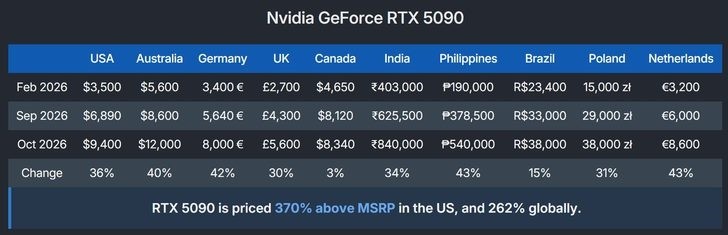
Read this if you only have a minute: the GeForce RTX 50 family has stopped behaving like a product lineup and started behaving like a ladder of surcharges. Tech Spot's latest price survey is the clearest public snapshot we have, and its headline number is that the flagship RTX 5090 now sells in the United States for 370% above its recommended price, and roughly 262% above it on a global average. What matters more to an ordinary buyer, though, is the pattern underneath those two figures: the premium follows how much video memory is soldered onto a board far more closely than it follows gaming performance. See that, and both questions people keep asking — "which card in this generation is least overpriced?" and "should I just wait?" — get much easier to answer.
Five figures that frame everything else
- 370% and 262% — the mark-up over MSRP that Nvidia's RTX 5090 now carries in the United States and on average worldwide.
- US$9,000 (about RMB 67,834) — the barrier the same card has broken through in the US, versus the US$3,000 (about RMB 19,944) level buyers were already refusing to pay late last year.
- 36% against more than 40% — the single-month price jump logged between September and October in the US market, compared with Germany, Australia, the Philippines and the Netherlands.
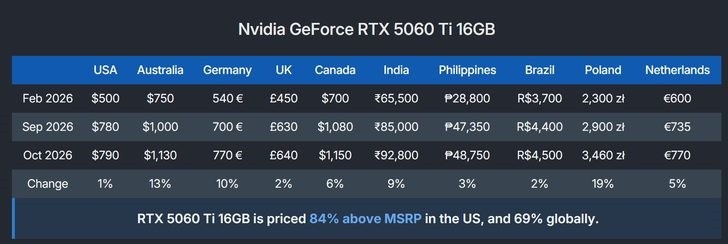
- 44 percentage points — the gap between the US premium on the 16GB RTX 5060 Ti and the premium on the 8GB version of the very same GPU.
- 40% to 120% — the band into which almost the entire RTX 50 range fell during 2026, with the flagship sitting far above it.
The premium ladder: every RTX 50 model side by side
Below is the full spread as Tech Spot reported it. The two middle columns are deviations from recommended retail price; the last column is our own read of what the number means for someone holding a budget.
| Model | United States vs MSRP | Global average vs MSRP | Street-price signal | ItInsightsWorld verdict |
|---|---|---|---|---|
| RTX 5090 | +370% | +262% | Above US$9,000 (about RMB 67,834); US$3,000 (about RMB 19,944) late last year | No longer a component purchase; treat as speculation and walk away |
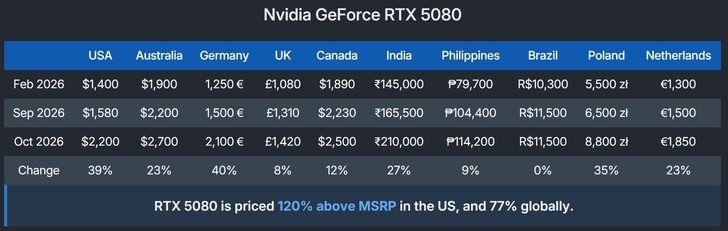
| RTX 5080 | +120% | +77% | About US$2,200 (about RMB 14,626) in the US | Flagship problems at a smaller scale; only if a job demands it |
| RTX 5070 Ti | +67% | Not broken out | Upper end of the 70 series | Best inflation-adjusted value if you can find it near list |
| RTX 5070 | +64% | Not broken out | October's monthly rise stayed inside 10% in most regions | The least distorted performance card in the range right now |
| RTX 5060 Ti 16GB | +84% | Not broken out | Approaching US$800 (about RMB 5,318) or more | Memory tax made visible; the chip is not what you are paying for |
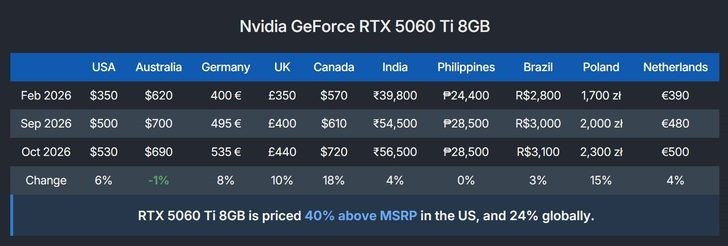
| RTX 5060 Ti 8GB | +40% | +24% | Milder climb than the 16GB variant | The rational pick if 8GB genuinely covers your workload |
| RTX 5060 | +51% | +40% | Steady upward drift | Mid-range no longer means mid-priced |
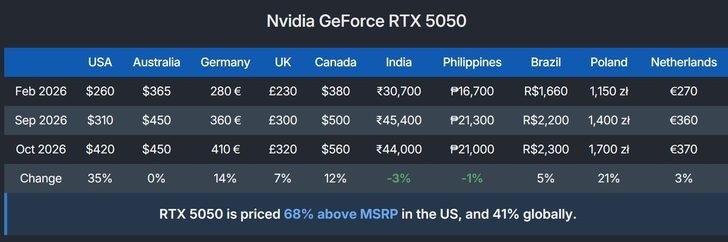
| RTX 5050 | +68% | +41% | US$260 (about RMB 1,728) early in the year, now US$420 (about RMB 2,792); hard to find under US$400 | The cheapest 8GB card of the generation, but the entry ticket is no longer a discount ticket |
Two patterns in that table deserve more airtime than the flagship headline.
The first is the step inside a single model. The 16GB RTX 5060 Ti runs 84% above MSRP in the United States, while the 8GB edition built around the same processor sits at 40% there and 24% worldwide. Same silicon, same driver stack, same benchmark rows — a 44-point difference in premium. That is about as clean a demonstration as you will get that buyers in 2026 are being priced on memory, not on graphics horsepower.
The second pattern is that the bottom of the range is not the safe place people assume. The RTX 5050 jumped from US$260 (about RMB 1,728) to US$420 (about RMB 2,792) inside a year, a 68% US premium against the RTX 5070's 64%. Historically the cheapest card absorbed price pressure first and smallest; this cycle the cheapest card absorbed it hardest, because rising memory and board costs hit low-margin products hardest of all.
Where you live now moves the price more than which card you want
Between February and October this year (2026), the upward curve steepened rather than flattened. In the September-to-October window alone, the average US price rose 36% in a single month, while Germany, Australia, the Philippines and the Netherlands each logged monthly increases above 40%.
Practical translation: the long-standing habit of "wait for the cheapest European quote, then import" has lost its edge, because the lowest-priced market is now one of the fastest-moving ones. Add shipping, import tax and a warranty that is awkward to claim abroad, and the arbitrage that once saved hundreds of dollars is worth little when every market inflates at the same time.
Layered on top of that, multiple reports claim the RTX 5090 will be quietly phased out, which has poured fuel on recent pricing: scarcity expectations make resellers hold stock rather than release it, and the card has never been sold at MSRP in volume, so the published list price works as a psychological floor rather than a real supply signal.
Why the prices moved: a memory tax, not a scalper story
Forum culture blames resellers, and resellers are real, but the structural cause sits one layer further down the supply chain. The RTX 50 range is built on GDDR7 memory, and the same three fabrication partners that supply it — Samsung, SK hynix and Micron — have been steering advanced capacity toward high-bandwidth memory for AI accelerators, where margins are far richer.
Nvidia's own leadership has said as much. On the company's earnings call in February 2026, chief executive Jensen Huang warned that gaming graphics card supply would be very tight for the coming quarters and put the bottleneck on GDDR7 availability rather than on GPU dies. Coverage of that briefing by Tom's Hardware recorded the phrasing investors latched on to: supply would remain constrained "for a couple of quarters". That wording matters for a buying decision — it puts a defined horizon on any "wait it out" plan, instead of leaving it open-ended.
The revenue mix explains the incentive. Reporting on Nvidia's fourth-quarter fiscal 2026 figures by MyDrivers put total revenue near US$68.1 billion, with the data-centre business around US$62.3 billion and the gaming business roughly US$3.7 billion — a single-digit slice of the company. When the same wafer slots and the same memory modules can serve either side of that ratio, consumer GPUs are the variable that gets trimmed.
Worth keeping as context: an earlier Tech Spot sweep that tracked listings across ten markets found the overall market averaging about 28% above launch MSRP once the RTX 5090 was excluded, a figure also carried by TweakTown. Read together with the current report, that 28% is a useful yardstick: a card priced a quarter above list is showing supply-and-demand stress; a card priced 64% to 370% above list is something else entirely.
Is switching brands the escape hatch? Not really
The most persistent advice online is "buy the other brand instead". In mid-2026 that looked convincing: Radeon cards started from a lower recommended price, and analyst commentary at the time framed them as the value counterweight to Nvidia's across-the-range mark-ups. But the hedge has been shrinking. As Wccftech reported, AMD itself raised the official price guidance for its Radeon RX 9000 line during the third quarter of 2026, with increases of up to 20%, and the RX 9070 XT crossed the US$1,000 mark on average.
Why it cannot stay cheap: an RX 9000 card buys GDDR memory from the same three suppliers as a GeForce card does. A brand switch can dodge one vendor's allocation choices; it cannot dodge a memory shortage.
Match the card to the job — if you must buy this quarter
- Full-HD and 1440p gaming only: the 8GB RTX 5060 Ti (+40% in the US) is the least punishing way to stay inside the generation. Accept the memory ceiling consciously rather than paying for capacity you will not use.
- 1440p high-refresh, few upgrades planned: RTX 5070 (+64%) currently looks like the most defensible purchase in the range, because its monthly movement in October stayed under 10% in most regions.
- 4K gaming or heavy modding: RTX 5080 (+120% in the US, +77% globally) is the tier where that workload actually lives, but at about US$2,200 (about RMB 14,626) you are paying a genuine scarcity premium.
- Video editing, 3D and local AI experimentation: memory capacity is the constraint, which is precisely the component being taxed. This is the only group for which the 16GB boards can be argued as value rather than excess.
- Upgrading from an RTX 30- or 40-series card: run the premium maths before the hype maths. A 64% to 370% surcharge will usually buy more perceived gain in a monitor, storage or CPU refresh than in this generation's frame-rate step.
- No working card at all, must buy now: skip the flagship entirely, cap yourself near a 30% premium over list — the pre-spike market average — and consider a pre-built machine or a laptop, where allocation is often handled better than on the open board market.
Five misconceptions worth retiring
- "MSRP is a price." For the RTX 5090 the recommended figure has never been a realistic transaction price, which is exactly why a 370% premium can persist without looking like an emergency.
- "Only the flagship is inflated." The whole range sits in the 40% to 120% band during 2026, and even the entry RTX 5050 now carries a 68% US premium.
- "Buy from another country and you win." Germany, Australia, the Philippines and the Netherlands posted the steepest monthly gains of all — above 40% between September and October.
- "A different brand fixes this." AMD raised official pricing on its own lineup by up to 20% in the third quarter of 2026, because the shortage sits upstream of both vendors.
- "Prices will snap back like the last cycle." That recovery came when memory supply normalised. Until high-bandwidth demand from AI infrastructure eases, the floor under these boards is cost, not hype.
A practical action list
- Write down your ceiling as a premium, not a currency amount. Decide the maximum percentage above list you will pay — 25% to 30% is a defensible line today — and reject anything above it by rule, not by mood.
- Count memory before counting cores. If your workload does not need 16GB, the 8GB variant of the same chip is the cheapest way to dodge the memory tax.
- Track two markets, not one. Watch your domestic average alongside the fastest-moving foreign market; when the gap narrows, arbitrage has stopped working and patience beats importing.
- Separate need from rumour. Discontinuation talk moves prices before it moves products; treat any "last chance to buy" framing as a price signal, not a supply fact.
- Buy the capability you will use this year. The value case for the RTX 50 series is strongest for memory-hungry professional work and weakest for a one-step gaming upgrade.
- Set a re-entry trigger in advance. A month-on-month fall across most regions, an easing in memory contract prices, or a documented supply commitment from Nvidia — pick one, and act only on it.
FAQ
Is the RTX 5090 worth buying now?
Not for a gaming build. With a 370% US premium, a global average premium of 262% and a price that has gone through US$9,000 (about RMB 67,834) after passing US$3,000 (about RMB 19,944) late last year, you are buying a supply story, not a frame-rate story.
Which GeForce RTX 50 card is holding its price best?
The RTX 5070 in relative terms: +64% in the United States, with October's monthly rise kept inside 10% across most regions — calmer than everything above and beside it.
Why is the 16GB 5060 Ti so much more inflated than the 8GB card?
Because the tax falls on memory. The 16GB version runs 84% above MSRP in the US, while the 8GB version of the same GPU sits at 40% there and 24% globally.
Should I wait for prices to fall?
Waiting is a reasonable default if your current hardware still works, but plan against a stated horizon rather than hope: Nvidia's own guidance in February 2026 pointed to tight gaming-card supply for the next couple of quarters, and the entry-level RTX 5050 is still expected to rise as memory and PCB costs keep climbing.
Is the RTX 5050 the budget answer?
Only by elimination. At US$420 (about RMB 2,792), up from US$260 (about RMB 1,728), it is now the lowest-priced 8GB card of the generation, but it is also the model whose value-for-money drew the most criticism at launch.
Does the whole product line have this problem?
Yes — with one extreme outlier on top. RTX 50 models rose broadly between 40% and 120% during 2026; the RTX 5090's 370% is not a trend within the range, it is a different market.
Here is the frame we would leave you with. Every card Tech Spot measured has been repriced by the same upstream shortage, so the interesting question is no longer which GPU is "overpriced" — they all are — but which premium you can justify with work you will actually do. Buy the memory you need, refuse the premium you were never planning to pay, and read the flagship's 370% mark-up as a market signal rather than a shopping-list item.