
Case review: What Rochester Electronics' six-language checkout upgrade means for buyers
Short answer: translation is rarely the bottleneck in component sourcing; transaction completeness is. A buyer may find a part in a local language, then still have to leave that page to confirm price, inventory, account terms, or shipment status. Rochester Electronics says the six newly upgraded regional sites now cover that full journey for Portuguese (Brazil), Spanish (Mexico), French, German, Italian, and Polish buyers, while the company continues to operate full e-commerce sites in English, Chinese, Japanese, and Korean (South Korea).
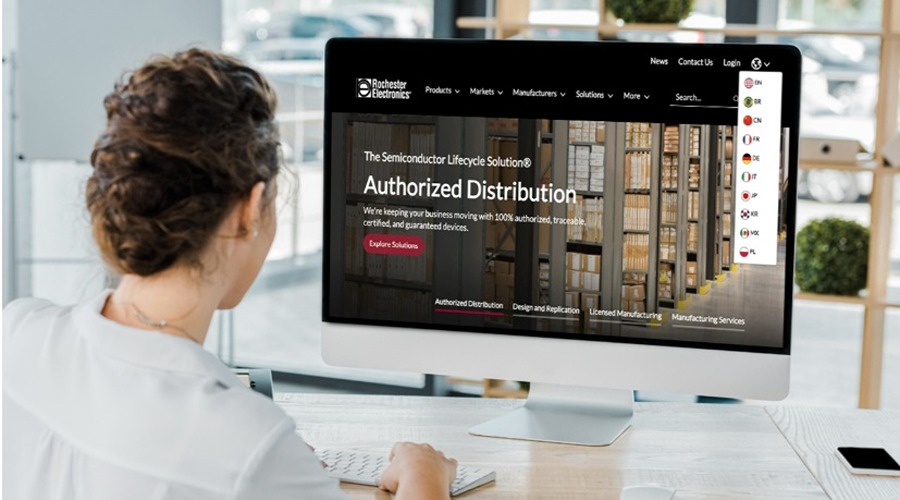
The public launch notice, dated October 6, 2026, frames the update as an extension of an already localized network, not a new storefront from scratch. One procurement detail changed: the local site no longer ends at product content. It can carry search, cart, order, invoice, account, and tracking behavior in the buyer's regional context. From an ItInsightsWorld case-review angle, the useful question is not how many languages were added, but whether the transaction itself became local.
What was the bottleneck before the upgrade?
Before this update, regional sites carried localized product information and content. That sounds helpful, but it leaves a gap between knowing a part and buying it. In a procurement workflow, the moment a buyer must switch site, currency, or language is the moment handoffs appear: quote notes, email approvals, re-keyed part numbers, manual checks on lead time.
The upgraded platforms address those handoffs by making the local site the transaction place. The company says sourcing becomes simpler, efficiency rises, and processing time is shortened. The more useful way to read that is operational: each market's buying team can validate availability and price without assuming the global English site is the single source of truth.
This matters especially in long-lived systems. The lesson mirrors a wider embedded problem: memory volatility in embedded planning can outlast a product's certification window. When parts are not disposable, a purchasing system must expose lifecycle status as clearly as stock status.
How the six markets fit into a larger sequence
The six languages are not isolated. They sit beside existing English, Chinese, Japanese, and Korean (South Korea) commerce sites. Earlier reporting also described a refreshed South Korea website in March 2026, which makes the October expansion look like completion of a staged regional build rather than a single-site experiment. Rochester Electronics traces its operating focus to 1981, when it began around reliable semiconductor access; the current digital rollout is a way of putting that access into a repeatable buying interface.
The press release also lists regional domains such as rocelec.mx for Mexico and rocelec.com.br for Brazil. Those URLs are a useful signal: the localization target is not a generic corporate page with a language dropdown, but a market entry point that can align pricing, content, and ordering within one account model.
What changed inside the buying workflow?
| Workflow step | Localized content site | Full transaction site | Why it matters |
|---|---|---|---|
| Part discovery | Translated descriptions and resources | Advanced search, filters, alternative-part recommendations | Buyers can test substitute paths before asking for a quote |
| Line management | Static lists or downloaded BOMs | Bill of Materials tools | Reduces re-entry of long part lists |
| Inventory | Text availability may sit elsewhere | Current and future inventory visibility | Helps distinguish now from next quarter |
| Lifecycle | General product status | Availability plus TLS360 lifecycle management | Supports long-term system maintenance decisions |
| Ordering | Handoff to sales or another site | Order status, shipment tracking, invoices, account settings, secure checkout, One-click reorder | Keeps audit trails in one place |
Why TLS360 belongs in the same review as checkout
TLS360 may sound like a back-office label, but in e-commerce it belongs to the same decision chain as stock. Rochester's TLS360 product page describes it as "program level lifecycle assurance" for selected mission-critical families; EE Times frames the program as authorized lifecycle support that keeps selected mission-critical semiconductors available beyond normal product life. The practical buyer question is simple: can the cart tell me whether this part is a short-term buy or a long-term design dependency?
If a site shows a part is in stock but does not surface lifecycle risk, procurement may treat a fragile component as a commodity. That is the wrong decision pattern. A localized storefront should make risk visible at the point of order, not only in a separate engineering conversation.
What buyers should test before trusting a localized storefront
- Search a real part number, not only a generic category. Confirm the result page, local currency, and cart language remain aligned.
- Upload a small bill of materials and watch where substitution prompts appear.
- Check current inventory and future inventory signals before treating a date as a promise.
- Compare lifecycle indicators with your own product roadmap. A part can be available now and still be wrong for a five-year maintenance plan.
- Test account settings, billing terms, shipping rules, and invoice download paths before placing a repeat order.
- Reorder a non-critical item to verify that the saved workflow works in the local market, not only in English.
Common misconceptions
- Localized language equals complete sourcing. It does not. The update's value is that six newly enabled platforms now cover search through checkout, while content-only pages could previously stop short.
- Regional pricing is only a number change. It changes approval speed, currency exposure, and the clarity of quote-to-order comparison.
- Inventory visibility removes uncertainty. It reduces one class of uncertainty. It does not replace design validation, alternate-part review, or contract terms.
- TLS360 is a shipping label. It is a lifecycle assurance signal. The meaningful use is long-term availability planning, especially for systems that remain in service after original production runs end.
Decision frame for the buyer, the engineer, and the finance owner
Buyers benefit from fewer handoffs. Engineers benefit when alternative parts and lifecycle status are visible before design sign-off. Finance benefits when local currency, invoice terms, and account settings are stable enough for reconciliation. The risk is treating the upgrade as a marketing page refresh. If the buying team still has to chase order status or confirm pricing in a second channel, the transaction has not truly moved.
FAQ
Is this only a translation update?
No. Translation existed earlier in localized content. The change is that six market sites can now support the complete buying path, including checkout, within the regional site.
Why does the South Korea site matter in a six-market story?
Because it shows the architecture is not brand new. Korean (South Korea) was already part of the existing full commerce set. The six additions extend that model to Europe and the Americas instead of replacing it.
Who benefits most from TLS360 visibility?
Teams maintaining systems with long certification or service lives. They usually care more about lifetime continuity than lowest spot price.
Does a localized storefront replace human support?
Not necessarily. A site can shorten processing time, but complex account terms, unusual delivery needs, and lifecycle exceptions still need validation through the provider's support channels.
Reusable checklist
| Check | Pass signal | Warning signal |
|---|---|---|
| Market coherence | Language, price, account, and checkout remain in one site | Buyer must switch pages to see terms |
| Part clarity | Search, filters, and substitution suggestions are visible | Only datasheet content is translated |
| Supply signal | Current and future inventory are shown with lifecycle status | Stock is shown but risk is hidden |
| Order evidence | Tracking, invoices, and reorder paths are downloadable | Proof requires manual email |
| Lifecycle context | TLS360 status informs long-term maintenance choices | Program name appears without explanation |