
Robot Climbing Mount Tai, Compared: Humanoid, Legged, Load or Exoskeleton — Which Format Actually Holds Up? | ItInsights World
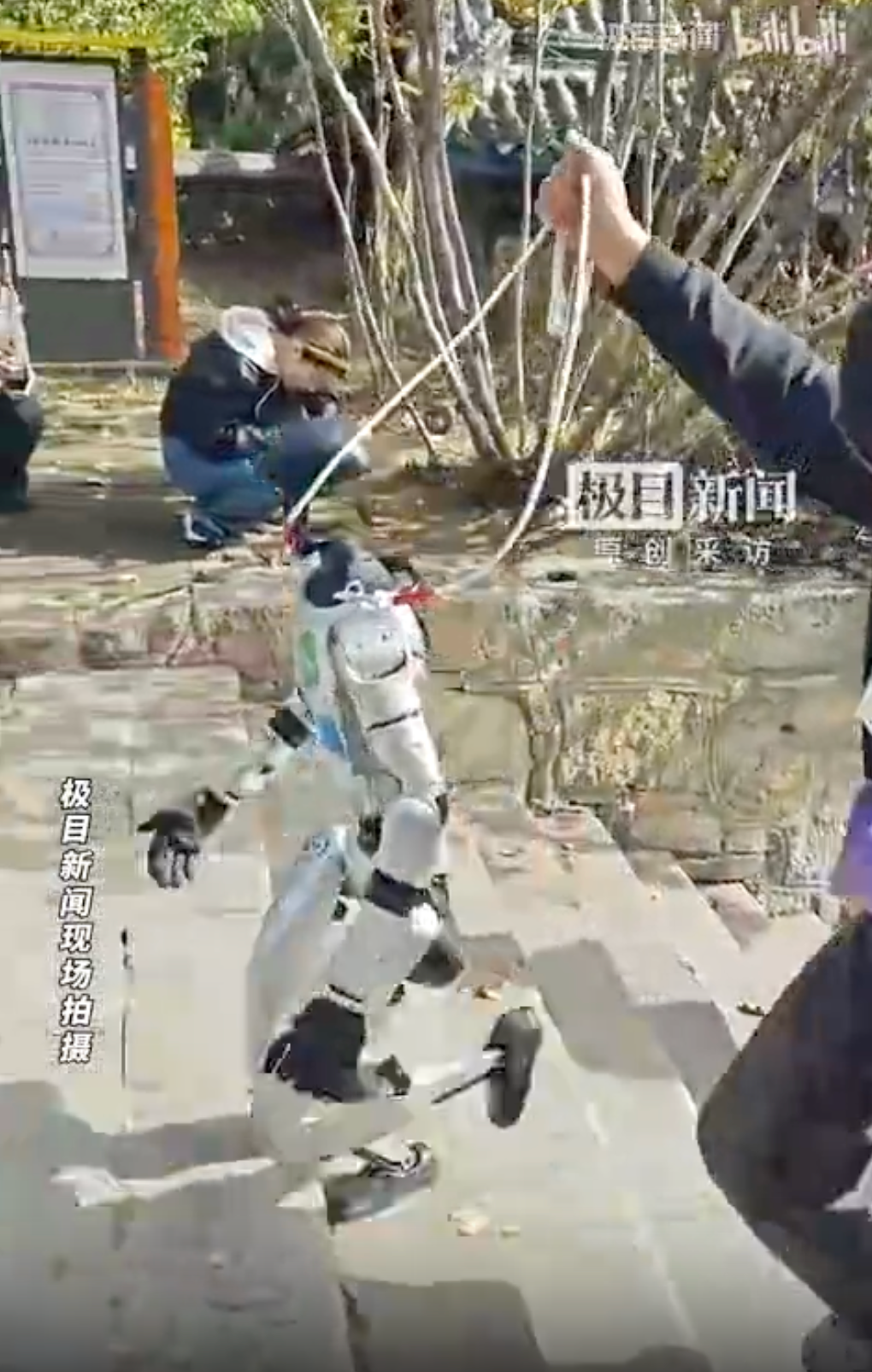
Start with the conclusion, because the headlines around this event are easy to misread. The Robot Climbing Mount Tai competition in Tai'an, Shandong did not prove that machines have conquered mountain stairways; it proved that a stairway is the cheapest honest examiner of a walking robot. The first robot to finish wrote the real story: on the last upward flight of steps it wobbled, lurched, and at one point looked as if it were taking “one step up, three steps back”, while another machine was steered across by a handler holding a rope at its neck. Speed was never the scarce resource here. Stability, heat and genuine autonomy were — and those three variables are exactly what you should weigh when you judge any stair-climbing robot claim, in a warehouse, a hospital corridor or a landslide zone.
The setup: what was really under test
The course was the mountain's own thousand-year-old stone path rather than a purpose-built arena. The route of the Robot Climbing Mount Tai competition runs about 3.9 kilometres and climbs more than 3,100 steps, with a height gain of close to 600 metres according to organiser briefings — uneven tread depths, narrow shoulders, loose cobble stretches and, in the qualifying round of 26 October, autumn rain that made the rock slick. Roughly 90 teams entered the main event on 2 November, competing across four official events — the humanoid robot race, the legged robot race, the legged robot load-carrying race and the exoskeleton robot assistance race — plus one all-terrain mobility scouting challenge that opens the door to wheeled, tracked, wheel-leg hybrid and even spherical machines.
Two rule details matter more than any lap time, and they are the reason this event reads as a technology audit rather than a stunt. First, scoring is penalty-weighted: helping a robot by hand, lifting it, letting it leave the course or obstructing visitor traffic each add time, in bands of about 50 to 100 seconds, so the first machine over the line does not necessarily record the best result. Second, a fully autonomous climb is scored differently from one piloted by a remote operator. Organisers even had to change how they officiated: one judge per robot was planned, but the machines proved faster than human endurance on the 3,100-plus steps, so officials were relocated to fixed posts along the route — a vivid way of saying the hardware outpaced its own supervision system.
Head to head: the five formats, side by side
| Format | What the stone steps expose | Where it typically breaks | The real-world job it maps to |
|---|---|---|---|
| Humanoid robot race | Two-legged balance on risers that vary in height from step to step | Terminal-phase instability — the stagger-and-slide effect seen near the top of a flight | Moving inside human buildings: stairs, doorways, ladders, aisles sized for people |
| Legged robot race | Gait speed, foot placement and recovery after a slip on wet rock | Impact recovery on narrow edges; battery planning for a climb and a descent | Inspection and patrol on unstructured terrain — substations, quarries, trails |
| Legged robot load-carrying race | Centre-of-mass control with weight on board, not empty-frame walking | Cargo shift and damage; entrants hauled fragile items such as eggs, and broken goods cost them points | Last-mile and relief supply transport — deliberately echoing Mount Tai's traditional porters |
| Exoskeleton robot assistance race | Human benefit rather than machine balance: how much load is taken off the wearer | Fit, control latency, endurance of the suit's own battery; this edition skipped qualifying and assessed wearers directly | Portering, rescue carries, trekking support for older or fatigued hikers |
| All-terrain mobility scouting challenge | Breadth of passage across very different chassis philosophies | Single-purpose designs that cannot recover once geometry defeats them | Reconnaissance and route-clearing ahead of human teams in disaster response |
Three trade-offs that decide the comparison
1. Pace versus stability: the stumble was predictable
Stair ascent in the Robot Climbing Mount Tai competition is a control problem that hides until the very end. Each tread is a new obstacle with a different lip, and the sensors that read it are usually mounted high on the torso, so the machine reasons about ground it has already committed to stepping on. Chinese coverage of these teams describes two practical fixes: moving the camera down to chest height so the view of the next tread is shorter and more direct, and relying on “foot feel” — reading joint force at touchdown to adjust stride length and balance without visual confirmation, much like climbing blindfolded. That explains why the first finisher looked worst in the final metres: a robot can hold a gait for an hour and still lose the margin when fatigue, wet edges and a higher centre of mass stack together. For a general reader, the lesson transfers directly to marketing demos — a clean climb at half speed tells you less than a sloppy final third.
2. Power today versus hardware life later: heat is the quiet retirement
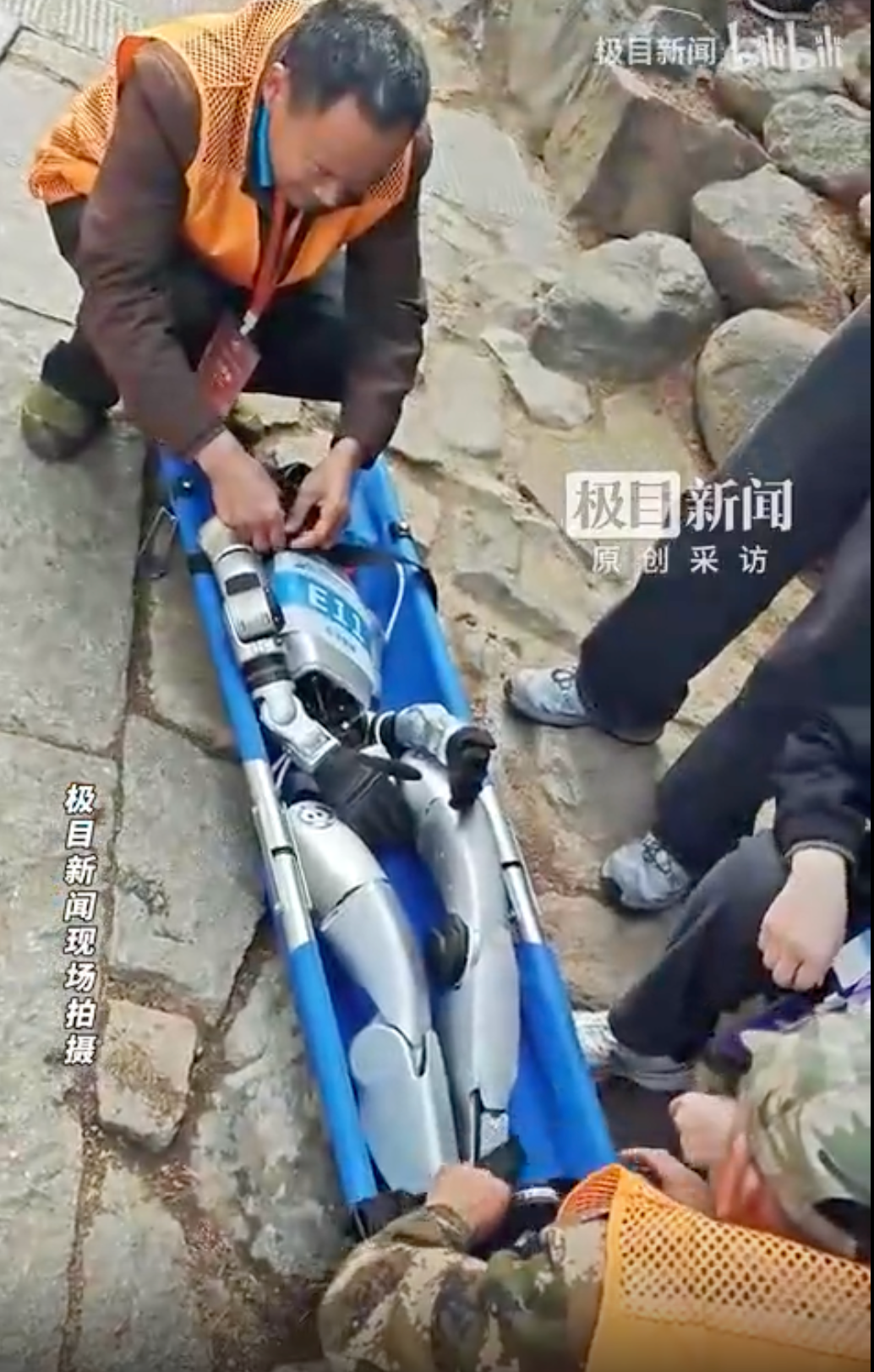
One high-profile humanoid entry, familiar from stage shows, did not finish at all: media reports from the course say it was retired mid-climb after running hot and was carried downhill on a stretcher. That is the most underrated data point of the weekend, because it matches published robotics research rather than contradicting it. In a documented outdoor trial of a quadruped covering 650 metres of grass, cobblestone and stairs with a 3 kg payload, the baseline controller failed halfway when knee actuators overheated and forced a hardware shutdown; only a policy that explicitly traded locomotion performance against motor thermal safety completed the route. Stair climbing is a worst-case duty cycle: repeated torque spikes, poor airflow inside sealed joint housings, and no downhill coasting. Battery and thermal limits also cut across formats asymmetrically — clinical-grade walking exoskeletons, for example, are typically rated for about three to four hours of use and many are not cleared for stair negotiation at all, so a suit that assists on a slope is not automatically a suit for steps. That asymmetry is why the exoskeleton robot assistance race needs a separate yardstick from the legged robot race.
3. A human on the rope versus a machine deciding for itself
The most critical question after this event is not “how fast” but “who was walking”. In qualifying, one team's legged machine reached the mid-mountain gate in roughly an hour — faster than many visitors manage on foot — on the strength of a single start command, with route decisions computed on the robot itself. Other entries, as the on-course footage shows, were guided continuously by handlers. If the humanoid robot race or the legged robot race scored only elapsed time, teleoperation would win; because the rules weight autonomy and add time penalties for human intervention, they separate machines that perceive and act from machines that are being puppeteered. For readers evaluating the industry, that distinction is the whole investment case: perception plus onboard decision-making is what lets a robot work in a smoke-filled stairwell where a signal may not reach the operator.
Our ranking: which format to trust first
- The legged robot load-carrying race, the most honest readiness signal. Weight on board converts a balance trick into a work trial, and damage deductions make fragility visible in the score.
- The legged robot race, for terrain competence. Fast, repeatable and the easiest result to verify, but its scores flatter well-conditioned machines on a wet day.
- The all-terrain mobility scouting challenge, for breadth. Different chassis win different ground; treat it as a portfolio, not a winner.
- The humanoid robot race, for long-term relevance to human buildings — not for today's reliability. The bipedal format is closest to where the money eventually is, and furthest from dependable.
- The exoskeleton robot assistance race, as a human-performance product rather than a robot milestone. Judge it on wearer load reduction and session length, not on who reaches the summit.
FAQ: the questions readers keep asking
Why haul robots up a mountain instead of a laboratory treadmill?
Because the mountain manufactures the failure modes that labs fake. Real stone varies step to step, weather changes friction mid-run, tourists and railings create obstacles nobody programmed, and the descent is as long as the climb. A treadmill can only report what the controller already expects.
Did any robot genuinely finish?
Yes — the first robot to finish completed the course, and it is precisely that footage which shows the stagger on the final steps, including “one step up, three steps back”. Completion and competence are not the same measurement, which is why the penalty-weighted score of the Robot Climbing Mount Tai competition matters more than the headline order.
Is a robot guided by a remote operator still worth anything?
Sometimes, but not as an autonomy claim. Remote guidance is a legitimate product pattern in dangerous, short-duration tasks. It stops being useful when connectivity is the single point of failure — and this event's scoring deliberately discounts that pattern.
What should a non-specialist take away?
That walking machines are now strong enough to attempt unstructured terrain, and weak enough that the deciding variable is housekeeping: heat, battery, sensor mounting, recovery logic. Those are boring engineering items — which is exactly why they predict commercial usefulness better than a viral video.
When will stairs actually pay off for businesses?
Where a task is repetitive, hazardous and low-payload: carrying supplies up heritage steps and temple paths, delivering inspection equipment across damaged ground, assisting rescue loads. Where speed on flat floors matters, wheels still beat legs and will for years.
Common misconceptions
- “Finishing first means winning.” Time penalties for human help, lifting or leaving the course can rewrite the standings.
- “Humanoid robots failed, legged robots passed.” The stumble was concentrated in the last stretch of steps after an otherwise complete climb; failure here is marginal, not categorical.
- “An exoskeleton is just another robot.” The exoskeleton robot assistance race tests a wearable, and must be judged on wearer benefit, fit and session duration.
- “A mid-course retirement means bad engineering.” Overheating is a design trade-off of sealed, lightweight joints under repeated torque spikes — the fix is thermal and duty-cycle policy, not a different robot.
- “Remote-controlled, therefore a gimmick.” Teleoperation is a real deployment mode; the gimmick is selling it as autonomy.
Action advice: six questions before you believe a stair-climbing demo
- How long was the machine climbing before the clip ends, and what happened in the final third?
- What was the payload, and was cargo integrity scored rather than just movement?
- Was the surface wet, uneven or unprogrammed — or a tidy indoor staircase?
- How much of the climb was decided onboard versus commanded by a person?
- What is the stated joint-temperature and battery ceiling, and is there a swap or cooldown plan?
- What happens on the way down, which is where most frames quietly die?
Mount Tai has carried emperors, poets and shoulder-pole porters for two thousand years, and for a weekend this autumn it carried robots as well. The honest reading of the scoreboard is neither triumph nor ridicule: the machines now survive the mountain, and the mountain still exposes them. That gap — between finishing and working — is where the next several years of embodied AI will be spent, and it is the gap worth watching if you are buying, investing in or simply trying to decide what these viral climbs mean.
Written by James Hartley for ItInsights World, our general-insight desk. Rules, course and weather detail above draws on event briefings and Chinese race coverage published between 26 October and 2 November 2026. Spotted a factual gap or want our verdict on a specific mobility technology? Contact IT Insights at contact@itinsights.com.