
What Happens When AI Gets a Body: Inside OktoberTech Silicon Valley 2026 and the Security Question Nobody Has Answered
By James Hartley — IT Insights editorial desk (contact@itinsights.com)
Short answer: the machines are ready; the trust layer is not. At OktoberTech Silicon Valley 2026, Infineon put working robots on stage in Mountain View, California, that perceive, decide and move on their own — and the host's own executives named the unresolved problem: whether those systems are safe enough to leave the demo floor. This year the industry's centre of gravity slid from chatbots to hardware, and the bottleneck moved from model quality to silicon, namely memory, motor control and a verifiable root of trust.
What is physical AI, and what does it actually change?
Physical AI is artificial intelligence that leaves purely digital environments and runs inside machines, factories and logistics networks. Instead of replying to prompts, it senses, thinks and acts autonomously in real time, which is why the story reaches well beyond robots into everyday convenience, healthcare, mobility and industrial automation.
The framing Infineon's managers used for the shift is a journey from automation to autonomy: machines that repeat fixed routines versus machines that adapt to what they encounter. The timing matters because AI data centers have entered a more mature phase, so capital and engineering attention are hunting for the next large workload — and robotics is the use case now absorbing it.
The World Economic Forum's 2026 report on physical autonomy states the distinction plainly: unlike digital systems that operate solely on information, physical autonomous systems "must contend with the continuous, uncertain and unforgiving dynamics" of the real world. A wrong answer no longer stays on a screen.

Figure 1: A machine running physical AI must perceive its surroundings, communicate securely, process data locally through edge AI, and act safely and reliably while spending as little energy as possible. Source: Infineon
Why is so much money suddenly flowing into robots?
Because the funding curve has gone vertical. PitchBook's quarterly reporting recorded a then-record $16.3 billion of venture investment across 492 robotics and physical AI deals in the first quarter of 2026, followed by a record $18.6 billion in the second quarter — roughly $33.4 billion in the first half of the year alone, already more than the whole of 2025.
Read that correctly and the lesson is not "robots are winning." It is that investors are paying for scarce inputs: real-world motion and touch data, and the hardware that can capture it. Falling component costs, labour shortages and reshoring pressure are the practical drivers, and the semiconductor layer displayed in Mountain View is where that money ultimately lands.
Is physical AI only about humanoid robots?
No, and the industry's own leaders say so. Asked whether physical AI extends beyond robotics, Stephan Zizala, division president of edge systems at Infineon, pointed to motor control. “Several machine learning algorithms are now powering motor control designs.” He also described robotics as the tip of the iceberg for physical AI.
That reframing is worth keeping. McKinsey has estimated that high-profile humanoids may account for only about 2% of the economic value physical AI can unlock, with most of it coming from retrofitting equipment that already exists — motors, pumps, conveyors, appliances, locks. Developer booths at this year's event showed exactly that spread: industrial automation, home appliances and smart home security assembled from the same functional blocks of sensing, computing, connectivity, motor control and power management, alongside live robots on the floor.
Why security, not intelligence, is the gating factor
Zizala characterised the discussion around generative AI, agentic AI and physical AI as the arrival of a new era in artificial intelligence, and noted that physical AI is already at work. The larger issue, in his account, is whether it is ready from a security standpoint. “While physical AI translates perception into precise movement, functional safety and cybersecurity embedded at the hardware level provide an anchor of trust for even the most advanced robots.”
Earlier this year, Infineon introduced the OPTIGA Trusted Platform Module (TPM), SLB 9672, a hardware-based solution that secures the Jetson Thor platform from Nvidia. It stores cryptographic keys securely and verifies system integrity at the chip level, creating a certified, quantum-resilient root of trust for physical AI systems.
Outside evidence backs the urgency. The World Economic Forum's Global Cybersecurity Outlook 2026 reports that roughly 26% of surveyed leaders expect autonomous systems and robotics to influence cybersecurity outcomes this year, and the Forum's own analysis argues that once code produces kinetic action, a cyber incident stops being a data problem and becomes a life-critical safety problem. That is why a chip-level trust anchor, not a patch cycle, is the differentiator to ask about.
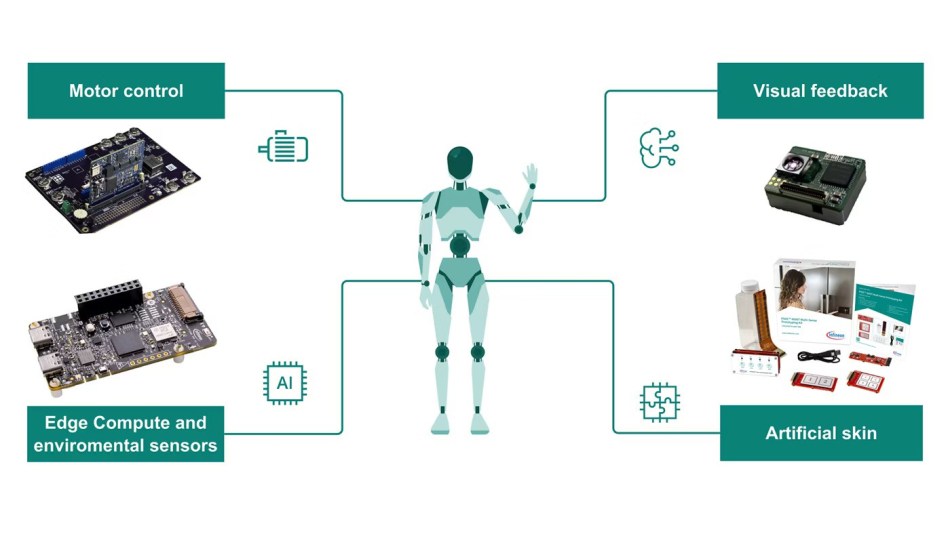
Figure 2: System-level building blocks for physical AI, demonstrated on the show floor at OktoberTech Silicon Valley 2026. Source: Infineon
What the memory wall is, and why machines hit it next
Definition first: the memory wall is the widening gap between how fast a chip can calculate and how slowly it can retrieve the data it needs. In data centers it appears as scarce, expensive high-bandwidth memory. Inside a robot, it appears as a model that simply will not fit.
Talking about these AI-era MCUs, developers at the event stressed the need for more memory; one said the issue comes down to more memory, so more AI models could be used. Zizala outlined a design value chain in which developers take sensor data, train models, and deploy them on microcontrollers. In his keynote, Andreas Urschitz, chief marketing officer at Infineon, referred to these parts as foundational MCUs — microcontrollers reimagined for edge AI and physical AI applications.
Engineering coverage of on-device inference, such as Embedded.com's 2026 guide to inference on edge AI MCUs, describes the standard mitigations — quantisation, pruning, aggressive memory management and model partitioning — as trade-offs that buy space by giving up accuracy headroom and update capacity. The practical consequence is that the memory wall story from data centers appears likely to reach physical AI designs sooner or later, and whoever supplies affordable on-device memory will set the pace for the whole category.
Four misconceptions worth dropping
- “Physical AI means humanoids.” Humanoids are the most visible and least representative slice; motor control and retrofits of existing equipment carry most near-term value.
- “A good demo means a ready product.” Robots on a stage operate in bounded rooms with known networks. Security, liability, warranty and service questions begin where the demonstration ends.
- “Safety is a software problem.” If a sensor can be spoofed or a model file tampered with, application-level code cannot compensate; trust has to be anchored in hardware.
- “Bigger models are always better.” A machine working under millisecond reaction windows and a battery budget usually benefits more from a smaller verified model than from a larger one that must ask the cloud.
Digital AI versus physical AI: what changes in practice
| Dimension | Digital AI (assistants, copilots) | Physical AI (robots, factories, logistics) |
|---|---|---|
| Where inference runs | Centralised GPU clusters | On the machine at the edge, with cloud fallback |
| Cost of a wrong output | Regenerate and retry | Force, motion, downtime, injury exposure |
| Dominant bottleneck | Compute supply and data licensing | On-device memory plus verifiable trust |
| Security approach | Account, network and data controls | Hardware root of trust, chip-level integrity checks, functional safety |
| Maturity signal to watch | Benchmarks and token pricing | Certifications, energy per action, hours run without intervention |
Six questions to ask before trusting a physical AI product claim
- Where exactly does inference happen — on the device, at a gateway, or in the cloud?
- Is there a hardware root of trust, and which third party certifies it?
- Which functional safety standard governs the motion the machine performs?
- How much memory headroom is left for model updates over the product's life?
- What is the safe fallback when connectivity drops or a sensor is fooled?
- Is progress measured in units shipped, hours operated, or tasks completed without help?
FAQ
Is physical AI the same thing as edge AI?
No. Edge AI describes where computing happens — on the device rather than in a data center. Physical AI describes what a system then does: perceive, decide and act on the physical world. A smart lock can use edge AI; a warehouse robot that re-plans its route around a person is using physical AI.
Why did a chip supplier stage a robotics show?
Because a robot is a bundle of semiconductor functions. At OktoberTech Silicon Valley, Infineon presented live robots together with the blocks those robots need: sensing, computing, connectivity, motor control and power management. The event, held in Mountain View, California, marked the tenth edition of a series that began with the company's Silicon Valley innovation work in 2016.
Are humanoid robots already working in factories?
At pilot scale, yes; at economic scale, not yet. Research firm Interact Analysis reported global humanoid production exceeded 20,000 units in 2025 and expected volumes to more than triple in 2026, while analytics firm SAG projects shipments approaching 60,000 units this year. Both metrics count hardware movement, not revenue-generating labour.
What does the long-run market look like?
Forecasts diverge widely, which is itself useful information. McKinsey's scenario work suggests general-purpose robotics, valued under $1 billion today, could reach an estimated $370 billion by 2040; J.P. Morgan Private Bank's published outlook puts humanoid sales near $300 billion by 2035 against roughly $2 billion in 2025. Treat these as directional ceilings rather than budgets.
Trend read: the next 24 months
- Trust becomes a spec sheet item. Expect chip-level root of trust, integrity measurement and safety certification to move from marketing narrative to procurement requirement, following the pattern already visible in hardware secure-element products.
- The retrofit market outruns the showcase market. Motor control and edge AI inside existing equipment deliver measurable energy and uptime gains faster than new human-shaped machines, which is where the iceberg beneath the visible robots gets its value.
- Memory, not model size, sets the roadmap. This is analysis rather than a reported fact, but the pattern is consistent: once developers exhaust the trade-offs of quantisation and pruning, device memory economics decide how many models can live on a machine at once.
What to do now
- In the next 30 days: list the machines in your operation that already have controllable motors or actuators, and note which ones could benefit from local inference instead of a fixed program.
- In 90 days: add two gates to your technology evaluation — a hardware trust question and a memory headroom question — using the six-point checklist above.
- In six months: track three signals rather than headlines: funding volumes per quarter, announced production units versus verified deployments, and any security certification attached to a robot platform.
- For general readers: ignore demonstrations that do not say where the computing happens or what the machine does when it is wrong. Those two answers separate a product from a prototype.
Sources
- Infineon — OktoberTech event pages (event venue and history): https://www.infineon.com/event/oktobertech and https://events.infineon.com/
- EE Times — coverage of Infineon's OktoberTech 2026 programme, including edge AI and data center power: https://www.eetimes.com/infineons-oktobertech-edge-ai-sdvs-and-the-road-to-800-vdc/
- PitchBook — Robotics & Physical AI reports, Q1 and Q2 2026 funding data: https://pitchbook.com/news/reports/technology-software/robotics
- World Economic Forum — Global Cybersecurity Outlook 2026 and physical autonomy report: https://reports.weforum.org/docs/WEF_Next_Generation_Physical_Autonomy_2026.pdf and https://www.weforum.org/stories/emerging-technologies/physical-ai-cybersecurity
- McKinsey — robotics scenarios and value estimates: https://www.mckinsey.com/featured-insights/the-next-normal/robotics
- J.P. Morgan Private Bank — robotics and humanoid market outlook: https://privatebank.jpmorgan.com/nam/en/insights/markets-and-investing/ideas-and-insights/robotics-the-next-big-frontier-in-ai
- Embedded.com — best practices for inference on edge AI MCUs: https://www.embedded.com/best-practices-for-inference-on-edge-ai-mcus/
- SC Digest (Interact Analysis data) — humanoid production and 2026 volume outlook: https://www.scdigest.com/ontarget/26-09-07.php?cid=24196 ; SAG shipment projection: https://smartanalyticsglobal.com/global-humanoid-robot-shipments-2026-agibot-unitree/
Written by James Hartley for ItInsightsWorld. Corrections and editorial queries: contact@itinsights.com. Published by IT Insights — https://itinsightsworld.com