
Wired or Wireless for Game Audio? How the US$79.99 Razer Hammerhead V3 Chroma Compares
If the machine you actually game on is a phone, tablet or handheld you already own, the wired Razer Hammerhead V3 Chroma delivers what most true-wireless buds cannot: no charging, no Bluetooth codec lag, active noise cancellation and 7.1 surround sound on PC — for US$79.99 in the United States. If you move around while you listen, wireless still wins. The trade-off, scenario by scenario, is below.
For almost a decade the cable was treated as a relic. Bose was among the first audio brands to quietly reverse that assumption, and now Razer has joined the comeback with a product that combines old-school wiring with the most recognizable gaming decoration in the industry: RGB lighting.

What exactly has Razer built here?
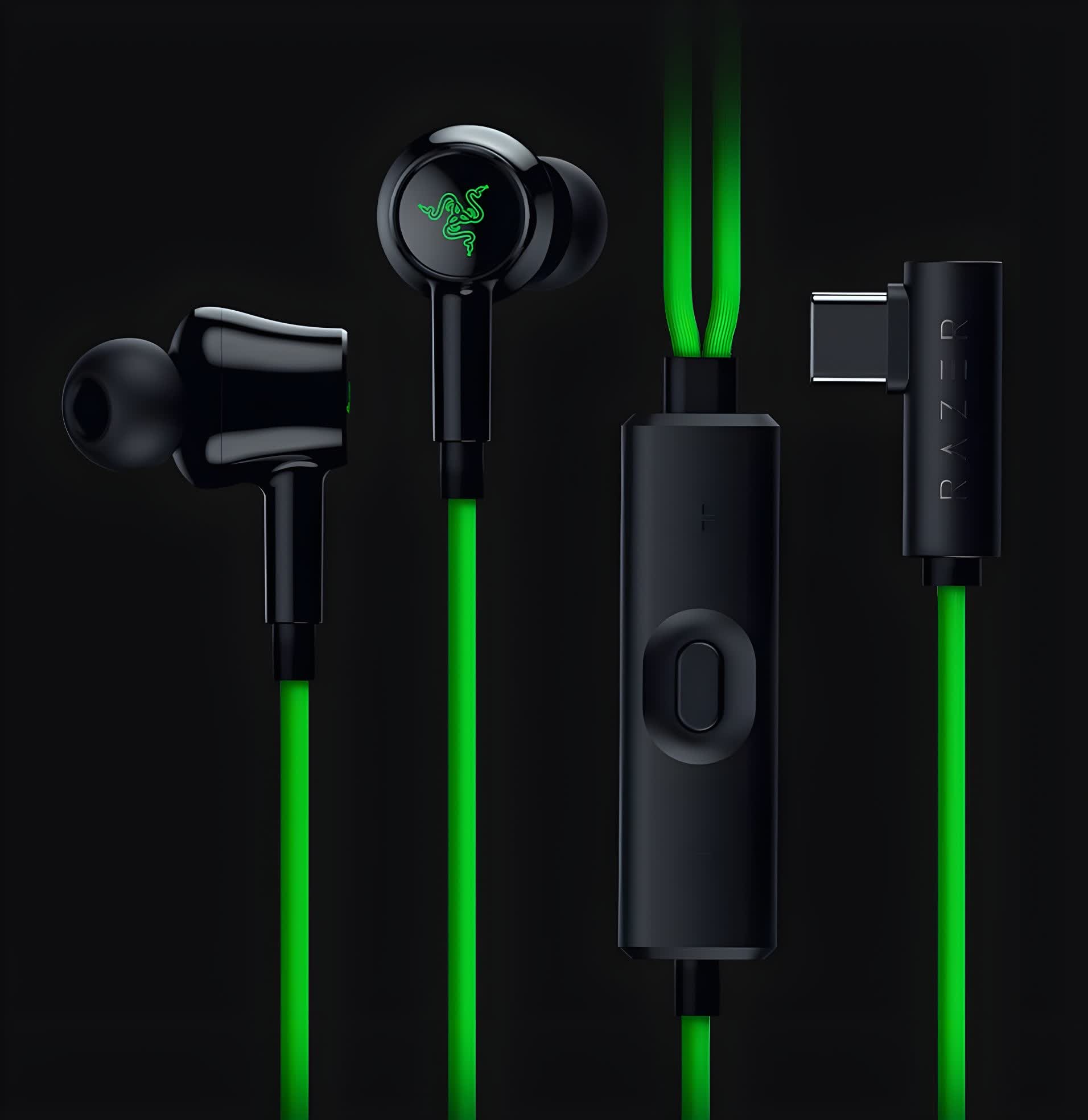
Conclusion first: an in-ear USB-C gaming earbud with feed-forward noise cancellation, a two-driver layout and Razer Chroma lighting, sold for seated play rather than for audiophiles.
- Connection. USB-C, not a 3.5 mm analog jack. The plug is bent at 90 degrees so the cable runs down the edge of a phone gripped in landscape mode.
- Drivers. An 11 mm main driver carries bass and body; a dedicated high-frequency unit — listed on Razer's specification page as a 6 mm tweeter — handles detail, with a stated frequency range of 20 Hz to 28 kHz.
- Lighting. Razer Chroma RGB on each shell, adjustable through approximately 16.8 million colors and linkable to other Chroma devices or in-game events.
- Noise control. Feed-forward active noise cancellation plus an ambient pass-through mode, toggled from the inline remote.
- Sound profiles. Four sound presets covering game, music, movie and call, with one custom equalizer slot.
- Spatial audio. THX 7.1 surround sound becomes available once the earbuds are attached to a PC and configured in Razer Synapse 4.
- Everyday hardening. An omnidirectional microphone on the cable and IPX4 splash resistance for sweat and light rain.
Why push a wired product in 2026?
Because the numbers and the complaints both turned. Circana, the consumer-technology analyst firm, documented five consecutive declining years for wired headphones that ended with a roughly $42 million drop in 2024, followed by a 3% rebound — about $15 million — in 2025, with the climb steepening in the second half of the year and into 2026.
Nostalgia is only part of it. Wireless owners report dead batteries mid-session, charging cases left at home, pairing glitches and single earbuds lost in car seats. A cable deletes every one of those failure modes, and USB-C has become standard on phones, handheld consoles and laptops, which makes "plug in and it works" realistic again.
Games add a second argument: transport delay. Test-methodology data published by webcammictest puts ordinary Bluetooth SBC and AAC at roughly 150 to 300 milliseconds end to end, low-latency codecs such as aptX Adaptive around 40 to 80 milliseconds, and a wired path at 5 to 30 milliseconds of device buffering, with a small extra allowance when the earbud carries its own USB-C digital-to-analog converter.
How do wired USB-C, true wireless and 3.5 mm compare on the things that matter?
| Decision factor | Razer Hammerhead V3 Chroma (USB-C wired) | Gaming earbuds with 2.4 GHz plus Bluetooth, such as Razer Hammerhead V3 HyperSpeed | Legacy 3.5 mm earbuds |
|---|---|---|---|
| Power source | Drawn from the connected device; no charging at all | Battery in each bud; HyperSpeed rated at about 10 hours per charge and 40 hours with its case, which doubles as a 2.4 GHz receiver | Passive, none required |
| Audio delay | Lowest of the three; only device buffering plus an onboard DAC | Depends entirely on codec and mode; Bluetooth paths can climb far higher than the marketing figure | Analog, effectively immediate |
| Noise cancellation | Feed-forward ANC powered over the cable | Hybrid ANC, but draining battery when enabled | None |
| Spatial sound | THX 7.1 surround sound on PC via Razer Synapse 4 | Spatial modes usually locked to the maker's own app or console | Two channels only |
| Visual styling | Razer Chroma RGB, approximately 16.8 million colors | RGB on some models, tied to battery use | Rarely any |
| Freedom of movement | Limited to the length of the cable | Unrestricted, subject to range | Unrestricted only near the jack |
| What breaks first | Cable insulation and the strain point near the plug | Cell capacity after a few hundred cycles | Cable or the phone's missing jack |
| Price anchor | US$79.99 in the United States; listings in the Chinese retail market opened around 599 yuan | Retail listings put HyperSpeed at US$129.99 | From a few dollars upward |
Who gains the most from this design?
- Handheld and mobile shooters. Landscape grip matters more than people expect, and the 90 degrees connector is aimed squarely at it.
- Long squad sessions. Voice chat runs through the omnidirectional microphone while the cable supplies power, so the mic never dies at rank reset time.
- Desk PC players on a budget. At US$79.99 you get the physical hardware plus THX 7.1 surround sound in Razer Synapse 4, where a wireless equivalent with a dongle costs materially more.
- Frequent flyers and commuters. Feed-forward ANC trims engine hum and cafe noise, and there is no charging case to find at security.
Who should stay with wireless?
Anyone whose listening happens while the body moves. Cables catch on sleeves, door handles and bed frames; reach is fixed by the cord; and the 90 degrees plug improves comfort in the hand, not the tether itself. Gym work, cooking, walking a dog or gaming on a sofa while someone else watches television are all cases where the wireless trade — battery upkeep in exchange for freedom — still pays.
Which five assumptions should you check before ordering?
- "USB-C means it works with every phone." USB-C carries digital audio, so the device must support USB audio output. Google's Pixel documentation warns that the handset has to support USB-C digital audio, and buyer guides recommend looking for explicit "built-in DAC" or "USB Audio Class" labeling rather than vague "hi-fi" claims.
- "Wired means zero lag." It means very little lag. Device buffering, app mixing and the earbud's own converter still add a few milliseconds.
- "Active noise cancellation fixes noise." Feed-forward ANC is best against steady, predictable sound such as air conditioning or transport rumble. Sudden voices and sharp impacts are reduced, not erased.
- "IPX4 means waterproof." It means splash resistant. Sweat and drizzle are covered; rinsing under a tap or running in a downpour is not.
- "THX 7.1 surround sound works everywhere." It is a PC feature running through Razer Synapse 4, and Razer's own THX page notes that its spatial features require Windows 11 version 23H2 or later. Console and phone users get the four sound presets, not THX.
A five-question framework for the buying decision
- Does my main device expose a working USB-C audio path? Verify before checkout.
- Do I play seated? If yes, the cable is invisible in practice.
- Do I need spatial cues for footstep direction? That pushes you to a PC plus Razer Synapse 4, not to a pricier wireless pair.
- Am I replacing a US$129.99-class wireless set? Then the US$79.99 wired option is a subtraction of features you were paying to maintain, not an upgrade.
- Can I live with one connector? A cable is a single point of failure, so a spare pair in the backpack may be worth the cost.
Frequently asked questions
Do these earbuds need charging?
No. Power and audio both travel over the USB-C cable, which is the central argument for the product.
Will it work with a handheld console or a phone?
Provided the device outputs digital audio over USB-C. The 90 degrees connector keeps the cable along the frame in landscape use, and the shell rating is IPX4 against sweat.
Is the RGB lighting functional or cosmetic?
Largely cosmetic, with one practical use: Razer Chroma can mirror in-game events, so lighting becomes a second information channel rather than pure decoration, adjustable across approximately 16.8 million colors.
Is this better than Bluetooth for competitive mobile games?
For shooting and rhythm titles, yes, because the wired route skips codec buffering entirely. For story-driven or turn-based play, the difference is academic.
Where is it available and what does it cost?
The product is shipping in the global market, with a United States price of US$79.99.
Read next on ItInsightsWorld
Category comebacks rarely mean a return to the past. The interesting version of this story is that a connector designed for charging has become a low-latency audio port, and that the same cable phones abandoned is now the reason a gaming earbud can carry noise cancellation without a battery. That is the frame worth keeping for the next product announcement you read.
Written for the ItInsightsWorld General desk by James Hartley. Queries: contact@itinsights.com.
Sources referenced
- Razer product page for Hammerhead V3 Chroma, including driver and connector specifications — https://cn.razerzone.com/mobile-earphones/razer-hammerhead-v3-chroma
- Circana, "Wired Headphones Growth Is a Throwback to 2016" — https://www.circana.com/post/wired-headphones-growth-is-a-throwback-to-2016
- Razer THX Spatial Audio support page, listing the Windows 11 23H2 requirement — https://www.razer.com/thx-spatial-audio
- Razer Hammerhead V3 HyperSpeed product page, battery and 2.4 GHz case — https://www.razer.com/mobile-earphones/razer-hammerhead-v3-hyperspeed
- Best Buy listing for Razer Hammerhead V3 HyperSpeed, US$129.99 retail reference — https://www.bestbuy.com/product/razer-hammerhead-v3-hyperspeed-wireless-multi-platform-anc-in-ear-gaming-earbuds-2-4ghz-bluetooth-6-0-up-to-40-hr-battery-black/J39HWFTJH2
- webcammictest headphone latency methodology and codec figures — https://webcammictest.com/zh/headphones/delay/
- Chinese technology press coverage of the 599 yuan opening retail price — https://m.163.com/dy/article/L925J9OC05118EDB.html