
The "ByteDance Time" Row Ends in Court: A Practical Guide to Auditing Any Claim That One App Owns Our Attention
A quarrel over how much of a nation's screen time one company holds has crossed a line: in a statement released today — made public on November 2, according to Chinese business media — commentator Qin Shuo said he had commissioned lawyers to file a case with the People's Court over remarks he described as infringing his reputation, published by "Li Liang of Douyin Group". The underlying dispute, over whether China's internet really contains a "ByteDance time", is genuinely useful to readers who never touch app-industry data — but not as a scoreboard. The transferable skill is a method for stress-testing any claim that opens with a percentage of time and closes with a verdict about a whole industry. Below: what was actually said, what the numbers measure and what they do not, a six-question audit checklist, the traps that turn a statistic into a slogan, and the practical steps if an argument escalates into litigation.
1. Eight days of escalation, in order
- October 26 — Qin Shuo published a signed article, "Terrifying Hongguo and the ByteDance Time of China's Internet", on Qin Shuo Circle, his personal media outlet. Its thesis: Chinese internet order may be shifting from Tencent time to ByteDance time, from WeChat time to "Douyin + Hongguo time".
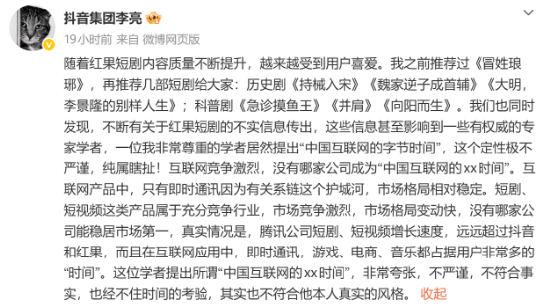
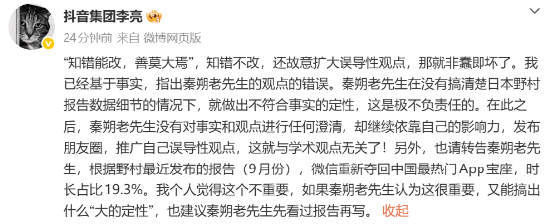
- October 27 — Li Liang, vice-president of Douyin Group, answered on Weibo, arguing that one reason users like Hongguo more and more is the steady rise of its content quality. He called the label "the ByteDance time of China's internet" extremely sloppy — "absolute nonsense!"
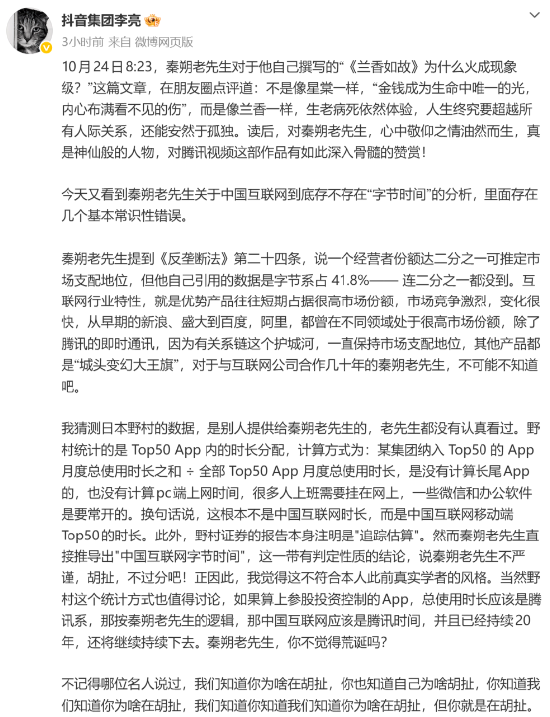
- On the morning of October 28 — Li returned with a second and third round, saying Qin's analysis contained several "common-sense errors" and attacking the data compiler, Japan's Nomura Securities, and its calculation method.
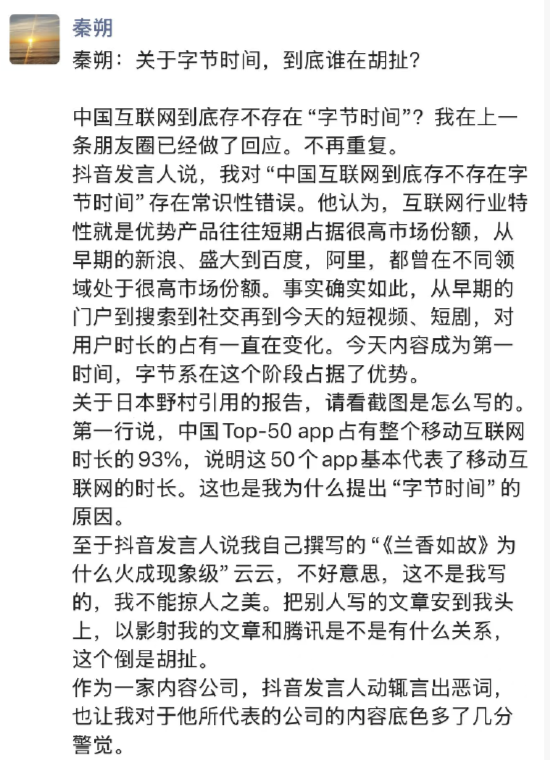
- On the afternoon of October 28 — the exchange was now framed publicly as the question of whether China's internet does or does not contain a "ByteDance time", an open polemic in which the two traded repeated shouting across platforms.
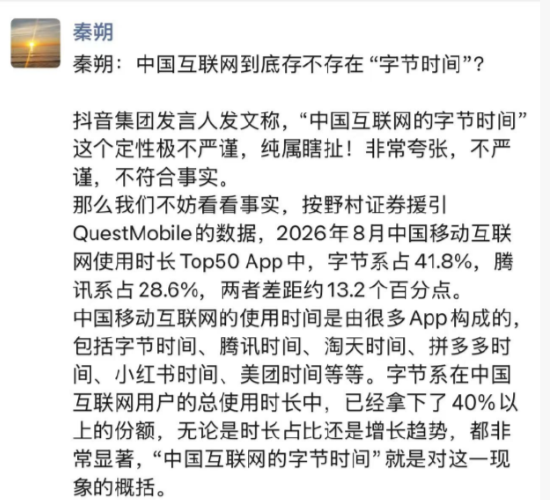
- In recent days — Qin held that the ByteDance app family already holds more than 40% of Chinese mobile internet users' total time and that "ByteDance time" simply names that trend — while arguing that heavy time is not the same as heavy social value.
- Today — the argument moved from public opinion to procedure: a defamation filing with the People's Court against "Douyin Group's Li Liang".
2. The two data stories, laid side by side
Both sides quote the same report and reach opposite conclusions because they are answering different questions. Reading them in one table is the fastest way to see where the disagreement actually lives.
| Point at issue | Qin Shuo's reading | Li Liang's reading |
|---|---|---|
| Source of the number | Nomura Securities, citing QuestMobile data | The same Nomura report explicitly labels itself a "tracking-based estimate" |
| Universe measured | The Top 50 apps for time spent, August 2026; Qin notes the report's opening line says China's Top 50 apps hold 93% of mobile internet time | Only the Top 50 of a field with vastly more apps: no long-tail apps, no PC hours, and no always-on office and messaging windows at work |
| ByteDance share | 41.8% of that pool — a share in the 40% range, i.e. more than 40% of total user time | Not even one-half, so the framing does not survive its own legal analogy |
| Tencent share | 28.6%; the gap is 13.2 percentage points | Count equity stakes and invested companies and the Tencent group leads by total time |
| Legal yardstick | Article 24 of the Anti-Monopoly Law presumes dominance at one-half of a relevant market; with 40%-plus on the time axis, ByteDance has real dominance there | Short video and short drama are fully contested sectors; only instant messaging holds a stable position, because of the relationship-chain moat |
| Single-app facts | Hongguo is already the fourth-largest app in China by total usage time, behind Douyin, WeChat and Douyin Lite; its per-user daily time hit 125 minutes this past February | The most recent Nomura report (for September) shows WeChat back on top of China's most-used app list with a 19.3% share of time |
| Bottom line | "But the ByteDance time of China's internet has surpassed Tencent time — that is a fact, not an exaggeration at all" | No company can be called the "xx time of China's internet"; market flags change on the city wall constantly |
Qin's own analogy is worth keeping in view: scholars and media at home and abroad speak of the 21st century as China's century even though China's GDP is roughly 17% to 18% of the world's, and when Henry Luce proposed "the twentieth century was the American century" back in 1941, the United States economy was a little over 30% of the global total. Trend names are arguments, not measurements.
3. The case against Hongguo — and the case for it
Why is Hongguo so red? Qin's summary: it has become an emotion-dispensing machine and a time-absorbing machine, driven jointly by free content, algorithmic recommendation, advertising monetisation and a platform ecosystem. Under that pressure Tencent launched Green Bubble short drama inside WeChat mini programs, "green" against "red", but Qin is not optimistic: Hongguo, like much of ByteDance's product line, is a highly algorithm-driven distribution machine, and ByteDance's inborn trait is using algorithms to grip human nature with a mastery he calls "the very peak".
His moral point is the 125 minutes themselves. That is a good number for ByteDance, he argues, but nothing to celebrate for users or society: the opportunity cost is less time in nature, less reading, less thinking, less time with relatives. The "high" is expensive, and the effects last. His remedy is not a ban but a demand that ByteDance use its content flow for more social value to repay the social cost it occupies, noting Toutiao and Douyin have already made some effort with some results.
Li's counter is commercial, not moral: users increasingly like Hongguo because content quality keeps rising; Tencent the company is growing its short-drama and short-video businesses far faster than Douyin, its Hongguo and the Douyin apps; and time is spread thickly across messaging, gaming, commerce and music. He also rejected the attribution implied by his own phrase: "This scholar proposes a so-called 'xx time of China's internet' — grossly exaggerated, not rigorous, not consistent with the facts, and it will not stand the test of time; it is not, in truth, the style of the man himself."
Two disputes the tables hide
- Group labelling. Li argued the aggregation method itself deserves debate: "Nomura's statistical approach is also open to discussion — if you count apps in which equity or investment gives control, total usage time should belong to the Tencent group. Then by your logic, China's internet should be Tencent time, and it has been for 20 years and will go on being so. Do you not find that absurd?"
- Who wrote what. Li had said Qin "wrote it himself" — a piece on why the drama Lan Xiang Ru Gu became a phenomenon, praising the Tencent Video production as "truly godlike figures". Qin replied: "I did not write it, and I will not claim another's work as mine. Pinning someone else's article on me to hint at a link between my writing and Tencent — that is the nonsense."
4. Six questions to ask of any "one platform owns our time" claim
Question 1: What is the denominator?
Li's core technical objection is the most reusable one in the whole exchange: "I suspect the Nomura data was handed to Mr Qin by someone else, and he never really read it. Nomura measured the distribution of time inside the Top 50 apps, calculated as: the sum of monthly usage time of a group's apps that appear in the Top 50, divided by the total monthly usage time of all Top 50 apps. It does not count long-tail apps, and it does not include PC internet time — many people have to stay connected at work, and messaging and office software are left open all day." Put plainly: in his words, "this is not China's internet time at all, it is the time of the mobile Top 50", and the report itself flags the numbers as a "tracking-based estimate".
Question 2: Whose aggregation rule is being used?
Group totals depend on whether a stake counts as membership. Any share figure that can move several points by a labelling decision should be treated as a contested estimate, not a measurement.
Question 3: Is time being read as value?
Even the claim's author concedes it is not: ByteDance's 40%-plus share of user time does not equal 40% of user value. Alipay, Meituan, JD and Pinduoduo are service and transaction tools — used and left — so they can never match Douyin or Hongguo on the clock, which says nothing about what they create for users and society.
Question 4: Is the ranking stable?
A metric that flips within weeks is a poor foundation for a permanent label. Qin's own list of competing clocks — ByteDance time, Tencent time, Taotian time, Pinduoduo time, Xiaohongshu time, Meituan time — is closer to what the data shows.
Question 5: Is the legal analogy doing work?
Article 24's one-half presumption is a rule about a defined relevant market, not a scoreboard of minutes. Comparing 41.8% with one-half is a legitimate check; concluding dominance from it is a legal argument, not a statistic. Qin's phrasing was that with a 40%-plus share on the time axis, "ByteDance time" is a very real fact, not something invented out of thin air — while admitting WeChat holds a dominant position on the social axis.
Question 6: What is the claim for?
The same numbers underwrite a policy warning, a competitor's marketing brief and an investor's deck. Naming the intended audience is the fastest way to judge the claim. Li's own parting shot was a warning against reaching for a "grand characterisation": read the report first, then decide whether a single ranking matters enough to build a thesis on it.
5. Five common misconceptions
- Misconception 1: "40% of app time means 40% of all internet time." The figure is a slice of the Top 50 mobile pool, from an estimate whose own publisher calls it tracking-based.
- Misconception 2: "More minutes equal more influence." Service apps win on transactions; entertainment apps win on clocks. Li's point about messaging, gaming, commerce and music is that no single clock decides everything.
- Misconception 3: "A trend label is a finding." "ByteDance time" is a metaphor in the family of "the 21st century", not a measurement with units.
- Misconception 4: "Market structure is fixed." Qin himself accepted the churn — from portals to search to social, then to short video and short drama — saying "today content has become the first choice for spending time, and the ByteDance family holds the advantage in this stage", while Li reduced the same history to "the flag on the city wall changes".
- Misconception 5: "An insult is an argument." The exchange ended with lines such as "I cannot recall which famous person said it: we know why you are talking nonsense, you know why you are talking nonsense, you know that we know it, we know that you know that we know it — and yet you keep talking nonsense", and Li's "recognising a mistake and correcting it is the best thing; refusing to correct it and deliberately widening a misleading claim is either stupidity or bad faith". On Weibo that reads as heat; in a court filing it is exactly the kind of sentence that gets litigated. Qin added that a content company whose spokesperson reaches for abusive language makes him more alert to the underlying tone of that company's content.
6. When a data argument becomes a lawsuit: the practical path
Readers should understand the machinery, because it now sits at the end of many public online disputes in China.
- Fix the evidence first. Guidance published by the People's Daily Overseas Edition's lawyer column and by law-firm commentary both put evidence collection and preservation before anything else: capture the account name, post URL, full text, timestamp, view and repost counts, and use notarisation or trusted timestamping before the post can be edited or deleted.
- Notify the platform. The same People's Daily column advises asking the network platform operator to take the content down or delete it, keeping the request and the response on record.
- Build the three-part proof. Court guidance such as that published on the Jiangsu court portal describes reputation disputes as requiring an infringing act, actual damage to reputation, and a causal link between them; claims collapse when one link is missing.
- Choose the remedy. Apology, deletion, damages, and in serious cases a criminal defamation complaint. Qin's statement frames his filing as taking legal measures to protect his lawful rights and to pursue the liability of the allegedly infringing side.
- Expect a truth-and-opinion split. Demonstrably false statements are easier to attack than sharp characterisations of a trend — which is why both sides spent the argument re-labelling each other's sentences as either fact or opinion.
7. Background the argument skipped: how big is this time, really?
Three verified data points put the fight in proportion.
- QuestMobile's 2026 half-year report on China's mobile internet counted 1.282 billion monthly active users by June 2026, up 1.2% year on year, with average monthly usage of 189.3 hours per user, up 7.4% — roughly 6.3 hours per person per day on a 30-day basis. The caveat carried in the same reporting matters: this is a monitored mobile-internet measure, not a census of how long people really stare at screens, and not all of it is leisure.
- The Hongguo model is structurally time-hungry. It launched in August 2023 as a free, ad-funded short-drama app, industry coverage reported 168 million daily active users this year, and the China Netcasting Services Association states that China's micro-drama market passed 100 billion yuan in 2025. Free viewing financed by in-app advertising means the business goal is minutes, not tickets — which is precisely why the "time" metric is contested at all.
- The "harm" premise is less settled than either side admits. The American Academy of Pediatrics frames the concern as "crowding out", holding that heavy screen time may displace face-to-face interaction, physical activity, reading and sleep — the same logic as Qin's opportunity-cost argument. But longitudinal studies of the time-displacement hypothesis have found little evidence that phone use reliably cancels enrichment, physical activity or sleep among young adolescents, or reading time in toddlers. A 125-minute figure is a fact about a product; what it costs an individual is an open research question.
8. FAQ
Is there a "ByteDance time" or not?
Both answers are defensible because the phrase has no units. If it means "ByteDance apps are the largest single block of measured mobile app time in the Top 50", the 41.8% figure supports it. If it means "ByteDance defines Chinese internet time", the missing long tail, the missing PC hours and the September reversal to WeChat's 19.3% defeat it.
Why did a statistics quarrel end in court?
Because the vocabulary migrated from data to character. Words such as "absolute nonsense!" and "either stupidity or bad faith" are about the person, not the number, and Qin's filing argues that remarks published by "Li Liang of Douyin Group" harmed his reputation.
Does a 40%-plus share of time make a company a monopoly?
Not automatically. Article 24's one-half presumption needs a defined relevant market; time shares across 50 apps in a mobile panel are not that market definition.
Should I delete the free drama app?
Use your own denominator. Check the device's own screen-time report, then ask which specific activities, if any, those minutes replaced. The research says displacement is possible, not inevitable.
What should a marketer or analyst take away?
Audiences are sold by attention, budgets are earned by transactions, and the two are measured by different panels. Never compare a share-of-time number from one source with a share-of-time number from another without checking the inclusion rules.
9. Action checklist
For readers
- Read the footnote of any chart before the headline: the universe, the window and the compiler.
- Convert the abstract number into your own week: 125 minutes a day is roughly two hours; compare it with what you actually want in that slot.
- Treat "X time" labels as opinion pieces. Hunt for the underlying report — here, Nomura Securities quoting QuestMobile — and read its first line.
For analysts and marketers
- Recompute any group-share claim twice: once with the panel denominator, once with your own category denominator.
- State the metric out loud in every deck: minutes, users, sessions or revenue. Most "domination" claims fail this test.
- Track reversals monthly. The September swing to 19.3% is a reminder that rank charts decay fast.
For anyone publishing an opinion about a company
- Separate verifiable numbers from characterisations, and label them accordingly.
- Keep the source document to hand; "did you actually read the report?" is now a live question both in public and in court.
- Criticise the claim, not the person — that single habit is what separates a data argument from a defamation file.
The takeaway
Nobody needs to settle whether China's internet runs on ByteDance time to get value out of this episode. Settle something smaller and far more useful: whether you know the denominator of the next attention statistic you quote. The lawsuit will eventually produce a ruling; the six-question audit works the same day, on any chart, and costs nothing but a paragraph of footnotes.
Written by James Hartley, content editor at IT Insights (ItInsightsWorld). This guide is general information, not legal advice; for a reputation dispute, consult a qualified lawyer. Questions or corrections: contact@itinsights.com.