
“ByteDance Time”? Qin Shuo and Douyin Group’s Li Liang Clash Over Who Owns China’s Screen Time
Recently, one contested phrase has been enough to pull two very different voices of China’s tech conversation into an open argument: media scholar Qin Shuo, and Li Liang, vice president of Douyin Group. At stake is whether “ByteDance Time” actually exists in China’s internet — in other words, whether the ByteDance camp now sets the clock that once belonged to Tencent and WeChat. The exchange opened with a signed essay on October 26, was dismissed on Weibo the following day, and was then answered with third-party data on Moments.
The essay that started the exchange
On October 26 Qin Shuo published a bylined piece titled “The Terrifying Hongguo and the ByteDance Time of China’s Internet”. Comparing how much consumption time flows to the Tencent camp versus the Douyin camp, he put a structural question to his readers: is China’s internet moving into a new order, leaving Tencent Time and WeChat Time behind and entering ByteDance Time and a combined “Douyin + Hongguo Time”?
The four figures underpinning his alarm
His case rests on rankings and on duration:
- Hongguo is now China’s fourth-largest app, placed behind only Douyin, WeChat and Douyin Lite.
- In February this year, per-user daily usage of Hongguo hit 125 minutes.
- That 125-minute level puts it ahead of Douyin and WeChat measured per user per day.
- Its growth is driven together by free content, algorithmic recommendation, advertising monetization and platform ecosystem.
Read as a whole, those four forces have, in his words, turned Hongguo into an emotion distributor and a time absorber.
A green reply to a red threat — and why he is doubtful
Confronted by Hongguo, Tencent launched Green Bubble short drama and embedded it in WeChat Mini Programs, an attempt to counter red with green. Qin Shuo does not rate that reply. His reason: Hongguo, like many ByteDance products, is a distribution machine governed by a highly tuned algorithm, and the native instinct of Byte is to hold human nature with algorithms, an understanding and control of human nature he describes as reaching the very pinnacle.
The 125 minutes, he stresses, is flattering data for ByteDance but nothing that users and society should find reassuring. The opportunity cost of that time is less time in nature, less reading time, less thinking time and less time spent with relatives; the price of such instant pleasure is high, and its impact will last a long time. His expectation is that Byte use its powerful content flow to carry more responsibility for social value and make up for the social cost it occupies, adding that Toutiao and Douyin have already made some efforts and achieved some results.
October 27: “Pure nonsense!”
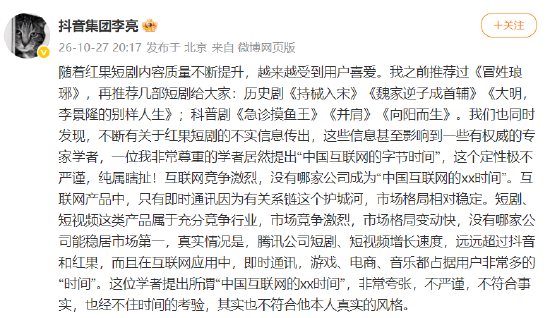
The next day Li Liang posted on Weibo. One reason users like Hongguo more and more, he wrote, is the continuous improvement of content quality. The characterization “the ByteDance Time of China’s Internet” is extremely unrigorous, he replied — “pure nonsense!”
His rebuttal is built on market structure:
- The internet is fiercely competitive, and no company has become “the XX time of China’s internet”.
- Among internet products, only instant messaging has a relatively stable market landscape, because the relationship chain acts as a moat.
- Short drama and short video are fully competitive industries with intense rivalry, fast-changing market order and no company able to hold first place in the market permanently.
- The real situation, by his account, is that Tencent Corp is growing in short drama and short video far faster than Douyin and Hongguo.
- Across internet applications, instant messaging, gaming, e-commerce and music all occupy very large amounts of users’ time.
He closed with a criticism aimed at the analysis without naming its author: “This scholar’s so-called ‘the XX time of China’s internet’ is highly exaggerated, unrigorous, inconsistent with the facts, cannot withstand the test of time, and in fact does not match his own real style.”
The reply on Moments: 41.8% against 28.6%
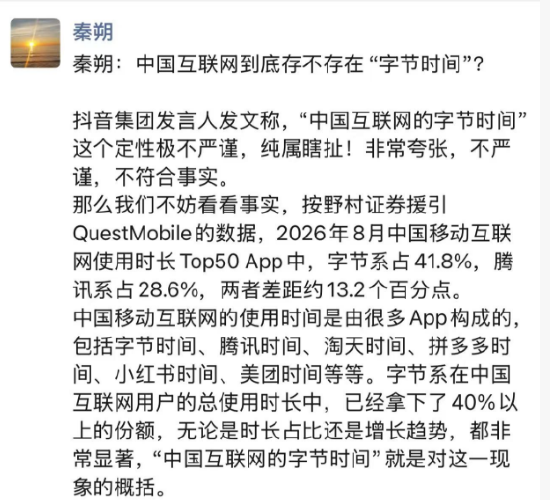
Qin Shuo responded on Moments, this time leaning on external measurement: citing data that Nomura referenced from QuestMobile on the Top 50 apps by mobile internet usage time in China for August 2026.
| Item cited by Qin Shuo | Value | Measurement referenced |
|---|---|---|
| ByteDance camp share of time among the Top 50 apps | 41.8% | Nomura citing QuestMobile, August 2026 |
| Tencent camp share of time among the same list | 28.6% | Nomura citing QuestMobile, August 2026 |
| Gap between the two camps | about 13.2 percentage points | Nomura citing QuestMobile, August 2026 |
| ByteDance camp share of total user time on China’s mobile internet | more than 40% | same dataset |
China’s mobile internet time, he notes, is made up of many apps — ByteDance time, Tencent time, Taotian time, Pinduoduo time, Xiaohongshu time, Meituan time and others. With the ByteDance camp already taking a share of total user time above 40%, and with both its proportion and its growth trend so visible, he argues that “the ByteDance Time of China’s Internet” is a summary of an observable phenomenon.
Why trend language is not a total tally
To defend the way labels describe direction rather than arithmetic, he offers an analogy: scholars and media at home and abroad call the 21st century China’s century, which is a judgment about a trend, even though China’s GDP stands at roughly 17%-18% of the global total. When Henry Luce proposed that “the 20th century is the American century” in 1941, the United States’ share of world GDP was a little over 30%.
The antitrust yardstick
Qin Shuo then brings the law into it. Under Article 24 of the Anti-Monopoly Law, where a single operator reaches one half of the market share in a relevant market, dominance may be presumed for that operator. On China’s mobile internet, countless apps compete for users’ time; when one operator alone passes 40%-plus of share, it already holds a degree of dominant position on the dimension of time, so “ByteDance Time” is, for him, a very real fact rather than something groundless. He frankly grants WeChat’s dominant position in social, and the important standing of the whole Tencent camp in user time, while insisting: “but the ByteDance time of China’s internet has exceeded Tencent time — that is a fact, and it is not exaggerated in the least.”
Minutes are not the same thing as value
The distinction Qin Shuo draws last is the one that keeps the argument from collapsing into a slogan fight: holding 40%-plus of user time is not the same as creating the same proportion of user value. Alipay, Meituan, JD.com and Pinduoduo are basically service-type and transaction-type apps, used and then closed, so their duration can never compare with Douyin and Hongguo — yet that does not mean the value they create for users and society is inferior to Hongguo’s. His parting message to ByteDance: rather than worrying about the phrase “ByteDance Time” for no reason, it should work to make that time carry more social value and meaning.
Placed side by side, the two positions differ mainly over what a time share is supposed to prove. One reads the ranking and the 125-minute figure as evidence that the clock of China’s internet has changed hands; the other reads the same numbers as a moving snapshot in industries where leadership rotates quickly. For anyone watching the attention economy, the useful residue of the argument is methodological: a share of minutes and dominance over a market’s clock are two separate claims, and the evidence in this exchange supports the first far more easily than the second.