
ItInsightsWorld General Playbook: Flood Readiness Before the Northeast Monsoon — Alerts, Routes and Premises Checks
Short answer: flood readiness ahead of the northeast monsoon comes down to a four-step routine — subscribe to PUB's flood alerts on Telegram and the myENV app, check whether your home, commute or business sits in a flood-prone area, pre-plan alternative routes, and put protection measures in place at your premises. The new campaign from PUB and TBWA\Singapore is best read as a prompt to make that routine run without relying on luck.
A concrete scene explains why the routine matters. In March 2025, a monsoon surge brought so much rain that the two-day total reportedly exceeded Singapore's average monthly rainfall of 209.7 mm, and PUB issued flash flood risk alerts naming Mountbatten Road and the Pan-Island Expressway. I can't verify the gauge readings myself — the figures circulated through media reports citing PUB — but the sequence is what matters: people who had the alert channel installed saw the risk early enough to reroute; people who didn't discovered the flooded stretch at the wheel. Same weather, same drainage, different preparation. That gap is what this guide tries to close.
When is the flood window, and how bad does it get?
The riskiest stretch runs from December to early March, with December and early January the peak. The Meteorological Service Singapore describes the northeast monsoon as having a wet phase from December to early January, when monsoon surges bring widespread, continuous moderate to heavy rain, with winds of 25–35 km/h. December is statistically the wettest month: the 1991–2020 climate normals put Changi's December average at 331.9 mm. In plain terms, the season is not one dramatic day but weeks in which any surge can flood a low-lying road.
What the 'luck' campaign is actually arguing
PUB, Singapore's national water agency, has teamed up with TBWA\Singapore on a flood resilience campaign titled "Luckily you didn't rely on luck". It pushes back on the familiar habit of crediting every close call to chance: a comic film follows a man who seems to win at everything, until the weather turns and what saves him is not fortune but earlier, deliberate choices. The campaign runs until 21 January 2027 across free-to-air television, radio, out-of-home placements and social media.
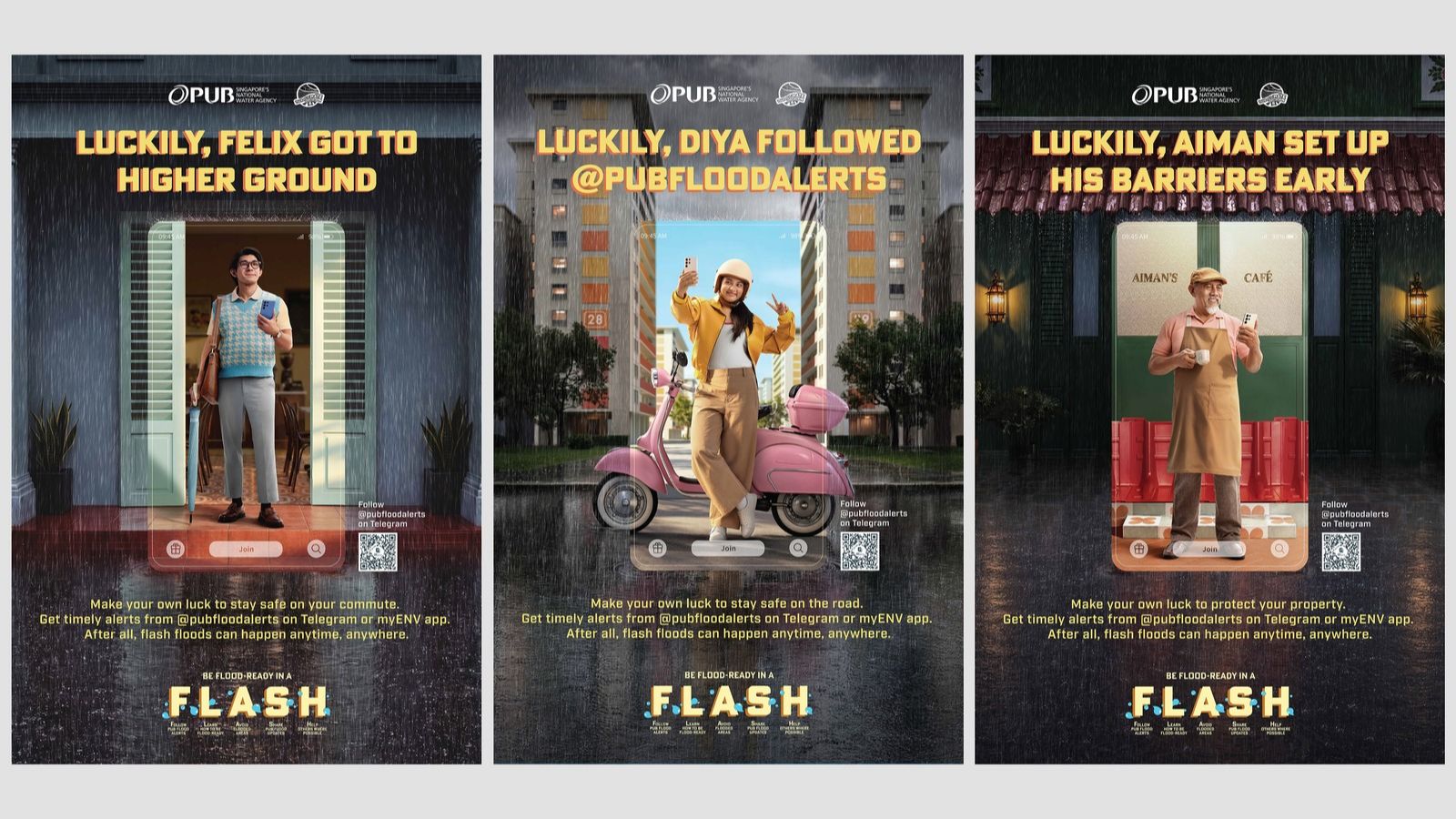
Two quotes frame the intent. Ann Chan, director of the 3P Network Department at PUB, said: "Everyone has a part to play in building a more flood-resilient Singapore. Checking the weather before heading out, subscribing to flood alerts and knowing what to do during a flash flood can help keep everyone safe. Through this campaign, we hope to encourage Singaporeans to make these actions a habit," she said. Loo Yong Ping, executive creative director at TBWA\Singapore, put it in cultural terms: "At TBWA, we believe culture can unlock behavioural change. For this campaign, that part of culture was luck. 'Luckily' comes so naturally to us in Singapore. It's how we describe a close shave or a day that went our way," he said. "We wanted to turn that familiar expression into a moment of recognition: if you checked an alert and avoided a flooded road, you made your own luck. Through humour and a charming visual world, we're making flood preparedness feel simple, relevant and achievable," Loo added.
The campaign also corrects a widespread assumption: that Singapore's drainage infrastructure rules out flooding altogether. PUB's engineering has cut flood risk sharply over the decades, but sudden and intense rainfall can still exceed drainage capacity, and climate change is expected to push those risks up further. The lineage is worth noting too. PUB's partnership with Splash Productions last year produced "Flood-Wise in a F.L.A.S.H.", which reached motorists, commuters and business owners through targeted placements with partners such as Grab and Gojek, alongside free-to-air television, out-of-home, transit, digital and social channels. PUB's public education reaches beyond flooding as well, as in the earlier water-saving message "Big ways, small ways. All OK," which asked Singaporeans to save water in any volume.
What should you actually do: a four-step routine
Here is the operating procedure I would run before the wet phase starts, in order:
- Subscribe once, today. Follow PUB's @pubfloodalerts Telegram channel and install the myENV app. The trade-off is real — more push notifications versus paying nothing and finding out late. With December averaging 331.9 mm at Changi, I would accept the noise.
- Locate yourself on the risk map. PUB publishes a List of Flood Prone Areas; the November 2025 edition names 36 flood-prone locations. Check your home, commute, school run and any business premises against it. If you touch one of those 36, everything below gets a higher priority.
- Plan the fallback route before an alert. Identify at least one alternative route for critical trips, and decide in advance what an alert naming your usual road means: reroute, or delay non-essential trips until the surge passes. A 30–60 minute delay window is my own suggestion, not an official instruction — but it costs less than guessing.
- Protect the premises. PUB offers consultative advice to building owners, and its Code of Practice on Surface Water Drainage sets minimum platform and crest levels plus flood protection measures that owners and developers must implement. Amendments to the Sewerage and Drainage Act passed in November 2024 require owners and developers to keep operating and maintaining those measures after installation. For low-lying buildings, PUB has pointed to automated flood barriers — the type trialled at Fortune Park Condominium in 2021, which buoy themselves up with approaching water and need no power or human intervention — as a viable, cost-effective option.
Who does what: commuters, businesses, residents
The actions split cleanly by audience, and mixing them up is where most preparation fails:
| Audience | Before the season | When an alert lands | After an incident |
|---|---|---|---|
| Commuters and motorists | Follow @pubfloodalerts on Telegram and the myENV app; map one alternative route per critical trip | Avoid roads named in the alert; reroute or delay | Review the route that failed and fix the map |
| Business and premises owners | Check the flood-prone list; maintain flood barriers and drains (a statutory duty since November 2024) | Move goods off ground level; deploy barriers | Log what failed; refresh the maintenance plan |
| Residents | Keep private drains clear; know whether you are in a listed flood-prone area | Keep essentials elevated; follow official alerts | Feed local knowledge back into community exercises |
Common pitfalls
- Treating drainage as a guarantee. The campaign's core correction: even strong infrastructure can be overwhelmed by intense rain, and climate change raises the ceiling on that intensity.
- Checking alerts after you have left. An alert's value decays with time; checking from the desk, not from behind the wheel, is what creates a reroute window.
- Arguing with the alert. PUB's alerts name specific roads to avoid. The failure mode is treating a named road as optional because "it was fine last time".
- Assigning flood preparation to nobody. In a business, if no one owns the barriers and drains, they do not get maintained — and since November 2024, maintaining them is a statutory responsibility, not a courtesy.
- Waiting for a top-down fix. PUB officials have said publicly that everyone should build resilience rather than wait for government-only solutions; the alert tools exist precisely so individuals can act first.
- Installing barriers and never testing them. A barrier that has not been deployed in twelve months is a hypothesis, not a control — that judgment is mine, not a quoted standard.
Frequently asked questions
When does the northeast monsoon run in Singapore?
December to early March, according to the Meteorological Service Singapore, with the wettest phase from December to early January, when monsoon surges bring widespread heavy rain.
What is the fastest way to get flood alerts?
Checking PUB's @pubfloodalerts Telegram channel or the myENV app for flood alerts before travelling — the campaign explicitly recommends both.
How many flood-prone areas does PUB currently list?
The November 2025 edition of PUB's List of Flood Prone Areas names 36 locations across the island.
Is this campaign new, and how long does it run?
It follows PUB's "Flood-Wise in a F.L.A.S.H." campaign with Splash Productions last year, and runs until 21 January 2027.
What should a business owner do first?
Confirm who is responsible for flood protection measures at the premises, verify maintenance records, and ask PUB for consultative advice if the building sits in a low-lying area.
A reusable checklist
Copy this into your calendar before December:
- Install the myENV app and follow @pubfloodalerts on Telegram — today, not in December.
- Download PUB's flood-prone areas list and mark every location you touch weekly: home, commute, school run, warehouse.
- Define one alternative route per critical journey and walk or drive it once in dry conditions.
- Set a personal rule for surge alerts: reroute or delay. No exceptions for "short trips".
- Businesses: name an owner for flood protection measures, confirm maintenance records, and schedule a barrier deployment test.
- Clear private drains monthly through the wet phase.
- Keep 21 January 2027 in view — the campaign runs that long, and it doubles as a seasonal reminder.
Flood outcomes in Singapore are decided by who saw the alert first and who had already decided what to do with it. Luck, as the campaign argues, has little to do with it.
References
- PUB, Singapore's National Water Agency — PUB launches third flood resilience campaign: pub.gov.sg
- PUB — List of Flood Prone Areas (as of Nov 2025): pub.gov.sg (PDF)
- Meteorological Service Singapore / NEA — Climate of Singapore: weather.gov.sg
- Ministry of Sustainability and the Environment — Oral reply on drainage improvement (Feb 2025): mse.gov.sg
- MSE — COS 2022 speech by Minister Grace Fu (automated flood barrier trial): mse.gov.sg