
ItInsightsWorld: Maintenance Execution Gaps Drive Plant Downtime, Not a Shortfall of Technology

Whether a plant stays online often comes down to unglamorous logistics: who signs the work approval, whether the correct part is on the shelf, and whether the one person who understands the machine is still on shift. That practical message runs through The State of Maintenance Report from Limble, a September 2026 survey of 686 U.S. maintenance and operations professionals that reached leaders, technicians and frontline employees.
What the survey numbers highlight
| Survey indicator | Reported result |
|---|---|
| Scheduled preventive maintenance actually completed by teams | 54% |
| Teams reporting consistent CMMS use across the whole group | 39% |
| Organizations with a critical asset only one employee knows how to repair | 74% |
| Technicians logging three hours or less of hands-on maintenance in a typical shift | 62% |
Money has flowed into maintenance software, predictive technologies and equipment data, yet the day-to-day difficulty for many teams has not shifted: finishing scheduled work while preserving the knowledge needed to keep critical assets running.
The findings point away from a purely technological explanation. The largest reliability issues appear to trace to how maintenance work is scheduled, performed, documented and shared.
Deferred schedules surface as downtime
Predictive ambitions do not always reach the work queue. Surveyed leaders estimate that their teams complete just 54% of scheduled preventive maintenance.
The consequence is not limited to postponed tasks. Nearly half of maintenance leaders report at least 10 hours of unplanned downtime in a typical month, and 24% report more than 20 hours. Four in 10 estimate that annual downtime costs their organizations at least $100,000.
Those results suggest manufacturers look closely at the conditions that stop planned work from getting done: competing priorities, approval delays, parts availability and incomplete asset information.
Approvals, parts and stale records squeeze hands-on time
The report also charts how administrative and operational barriers limit wrench time. 62% of technicians report spending three hours or less performing maintenance during a typical shift. Respondents identified the obstacles as:
- Waiting for approvals — 51%
- Incomplete or outdated asset records — 41%
- Difficulty finding parts — 40%
- Software that is hard to use — 35%
Adding maintenance tasks or purchasing new tools will not, on its own, lift reliability. Leaders who streamline workflows and place accurate information where the work takes place give technicians more room to address equipment needs.
Single-person dependencies and know-how that walks out the door
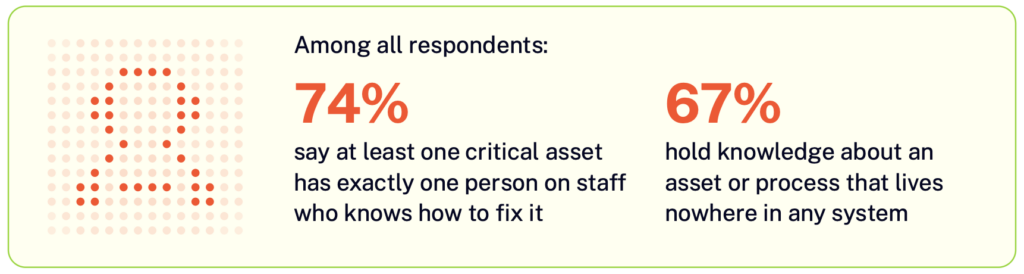
Workforce knowledge is the other exposure. 74% of respondents say at least one critical asset depends on a single employee who knows how to repair it. At the same time, 67% say asset or process knowledge is not captured in a system, and 47% report losing maintenance knowledge when an employee leaves.
Records of troubleshooting steps, repair history and work-order findings reduce reliance on individual memory. They also give newer technicians a stronger starting point as experienced employees retire or move on.
John Rimer, CFM, Vice President of Professional Services, Limble, states that “One of the biggest challenges is a lack of internal resources and expertise. Collecting accurate, comprehensive asset data takes significant time, and most maintenance teams are already stretched thin.”
A CMMS only pays off when everyone uses it
Although 82% of respondents say their organizations use a computerized maintenance management system (CMMS), only 39% report consistent use across the entire team.
Adoption is what converts a system into reliable maintenance data, and that data supports planning, performance measurement and decisions about where to focus resources. Training gaps, limited field usability and software that takes longer than existing workarounds can all undermine it.
Artificial intelligence is entering the picture, with 55% of respondents saying they use AI in some form. However, 92% agree that AI requires good, complete maintenance data to be effective.
Execution first: three priorities for manufacturers
For plants targeting better asset performance, the findings cluster into three priorities:
- Clear the barriers that stop planned work from being completed.
- Capture equipment knowledge before it disappears with the workforce.
- Make maintenance systems practical enough for technicians to use consistently.
Analytics layers and AI features can sharpen decisions, yet they cannot make up for records that were never written or routines that were never followed. Read this way, the survey keeps the human workflow, rather than the tool list, at the center of any durable reliability effort on the plant floor.