
ItInsightsWorld General Feature: A Single Spherical Photo for Setting Fixed Solar Panel Tilt in Urban Canyons
For open sites, panel placement can be described with a simple rule, but cities break that rule. This ItInsightsWorld feature explains how the Engineering School at Columbia University in New York used a single spherical photo to choose a practical fixed tilt for small urban arrays.
Why urban placement is not a simple aim problem
Street-level installations for kiosks, signs, charging hubs, and similar equipment are bounded by buildings, shade lines, glass façades, and partial sky visibility. The light path changes from hour to hour, so the instinct to point it at the sun’s maximum can produce a weak result. A 3D model may help in some workflows, but it can overlook compact nearby objects that matter to net irradiance.
The paper frames this setting as the urban canyon. In that context, the team reports that the proposed approach can raise capture by 10% to as much as 30%, without adding hardware cost.
What one image supplies
The system begins with one spherical capture. It reads shadows and architectural lines to infer orientation, then separates the frame into parts that contribute to irradiance. A photograph can reveal the sun’s direction, gravity relative to Earth, and the visible sky aperture around the panel.
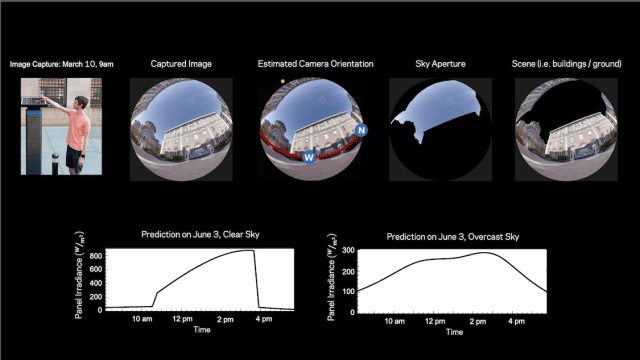 Figure 1: A single site image supports year-round daylight estimation, including location, position, time, date, and likely weather before selecting the orientation that maximizes captured energy (Columbia University/Nayar Lab).
Standard shortcuts often miss how the visible sky section changes over the day and year. They also miss light bouncing from surrounding façades. In the team’s observations, reflections account for roughly 12% of a panel’s total annual energy.
Estimating scene irradiance
A segmentation step identifies sky visible to the panel; building texture and layout provide clues about materials and geometry.
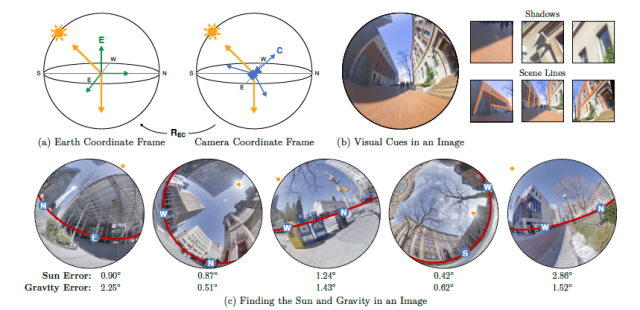 Figure 2: Camera orientation can be inferred from one image. The Earth coordinate frame E and camera frame C are related by a rotation R EC. Shadows and scene lines supply sun and gravity cues. The sun need not appear; shadow direction must be present (Columbia University/Nayar Lab).
With orientation fixed, a laptop-based pipeline forecasts sun position through the visible sky, estimates reflected light from surroundings, and uses historical weather data to extend predictions into cloudy and overcast periods.
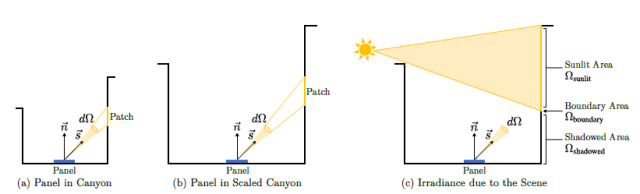 Figure 3: Scene irradiance properties in an urban canyon. The panel sees direct sun, shadowed patches, and diffuse sky components. Under Lambertian assumptions, the resulting irradiance changes smoothly through time (Columbia University/Nayar Lab).
A physically based renderer supported the analysis. The team studied 54,933 rendered locations across sun positions in a Lambertian urban environment and used principal component analysis to compact the irradiance functions.
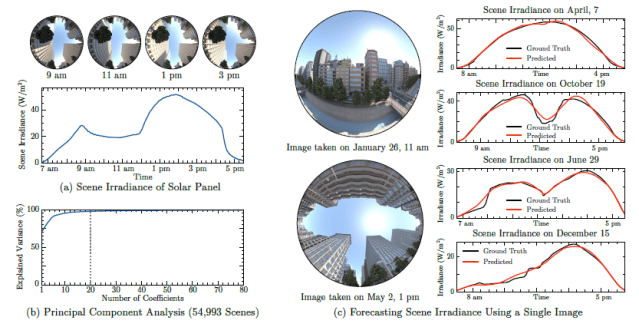 Figure 4: Forecasting from one image. Simulated scene irradiance can vary smoothly despite many shadows and reflections. A neural network learns to predict irradiance from a hemispherical image (Columbia University/Nayar Lab).
The final model uses a vision transformer backbone and an MLP head to output scene irradiance for a requested sun position. The inputs are the image, estimated orientation, time, and GPS location.
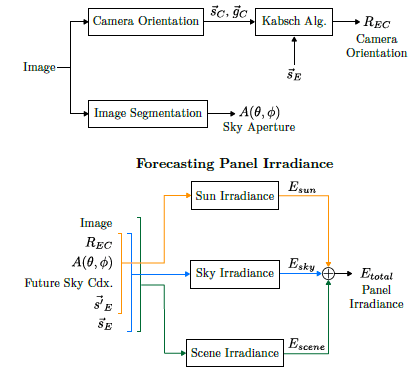 Figure 5: The full pipeline estimates sun and gravity direction from camera coordinate cues, then forecasts solar, sky, and scene irradiance components. Their sum gives total panel irradiance (Columbia University/Nayar Lab).
Rule of thumb versus measured city light
The familiar heuristic says a fixed panel should aim toward the equator with a zenith angle matching latitude. That assumption depends on broad sky access, which dense streets often lack. The researchers validated their method with real urban irradiance measurements and found the best fixed orientation can depart from that heuristic.
Publication notes
The work appears as Forecasting solar energy using a single image in Solar Energy. The article runs 23 pages! but remains readable for technical audiences. Because the journal posting may sit behind a paywall, an open version is also available on arXiv, a non-profit repository that hosts preprints before formal peer review and journal publication.
ItInsightsWorld takeaway: when the site is cramped and reflected light matters, a measured spherical image can guide a fixed tilt more reliably than a generic rule.