
ItInsightsWorld Breakdown: An Invisible Cities One-Shot Test and the AI Work Identity Question
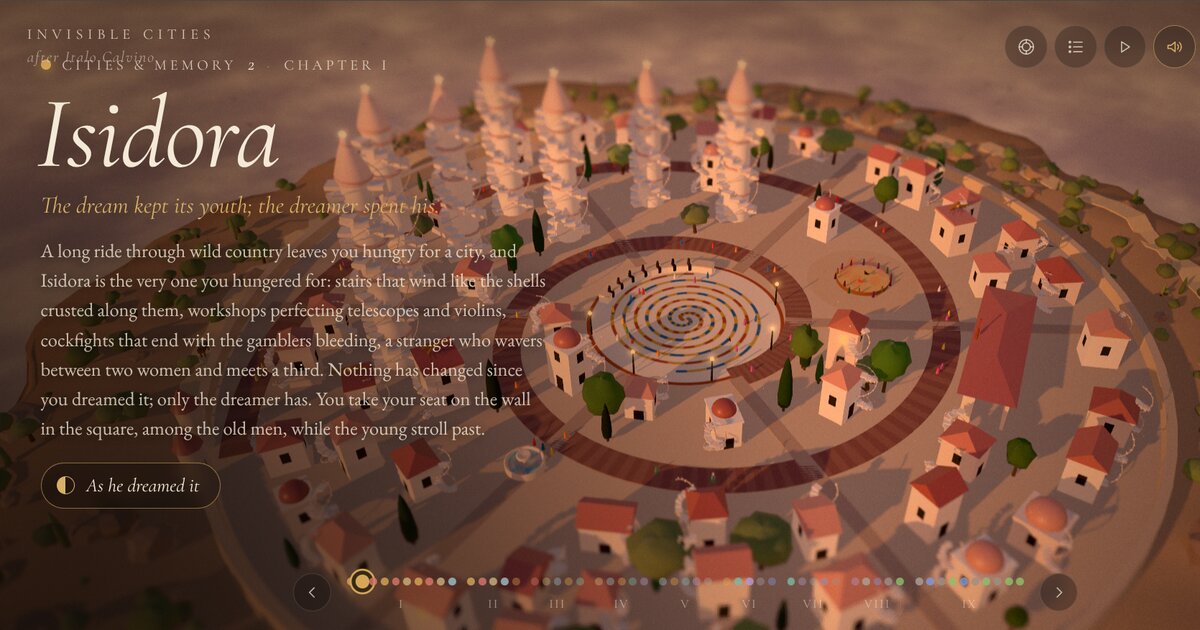
Why this one-shot visualization matters
For ItInsightsWorld readers, the useful takeaway is that Piotr Migdał’s one-shot prompt exposes both model capability and a professional anxiety: what remains for interactive-media makers when a generative model can attempt a full visualization?
From book to prompt
Invisible Cities, Italo Calvino’s postmodern novel, consists of short poetic passages about 55 imaginary cities, often complex and abstract. The requested output was a three.js (pnpm) visualization made without clarification, treated as a one-shot task and allowed 6h of work.
Piotr’s earlier 2019 project used GPT-2 for a storytelling performance. The new prompt tested whether today’s models can go much further.
The repeat run: medium and max settings
Repeating Piotr’s question - “What is my place in creating interactive media?” - produced a blunt answer from the writer: yes, the outcome can be stunning. After inspecting the result, Piotr, a data vis specialist, is left with that identity question rather than a neat conclusion.
The repeat compared Claude Opus 5.5 at medium effort without ultracode and Claude Opus 5.5 at max effort with ultracode. The images below show the two outputs.
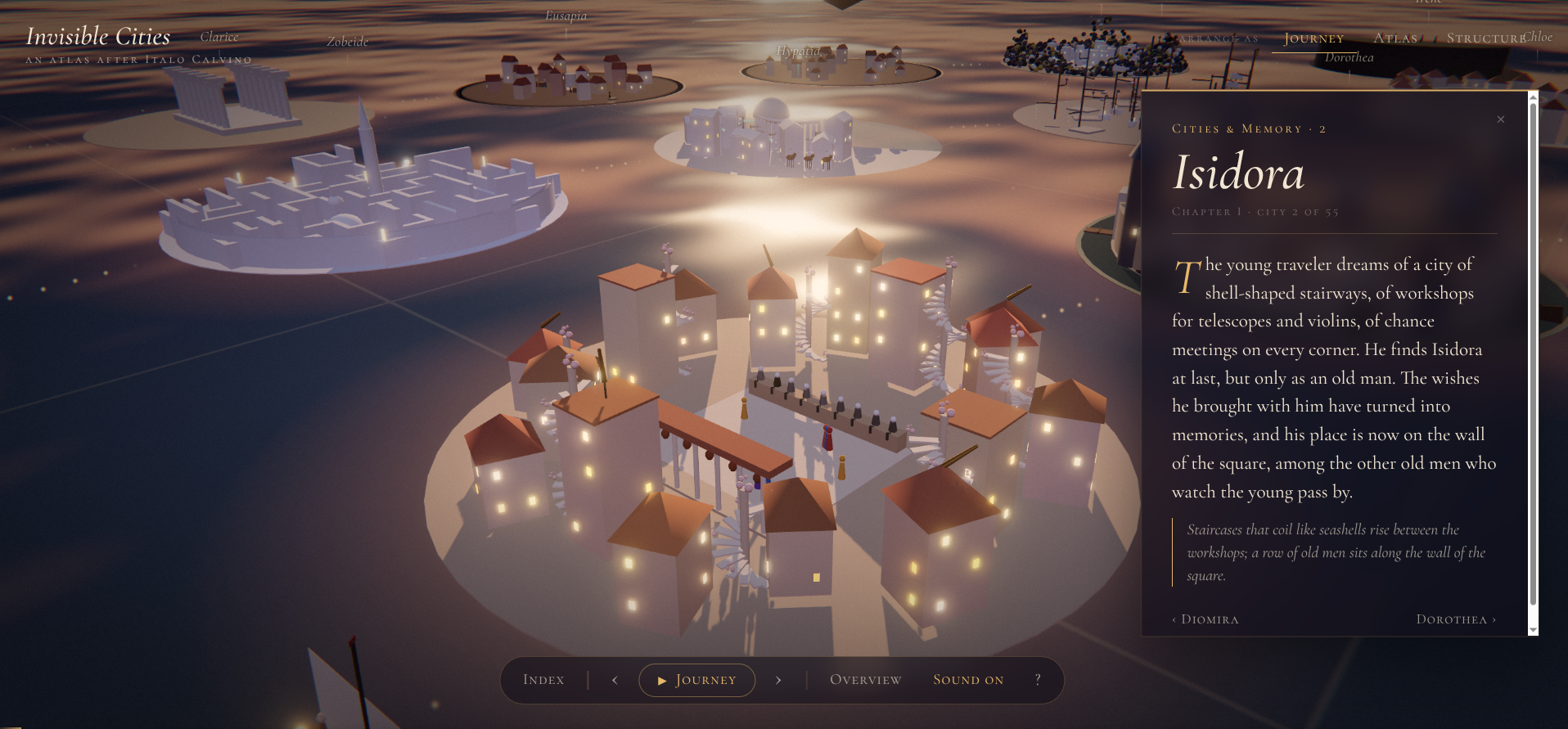
Claude Opus 5.5, medium effort, no ultracode
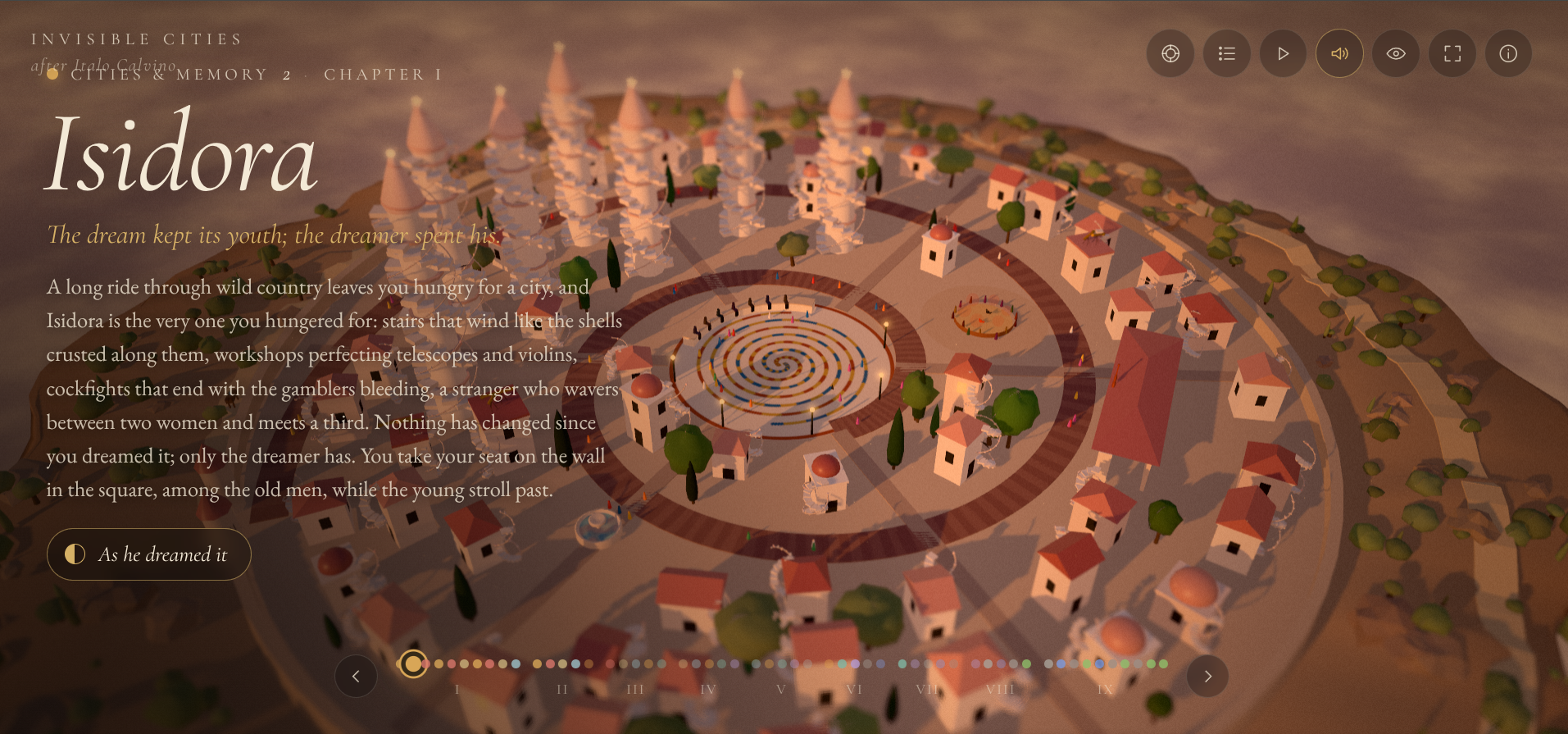
Claude Opus 5.5, max effort, ultracode enabled
Keyboard use only; the README explains details.
Claude Code comparison
Claude Code + Opus 5.5 runs in the two configurations can be read through cost, tokens, time, and code volume.
| Measure | medium effort | max effort + ultracode | Max divided by medium |
|---|---|---|---|
| Total cost | $14.9800 | $264.6400 | 17.7x |
| Opus 5.5 spend | $14.9800 | $261.4700 | 17.5x |
| Haiku 5.5 spend | $0.0001 | $3.1700 | - |
| Measure | medium effort | max effort + ultracode | Max divided by medium |
|---|---|---|---|
| Opus input tokens | 402 | 637,693 | ~1,586x |
| Opus output tokens | 313,168 | 5,326,576 | 17.0x |
| …of which thinking | 69,578 | 3,655,322 | 52.5x |
| Opus cache read | 27,899,390 | 297,377,614 | 10.7x |
| Opus cache write | 392,035 | 18,013,330 | 45.9x |
| Haiku input / output | 1,215 / 23 | 5,668,132 / 374,003 | - |
| Web searches | 0 | 242 | - |
| API time (summed) | 0h 53m 4s | 16h 29m 10s | 18.6x |
| Wall time, active | 2h 46m 45s | ~1h 50m 12s | 0.66x |
| Lines added | 7,746 | 31,387 | 4.1x |
Timing and token notes
- Active wall time excludes a pause. It hit the session limit on Oct 9 at 14:19 UTC and resumed on Oct 13 at 12:06 UTC. The ~1h 50m figure sums two working stretches: 1h 4m 2s before the limit and 46m 10s after resume to final answer at 12:53, omitting ~94h. Logs cannot confirm whether agents worked during the pause, so the number is approximate.
- API time adds all parallel agents, about 11 city builders plus research agents, which is why it sits far above wall time.
- The small input-token baseline reflects only uncached prompt content. Most input came from cache, as the cache rows show, so the ~1,586x ratio overstates the real workload gap.
Quality, limits, and sharing
The original author did not claim specialist review of the book or of data visualization, but said both results were very similar. Piotr’s same-parameter version looked a little better. The max effort + ultracode version looked more impressive, yet mouse input remained faulty, so keyboard controls only. Source code and agent transcripts are available in the repository.
- Claude Opus 5.5, medium effort, no ultracode: interactive output and code
- Claude Opus 5.5, max effort, with ultracode: interactive output and code
The wider invitation is to run the same prompt on other models and agents and compare what they return.
Identity crisis, not proof
The headline is catchy: there is no proof that Opus 5.5 caused a personal crisis for anyone. It is still true that GenAI is triggering anxiety for some people, and that this began well before 2026.

The meme’s point is simple: identity crisis is not a joke, Jim.
Within the IT bubble, programmer discomfort with large language models is familiar; the deeper issue is identity. The write-up points to YouTube videos, social posts, and blogs that describe alienation, loss of human dignity, and anger over stolen independence.
Industrial Revolution echo
Texts from the 18th and 19th centuries contain comparable distress. The phrase did not exist then, but the feelings did. Historians studied hundreds of autobiographies from working-class citizens, including collections by Emma Griffin in Liberty’s Dawn. Workers also petitioned governments about machines erasing their identities as skilled artisans.
Skills change, not vanish
Eventually the job remains, technology grows stronger, and work changes shape. Still, some people remain anxious. The source has previously connected mathematicians to the identity crisis of programmers, and expects the pattern to spread to scientists and white-collar workers.
Some researchers see autonomous AI agent swarms as extremely damaging; others use armies of agents to solve physics. The future may still look more like transformation than disappearance. Go players already experienced that after AlphaGo, and similar pressure may reshape every skill AI touches.
Kamil Stanuch notes on LinkedIn that human Go play stayed flat from 1950 to 2016 and then jumped after AlphaGo.
Publication context
This is the source’s first post on a new blog, made after almost 10 years of previous publishing. Future notes can remain occasional and concise: interesting data, insights, latest trends.