
ItInsightsWorld General: USFP Could Shift AI Optics Benchmarks Toward 400 Gb/s-per-lane Density
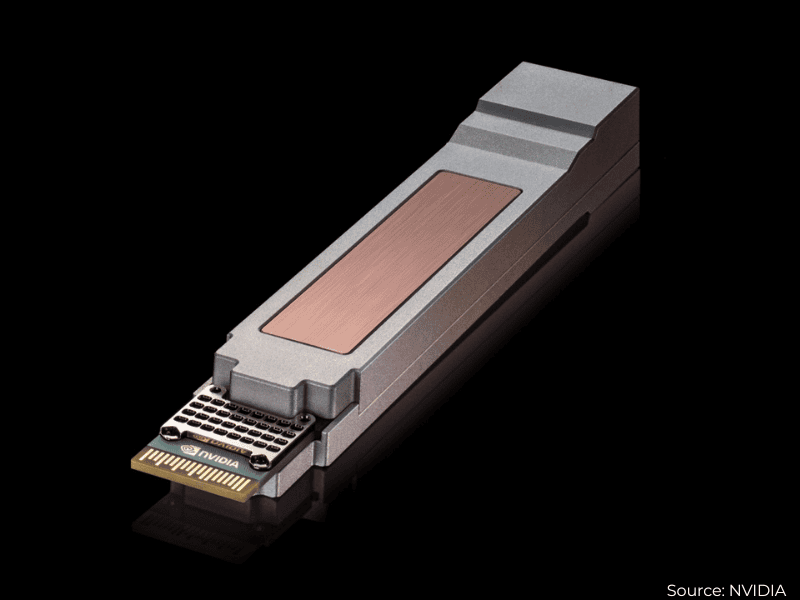
From the ItInsightsWorld General viewpoint, the main signal in the USFP announcement is a standards track that could change how European AI infrastructure teams compare optical density, power headroom and switch faceplates.
Density metrics the proposal centers on
The effort is positioned around Ultra-Dense Small Form Factor Pluggable technology from NVIDIA and Cisco, intended to carry 400 Gb/s per lane electrical signaling while supporting 400 Gb/s-per-lane optical links in next-generation AI factories. The density argument rests on four times the front-panel bandwidth of present 200 Gb/s-per-lane pluggable optics and claimed aggregate capacity of up to 12.8 Tb/s.
| Design point | What the partners state |
|---|---|
| Lane packing | Initial modules plan 16 full-duplex lanes in an OSFP-sized footprint for switches and SuperNICs; later variants may go to 32 lanes or more. |
| Thermal envelope | Modules can dissipate up to 100W without a dedicated embedded cooling circuit. |
| Efficiency | Power efficiency is described as approximately 1.3 times better than existing 200 Gb/s-per-lane modules. |
| Connector mechanics | The two-dimensional array connector uses a two-step insertion mechanism, with high-speed electrical contacts engaging after module insertion. |
Why the connector change matters
Reliability, insertion force and signal integrity are framed as the operational payoff: contacts wear less when engagement is delayed, and the connector architecture is meant to improve behavior at 200 Gb/s as well as at 400 Gb/s per lane. Optical technologies that simplify signal processing are also cited to reduce latency and power use across different connection distances.
Quote from the ecosystem sponsor
Gilad Shainer, senior vice president NVIDIA, said, “Building the world’s largest AI factories starts with rethinking the smallest of connections,” adding, “With USFP, NVIDIA and Cisco are building an ecosystem to reinvent pluggable optics — connecting more computing with greater efficiency to power the next generation of AI factories.”
Open-spec path and supply-chain scope
The partners are working with TE Connectivity and Amphenol on connectors, cages and modules, with more participants expected. They also aim for an open industry specification through a community-led multi-source project, so component suppliers can target interoperable high-density optical hardware. The proposal extends collaboration spanning Spectrum-X Ethernet and Cisco Silicon One-based networking for enterprise, neocloud and sovereign cloud AI deployments.
What European teams may notice first
For European operators, equipment makers and optical component suppliers, the near-term relevance is whether AI factories can add computing capacity without proportional growth in switching layers, network complexity, energy draw or service disruption. ItInsightsWorld General sees that as the practical benchmark for judging USFP beyond the headline 400 Gb/s-per-lane figure.