
ItInsightsWorld General Explainer: The Newegg RTX 5090 Restock — $6,599.99, GB202 Scarcity, and Why the Price Is About 3.3 Times MSRP
The RTX 5090 is back on Newegg, but nowhere near its official price: the cheapest self-sold model, Gigabyte's AORUS RTX 5090 Xtreme Waterforce, lists at $6,599.99 — about 3.3 times NVIDIA's $1,999 MSRP. This is an inventory event, not evidence of easing scarcity. GB202 allocation and GDDR7 costs still set the floor, and planned China market increases this month point up, not down.
For enterprise readers following Generative AI Adoption, the restock is a clean signal of how scarce high-end silicon is being rationed between gaming and professional lines. Below are the listings, the reasons behind the premium, and a practical decision frame.
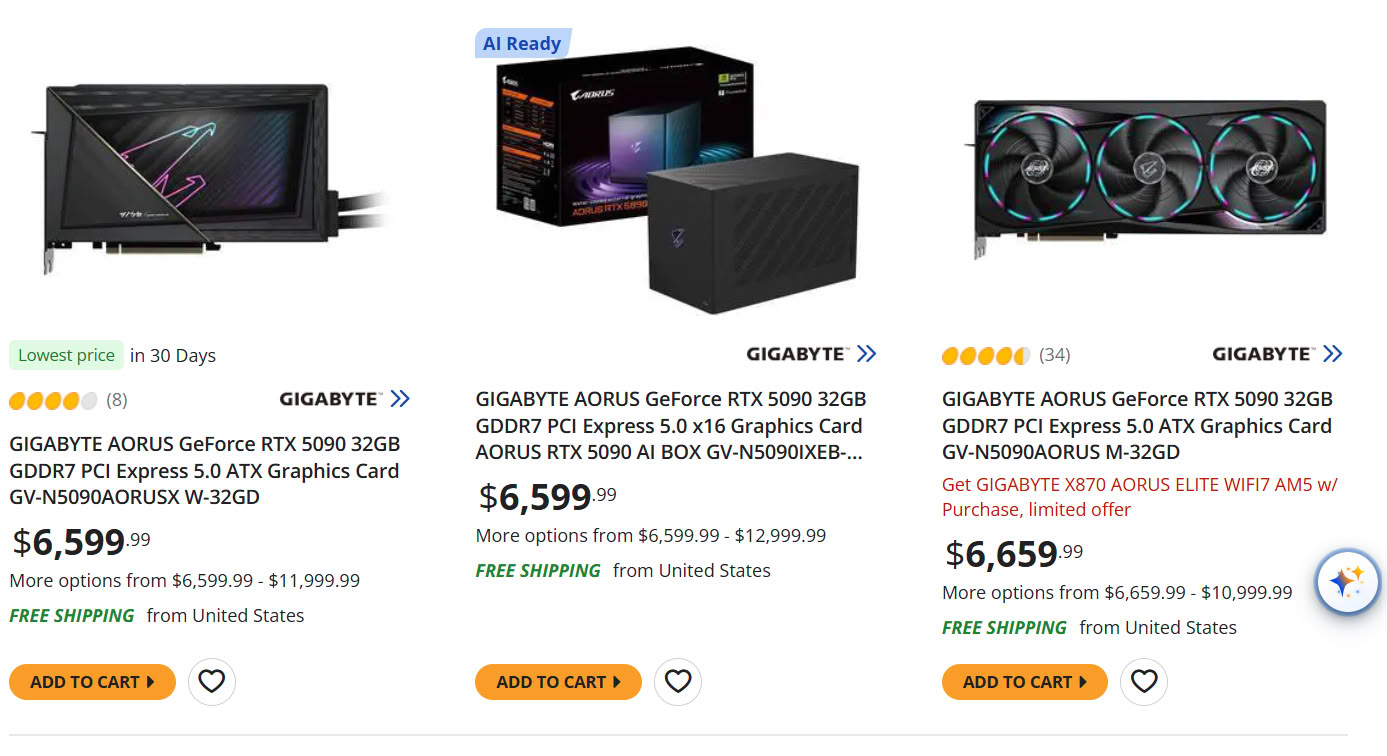
What exactly did Newegg put back on sale?
Conclusion: the batch is entirely Newegg self-sold inventory spanning ASUS, Gigabyte and MSI, with current prices from $6,599.99 to $9,490. None of these cards come from third-party marketplace sellers.
| Model | Price on Newegg | Status |
|---|---|---|
| Gigabyte AORUS RTX 5090 Xtreme Waterforce | $6,599.99 | Lowest self-sold listing |
| Gigabyte AORUS Master ICE | $6,759.99 | Listed in the restock |
| MSI Gaming Trio OC, Ventus 3X OC, Suprim Liquid SOC | $6,999.99 each | Uniform price across the three models |
| ASUS ROG Astral RTX 5090 OC | $6,249.99 briefly, now $9,490 | Sold through almost immediately |
| Official reference price | $1,999 MSRP | The $6,599.99 floor is about 3.3 times this figure |
The ASUS ROG Astral RTX 5090 OC is the clearest illustration of demand pressure: it appeared at $6,249.99, was snapped up almost immediately, and the same card is now quoted at $9,490.
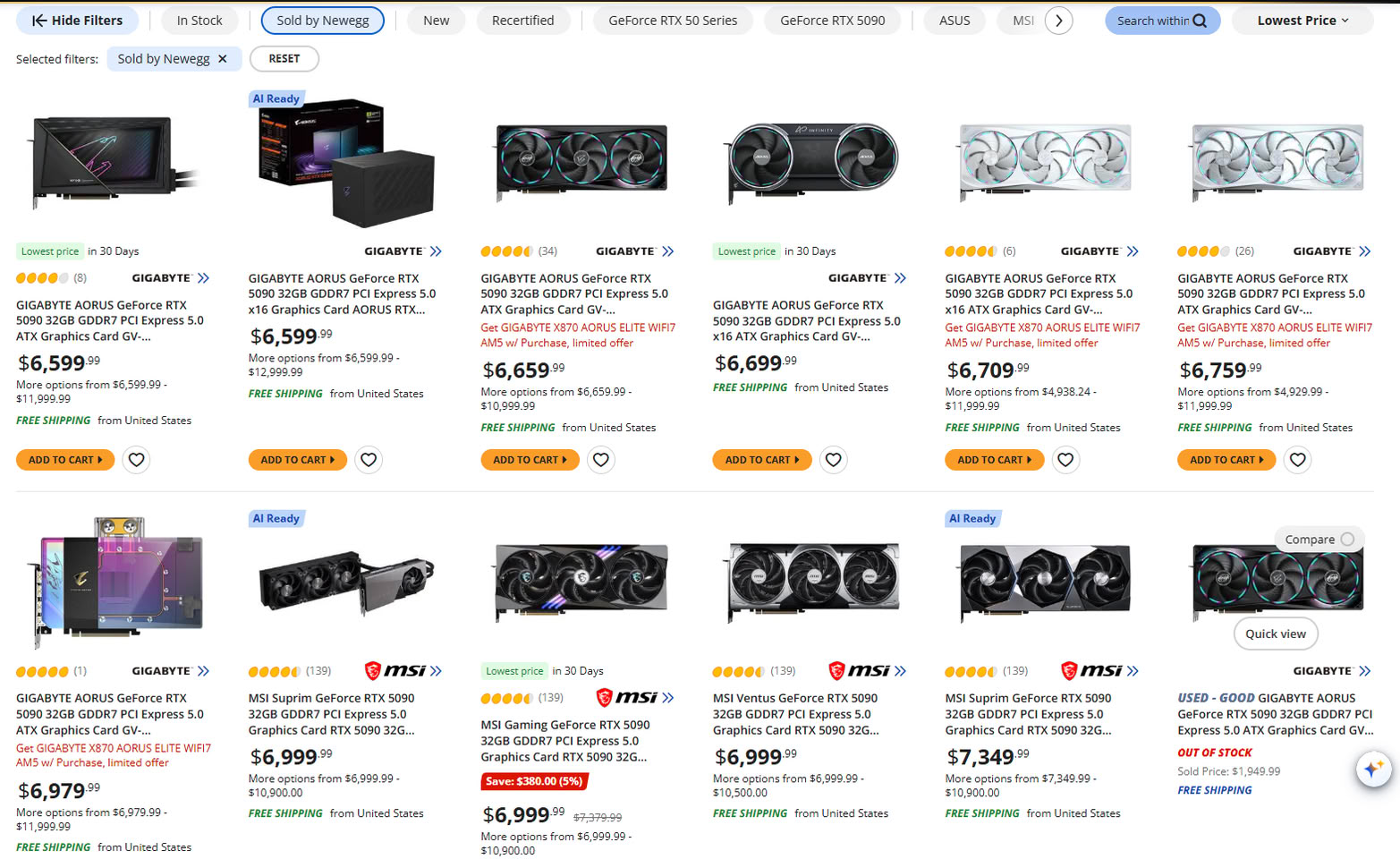
Why is the RTX 5090 still around 3.3 times MSRP?
Conclusion: allocation, not lack of interest, is doing most of the work. In early October this year, reports emerged that NVIDIA was reducing or halting GB202 assignments to the RTX 5090 line in favour of RTX PRO professional workstation cards. TechPowerUp reported on 10 October 2026 that future GB202 supply was being reserved for the professional channel, a claim consistent with the production rumours circulating at the time.
The incentive is straightforward. The same GB202 die underpins several RTX PRO cards, including the 96GB RTX PRO 6000, the 84GB RTX PRO 5500 and the 72GB/48GB RTX PRO 5000. Those products sell into workstation and AI infrastructure budgets where margins are healthier than in consumer gaming, leaving gaming boards to compete for whatever capacity remains just as component costs climb.
Memory is the second half of the story. TrendForce, cited by Igor's Lab, still expects DRAM and NAND contract prices to rise in the third quarter of 2026, with graphics DRAM (GDDR6/GDDR7) remaining tight. Newegg's own Insider analysis puts the mid-2026 cumulative DRAM increase at roughly 170% over 2025 and cites a Gartner projection of about 130% higher DRAM and SSD prices by year-end. A flagship card built around 32GB of GDDR7 cannot escape that arithmetic.
The human detail came via overclocker Der8auer: an unnamed NVIDIA board partner said it had received no formal end-of-life notice, but could no longer order GB202 chips paired with 32GB GDDR7 memory — the exact combination an RTX 5090 requires. NVIDIA has publicly denied that the model is discontinued while acknowledging that supply is very tight. Micro Center also removed the RTX 5090 from its catalogue, fuelling discontinuation speculation.
Are prices actually moving in the right direction?
Conclusion: they are down from the peak, but the trend is not reliably downward. TechSpot surveyed the US market in October this year and found the cheapest RTX 5090 spot price at about $9,400, with many models sitting above $11,000 for long stretches. Against that benchmark, $6,599.99 is genuine progress — several weeks ago, buyers in the US faced a far worse floor.
However, reports say some graphics-card partners in the China market plan another RTX 50 series price rise this month, echoing the China market supply-chain reset seen in adjacent hardware sectors. With no word on how much stock Newegg received or how long it will last, the global market has no obvious catalyst for a retreat. Global buyers should treat the current listings as inventory timing, not a turning point.
What are the common misconceptions?
- "Restock means the shortage is over." A single batch of self-sold inventory does not change GB202 allocation or GDDR7 availability.
- "NVIDIA has quietly killed the RTX 5090." NVIDIA denies discontinuation; what is documented is tight supply and a reported shift toward RTX PRO.
- "These are marketplace scalpers." Every card in this batch is sold by Newegg itself, so the premium sits in the channel, not with third-party resellers.
- "It will soon return to $1,999." With memory costs rising and professional cards prioritised, the MSRP is a reference point rather than a near-term forecast.
What should gamers and IT teams do now?
Conclusion: treat $6,599.99 as today's floor, not a bargain, and separate consumer from enterprise decisions. For most players, the RTX 5080 costs a fraction of the RTX 5090 and is the rational buy. For enterprises planning Generative AI Adoption, compare local workstation capacity with Enterprise Cloud and Multi-cloud options instead of anchoring on a gaming MSRP, and fold Data Governance and Cyber Risk into any new hardware rollout.
- Confirm the seller is Newegg itself rather than a marketplace reseller.
- Benchmark any quote against $6,599.99 and the $9,400 / above $11,000 US market figures from October.
- Watch RTX 50 series pricing in the China market this month as a leading indicator.
- Recheck GB202 and RTX PRO allocation news before committing to 32GB GDDR7 workstation builds.
- For mainstream gaming or light development, price the RTX 5080 first.
Frequently asked questions
What is the cheapest RTX 5090 on Newegg right now?
Gigabyte's AORUS RTX 5090 Xtreme Waterforce at $6,599.99, about 3.3 times the $1,999 MSRP.
Has NVIDIA discontinued the RTX 5090?
There is no formal confirmation. NVIDIA denies discontinuation; reporting points to GB202 being steered toward RTX PRO, and Micro Center delisted the card.
Why did the ASUS ROG Astral RTX 5090 OC move from $6,249.99 to $9,490?
The $6,249.99 listing sold out immediately; the remaining quote reflects a much smaller pool of available inventory.
Will prices fall before the end of this month?
Unlikely. Planned China market increases on RTX 50 series cards and unresolved GB202 and GDDR7 supply argue against a rapid global decline.