
Settling the Musk–Broersen Cooling Argument: A Practical Checklist for Judging Space Data Centres
By James Hartley · ItInsightsWorld, General
The fight that flared on X late last night (Beijing time) looks like a slugfest between a professor and a billionaire, but it is really two arguments wearing one costume. One of them is already closed by physics; the other is still open and has a price tag attached. Take this as the headline conclusion: Jan Broersen is correct that a vacuum kills convection and conduction, and Elon Musk and Shaun Maguire are correct that infrared radiation is a legitimate, fully understood heat path — provided you can launch the mass. Nobody in the exchange disproved thermodynamics. The contested variable is cost per kilogram to orbit, not the second law.
What follows is a working framework rather than another take: a 90-second timeline, a five-step method for judging claims like this one, one calculation you can redo yourself, one benchmark from hardware that has actually flown, plus a checklist, a comparison table, common misconceptions, an FAQ and an action list.
The sequence, in 90 seconds
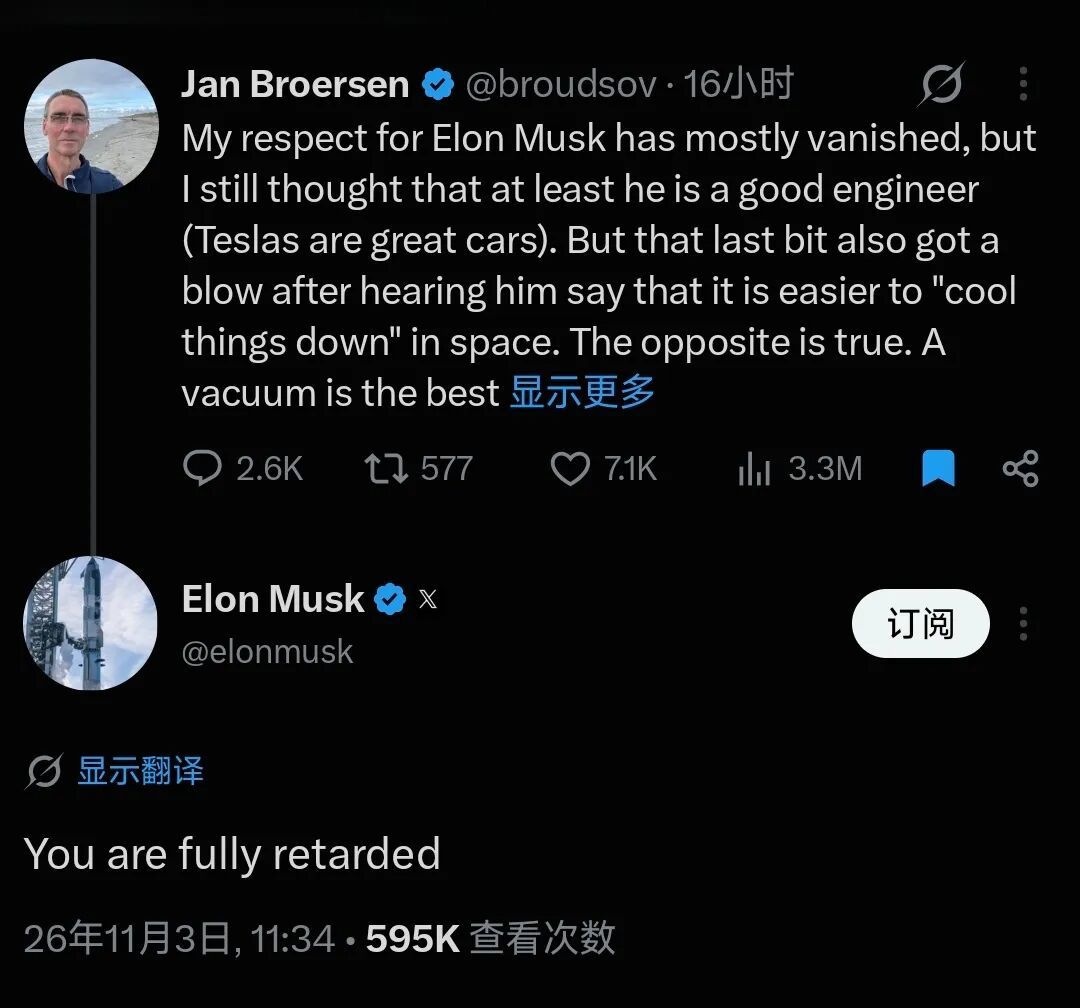
Broersen — who lists himself as a professor of philosophy, logic and AI at Utrecht University in the Netherlands — posted a rejection of the orbital compute idea. The core of it:
“I have lost nearly all of my respect for Elon Musk, but I still thought he was at least a decent engineer (Tesla makes good cars). After hearing him say that ‘cooling things down’ in space is easier, even that last shred of respect has evaporated. The truth is the exact opposite. Vacuum is the best insulator. In space, you can only carry heat away by radiation. These space data centres are extremely unlikely to ever materialise — and certainly not within our lifetimes.”
His post crossed roughly 3.2 million views within a dozen-plus hours, and a lot of the replies had a deliberately “friendly” edge. The counter-reactions arrived fast:
- The engineer's shrug. Tom Mueller, part of SpaceX's early technical core, answered with two words plus an eye-roll: “philosophy professor”.
- The existence proof. James Stephenson replied: “What about your respect for Sundar Pichai? He already has a data centre in space, shedding heat by radiation in vacuum.” He means Google's Project Suncatcher prototype satellite, which has powered a TPU in orbit and returned results.
- The insult. Musk then replied to Broersen directly: “You are a complete moron.” The account Retard Finder — which publicly archives ridiculous online claims and has close to a million followers — answered “Confirmed”.
- The long analysis. Shaun Maguire, a Sequoia Capital partner and Caltech PhD in physics, posted a detailed rebuttal under Broersen's thread, hours after publishing an essay this morning titled “People Don't Understand SpaceX”.

Maguire's argument, compressed: orbital heat rejection is genuinely much harder than ground cooling, but 99.9999% of that difficulty is Starship. If large mass can be lifted cheaply, cooling stops being exotic. The loop can be passive — a light, highly conductive metal panel (aluminium is a good candidate) with a circulating working fluid; ammonia has been the industrial standard for space radiators for decades. Fluid vaporises near the chips, density difference drives circulation, the aluminium pulls heat out of the working fluid, and black-body radiation dumps it into space. Because radiated power rises with the fourth power of temperature, hotter chips and hotter fluid reject heat faster. His verdict: frankly, this system is far simpler than a ground plant.

Musk then backed him on X:
Yes, getting rid of heat in space is much easier. 1,300 watts per square metre is easy for an aluminium radiator pointed away from the Sun, because what it mainly sees is only the cosmic background radiation, roughly 3 degrees above absolute zero! Solar panels generate 250 watts per square metre, so you should expect their area to be about 5 times that of the radiators. Most of a satellite's mass is solar panels.
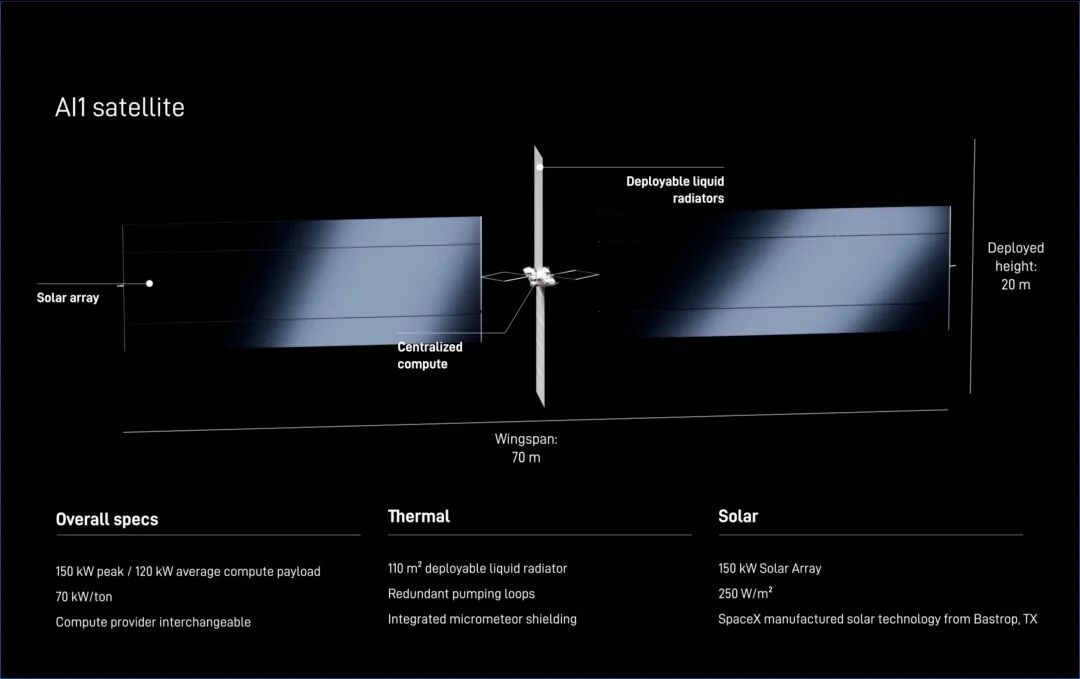
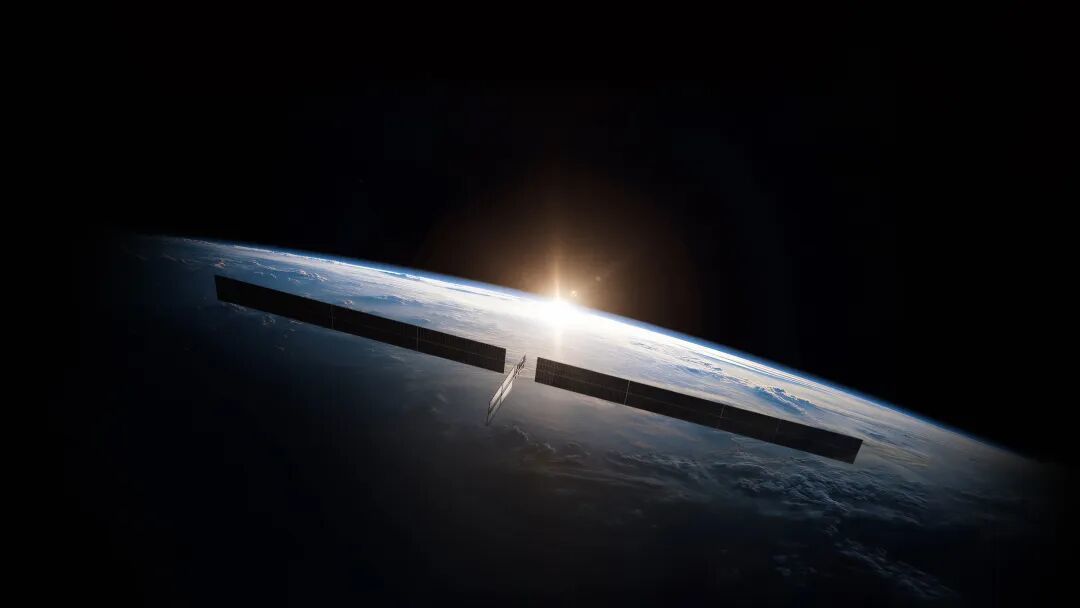
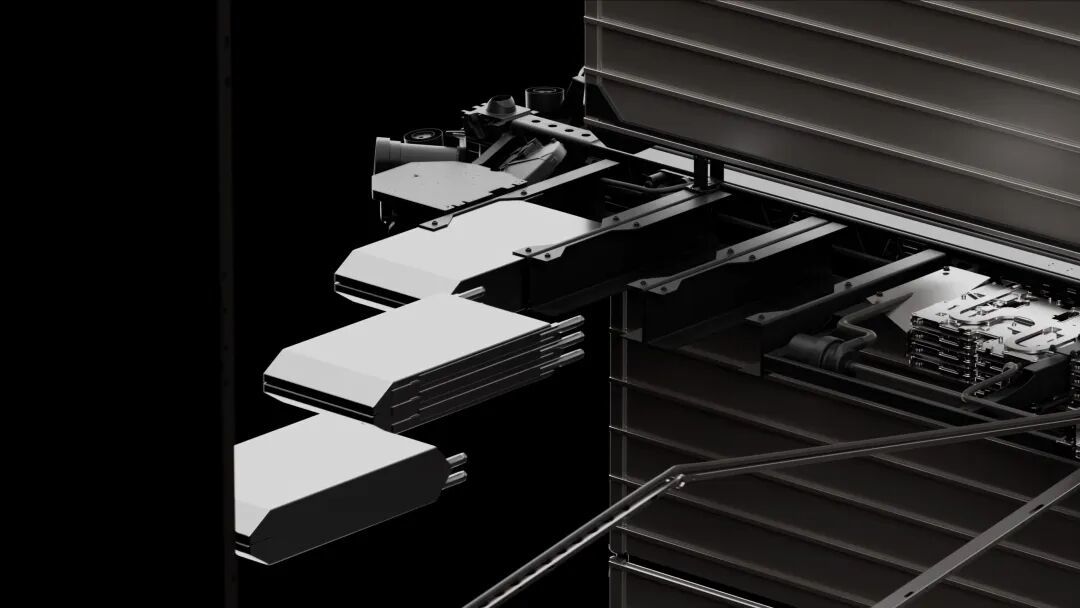
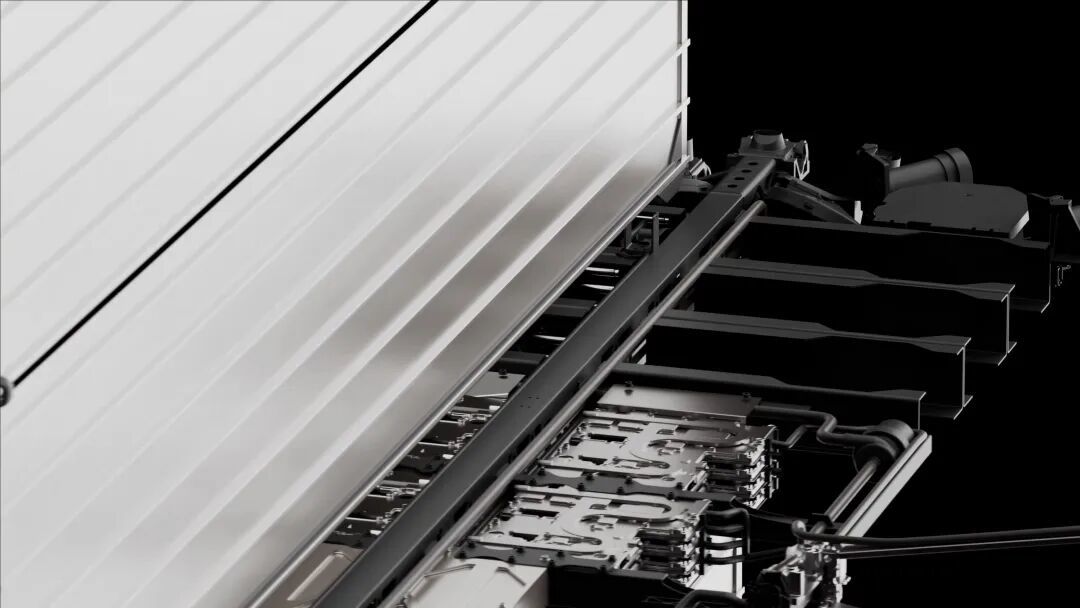
The object under dispute is AI1, the first-generation spacecraft in the Starmind constellation that SpaceX has disclosed. Published specifications show a central compute core, with long narrow strips running from it that are double-sided, liquid-cooled radiator panels, and enormous solar arrays on the wings. Deployed span is around 70 metres, height in the 20-metre class, peak compute roughly 150 kW and sustained roughly 120 kW, with about 110 square metres of deployable radiator area and redundant pump loops.
Step 1 — Separate the physics claim from the cost claim
Every headline in this debate fuses two testable propositions. Sorting them is the first move in any analysis:
| Dimension | Ground data centre | Orbital compute (AI1 / Suncatcher pattern) |
|---|---|---|
| Heat path out | Air and water: fans, chillers, cooling towers, evaporative loss | Infrared radiation only; no convection, no conduction to ambient |
| Cold sink | Local air, river or groundwater; heat island and water stress | Cosmic background at roughly 3 degrees above absolute zero |
| Energy | Grid interconnect, permitting, transformer lead times of years | Continuous sunlight, but panels, batteries and eclipse duty cycles must be launched |
| Scaling unit | Megawatt halls, land, water, chips | Per-satellite mass: radiator area plus solar area dominate |
| Hard constraint | Power and water availability | Launch cost per kilogram and radiator specific power |
| Maturity evidence | Decades of operation | ISS thermal loops at tens of kW; Google Suncatcher at TPU-demonstration scale |
Read the table as a veto test rather than a scoreboard. Broersen's “you can only carry heat away by radiation” is a correct statement of row one, but it does not by itself refute row three and five. Musk's and Maguire's “much easier” is a statement about rows two and six, and it also does not refute the mass problem. The honest claim is the one the thread never quite states: radiative cooling is not forbidden, it is heavy.
Step 2 — Do the radiator arithmetic yourself
You do not need a thermal engineering degree to sanity-check the numbers on the table. Use the constant Stefan–Boltzmann gives you: an ideal black surface at 300 K emits about 459 W/m², and every rise in absolute temperature multiplies output by the fourth power.
- Take the disclosed AI1 heat load: sustained about 120 kW spread over about 110 m² of radiator. That is roughly 1,090 W/m² counted as one face — or roughly 545 W/m² per face if the “double-sided” description means both surfaces contribute. The first case needs a hot radiator and near-ideal emissivity; the second is achievable with conventional high-emissivity coatings at a modest temperature above the set points ground operators like. Both are physically legal.
- Musk's 1,300 W/m² sits at the optimistic end of that range: it implies a radiator surface running well above 100 °C if only one face is counted.
- Check his own ratio: 120 kW sustained divided by 250 W/m² of solar output is about 480 m² of cell area — consistent with his rule of thumb that arrays should be about 5 times the radiator area (5 × 110 m² = 550 m²). When a claim's numbers agree with each other, that is a point for the claim.
Step 3 — Benchmark against hardware that has actually flown
This is the gap most coverage skips: real radiators already exist in orbit, and their measured numbers are the fairest yardstick. The International Space Station's external active thermal control system was designed around six deployed radiator assemblies, each panel in the region of 22.7 m × 3.42 m, feeding two independently pumped anhydrous ammonia loops sized to reject about 70 kW — documented in SAE's 1995 Heat Rejection Subsystem paper (Oren). Engineering reviews of orbital compute cooling put practical flight hardware in the low hundreds of watts per square metre, on the order of 166 W/m² for the station's arrays — a fraction of the 1,300 W/m² figure quoted on X, and a reminder that quoted fluxes describe designs, not demonstrations.
The practical use of this benchmark is simple: whenever a space-cooling claim appears, ask which flown system the stated flux is closer to. If it is several times the ISS figure, the claim depends on a new radiator design or a deliberately hot machine, and that design should be named.
Step 4 — Test the launch-cost threshold, not the slogan
Maguire's “99.9999% of the difficulty is Starship” is the most falsifiable sentence in the whole argument, because launch price is a number that can be tracked. Independent modelling is sobering: an experience-curve study published in PNAS Nexus (Oxford Academic) projects average launch cost falling to roughly US$1,600 per kilogram by 2030 and about US$300 per kilogram by 2040, while several break-even analyses for orbital compute cluster around US$200 per kilogram. Set against a satellite where solar panels and radiators are the majority of mass, that gap is the actual debate. The correct scepticism is not Broersen's (“the physics forbids it”) but a budget question: at what dollars-per-kilogram does a kilogram of radiator beat a kilogram of ground cooling plant, water treatment and grid transformer?
Step 5 — Grade the evidence: a six-point checklist
Before you share any orbital-data-centre claim, run it through this list. Each item has a known answer for at least one of the parties in this dispute.
- Is a hardware demonstrator named? Project Suncatcher's first in-orbit prototype reportedly flies with four TPUs and short, roughly 15-minute compute bursts (Ars Technica, September 2026) — real, but demonstration-scale, and the burst cycle is a thermal and power lesson in itself.
- Are the flux and area conventions stated? Per-square-metre claims change by 2× depending on whether both radiator faces count.
- Is the mass budget published? Radiator plus solar plus structure, in kilograms, per kilowatt of sustained compute.
- Is the launch price assumption explicit? A cost-per-kilogram figure older than a year is usually worthless here.
- Is the radiation environment addressed? Commercial silicon suffers single-event upsets in low orbit; NASA's technical guidance on single-event effects notes that in redundant architectures the system failure rate scales non-linearly with the unit failure rate, so mitigation design belongs in the thermal mass budget.
- Who benefits from the claim? The same group can own the launcher, the satellites and the AI demand. That does not make the engineering false — it makes independent verification conditions essential.
Common misconceptions worth retiring
- “Space is cold, so cooling is free.” There is no air to carry heat away. An unshielded surface in sunlight can run hot while the shaded side dumps heat fast; the cold sink exists, but the pipe to it is radiative area you must build and launch.
- “Vacuum is the best insulator, therefore nothing can cool.” Vacuum insulation works against conduction and convection, which is exactly why the design problem becomes a geometry problem: view factor, emissivity and orientation.
- “Musk answered the physics, so the argument is over.” He answered with boundary conditions, not with test data. Broersen answered with a textbook fact, not with a mass budget. Both skipped the contested layer.
- “If the critics are experts, the idea is dead.” Expert scepticism about current engineering limits is not evidence about the limits of physics — the recyclable-rocket and mass-market-EV record is the counter-example critics keep re-litigating.
The geometry point that sets the tone of the whole exchange: radiators are best presented edge-on to the Sun, radiating from both faces while intercepting as little sunlight as possible and looking out at a background near absolute zero. Ground halls are short of power, water and land; in orbit the Sun is nearly always on and the cold sink is the universe. AI1's architecture is, in plain language, a way of firing surplus heat into the void.
FAQ
Who is actually right about the vacuum?
Both halves are true. Vacuum is an excellent insulator against conduction and convection, and that is precisely why radiation becomes the only exit. Broersen's “you can only carry heat away by radiation” is correct; his conclusion that this makes orbital data centres impossible does not follow on its own.
Is any of this already flying?
At tens-of-kilowatt scale, yes: the ISS thermal loops. At AI-accelerator scale in vacuum, Google's Project Suncatcher prototype has lit a TPU and returned results in orbit — a demonstration, not a data centre.
What would change the verdict most quickly?
Two numbers: a measured radiator flux from a deployed test article, and a repeatable cost per kilogram to orbit inside the US$200–US$300 band the break-even models use.
Which workloads would move to orbit first?
The ones that do not care about round-trip latency. Inter-satellite laser links currently operate in the single-digit to 100 Gbps class but still depend on ground-station access, so batch training-adjacent jobs, space-derived data pipelines and archive or resilience-critical storage are the logical first tenants; interactive inference is the last.
Your action list for the next 90 days
- Do not re-plan power strategy on this story. Treat orbital compute as a 2030s option; ground constraints — grid, water, permitting — stay the binding ones.
- Build your own watchlist: AI1 and Starmind publication updates, Suncatcher test reports after the October 2026 prototype flight, and quarterly launch pricing.
- Adopt the veto test. When a vendor cites per-square-metre heat rejection, ask for the face convention, the emissivity, the temperature and the flown demonstration. Refusing to answer three of those four is your answer.
- Track the mass budget. Radiator square metres per kilowatt is a cleaner metric than the word “easy”, because it converts directly into launch cost.
- Keep the two arguments apart in your own writing. Say “the physics is settled, the economics is not”, rather than picking a side in a shouting match.
Where this lands
The useful takeaway from the Musk–Broersen exchange is not a winner. It is that a philosophical intuition (“vacuum insulates”) and an engineering boundary condition (“cheap mass plus a big, hot, well-pointed radiator”) are talking past each other, and the only referee is hardware and pricing. If Starship delivers what Maguire credits it with, orbital cooling stops being a good move played on an existing board and becomes an entirely new piece minted onto it. Until then, a checklist is worth more than either insult.
Corrections and story tips: contact@itinsights.com — the ItInsightsWorld General desk publishes a new plain-language decision framework every week.