
After the Melbourne Delivery Rider Killing: A Practical Safety Guide for Riders and Readers
By James Hartley, ItInsightsWorld
A practical takeaway from the Melbourne delivery rider killing: riders should treat personal safety as the first delivery priority, pause work in risky situations, contact 000, and rely on police updates rather than social-media claims. Victoria Police said two delivery riders were involved in a three-party conflict, one man died and the other was injured, and a 51-year-old man was arrested on the morning of November 7 in Footscray.
What the case actually says: a bicycle dispute, one death and one injury
At its simplest, the incident was a case that produced one death and one injury after a short street dispute turned violent. Victoria Police said two delivery riders encountered one man they did not know while he appeared to be tampering with their bicycles in the Melbourne city centre area. The encounter escalated into a three-party physical conflict on the evening of Friday, November 6. One of them was killed at the scene, while the other rider was taken to hospital with injuries that were described as not life-threatening.
A police media release, as quoted by local reporting, said detectives understood that two men believed to be delivery riders had observed another man interfering with bikes on Frederick Way. The Age reported that the fatal attack occurred while the rider was working in central Melbourne. The point is not to infer motive from social posts, but to separate confirmed facts from rumours: police have described one case, two riders, one suspect arrest, and one death.
Police timeline: what is confirmed as of November 7
The clearest action point came on the morning of November 7. Victoria Police said officers from the homicide squad arrested a 51-year-old man in Footscray, in Victoria state. The man remained in custody and was expected to be questioned. Police also stated that no other suspects were being sought. The update gave the public a narrower picture than many early posts did: the emergency call was tied to the Melbourne city centre incident around 8 p.m., and the arrest followed the next morning.
For readers, this timeline matters because it tells people what to treat as settled. A police arrest is not a court finding. The case remains under investigation, so statements about intent, personal background, or the exact cause of the dispute should be read cautiously until official records confirm them. The confirmed public facts are still enough to shape safer behaviour: a brief confrontation over bicycles may have become lethal.
Platform response: what HungryPanda said riders should do
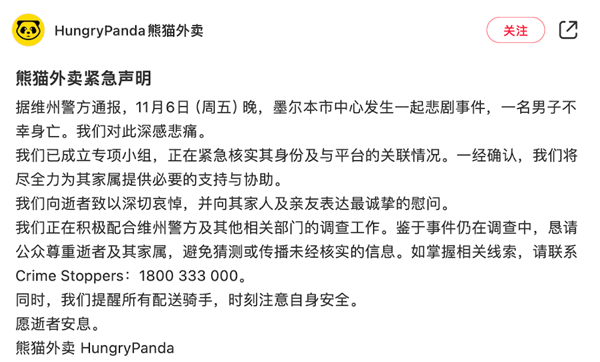
Panda Delivery, also known as HungryPanda, issued a statement after the police update. It said it had created a dedicated team to confirm the person's identity and connection to the platform, and that it would provide necessary support to the family once confirmed. It also expressed condolences to the bereaved family and friends, and said it was cooperating with the investigation by Victoria state police.
The most useful operational detail for riders came from the platform's rider notice. It emphasised that rider safety is ahead of orders. The company said it never requires riders to chase or confront anyone to recover an order. If a rider feels unsafe, the instruction is to stop delivery, leave the scene, and call 000. The notice also said that food loss caused by theft, robbery, or safety reasons should not be borne by riders, and orders not completed for safety reasons should not result in deductions or punishment. The platform's rider safety page can be checked through the HungryPanda riders safety statement.
Consular support and privacy
The Consulate General of China in Melbourne said it had contacted the bereaved family, expressed condolences, and was working with relevant parties to facilitate follow-up arrangements. The consulate also said it would continue communicating with local authorities and assist in handling post-incident matters. For readers, that is a practical point: consular contact is part of crisis support, but family privacy still matters. Information should come through official channels when it concerns identity, legal status, or cause of death.
Step-by-step guide for riders in a similar situation
The case does not prove that every bicycle dispute will become violent, but it shows how quickly a low-level roadside problem can become dangerous. A practical guide for riders should move from preparation to action.
- Before the shift: check that your bicycle, phone, power bank, lights, and work bag are secure. Note the safest route and avoid shortcuts through poorly lit or isolated streets if an alternative is available.
- When you see tampering: create distance. Take a photo or video only if it does not require standing close to the person. Do not assume a verbal exchange will be safe if the other person is agitated or the situation is dark and uncrowded.
- During an approaching conflict: back away, keep your hands visible, and speak in short, nonprovocative sentences. If the other person becomes threatening, leave the scene immediately.
- After disengaging: call 000 if you believe there is a risk of violence, then notify the platform. Keep your own injury, damage, and order details simple and factual.
- For follow-up: ask about insurance, incident reporting, and support for injured riders. If needed, contact a community legal service or local support group before making public statements.
Common misconceptions readers should avoid
A general-news incident can spread quickly when readers fill missing details with assumptions. The table below is a practical correction tool, not a legal summary.
| Common misconception | What is safer to assume | What to do instead |
|---|---|---|
| If a rider sees a bike being moved, they must recover it to avoid a penalty. | Personal safety should outrank order recovery. The platform notice says riders are not required to chase or confront anyone. | Leave, call police if needed, and report the incident through the rider app or support channel. |
| Social-media descriptions of the suspect, motive, or victim identity are reliable. | Police and court records move more slowly and are more reliable than crowd speculation. | Share only official updates and avoid naming unconfirmed individuals. |
| The arrest closes the story. | An arrest confirms custody, not guilt or full context. | Follow later police or legal updates before drawing conclusions. |
| Delivery safety is only a personal responsibility. | Platforms, employers, customers, and city services all shape the risk environment. | Use company rules, emergency numbers, route planning, and respectful customer behaviour together. |
What riders, platforms and customers can do next
The practical response should be divided by role. Riders control immediate behaviour, platforms control incentives and reporting, and customers control social pressure around late-night or high-risk deliveries.
| Role | Immediate action | Longer-term practice |
|---|---|---|
| Rider | Stop, leave, call 000, then notify the platform. Do not escalate to protect an order. | Build a personal safety checklist: route, lighting, communication, backup power, and a trusted contact after late shifts. |
| Platform | Confirm whether the rider is connected, support the family, and cooperate with police. Repeat no-confrontation guidance. | Make reporting channels simple, clarify safety exceptions to fines, and review night delivery practices in dense city zones. |
| Customer | Do not pressure riders for speed or confrontation over missing items. | Support clear refund paths for theft-related losses and choose pickup when a delivery zone feels unsafe. |
Platform background: why this case touches a broad service network
Public information about the platform helps readers understand why a local Melbourne incident can have wide relevance. HungryPanda Panda Delivery was established by HUNGRYPANDA LTD in 2017 in Nottingham, United Kingdom. It operates as a Chinese food delivery platform, with services extending to fresh-grocery delivery and lifestyle services. Its footprint is not limited to one city: it has expanded across 10 countries and more than 100 cities, including the United Kingdom, France, Italy, the United States, Canada, Australia, New Zealand, Japan, South Korea and Singapore.
That scale matters for the General reader because it means safety lessons are not isolated. A rider dispute in Melbourne can affect expectations in many markets where workers use bicycles, late-night hours, app-based dispatch, and customer ratings. The practical question is not only what happened, but how platforms design rules that reduce the chance that a minor roadside problem becomes a life-threatening one.
FAQ: practical answers about safety, fines and information
Is the Melbourne delivery rider case solved?
Police said one 51-year-old man was arrested and no other suspects were being sought. That is a major update, but it is not a final verdict. Readers should treat the investigation as ongoing until court or police records say otherwise.
What should a rider do first if they feel unsafe?
Leave the scene first. The practical sequence is distance, safety, emergency contact, and then reporting. If violence is likely or has started, call 000 before discussing order details.
Can riders refuse to chase a thief or confront a stranger?
Yes. According to the platform notice summarised above, the company says it never requires riders to chase or confront anyone to recover an order. Riders should not put their body in harm's way to protect a food package.
Should riders worry about fines for unfinished safety-based stops?
The platform notice also states that losses from theft, robbery, or safety reasons should not be borne by riders, and that orders not completed for safety reasons should not lead to deductions or punishment. Riders should still document the incident promptly and follow official reporting channels.
What can customers do without overreacting?
Be realistic and respectful. Do not demand that riders solve disputes, recover missing items, or work through unsafe situations for a late order. If a delivery fails because of safety, use normal refund or support channels rather than pressure.
Final action advice: what readers should keep in mind
The most useful lesson from the Melbourne case is simple: a delivery rider's body is not a backup for a lost order. Victoria Police confirmed a tragic chain in which two riders, one stranger, a bicycle dispute, and a physical confrontation turned into one death and one injury. The arrest of a 51-year-old man gave the investigation a clear lead, while the platform and the Consulate General of China in Melbourne pointed to support, family contact, and official follow-up.
For ItInsightsWorld readers, the practical takeaway is to build a small safety framework: trust confirmed police updates, leave dangerous confrontations, use emergency services, and expect platforms to protect workers when the order itself is not worth risking life. That framework can be used by riders, customers, and anyone following gig-work safety beyond this one case.