
Marvell and Lumentum at $115 billion: Your Top AI Connectivity Questions Answered
Lead with the conclusion: two companies that shuttle data between AI processors have agreed to become one. Marvell, the chip designer Jensen Huang has called the next trillion-dollar company, is acquiring optical component maker Lumentum in an all-stock deal valued at $115 billion. This is not purely a Wall Street story. It settles who controls the plumbing that lets thousands of AI chips behave like a single machine — and plumbing is where data center budgets increasingly leak.
Whenever a transaction this large lands, the same handful of questions reaches our desk at ItInsightsWorld. The answers below are ordered the way a non-specialist actually decides: what is being paid, why it matters, whom it challenges, what could go wrong, and what to watch next.
Question 1: what is being paid, and in what currency?
No cash changes hands. Under the merger terms, Lumentum shareholders receive 4.5 Marvell shares for every Lumentum share they own — an implied $1,132 per share, about 23.9% above Lumentum's Oct. 28 close (MarketWatch, with the filing summarised on StockTitan). After closing, existing Marvell holders would own roughly 67% of the combined company on a fully diluted basis and Lumentum holders about 33%, per Marvell's own investor release, which expects completion in the first half of calendar year 2028, subject to shareholder votes and regulatory approval.
Two consequences follow immediately. A $115 billion headline is really an equity decision: the visible cost is dilution for Marvell shareholders rather than drained cash reserves. And a 2028 finish line places the payoff in the next AI hardware cycle, so any verdict reached this quarter is premature.
Question 2: why should a silicon company care about light?
Because copper is running out of room. Inside a server, data travels as electrons; between racks and across campuses it must be converted into light, carried down fibre and converted back. Every conversion adds latency, burns power and creates another part that can fail. At cluster scale, the connectivity layer can rival the accelerators themselves for electricity.
Vendors have begun publishing what that is worth. Nvidia's co-packaged-optics switches, introduced in March 2025, are claimed to deliver 3.5x better power efficiency while using 4x fewer lasers than designs built around pluggable transceivers (nvidianews.nvidia.com).
Matt Murphy, chairman and CEO of Marvell, framed the moment this way: "AI infrastructure is undergoing a fundamental architectural shift toward optical connectivity, creating an opportunity that comes along once in a generation," he said. "We intend to help shape the next era of AI connectivity," he added.
Industry watchers have pointed to deals like this since the early 2020s, arguing that electrical and optical technologies have to be co-designed rather than stitched together late in the process. Their reading: a giant bet that the next generation of AI data will mostly run on light, not copper.
Question 3: what does each side actually bring to the merged signal chain?
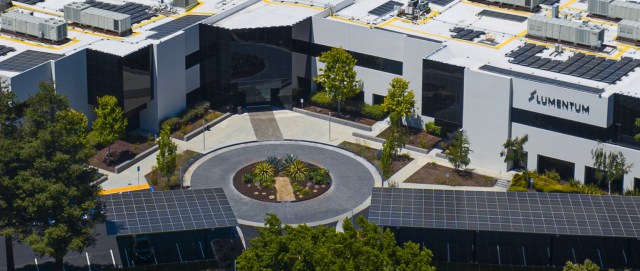 Lumentum supplies high-performance lasers, optical transceivers and optical circuit-switching capability for AI connectivity products. (Source: Lumentum)
| Stage of the signal path | What Marvell holds today | What Lumentum adds | Why the pairing matters |
|---|---|---|---|
| Silicon | Electrical and optical interconnects, network switching, XPU attach, custom accelerators | — | Network processors can be co-designed alongside lasers rather than adapted to them |
| Light source | DSPs that sit inside data center optical transceivers | High-performance lasers that generate the light | Both halves of one link planned together, cutting latency and power draw |
| Switching | Electrical packet switching silicon | Optical circuit switches that redirect light without electrical conversion | Conversion steps disappear from AI fabrics |
| Manufacturing | Merchant silicon model | Specialised compound semiconductor process technology, including indium phosphide (InP), from San Jose, California | Greater control over a constrained part of the AI networking value chain |
| Next design step | Marvell recently acquired Celestial AI to bolster its optical interconnect offerings | Lasers that are a critical building block in near-packaged optics (NPO) and co-packaged optics (CPO) | Two routes toward pulling optics closer to compute |
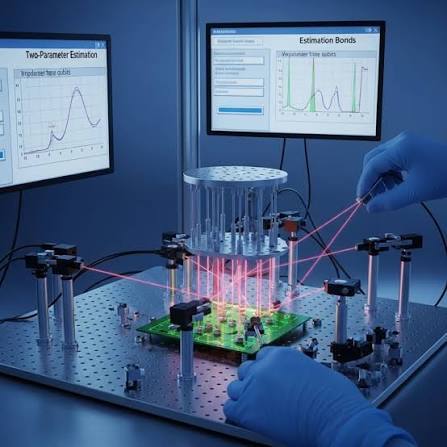 The acquired portfolio covers semiconductor lasers, laser sub-assemblies and wavelength management systems. (Source: Lumentum)
In cloud computing, the hand-off between silicon-based NICs and laser-driven transceivers is the connectivity bottleneck. Closing that gap means owning the whole chain — silicon, lasers, packaging, power efficiency — instead of negotiating across three suppliers at a time.
Question 4: whom is this aimed at, and where does Nvidia fit?
Bringing two AI connectivity suppliers under one roof creates a more vertically integrated AI networking portfolio and lets Marvell compete more aggressively with Broadcom, because influence over a scarce link in the chain widens the base on which it can compete.
Nvidia backs both companies and invested $2 billion each in Marvell and Lumentum earlier this year — a fact worth stating plainly. Murphy calls the transaction a double down on supporting Nvidia, and dismissed concerns about Nvidia's circular dealmaking: "I think having two of the key suppliers come together, that support that ecosystem, is going to be a big benefit for Nvidia," he said.
Question 5: if the logic is that clean, why did the shares fall?
Even though the combination makes business sense, both companies' shares dropped after the announcement. It ranks among the largest takeovers the semiconductor industry has seen, and the news landed after a week of bruising tech sell-off, with investors growing skittish about AI economics.
Axel Rudolph, chief technical analyst at IG Group, told Reuters this is an enormous bet, and that investors are right to ask whether Marvell is paying too much and taking on too much at once. The other side of the ledger is demand: Lumentum CEO Michael Hurlston points to a $550 billion market opportunity in optical connectivity.
Third-party research supports that direction of travel without settling the price question. IDTechEx projects the co-packaged optics market to exceed $20 billion by 2036, expanding at a 37% compound annual rate from 2026 (idtechex.com). Cignal AI expects optical circuit switching alone to reach at least $2.5 billion by 2029 (Fierce Network). Supply is already tight: 800G transceiver module lead times ran 36 to 50 weeks during 2026 (Supply Chain Connect), and TrendForce has tied AI data center buildouts to a wave of laser shortages.
Four misconceptions worth dropping
- Marvell wrote a very large cheque. It issued shares instead. The real cost to Marvell owners is roughly one third of the combined company going to Lumentum holders.
- Optics will replace copper outright. Copper keeps doing the short hops inside boards and racks; photonics wins wherever distance, heat and bandwidth bite.
- The deal is done. It is signed, not closed. Shareholder and regulatory approvals still have to arrive before the 2028 completion window.
- This is only about faster chips. The contested prize is the connectivity layer behind every accelerator roadmap, sized by Michael Hurlston at $550 billion.
Checklist: what to watch before the deal closes
- Vote outcomes at both companies, plus any regulatory conditions bolted on.
- Post-close guidance showing how much of the $550 billion ambition becomes booked revenue and margin.
- Laser and transceiver supply health — backlog, lead times, pricing — since Marvell now owns part of its own bottleneck.
- Design wins for NPO and CPO at hyperscale customers, which decide whether co-packaging goes mainstream or stays a niche.
- Broadcom's counter-moves on optics and custom accelerators.
- Whether the combined firm stays a merchant supplier open to all buyers, as analysts at TechTarget have questioned, or drifts toward a Nvidia-centred customer list.
Quick FAQ
Is this a cash acquisition?
No. It is all-stock, carrying an enterprise value of $115 billion including debt.
When should I expect it to be finished?
The companies guide to the first half of calendar year 2028, conditional on approvals — so plan on reading progress reports, not results.
Will this make my cloud bill cheaper?
Not directly, and not this year. Networking is a meaningful share of an AI facility's power draw, so tighter electrical-optical co-design should lower energy per unit of data over several generations of hardware.
Do other buyers lose access to Lumentum parts?
Nothing announced turns Lumentum's components into an exclusive supply on day one; integration advantage shows up across design cycles and roadmaps rather than a single contract clause.
Is this Marvell's first move in photonics?
No. Marvell recently acquired Celestial AI to bolster its optical interconnect offerings; Lumentum adds the laser and manufacturing layer that sits underneath.
Action advice, by reader type
If you hold the stock
Track dilution against disclosed synergy targets rather than headline valuation, and judge the position on the 2028 design cycle the deal is built for.
If you buy or operate AI infrastructure
Move optics onto the procurement agenda: ask suppliers for power per bit and an NPO/CPO roadmap, and secure long-lead laser and transceiver supply before quoting project dates.
If you simply follow the sector
Treat the shift from copper to light as the defining infrastructure storyline of the next cycle — the label Jensen Huang applies, the next trillion-dollar company, depends on owning the plumbing, not just the processors.
The bottom line
Marvell is not buying a product line; it is buying its own supply chain's hardest constraint and hoping to design around it faster than rivals can. The strategic case is coherent, the pricing is contestable, and the timing — announced into a nervous tape, closing years out — means the honest answer today is "watch the approvals, then the design wins."
Briefing prepared by James Hartley, IT Insights, for ItInsightsWorld readers. For questions about a follow-up on this topic, reach the team at contact@itinsights.com.