
Martech 2030 at Halftime: A Scorecard of Five Predictions and What to Do in 2026
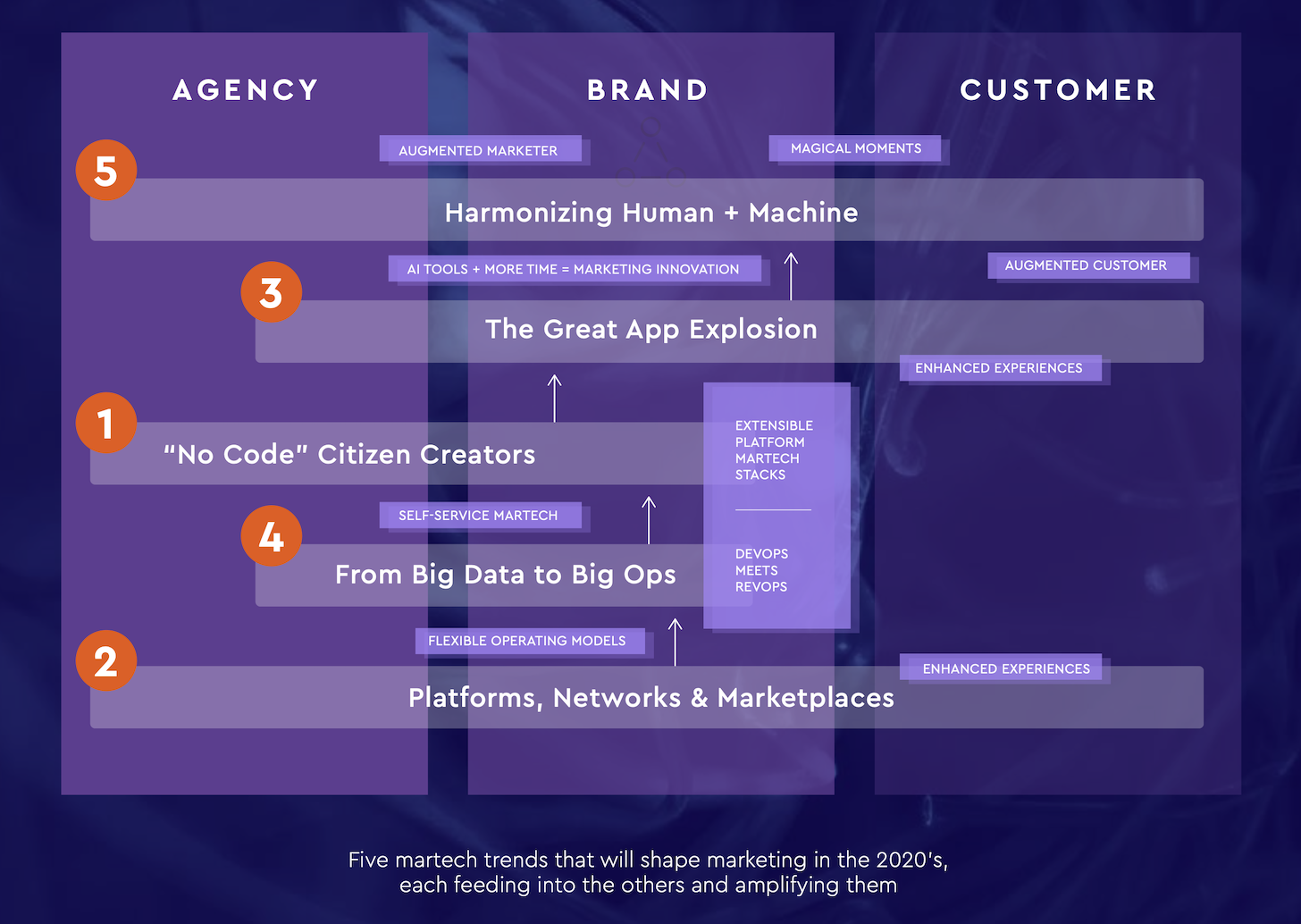
Short answer: most of the 2020 forecast held, and the parts that did not are now the honest to-do list. Five years ago, Jason Baldwin and Scott Brinker published Martech 2030, mapping five major trends for what they called The Decade of the Augmented Marketer. Re-read at the start of 2026, the paper looks strongest on machine-assisted creation and buyer-side AI, and weakest on orchestration and governance — the two areas where most marketing teams are still improvising.
The re-read is worth your attention for a practical reason: budgets assume these shifts are already mature. MarketsandMarkets, in a press release issued in March 2025, forecasts the global MarTech market expanding from USD 175.95 billion in 2025 to USD 296.88 billion by 2030, an 11.0% compound annual rate. When a category is expected to grow by more than 60% in five years, the useful question for a general reader is not “is AI real?” but “which of these predictions can I build on, and which is still a promise?”
Who graded the predictions, and how far can you trust that grading?
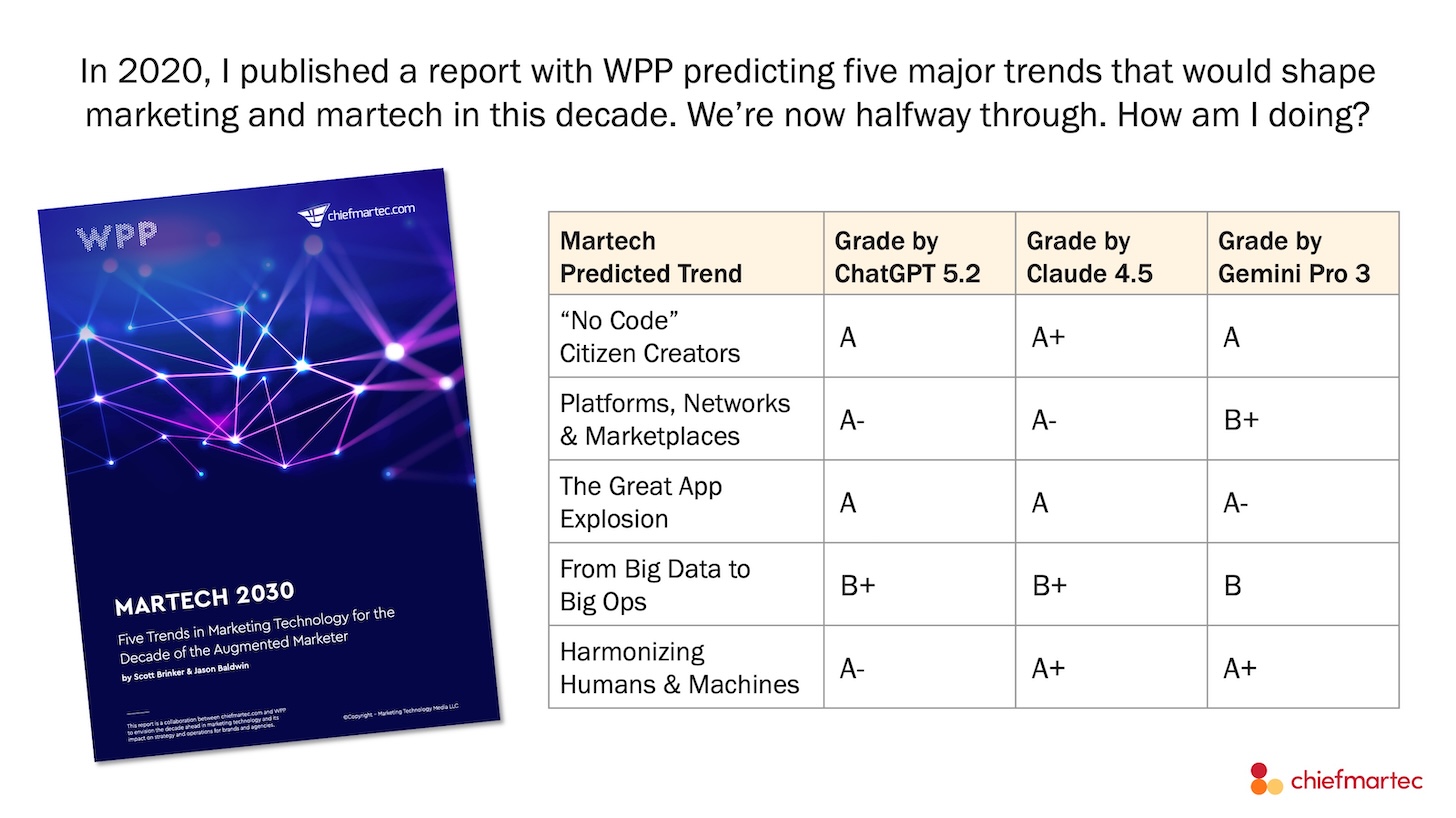
Conclusion first: treat the marks as a summary signal, not an audit. At the start of 2026 the report's authors asked ChatGPT, Claude and Gemini to score how well each forecast had aged. The automated assessments were generous, most of all on the vision of “harmonizing humans & machines.” Claude and Gemini handed back A+’s on that one — a result worth a chuckle precisely because the graders and the graded share the same ancestry of ideas.
The authors' own caveat survives the rewrite: you are the real judge, measured against your lived working reality. The table below therefore reframes Trend #1 through Trend #5 as a buyer's comparison — claim, evidence, and the decision each one implies for a team without a dedicated platform-engineering function.
| Prediction | What the 2020 report claimed | What the 2026 evidence shows | Verdict in the review | What to change in your stack |
|---|---|---|---|---|
| Trend #1 — “No Code” citizen creators | Marketers self-build databases, sites and automations | Unlocked by generative AI rather than drag-and-drop; controls lag | “We nailed this one” | Fund guardrails alongside licences |
| Trend #2 — Platforms, networks and marketplaces | Graphs and ecosystems displace linear value chains | Ecosystems beat the old suite-versus-best-of-breed argument; many firms still stall | A-/B+ | Buy through marketplaces and data layers |
| Trend #3 — The Great App Explosion | Tool counts keep climbing, then custom apps dwarf them | Tool count nearly doubled; the custom hypertail is early but live | Delivered; hypertail still ahead | Separate “buy” from “generate” in the roadmap |
| Trend #4 — From Big Data to Big Ops | Operating parallel apps and agents becomes the hard part | Problem confirmed; tooling and org design unfinished | B/B+ | You are buying a roadmap, not a capability |
| Trend #5 — Harmonizing humans and machines | Automation frees time for customers and creativity | Now common sense; buyer-side AI arrived, but checkout autonomy lags | A+’s | Optimise to be cited by assistants first |
Trend #1: Did the “No Code” citizen-creator bet pay off?
Verdict: yes, and partly by accident. Back in the previous decade the thesis was that no-code platforms would let marketers implement their own digital ideas without waiting on a development queue. Airtable, Webflow and Zapier served as the standing examples for databases, websites and workflow automation; Gartner named that population citizen creators, while the report preferred “marketing makers,” the builders inside go-to-market. The forecast was more of them, wielding more power. They arrived faster than anyone wrote down, because of the generative AI explosion that started in late 2022.
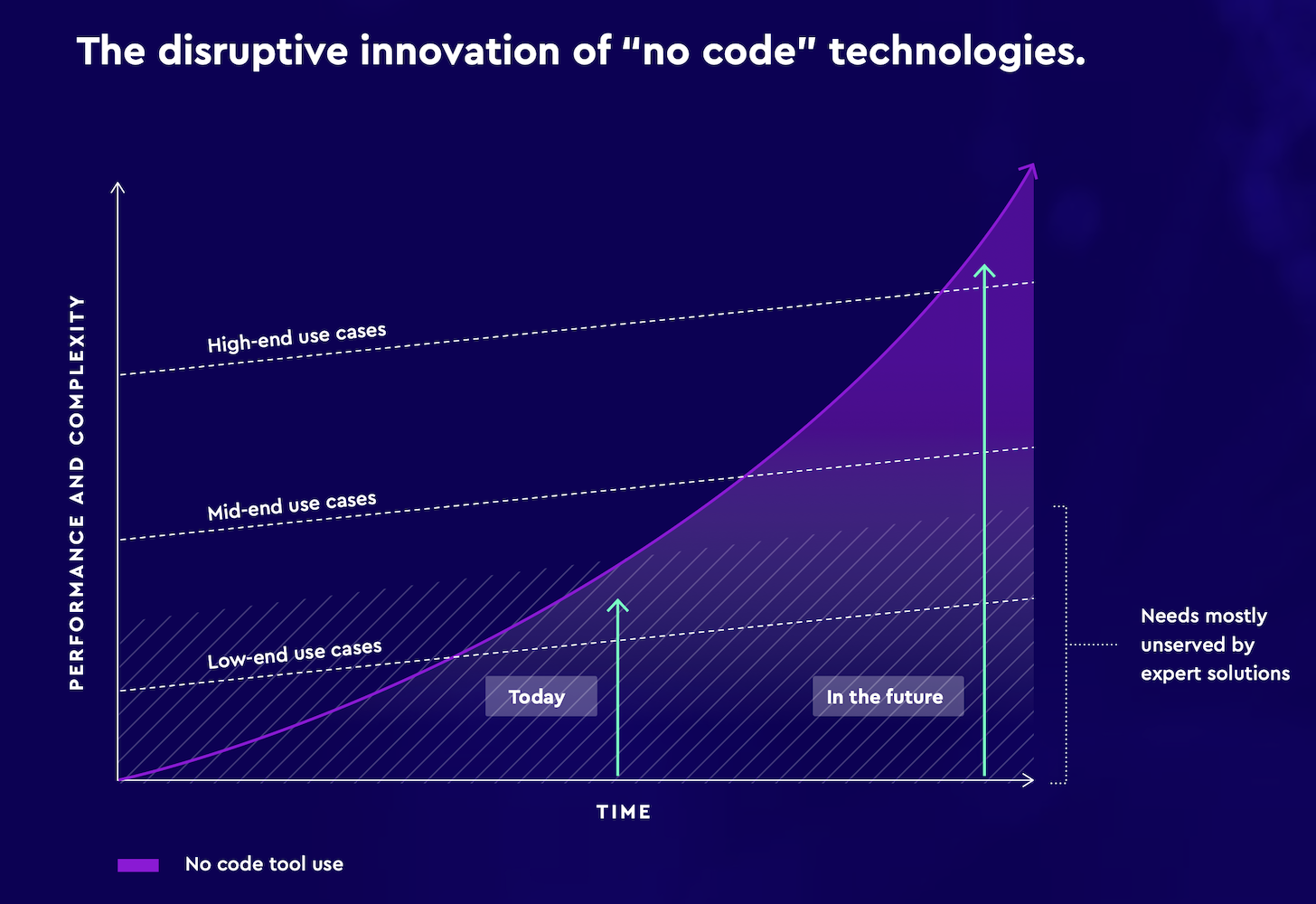
Before that shift, no code meant mostly drag-and-drop. Large language models swapped the palette for a prompt: describe the thing and the system drafts it. Early results were text and anatomically confident images — six fingers, still paging Inigo Montoya. Over the past two years the same capability extended to apps, agents, videos, infographics, workflows, campaigns, data analyses and PowerPoint decks. It remains a jagged frontier, but “quite good” is now a fair description of much of that output.
As Andrej Karpathy said, “The hottest new programming language is English.” In 2025 the vibe coding phenomenon, a term coined by Karpathy, pushed this into hyperdrive: non-engineers found it shockingly easy to create apps and agents through Bolt, Lovable, Replit and Vercel. That worked best on relatively basic use cases — and those underserved, unglamorous jobs are exactly what Clay Christensen identified as the launchpad of disruptive innovation. For the graduated version of that argument, the authors' Lemkin Scale of Vibe Coding is the practical reference point.
The adoption numbers point the same way. Gartner's low-code outlook, released in December 2022 and still cited throughout 2026 industry roundups, expected at least 80% of low-code tool users to sit outside formal IT by 2026, up from roughly 60% in 2021. That is a permanent redistribution of who builds, not a temporary workaround for backlog.
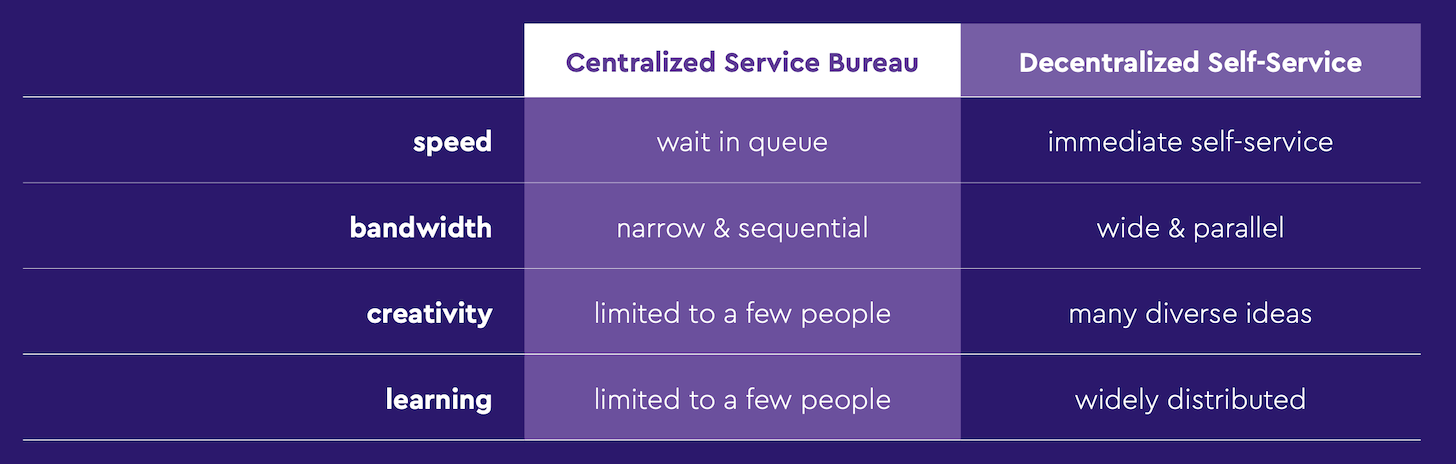
Read one level up, major assistants such as ChatGPT, Claude and Gemini now function as über no code platforms, generating a widening range of digital assets on demand. Teams that leaned in collected the returns: greater speed, bandwidth, creativity and the compounding learning that comes from decentralised self-service.
The unfinished half is control, and it is now measurable rather than theoretical. Security analyses of AI-built applications — Cycode's 2026 review of vibe coding is typical — group the recurring failures into insecure code patterns, exposed secrets, hallucinated dependencies and weak authentication. Governance checklists aimed at IT leaders converge on the same starting controls: an inventory of who built what, a named owner per asset, data classification, identity management and audit trails. The report flagged this gap early, which is why it circles back with Trend #4 about Big Ops.
Trend #2: Suites, best-of-breed or ecosystems — which structure wins?
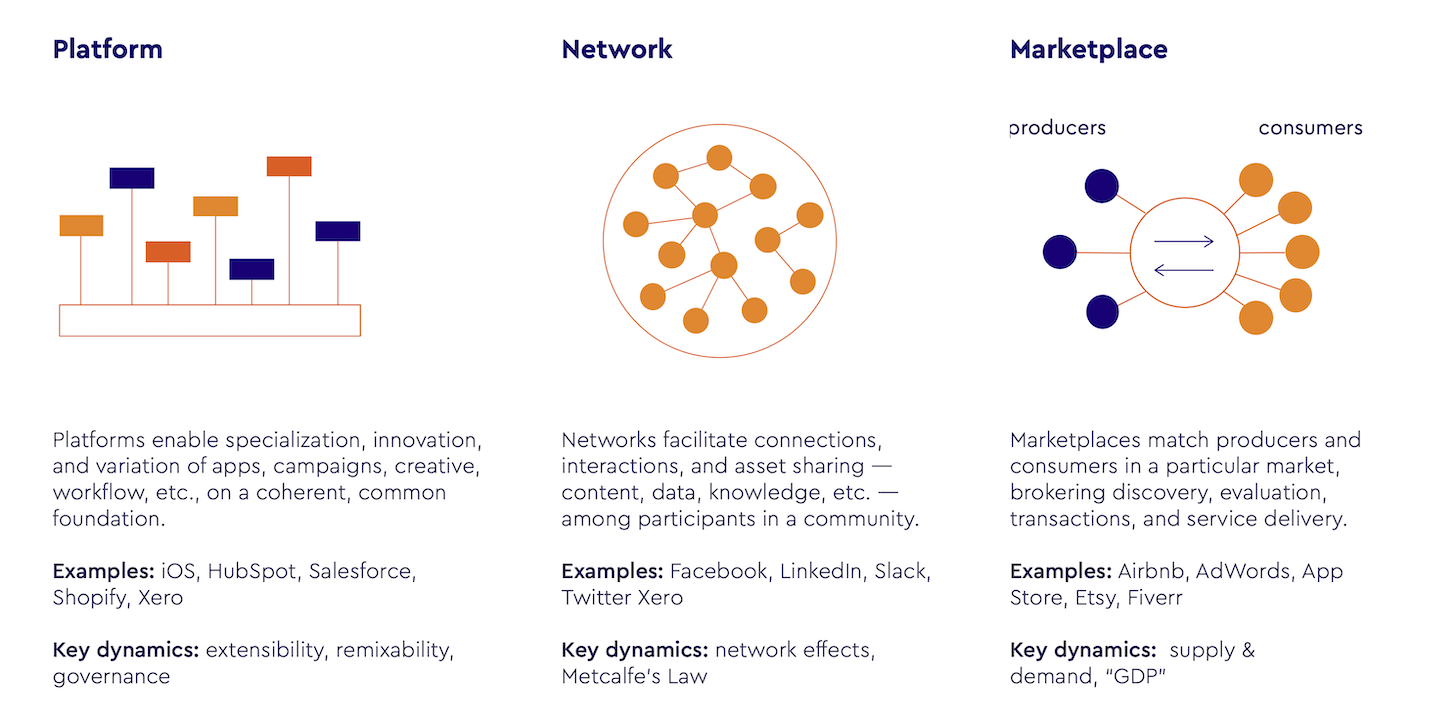
Verdict: directionally right, operationally incomplete — hence an A-/B+. If the prior decades were about firms optimising linear chains — value chains, supply chains, distribution chains — the expectation was that business structure and strategy would increasingly be driven by interconnected graphs and ecosystems built from platforms, networks and marketplaces. In martech, platform ecosystems have fully supplanted the old suite-versus-best-of-breed dichotomy, which is why that framing now reads like a museum label in vendor briefings.
The claim carries an unusually direct vantage point: Brinker helped drive this shift as VP platform ecosystem of HubSpot, a role he left this past September after 8 years of building the company's ISV programme from the ground up.
Two of the hottest platforms today are Databricks and Snowflake, acting as universal data layers that integrate across heterogeneous technology stacks. The most intriguing platform candidates headed into 2026, though, are the major AI engines themselves, with MCP connectors and the emerging concept of ChatGPT Apps turning assistants into distribution channels in their own right.
Networks were already ubiquitous and have grown more so. Digital marketplaces proliferated, and the most noteworthy in martech are the hyperscalers: AWS Marketplace, Google Cloud Marketplace and Microsoft Marketplace now transact an estimated $45 billion in annual enterprise software sales, and Adobe, HubSpot and Salesforce all sell through that channel.
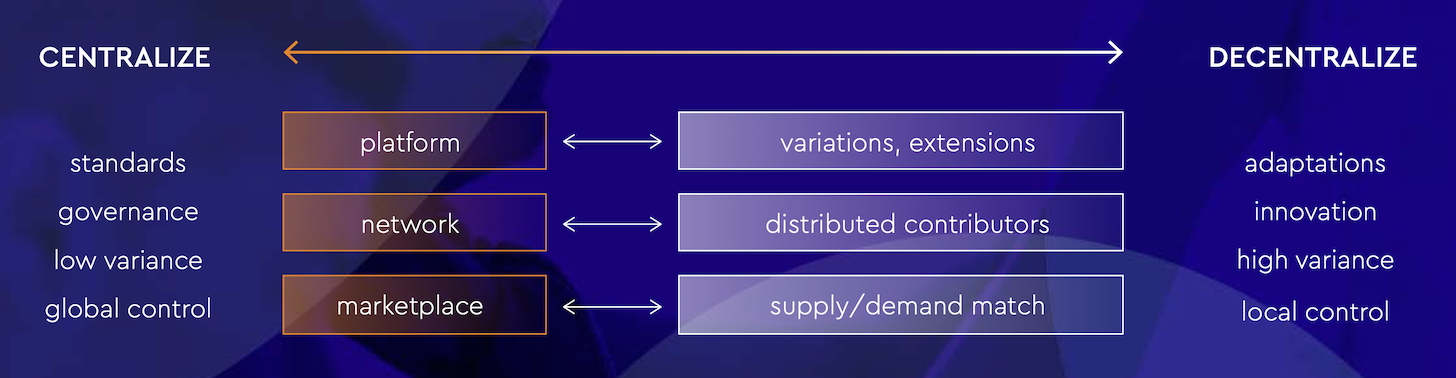
The balancing act that confuses newcomers: these ecosystem mechanisms drive decentralised growth and innovation through the centralised control of standards and governance, but only when paired with technical and philosophical openness. You centralize to decentralize. It is a bit of a Zen koan for the digital age — and it explains the modest grade. Ecosystem dynamics are still new for many companies, which prefer the control, or at least the illusion of control, offered by direct, linear go-to-market strategies. The authors double down: ecosystems, and the platforms, networks and marketplaces that animate them, will underpin marketing by the end of this decade.
- Choose the ecosystem route when your differentiation comes from combining data across tools, your buying committee is distributed, and you can live with vendor overlap.
- Choose the linear route when a single workflow defines your category, compliance requires one throat to choke, and your team can absorb integration work.
- Do both deliberately: centralise identity, data contracts and review; decentralise use-case building inside those rails.
Trend #3: Why did the app explosion double instead of consolidating?
Verdict: the visible half arrived; the spectacular half is still building. The 2020 martech landscape held 8,000 solutions when the report was written, and, as part of an annual tradition, most observers assumed that was “peak martech.” Here we are with nearly twice as many: 15,384 commercial solutions on the map in 2025.
Consolidation has never stopped — it runs continuously through competition and M&A. But software has effectively no barriers to entry, a condition AI has dialed up to 11, so new products arrive faster than old ones drain out. Ironically, the consolidation of hyperscaler cloud infrastructure and major app platforms spurred the blossoming of thousands of specialist apps built on those foundations. Those apps are the loooooooong tail of the landscape: vertical market apps, regional apps, ecosystem apps, service provider apps, and an unending tide of startups aspiring to disrupt the incumbents.
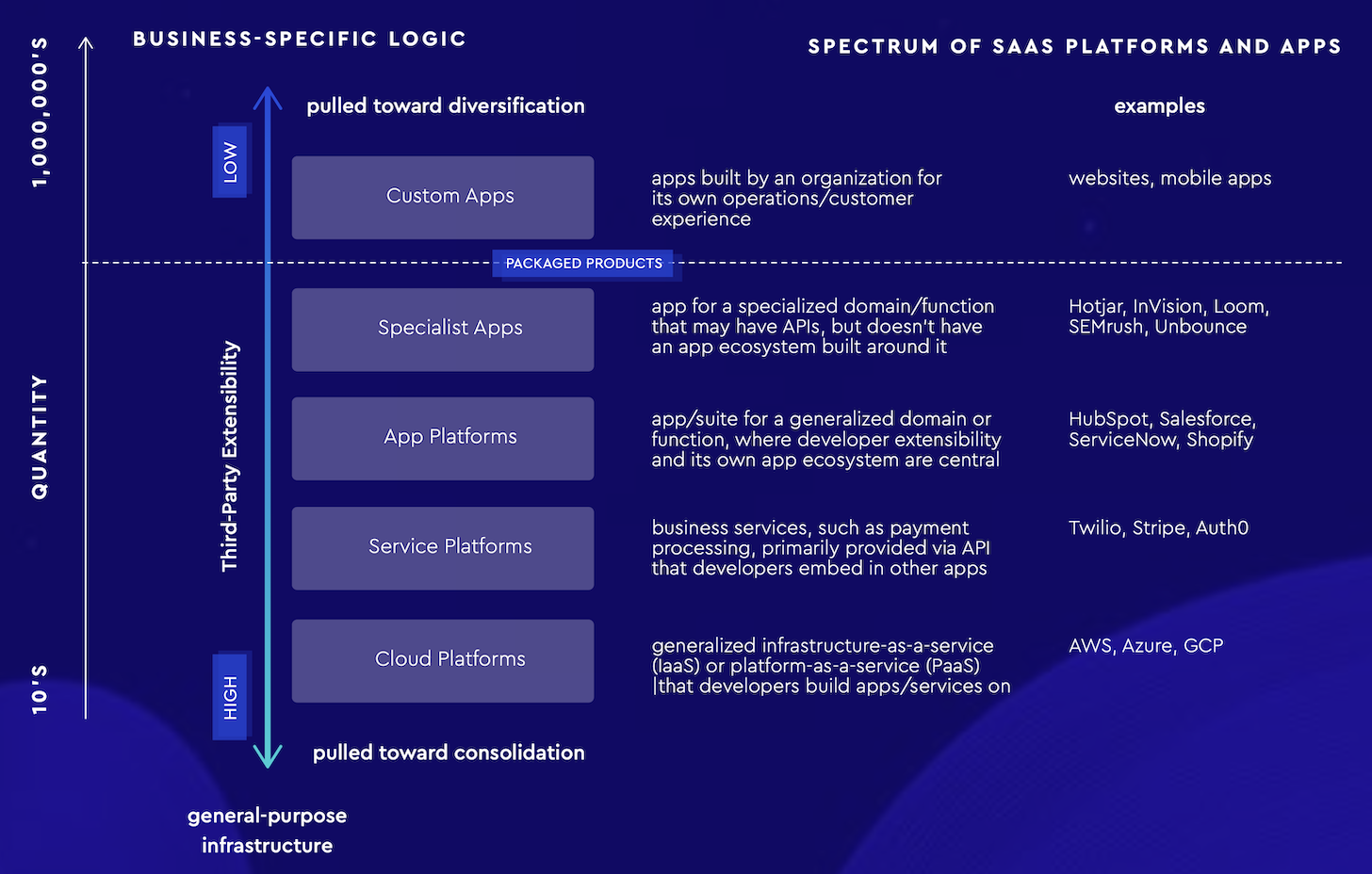
The bolder claim is the one still being tested: not thousands of apps, but Billions of them, the vast majority custom-built by organisations and tailored to their own operations and customer experiences. The commercial long tail keeps growing, the argument runs, but it will be dwarfed by the hypertail of custom martech. External estimates give the shape some plausibility: IDC projected in 2020 that more than 500 million apps and services would be developed and deployed using cloud-native approaches by 2023, and later IDC-linked analyses put cloud-native app volume around 750 million by 2026, roughly five times the 2020 level. The report's own evidence sits in the State of Martech 2025 and Martech for 2026 papers, published last spring and this past December.
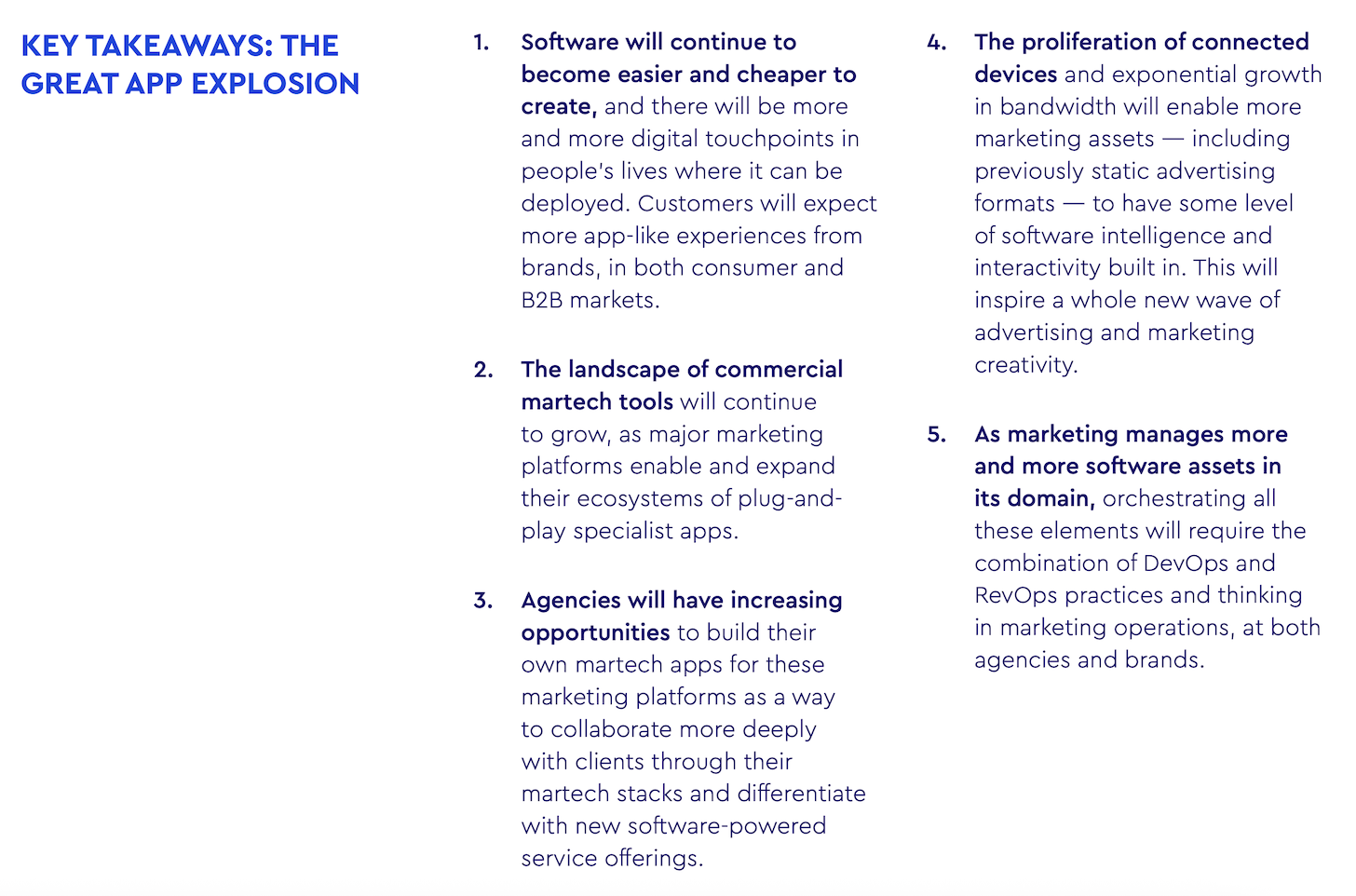
Five predictions nested inside this trend are also materialising, including service-as-software (takeaway #3) and the rise of intelligent, interactive marketing assets (takeaway #4).
One caution on the money side of this story. Category size estimates diverge enormously because definitions diverge: MarketsandMarkets counts the 2025 martech market at USD 175.95 billion, while Grand View Research frames the same year at $551.9 billion. Read any market-size headline as a scope claim, benchmark your own plan on tool counts and adoption evidence, and treat the “peak martech” genre of annual chart as a census rather than a prophecy.
Trend #4: What is “Big Ops,” and who will own the orchestration battle?
Verdict: the diagnosis was right, the treatment is unfinished — a solid B/B+. The prediction was that the 2020’s would be a decade of Big Ops. Just as Big Data had to be wrangled, the mission of Big Ops would be to tackle and tame the scale and complexity of hundreds to thousands of parallel apps, agents and automations operating on that sea of data inside a company's operations.
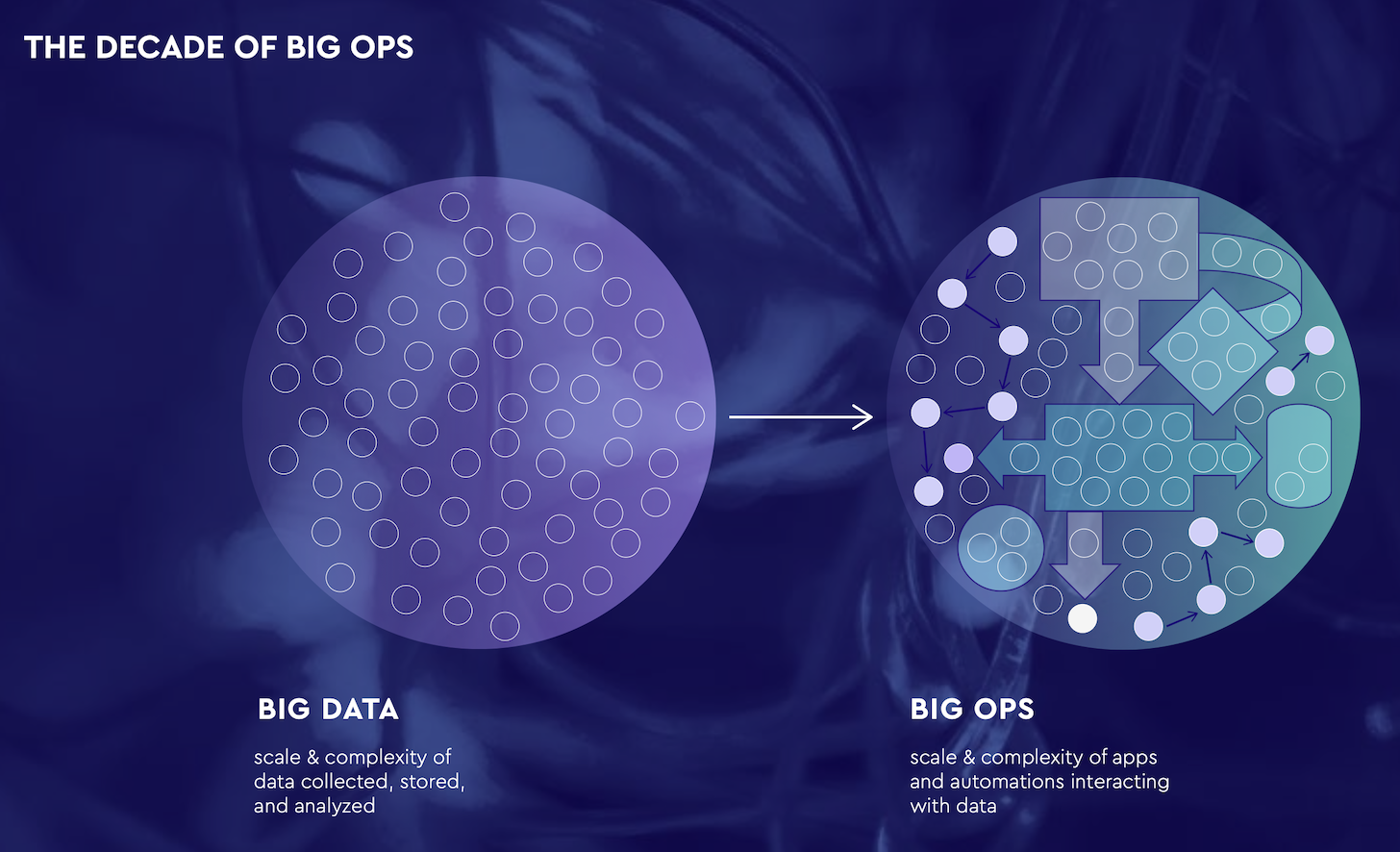
The chaos of uncoordinated “No Code” Citizen Creators colliding with The Great App Explosion is exactly the problem described five years ago, and naming it earned the report its grade. Solutions, both technical and organisational, are still emerging. Almost every major platform in martech is focused on this problem-and-opportunity right now, framed as “orchestration” and “decisioning.” That makes it the platform battle for the rest of this decade. Grab your popcorn.
Data is a critical asset in Big Ops, but its value is unlocked only through distillation and activation — what the report described as data intelligence and data reflexes. The metaphor worth keeping: data is not the new oil, it is the new oil paint. Big Ops is how you go from pigments on a palette to masterpieces on a canvas.
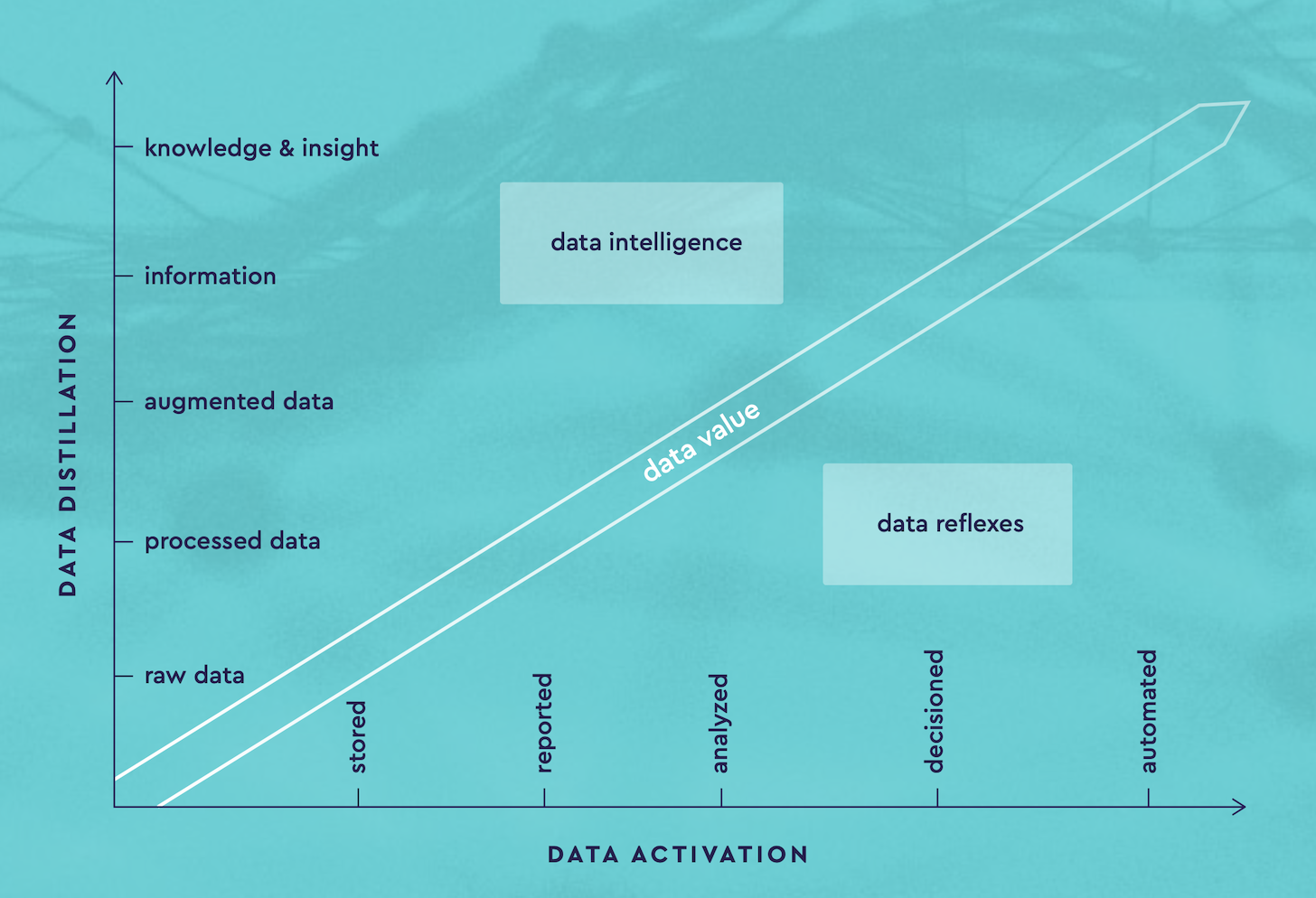
Because Big Data and Big Ops are entangled, Databricks and Snowflake — along with the hyperscalers AWS, Google and Microsoft — are serious contenders in the Orchestration Wars. What follows is a frenzy of coopetition with the public martechs, such as Adobe, Braze, HubSpot, Salesforce and Zeta; evolving CDPs, such as Hightouch, Tealium, Syncari, Treasure Data and Twilio; agent and automation platforms, such as CrewAI, n8n, Make, Workato and Zapier; a wave of next-generation martech startups, such as GrowthLoop and iCustomer; and even the AI giants Anthropic and OpenAI. We are going to need more popcorn.
For a marketing lead with a 2026 shortlist, the operational reading is blunter than the drama: nobody owns this layer yet. An orchestration contract signed today buys a roadmap and a seat at a standards fight, which is why the governance controls borrowed from the citizen-creator debate matter more than any single vendor logo on the slide.
Trend #5: Humans plus machines — why did this prediction age fastest?
Verdict: the safest call and, for ordinary readers, the most useful one. If the sentence were published today, the reaction would be “no duh.” Five years ago it was not obvious, yet “Greater automation and AI assistance will give marketers more time and new tools to focus on customers, creativity & innovation.” turned out to be prescient, and the trajectory sketched in the report is close to how matters played out. Automation and human engagement were never mutually exclusive; properly synthesised, they deliver experiences that neither can produce alone — the line where Claude and Gemini awarded their A+’s.
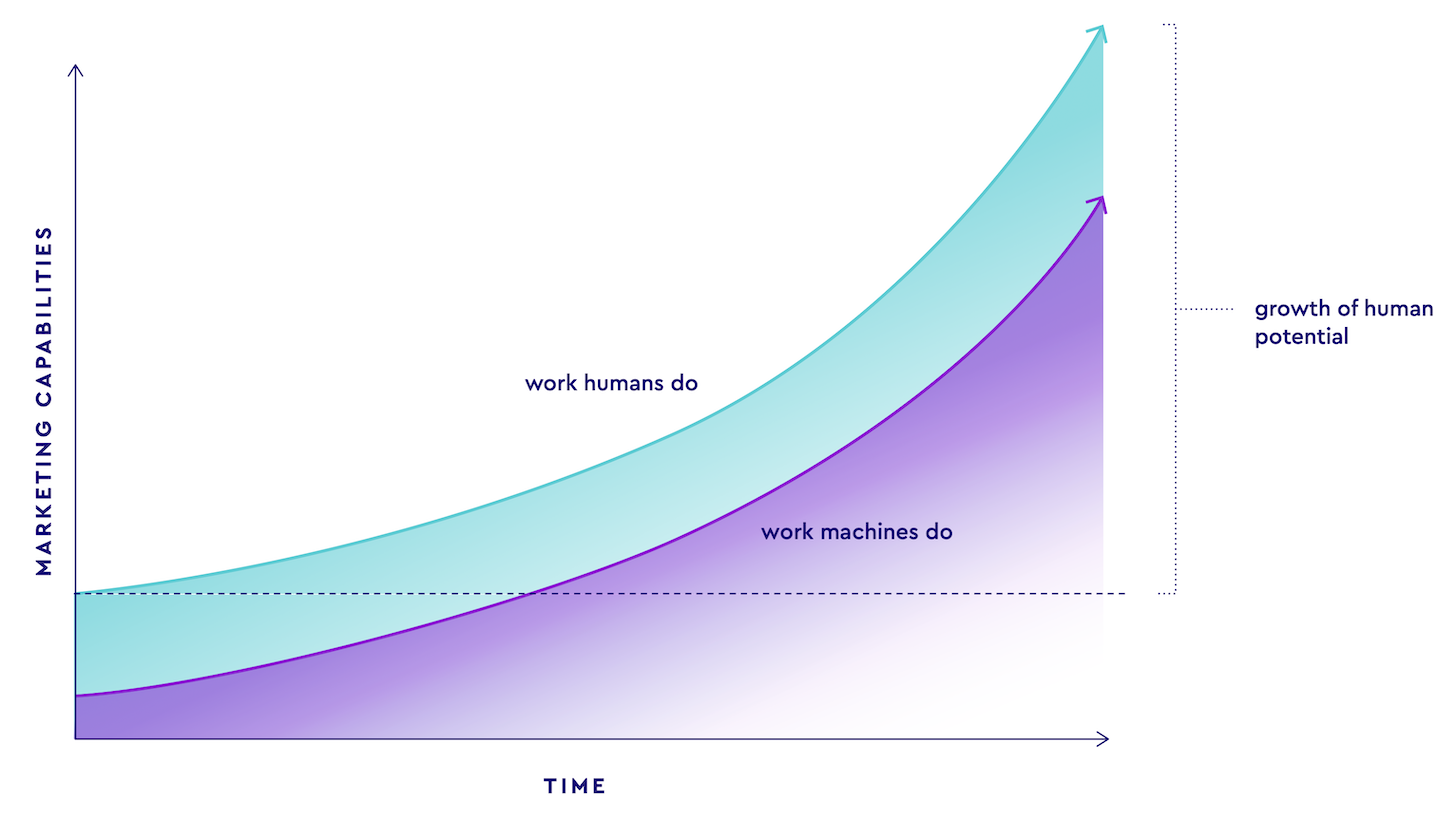
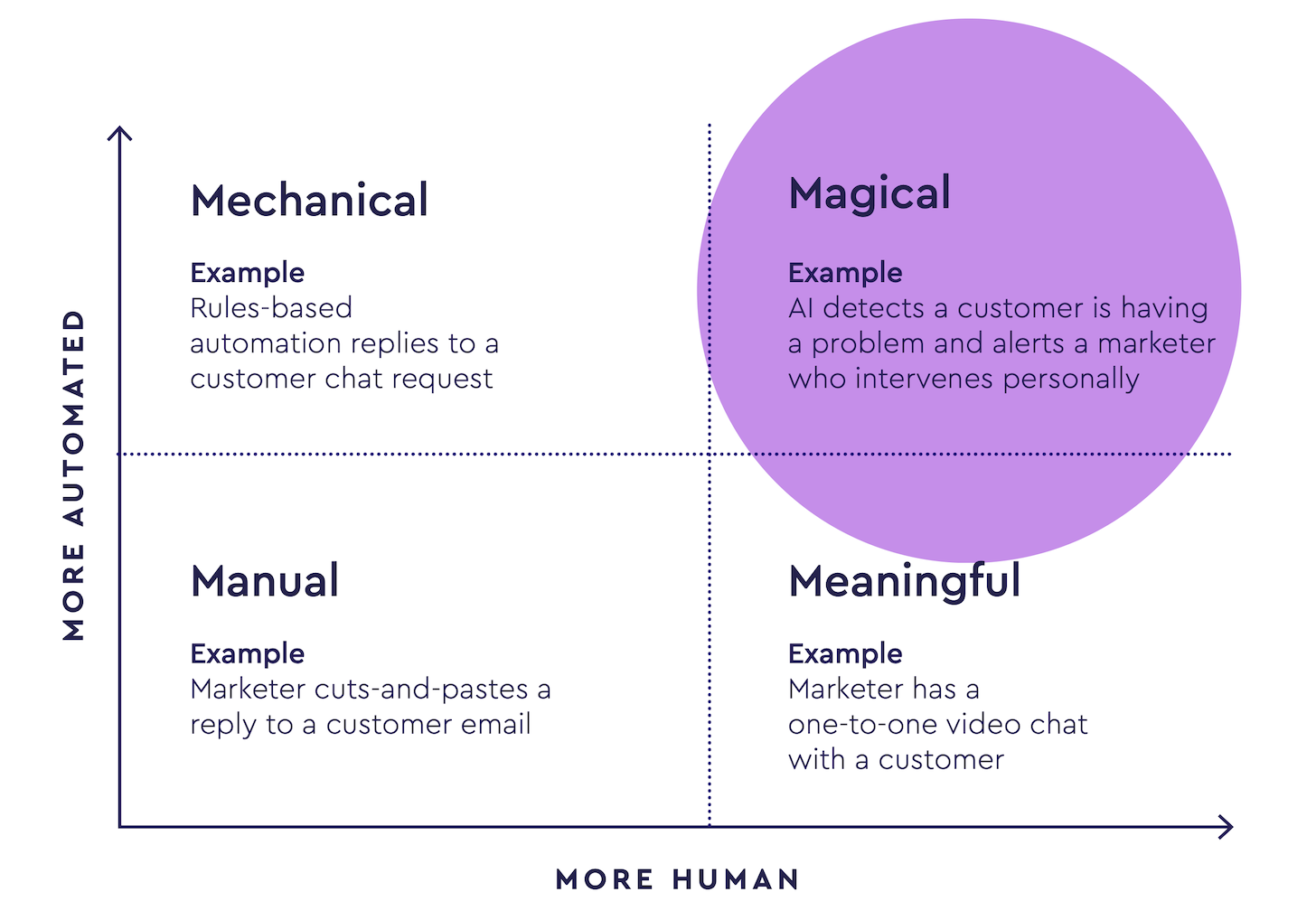
Buyer-side AI became a market force in 2025 with Agents of Customers, which the report also anticipated. What was envisioned in 2020 as a shift from SEO to BBO (Buyer Bot Optimization) is the phenomenon now known as the move from SEO to AEO (AI Engine Optimization), and what was predicted as Bot Commerce is sold today as Agentic Commerce. The labels we’ve landed on are cosmetically different, but the AI concepts defined five years ago have crossed from theory into reality.
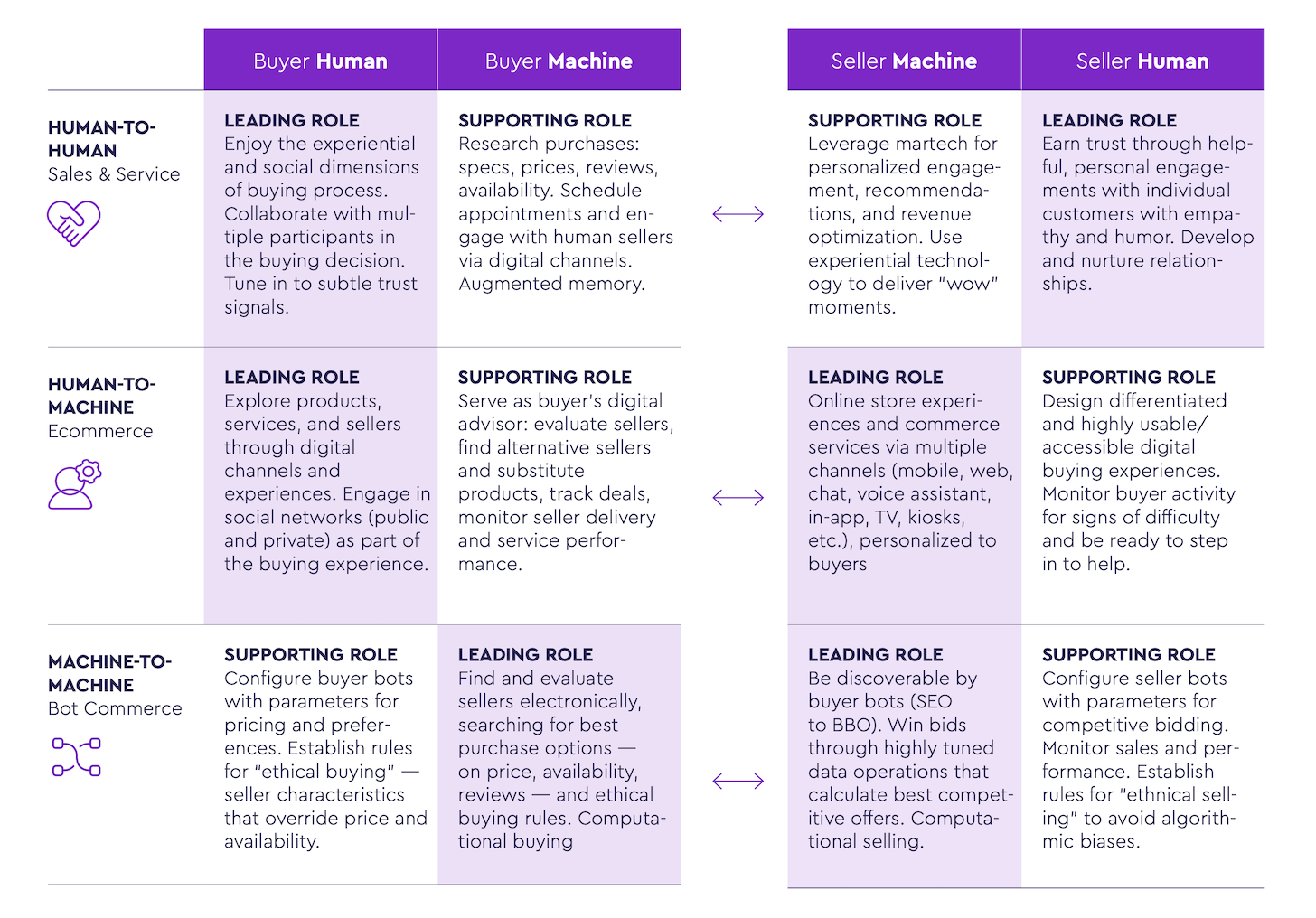
How far that reality has travelled is now measurable, and the gap is instructive. McKinsey's agentic-commerce research reports that more than 50 percent of global consumers use AI somewhere in shopping, while usage stays concentrated in the early journey — discovery and comparison — rather than in completed purchases. eMarketer's 2026 outlook is blunt about the remainder: fully autonomous, end-to-end shopping across brands and channels is where agentic AI “will still be underdeveloped through 2026.” Retail funnel surveys point the same direction, with roughly six in ten U.S. online shoppers using AI to research a purchase but only a small single-digit share ever letting an agent finish a checkout. For planning purposes: optimise first to be understood and cited by assistants, then invest in transactional agent readiness.
Five ways readers misread this halftime review
- Mistake one: “The report got an A, so the work is done.” The grades describe prediction accuracy, not implementation maturity; the lowest marks sit on the capabilities most teams still lack.
- Mistake two: “No code means no engineering.” Prompt-built apps still fail on secrets, dependencies and authentication; the build step got cheaper, the review step did not.
- Mistake three: “More tools means more capability.” Tool count doubled while the operating layer lagged — volume without orchestration converts spend into complexity.
- Mistake four: “Ecosystems need no central control.” The mechanism works precisely because standards are centralised so that experimentation can be decentralised.
- Mistake five: “AEO replaces SEO.” The evidence supports layering: assistants influence consideration, while owned pages and structured data remain the raw material they cite.
FAQ: the mid-decade check, answered plainly
What did Martech 2030 actually predict?
Five major trends for what its authors named The Decade of the Augmented Marketer: citizen creators building without code; platforms, networks and marketplaces replacing linear chains; a great app explosion measured in Billions of custom apps; a shift from Big Data to Big Ops; and the harmonisation of human and machine work in marketing.
Which prediction held up best?
The citizen-creator and human-plus-machine chapters. The first was overtaken by the generative AI explosion that started in late 2022; the second was graded so favourably that ChatGPT, Claude and Gemini awarded A+’s to the vision of “harmonizing humans & machines.”
Which prediction is furthest from finished?
Trend #4. The report correctly named the operating complexity of running hundreds to thousands of apps, agents and automations, and scored itself B/B+ because technical and organisational solutions are still emerging around orchestration and decisioning.
Do non-technical marketers really need to build now?
If “build” means describing a workflow precisely enough for a system to draft it, yes — that is already normal practice with assistants and tools such as Bolt, Lovable, Replit and Vercel. What you still need is an owner, a data classification and a review path, not a programming degree.
Is AEO the same idea the report called BBO?
Same concept, newer label. The 2020 framing was Buyer Bot Optimization; the 2026 version is AI Engine Optimization, with Bot Commerce rebranded as Agentic Commerce.
When are the final grades issued?
At the end of the ten-year window. The authors propose revisiting the paper once more in 2030 for final marks, which is the disciplined way to read any long-range forecast.
A 90-day plan for teams reading this scorecard
- Weeks 1–2 — Inventory the citizen-built layer. List every app, agent and automation your teams created, name an owner for each, and mark which touch customer data.
- Weeks 3–4 — Install the five minimum controls. Inventory, ownership, data classification, identity management and audit logging, before adding more builders.
- Weeks 5–6 — Test the ecosystem assumption. Check whether your two most important tools can exchange data through a shared layer such as Databricks or Snowflake, and whether they are purchasable through AWS Marketplace, Google Cloud Marketplace or Microsoft Marketplace.
- Weeks 7–8 — Make one assistant-visible asset. Rewrite a high-intent page so a model can cite it: clear claim, dated figures, sources, and a question-shaped structure. Measure referral traffic from assistants separately from organic search.
- Weeks 9–12 — Write your own Big Ops brief. Name the orchestration problem you actually have, list the vendors circling it — from Adobe, Braze, HubSpot, Salesforce and Zeta to the agent platforms — and set a 12-month review before signing.
- Throughout — Cut one tool per two you add. If the hypertail is coming, the discipline that protects your budget is subtraction, not selection.
Bottom line: judge the arc, not the next quarter
Amara’s Law — the observation credited to scientist and policy analyst Roy Amara — holds that we overestimate a technology's near-term impact and underestimate its long-term effect. That long arc was the ambition of Martech 2030, and the halftime evidence is a clean illustration: the five trends are further along than most budgets concede, while the operating and governance layers trail them badly. The pace is quickening, and nothing in the start-of-2026 record suggests 2026 will slow it.
The practical takeaway for a general reader is a rule, not a prediction: bet on creation and coordination, audit anything sold as finished orchestration, and grade the decade itself in 2030 — which is exactly the appointment the authors keep.
Sources and further reading
- MarketsandMarkets, “MarTech Market worth $296.88 billion by 2030” press release — https://www.marketsandmarkets.com/PressReleases/martech.asp
- McKinsey & Company, “Who wins when AI does the shopping? New evidence on agentic commerce” — https://www.mckinsey.com/capabilities/growth-marketing-and-sales/our-insights/who-wins-when-ai-does-the-shopping-new-evidence-on-agentic-commerce
- eMarketer, “How agentic AI will reshape shopping in 2026” — https://www.emarketer.com/content/how-agentic-ai-will-reshape-shopping-2026
- Cycode, “Vibe Coding Security: Risks and Vulnerabilities” — https://cycode.com/blog/vibe-coding-security/
- Caspio, “Vibe Coding Governance: The IT Leader's 2026 Checklist” — https://www.caspio.com/blog/vibe-coding-governance/
- Compilation of Gartner's December 2022 low-code forecast — https://cdp.com/articles/low-code-no-code-development/
- Grand View Research, Marketing Technology (MarTech) Market Report — https://www.grandviewresearch.com/industry-analysis/marketing-technology-martech-market-report
- Primary documents referenced in this review: the ungated Martech 2030 PDF, State of Martech 2025 and Martech for 2026.
Written by James Hartley, content editor at IT Insights (ItInsightsWorld). Corrections, questions and partnership requests: contact@itinsights.com.