
ItInsightsWorld Brief: Lula Wins Brazil Run-off as Flávio Bolsonaro Seeks Annulment Before a Divided Congress
Final numbers reported by Brazil's Superior Electoral Court give Luiz Inácio Lula da Silva 51.79% and Flávio Bolsonaro 48.21% after the run-off, but Lula enters the next term under three pressures: Bolsonaro's refusal to concede, a Congress tilted to the right, and a country split with more than 48% voting for the challenger.
Court result meets legal challenge
The certified margin makes Lula the victor, yet Bolsonaro has not accepted the outcome. Speaking in Brasilia, he called the extension of voting by two hours inexplicable and said he will pursue a path to annul the election, even though both campaign teams had asked for longer voting hours.
A fourth win built on a difficult comeback
Lula's backers describe the result as a historic victory and a fourth win in a presidential race. His earlier record includes two terms between January 2003 and December 2010, followed by another presidency beginning in January 2023. The Sunday run-off proved difficult after Bolsonaro led in the first round on 4 October; a reversal within three weeks looked doubtful to many observers.
Regional drift and campaign recovery
Lula's comeback also cuts against a broader pattern across Latin America, where incumbents were punished and voters moved rightward, leaving Argentina, Chile and Colombia under conservative leaders. After the first-round defeat, Lula's campaign responded with street demonstrations and a large social media effort, reinforcing the influence the former metalworker has held over Brazil's left since his first presidential bid in 1989. Still, the political setting around his return is the most difficult since he took office in 2003.
 EPA/ Shutterstock
Supporters welcomed Lula after he cast his ballot on Sunday.
Foreign policy pressure and domestic constraints
The term beginning 5 January 2027 will face constraints abroad as well as at home, including tension with US President Donald Trump. Trump did not openly endorse Flávio Bolsonaro, as he had done for right-wing winners in Colombia and Honduras, but his administration would likely have preferred a conservative government in a country of 213 million people.
Washington's outlook shapes this pressure: the White House treats Latin America as a sphere of US influence and wants governments that support its positions on defence, security and trade, while also limiting China's presence in the Western Hemisphere. Brazil, with oil wealth and the world's second-largest reserves of rare earth minerals, is the only large country in South America without a right-wing leader, and Lula is widely viewed as friendly toward China. Flávio Bolsonaro had promised closer alignment with Washington, whereas Lula warned the US against interference and said Brazil would 'never fit into anyone's backyard'.
Environmental stakes
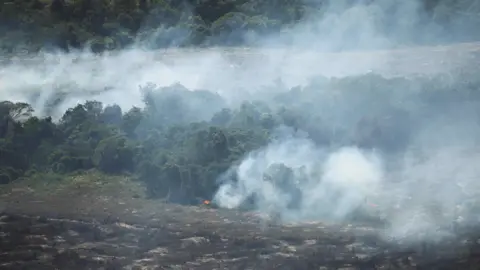
Many environmentalists see Lula's win as a relief. They feared a Bolsonaro victory would empower Brazil's agribusiness and mining sectors, citing record deforestation and forest fires in the Amazon during the presidency of his father, Jair. Their concern was that weaker rules under the younger Bolsonaro could again damage a key ecosystem.
 Reuters
A Greenpeace flyover captured flames in the Amazon rainforest around the UN Climate Change Conference (COP30), near Centro Novo in Brazil's state of Maranhao, in 2025.
A divided Congress and an unfinished mandate
The victory may energise supporters, but the vote shows Brazil remains deeply split: more than 48% backed Bolsonaro. Lula must therefore try to bridge opposing poles while governing with the most right-wing Congress of Brazil's democratic era. The Liberal Party (PL) recorded the largest gains, while Lula's Workers' Party showed its grassroots strength through huge rallies before the run-off.
In the campaign, Lula framed the ballot as 'a parting of the waters for Brazil' and promised 'a new way of governing' to pull the country's poles closer together. In a WhatsApp livestream he said 'this country will never be the same again', though he offered few concrete details. He insisted he would 'remain firm in the fight for a more just country, with opportunities for all and policies directed at the needs of the population'. With a largely hostile Congress, that task may prove harder for the veteran leader, who will be 85 by the end of his fourth term, than in his three previous terms.