
GPW4 Puppy Meme Backlash: What Logitech's Discount Ad Row Means for Everyday Shoppers | ItInsightsWorld General
By James Hartley | IT Insights — ItInsightsWorld, General desk
Bottom line first: in recent days a single promotional clip built around a cartoon dog has pulled a gaming-mouse brand back into a fight it had already paid a fine to close. The clip is short, the joke is older than the product, and the reaction was instant. For readers of the ItInsightsWorld General desk, the value of this episode is not the gossip. It is a free, very readable lesson in three things: how discount messaging is staged for your attention, who absorbs responsibility when a joke misfires, and what a normal buyer should check before letting a "flash sale" frame the decision for them.
Key takeaways in twenty seconds
- The controversy is about framing, not price. Nobody is in trouble for cutting prices; the trouble started with how the buyer was portrayed while those prices were cut.
- This is the second GPW-related ad dispute of the year for the same brand family, following an earlier clip on Douyin that a regulator formally found to have demeaned consumers.
- That earlier case ended with a RMB 200,000 penalty issued to a distributor that had been running the brand's authorized account since 2021 — a reminder that outsourcing a storefront does not outsource reputational risk.
- For shoppers, the practical skill is boring but valuable: read the arithmetic of a discount ("instant 100 off" versus "60 percent after coupon") and ignore the emotional costume wrapped around it.
What the new video actually showed
The upload came from the official account of the Logitech G Audiovisual Flagship Store and promoted one product: the GPW4 Zhuque mouse. The promotional pitch was delivered entirely through two sets of scenes built on the same template, with a puppy reacting to two different offers.
In the first set, the screen was labeled "instant 100 yuan off". The dog waved a paw and the caption read "Not interested, thanks." In the second set, the label changed to "60 percent after coupon, get it for a price starting with 3". This time the same dog gave a thumbs-up, captioned "You really know people."
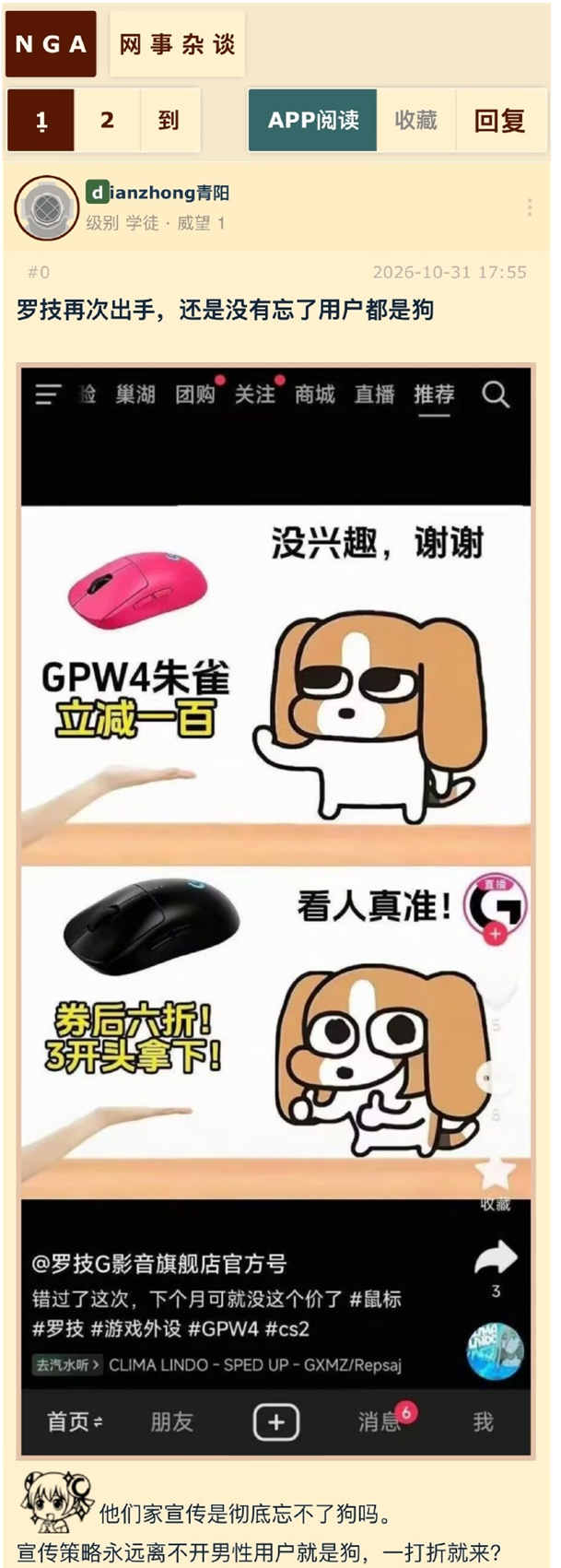
Read plainly, the device is a joke about bargaining psychology: a modest cut gets a shrug, a deep cut gets enthusiasm. Read the way part of the audience read it, the joke had a different target — the viewer. If the puppy stands in for the customer, then the message becomes: shoppers only come when the price is slashed, and that behavior is funny. Some users were indignant; others pushed back on that interpretation entirely, saying the meme was simply about deal-hunting and that they were reading insult into a stock image. Both reactions are worth taking seriously, because the gap between them is exactly where social-commerce copy goes wrong.
The precedent the comment section kept quoting
The reason the response was so fast is that this audience had seen the same setup before. Earlier this March, the Douyin account "Logitech" posted a promotion for the GPW Gen 3 mouse. Its line was blunt: "The moment I cut the price, you still come running like a dog."
Reporting by China News Service, citing the written administrative penalty decision, identified the advertiser behind that post as Shanghai Baishide Electronics Co., Ltd., a distributor of Logitech China. The same record shows that since 2021 the brand had authorized that distributor to operate the verified Douyin account. The regulator concluded that the advertisement demeaned and insulted the personality of consumers and violated good social customs, and fined Shanghai Baishide RMB 200,000.
The paperwork also described how the clip escaped to the public. According to the decision, the employee involved did not carefully proofread the copy and released the video while skipping the company's internal advertising review. Afterwards, customer service at the Logitech flagship store said the staff on the short-video team had been formally warned and had their full performance bonus deducted, and that content review would be tightened.
Side by side: the two clips that triggered the same backlash
| Point of comparison | The GPW4 Zhuque clip | The GPW Gen 3 clip |
|---|---|---|
| Where it appeared | Official account of the Logitech G Audiovisual Flagship Store | Douyin account "Logitech", operated under authorization since 2021 |
| Comedic device | Two sets of scenes with a puppy reacting differently to two offers | A single line of text casting the buyer as a dog that runs at discounts |
| Discount being sold | "Instant 100 yuan off" versus "60 percent after coupon, a price starting with 3" | A price cut presented as the trigger for the punchline |
| Why people objected | The mascot looked like a stand-in for the customer, so the laugh landed on the audience | The wording insulted shoppers directly rather than by implication |
| Documented outcome | Public complaints resurfaced the earlier case; customer service for the new clip said it was under review | RMB 200,000 fine on Shanghai Baishide; staff warned, bonuses deducted, review promised |
Why the punchline keeps landing on the customer
Three structural reasons explain the pattern, and they apply far beyond one mouse.
A joke aimed at buying behavior is aimed at the only people who can pay. Market research on brands that post memes finds that the humor effect depends heavily on fit and on who ends up as the butt of the gag; studies of brand comebacks on social media also show that a jokey response can backfire and lower trust among exactly the customers a brand needs. A mascot shrugging at a small discount is funny in a group chat of buyers. Signed by the seller, it reads as a verdict on the buyer.
Discount copy is not decorative. Chinese advertising rules prohibit commercial advertisements that disturb public order or violate good social customs, and the penalty band for such violations starts where this case ended, at RMB 200,000 for a first-tier sanction. Separately, consumer-protection law gives shoppers a right to have their personal dignity respected when they buy goods or receive services. In other words, the wording of a promotion is a regulated surface, not an open mic.
Brand, distributor and platform team blur together. The fine in the earlier case went to the distributor that published the ad, not to the brand owner. To the reader scrolling a storefront, there is only one name on the page. Accountability splits on paper and lands as one lump in public.
Common misconceptions about this story
- "It is just a meme, and memes are free to use." Memes are licensed, platform-hosted commercial content the moment a brand publishes them. Nothing about the format lowers the standard.
- "The regulator punished the discount, not the wording." It did not. The finding was about dignity and social customs; the price cut was only the premise of the sentence.
- "One careless employee was the whole problem." A single employee publishing without review is a symptom. Missing gates, no final proofread step and no post-publication sweep are the disease.
- "The brand is not responsible because the account runs through a distributor." The record states the account had been authorized by the brand for operation since 2021. Delegating the keyboard does not delegate the name.
- "Everyone is offended by everything now." Genuine disagreement exists — many viewers saw nothing wrong with the puppy gag. That does not neutralize the risk: the asymmetry between a small joke's reach and a legal finding's cost is enormous.
- "A deep discount is always a win for the buyer." Percentage claims and "after coupon" prices are marketing units, not verified savings.
What shoppers should actually do with this information
- Separate the arithmetic from the attitude. Write down the number: an instant cut of 100 yuan versus roughly 60 percent off a reference price with a coupon applied. Those are different deals and often different starting prices.
- Decode vague phrasing. "A price starting with 3" is a promise about a digit, not a discount rate. Ask which figure it modifies and whether shipping, bundles or membership sit behind it.
- Check a price over time, not over one screen. One screenshot cannot tell you whether a "coupon price" was the usual price last month. Open the listing, note the reference price, and compare across weeks before treating a cut as real.
- Treat mascot enthusiasm as decoration. If a clip needs a reaction image to make a price look good, that is information about the copywriting budget, not about the product.
- Decide before the countdown starts. Set the price at which you would buy without any framing at all. Anything better is a saving; anything worse is theatre.
- Keep evidence if you feel disparaged. Save the URL and a screenshot, raise it with the store, and, where warranted, file a complaint with the consumer-protection hotline or the local market supervision authority.
A practical checklist for small brands and social teams
- Name the target of the joke in one sentence. If the answer is "the customer", stop.
- Never publish around the review chain. If a workflow can be skipped by one person, assume it will be — that is precisely how the earlier clip went live.
- Run a dignity test on every promotion line: does any group of people look less rational, less dignified or less human because they bought, or did not buy?
- Verify the math of every claim — reference price, coupon, final price — before the video is cut, not after.
- Assign a response owner in advance, with authority to pull the post within hours.
- Log repeat risk. A second framing controversy in the same year invites sharper scrutiny than the first, and the first one is already on the public record.
FAQ
Was the new GPW4 clip ever ruled illegal?
No comparable finding is documented for this clip. What is documented is a wave of public complaint and a store response that the matter was being reviewed. The legal finding belongs to the earlier GPW Gen 3 advertisement.
Who paid the RMB 200,000?
Shanghai Baishide Electronics Co., Ltd., described in the penalty record as a distributor of Logitech China, which had been running the authorized Douyin account since 2021.
Is talking about discounts in an ad prohibited?
No. Promotions are routine and lawful. The regulated part is whether the content demeans consumers or violates good social customs — the framing, not the price.
What does "60 percent after coupon" usually hide?
Usually a reference price that does not match what the product sold for last week, and conditions on the coupon itself. Ask for the number before the percentage.
Should shoppers boycott over a meme?
That is a personal call. The more useful move is narrower: judge the product on tested performance and a verified price, and treat tone-deaf copy as a signal about how much care went into the campaign.
The bottom line
Two clips, two mascots, one recurring mistake: a seller treated the buyer as the punchline and was surprised when the audience recognized itself. The documented cost so far is RMB 200,000, a deducted bonus, and a second round of headlines about the same product line. The transferable lesson for anyone reading this as a consumer is calmer and more useful — the discount you are shown is a claim, the joke wrapped around it is a distraction, and neither is a reason to buy. Check the arithmetic, ignore the costume, and keep your price threshold ready for the next "flash sale" that needs a cartoon to sell it.
Have a story tip or a question about coverage from our General desk? Reach the IT Insights editorial team at contact@itinsights.com. ItInsightsWorld does not sell or endorse any product mentioned in this article.