
ItInsightsWorld General Guide: The ByteDance Time Reputation Dispute, Explained Step by Step
By James Hartley, IT Insights
Recently, Qin Shuo and Li Liang have been locked in a multi-day public exchange over “ByteDance time for China's internet.” The dispute has moved from a statistics debate into a reputation-rights lawsuit. On November 4, Li Liang, vice president of Douyin Group, posted again to respond to well-known self-media writer Qin Shuo and commentator Hu Xijin, who had earlier said the episode was “very unbecoming of a large company.” Li said he had hoped to stop there, but after his own criticism became a trending topic and many attacking articles circulated inside WeChat, he believed he needed to state his view clearly.
The central facts are narrow enough to track. Qin Shuo built his “ByteDance time” argument on data from Nomura Securities. Li Liang was the first to publicly push back, saying the reasoning was not rigorous because Nomura's scope only covered mobile Top 50 app time and did not include long-tail applications or PC internet time. On November 2, Qin Shuo announced in a social-media post that he had asked lawyers to sue Li Liang for infringing his reputation rights. Li replied on the same day that he would actively defend the case.
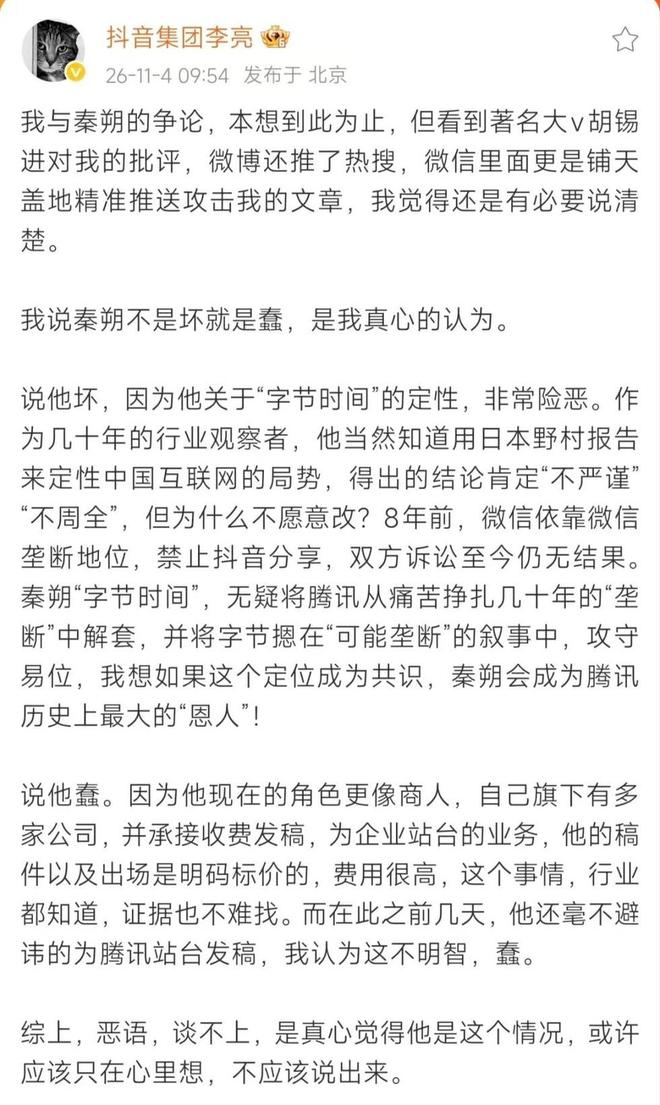
In Li's telling, the stakes are not just methodological. He wrote: “As an industry observer for decades, he certainly knows that using a Japanese Nomura report to characterize the state of China's internet will produce a conclusion that is ‘not rigorous’ and ‘not comprehensive,’ yet why is he unwilling to change it? Eight years ago, WeChat relied on WeChat's monopoly position to prohibit Douyin sharing, and the lawsuits between the two parties still have no conclusion. Qin Shuo's ‘ByteDance time’ clearly releases Tencent from the ‘monopoly’ burden it has suffered in painful struggle for decades, and presses ByteDance into a narrative of possible monopoly, reversing offense and defense. If this positioning becomes consensus, I think Qin Shuo will become Tencent's greatest ‘benefactor’ in history!”
Li also questioned Qin Shuo's independence: “He has multiple companies under his own name, takes commissioned posts and business that stand up for enterprises, and his articles and appearances are clearly priced, with high fees; the industry knows this, and evidence is not hard to find.” Whether or not a court accepts those claims, the accusation changes the conversation from app time to credibility.
Why this matters beyond a social-media argument
For a general audience, the value of the case is that it exposes three layers at once. First, there is the data layer: whose usage time is counted, and whether long-tail applications and PC browsing belong in the frame. Second, there is the narrative layer: whether a phrase such as “ByteDance time” becomes a public shorthand for market power. Third, there is the legal layer: once a party alleges reputational harm, the forum changes from commentary to evidence, procedure, and judgment.
China's Civil Code provides a useful background. Article 1024 recognizes reputation as a protected civil right and bars organizations or individuals from harming another person's reputation through insult or defamation. Reputation-management guidance also notes that a claimant may seek remedies such as stopping the infringement, an apology, and compensation. This helps explain why Qin Shuo's November 2 statement turned the public exchange into a lawsuit, while Li Liang's same-day response moved the matter into an active defense posture.
Timeline: the sequence readers should keep straight
| Time | Event | Practical meaning |
|---|---|---|
| Recently | Qin Shuo and Li Liang carried out a multi-day exchange around “ByteDance time for China's internet.” | The dispute began as a contest over how to interpret platform attention. |
| Eight years ago | Li referred back to WeChat blocking Douyin sharing, saying the lawsuits still have no conclusion. | Historical platform conflicts can make a present-day data debate feel much older. |
| November 2 | Qin Shuo posted that he had commissioned lawyers to sue Li Liang over reputation rights. | The exchange left the purely public sphere and entered a legal track. |
| Same day | Li Liang said he would actively defend the case. | Both sides now have litigation stakes as well as reputational stakes. |
| November 4 | Li Liang responded again, addressing Qin Shuo and Hu Xijin's earlier criticism that the episode was “very unbecoming of a large company.” | The argument widened from two people to a broader public-pressure dispute. |
A public-record clue that supports the “eight years ago” framing
Li's reference to old platform blocking is not only rhetorical. In February 2021, official court reporting said a Beijing court accepted Douyin's antitrust lawsuit against Tencent over restrictions on sharing links from WeChat and QQ. The details of that case are separate from the current reputation-rights suit, but the record shows why the memory of platform conflict remains active in today's argument.
The two positions, side by side
| Question | Qin Shuo's debate position | Li Liang's counter-position |
|---|---|---|
| What supports “ByteDance time”? | Statistical material from Nomura Securities showing time spent on apps. | That inference is not rigorous because the scope centers on mobile Top 50 app time and leaves out long-tail applications and PC internet time. |
| What is the competitive story? | The internet's attention structure is changing. | The framing could help Tencent escape a long-standing “monopoly” accusation while placing ByteDance under a “possible monopoly” label. |
| Why is the tone harsh? | Li's remarks are said to have damaged reputation. | Li questions Qin's paid publishing and commercial appearances, suggesting the data argument may serve commercial interests. |
| What should readers watch? | Whether the court treats statements as protected opinion or reputation harm. | Whether evidence emerges on data coverage, conflict of interest, and the older platform-blocking disputes. |
Practical checklist: how to judge the argument without getting lost
- Identify the data source. Here the source is Nomura Securities, but the question is whether its measurement window matches the claim being made.
- Check the measurement scope. A Top 50 app survey is different from total internet attention because long-tail applications and PC time can shift the picture.
- Separate fact from framing. App time can support a description of user attention, but “ByteDance time” is a narrative label with competitive and reputational implications.
- Read accusations carefully. Li's claims about paid publishing are allegations about incentives; they do not become legal truth merely because they are public.
- Keep the legal process distinct. A reputation lawsuit will focus on statements and harm, not on whether one side won the social-media argument.
Common mistakes to avoid
- Treating the lawsuit as already decided. The current record is an announcement of suit and a promise to actively defend.
- Assuming one chart explains the entire internet. The disputed data are described as mobile Top 50 app time, which is only a slice of attention.
- Confusing business rivalry with defamation. Platform competition, monopoly talk, and reputation claims are related but not identical.
- Overlooking incentives. The public fight is sharper because Li raised the issue of commercial relationships and paid influence.
FAQ: what general readers ask first
What exactly is “ByteDance time”?
It is a framing that attempts to describe how much user attention ByteDance-related platforms may capture in China's internet environment. Li Liang argues that, if built on narrow Nomura Securities data, the phrase is not sufficiently rigorous.
Why did Hu Xijin enter the discussion?
Hu Xijin criticized the public conduct of the argument by saying it was “very unbecoming of a large company.” Li Liang said that criticism, combined with widespread attacking articles inside WeChat, made him decide to clarify his position.
What does “actively defend” mean?
In this context, it means Li Liang is responding to the lawsuit by participating in the legal process rather than ignoring it. That phrase also signals to readers that the dispute has entered a formal, adversarial stage.
Should readers take sides now?
Not necessarily. The practical approach is to follow evidence: data scope, court filings, supporting documents, and whether claims of paid publishing can be substantiated. The strongest public lesson is that digital disputes often move from charts to reputation in a single step.
Action advice for readers, writers, and companies
- Busy readers: bookmark the timeline and treat headline claims as provisional until a court or primary documents clarify the facts.
- Writers: cite the measurement method, not only the conclusion. If you use app-time data, explain what was included and what was excluded.
- Communications teams: disclose paid commentary or commercial relationships before the issue becomes a credibility dispute. Public-relations ethics guidance treats real, potential, or perceived conflicts of interest as matters that should be handled transparently.
- Platform observers: compare the current reputation suit with older platform-blocking history. An eight-year-old grievance can still shape today's framing of market power.
By James Hartley, IT Insights. If you found this general explainer useful, contact contact@itinsights.com. This ItInsightsWorld guide is meant to organize the public record for general readers and is not legal advice.