
A 453% Sales Jump Could Not Save the Stock: Reading the Kioxia Memory-Cycle Wobble
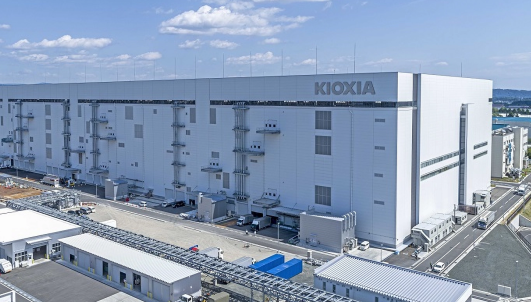
Public markets rarely pay for the quarter that has just closed. They pay for the quarter that comes next, and that single principle explains why a company with one of the most spectacular growth reports of the AI storage boom saw its shares sold hard. For general readers who follow chip headlines without a semiconductor background, the episode is a compact case study in how expectations, shipment calendars, price momentum and shareholder structure interact to move a stock.
The short version, before the detail
- Reported results were extraordinary; the forward outlook was not, and the outlook is what the tape traded.
- The trigger for the heavy selling on Monday was not a bad earnings report but the guidance issued with it.
- Management attributed the soft next-quarter shape to shipment timing rather than fading demand.
- Price speed matters more than price level in memory stocks, and the pace of NAND price increases has narrowed sharply.
- Two structural weak points stand out: a NAND-only product mix, and an unusually leveraged shareholder base.
What the reported quarter actually said
The figures released last Friday covered the 2026 fiscal second quarter, the three months ended at the end of September. Revenue reached 2.48 trillion yen, up 453.20% year on year. To put that single quarter in perspective, on its own it out-earned the roughly 2.34 trillion yen the business produced across the whole of the previous fiscal year. Adjusted operating profit surged 2181.10% against the same period a year earlier.
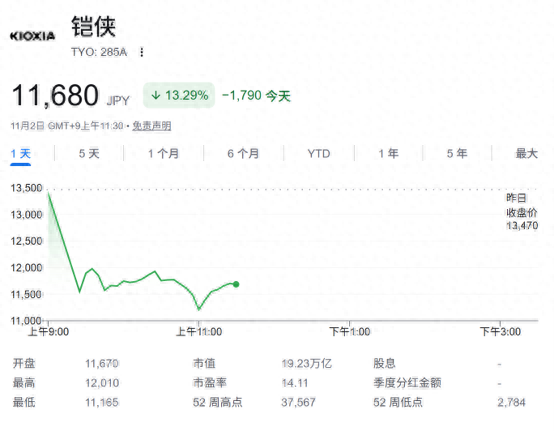
This June, that same AI-driven storage supercycle had lifted the company, Kioxia, to the rank of the most valuable listed company in Japan by market capitalisation. None of that history cushioned the reaction on Monday.
The number that changed the story
Alongside the results, Kioxia told investors to expect December quarter operating profit of 2 trillion yen, or roughly US$12.7 billion. That sits below the consensus held by analysts of 2.35 trillion yen, and it lands almost flat on the 1.99 trillion yen recorded in the September quarter. After past several quarters in which operating profit climbed steeply, a flat line reads as a stall.
The company's defence: calendar and cycle length, not demand
Kioxia's explanation for the flat outlook rests on where orders land, not on whether customers want product. Two mechanisms were described. Part of the volume originally scheduled for delivery in the current quarter was pulled forward into the September quarter at customer request. Other orders slipped to the March quarter of the following year, because enterprise storage products now make up a bigger share of the mix, and those products require longer production cycles before they can ship.
Chief Financial Officer Yoshihiko Kawamura said last week during the earnings call that demand from AI data-centre operators remains strong, and that the company expects to be back on a fast growth track in the March quarter next year. He also offered a visibility detail that cuts against the bearish reading: planned capacity for next year is already sold out, while more than half of the year after next has been allocated, and some major customers have begun negotiating contracts covering 2029 and beyond.
The price signal that spooked traders
Average selling prices are the pulse that memory investors monitor most closely. In 2026 Q2, Kioxia NAND prices rose about 70% quarter over quarter. In the third quarter, the increase narrowed to about 20%. Prices were still climbing, but at a fraction of the earlier pace, and in this sector markets track the speed of change rather than the absolute level. That deceleration is what many participants interpreted as a possible turning point in the up-cycle.
Kioxia versus its South Korean rivals: a structural comparison
| Dimension | Kioxia | Samsung Electronics and SK Hynix |
|---|---|---|
| Core exposure | Focused on NAND flash | Sell NAND and DRAM, the other key component inside AI computers |
| Commercial leverage | Narrower toolkit when buyers negotiate across categories | Two component families give stronger bargaining power with the same customers |
| Shareholder structure | The highest concentration of leveraged long positions among all listed companies on the Tokyo Stock Exchange | The forced-selling dynamic described here was specific to Kioxia in this episode |
| Monday reaction | Sharp selling on the outlook | Early weakness, then a full reversal during the session |
How the rest of the sector traded
For a few hours it looked like a sector-wide repricing. Samsung Electronics fell more than 3% in early morning trading, and SK Hynix slipped more than 1%. Then both reversed direction: at the time of publication Samsung shares were up 0.44%, and Hynix shares were up 2.75%. The divergence suggests that, for most investors, the problem was read as specific to one company's outlook and positioning rather than as a verdict on AI memory demand overall.
Five common misconceptions about this episode
- Strong growth should lift any stock. Reported quarters are already inside the price; the guidance attached to them is the new information.
- A flat profit guide means demand has collapsed. The company's own account points to orders being shifted between quarters by customer request and longer enterprise production cycles.
- Prices must be falling now. NAND prices were still rising, only much more slowly. Rate of change, not direction, is the metric being traded.
- One chip stock is a proxy for all AI hardware. Single-category suppliers carry different risk than suppliers of both NAND and DRAM.
- Fundamentals alone explain the size of the move. Margin-loaded positions can turn a modest catalyst into a steep intraday decline.
Why readers who never trade chips should still care
Flash memory sits inside laptops, phones, game consoles, surveillance systems and enterprise storage arrays. When suppliers' pricing momentum cools or heats, the effect travels outward into retail device prices, cloud storage tiers and upgrade decisions that households and small businesses make every month. The practical takeaway is not a stock tip but a habit: watch whether a component maker's commentary is about timing, about pricing, or about customers disappearing, because those three signals have very different consequences downstream.
Action checklist: how to read the next memory-sector report
- Read the guidance section before the results section; treat reported revenue as history.
- Compare next quarter's operating profit guide with the just-reported quarter, not with the year-ago quarter.
- Check whether management attributes any slowdown to shipment timing, product mix or genuine demand loss, and look for named mechanisms such as longer production cycles.
- Track price momentum by asking how fast average selling prices are rising, not merely whether they rose.
- Look at capacity bookings and contract horizons as a forward demand proxy.
- Note who else in the sector moved the same day; a one-stock move is a different story than a sector move.
- Before reacting to a sharp decline, ask whether crowded leveraged positions could be amplifying the fall.
Frequently asked questions
Did Kioxia report a weak quarter?
No. Revenue and adjusted operating profit for the 2026 fiscal second quarter both grew at multiples of the prior-year period, and revenue alone exceeded a full previous fiscal year.
So why did the stock fall on Monday?
Investors marked down the outlook. The December quarter operating profit guide came in below consensus and implied almost no sequential growth, which challenged the assumption that each quarter must be dramatically better than the last.
What is NAND, and why does specialisation increase risk?
NAND is the non-volatile flash used for storage. DRAM, by contrast, is the working memory inside AI computers. A supplier of only NAND negotiates with the same customers from a narrower position than rivals that can offer both.
What would confirm the shipment-timing explanation?
A March quarter that recaptures the deferred volume, together with management's repeated statement that next year's planned capacity is sold out and the year after next is over half allocated, would be the cleanest evidence. Continued deceleration in average selling prices would argue the opposite.
Does this mean the AI storage boom is finished?
The reported evidence does not settle the question. Demand commentary, capacity bookings out to 2029 and beyond, and the swift recovery of Samsung Electronics and SK Hynix during the same session all point to an unresolved debate rather than a confirmed peak.
The takeaway
Growth that looks heroic in a press release can still be yesterday's news. The durable lesson from this episode is methodological: in cyclical, forward-priced industries, the next quarter's guide, the speed of price change and the fragility of ownership matter more than the headline growth rate that has already happened. Once you read earnings reports in that order, fewer surprises look like sudden crashes and more look like arithmetic.
Written by James Hartley, published by IT Insights on ItInsightsWorld.