
How to Verify a Nothing Extra Claim: A Shopper's Checklist for Kendall Jenner's 818 Tequila | ItInsightsWorld General
By Jack Watson · ItInsightsWorld General
Short answer first: the claim is checkable without trusting the film. On its Nothing Extra page, 818 publishes third-party laboratory results for named Blanco and Reposado lots, with lot numbers a buyer can look up. The company describes the recipe as 3 ingredients, listed as 100% Agave Azul, water and yeast. We spent twenty minutes on that documentation page before opening the sales figures, and the useful part is not the slogan. It is where the evidence becomes specific enough to argue with.
What does the Nothing Extra campaign actually claim?
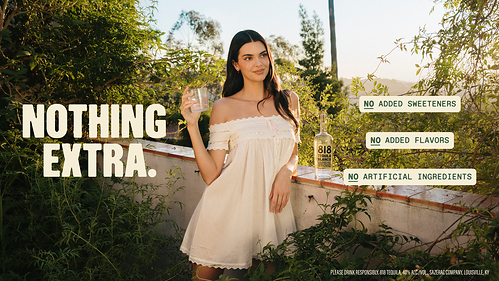
818 Tequila announced the work on November 9, and the spot is built on withholding. The camera teases a reveal, Kendall Jenner stays out of frame, and the object finally uncovered is the bottle. The film was shot at Flamingo Estate in Los Angeles, created by the agency Nice + Frank, produced by OBB Bolded and directed by Max Bartick. The Garden of Eden setting does quiet work: it makes the language of being bare legible to anyone, with no knowledge of distillation required. Jenner said the team "wanted to do something unexpected", and the genuinely unexpected choice is that the punchline is a composition list rather than a body.
 The setup runs on a reveal that never happens. Source: Little Black Book.
Why is a named ingredient list voluntary rather than required?
Most write-ups stop at the joke. The reference point that makes it worth reading is the category's own rulebook. Mexico's official standard, NOM-006-SCFI-2012, permits producers to use softening agents known as abocantes, a group that includes caramel colouring, glycerin, oak extract and sugar-based syrups, without naming them on the label, as long as their use stays at or below 1% of the tequila's total weight before bottling. On the US side, TTB's standard of identity at 27 CFR 5.22(g) says only that "Tequila is a distinctive product of Mexico" (TTB Industry Circular 06-03), and mandatory ingredient disclosure is still a draft rather than a rule: the Alcohol and Tobacco Tax and Trade Bureau published proposed Alcohol Facts and major-allergen labelling rules on January 17, 2025, then extended the comment period on April 7, 2025.
Set that baseline first, and the campaign reads differently. A bottle can carry "100% Agave Azul" and still sit inside the legal allowance for undisclosed agents. That makes a public commitment to 3 ingredients, backed by lot reports, a self-imposed standard. It deserves more scrutiny, not less, precisely because no regulator requires it.
What can the published lab results prove, and where do they stop?
Three things, each with a limit attached.
- Lots, not everything. The Nothing Extra page reports testing of specific Blanco and Reposado lots instead of a blanket guarantee across every bottle, and it publishes lot numbers customers can check.
- Trace is not the same as added. The results record trace propylene glycol detected in the tested samples even though 818 says none was introduced during production. The brand's explanation is that testing can identify trace compounds without an ingredient being deliberately added. That wording is narrower, and more honest, than a claim of literal nothingness.
- The formula change came before the advertising. 818 says tequila produced with its newer formula began rolling out in the United States in 2025, so November's campaign is a public-facing explanation of a transition the company says had already started.
Two more dates belong in the same timeline. Jenner founded 818, which began selling tequila in 2021, and the distribution picture changed earlier this year: in April the brand announced a strategic investment and an exclusive US sales and distribution agreement with Sazerac. Independent October reporting from Food Dive described 818 as entering a more aggressive growth phase after that deal. For a buyer, that sequence matters, because shelf access is what turns a web page claim into something you can audit in a shop.
How should the 77% growth figure be read?
As context, not as proof of the campaign. For the four weeks ending October 3, 2026, 818 reported, citing NielsenIQ, that US volume sales rose 77% from a year earlier, against 6% growth for the US tequila category priced at $24 and above. Those four weeks closed before the creative launched, so they describe the business entering the push rather than the push itself. Company-selected figures attributed to a measurement firm are still company-selected; that is a limit to note, not a scandal.
| Metric | 818 | US $24+ tequila segment |
|---|---|---|
| US volume sales growth for the four weeks ending October 3, 2026 | 77% | 6% |
The price band is the detail to hold onto: the comparison is against the $24+ segment, where a founder-led spirits label normally sits. A volume jump in a premium slice during an expansion quarter is an assortment and distribution story before it is a marketing story. Compare the Beats headphone advertisement, which uses several versions of Jenner to make a customisation feature easy to grasp; there, the celebrity is the interface. In this campaign she is the setup, and the product sheet is the payoff.
Which claims hold up, and which are easy to misread?
Common misreadings, listed plainly:
- Treating "100% Agave Azul" as a statement about additives. It is a statement about sugar source.
- Reading one lot report as a certificate for all production.
- Assuming a detected trace compound is a contradiction, when detection limits and addition are separate questions.
- Counting founder reach as distribution. A famous face cannot answer stock, price or shelf questions.
- Treating a celebrity campaign and a sales chart from the same quarter as cause and effect.
What does hold up is structural: the surprise ends on a fact, the fact is documented at lot level, and the documentation is reachable at the moment of purchase. That combination is rarer than either the celebrity or the slogan. It is also a question of who owns the product story, which is a brand control problem wherever a founder's name is bigger than the company's shelf presence. Read the Sazerac agreement the same way you would read any supply chain signal: as a change in who can actually buy the bottle, and therefore who can check it.
Frequently asked questions
Do I need to believe Kendall Jenner to use this campaign?
No, because the verification path is documentary. You need a lot code, the brand's published report for that lot, and the label in your hand. Kendall appears in the film; none of those three things depend on her.
Is a trace result a reason to distrust the brand?
Not on its own. It is a reason to prefer a report that says "trace detected" over a slogan that says nothing was added. Publishing the awkward line is what separates a transparency claim from a marketing claim.
Did the campaign lift sales?
Unknown. The 77% figure covers the four weeks ending October 3, 2026, before the November launch, and no attribution study has been published.
Is this category different from other spirits?
Only in disclosure habits. The 1% abocante allowance under Mexican law is the reason an explicit ingredient list is a position to take rather than a baseline to meet.
What should a general reader do next?
Two actions, one for buying and one for judging claims in general.
Buying: pick the bottle up, photograph the back label, and match its lot number against the published reports before you pay a premium band price.
Judging: reward brands that attach evidence to a slogan, and ask for the lot-level document when they do not. Attention is cheap; a testable claim is not.
Before you trust any transparency campaign, including this one, run the same list:
- Locate the lot or batch code on the bottle, usually printed on the back or neck label.
- Open the brand's testing page and confirm a report exists for that exact lot, not only for the range.
- Separate sugar-source wording such as "100% Agave Azul" from additive disclosure; they answer different questions.
- Look for "not detected" versus "trace detected", and note the reporting limit if one is stated.
- Compare the price against the $24+ premium band to judge whether you are paying for composition, branding or distribution.
- Confirm the product is stocked near you after the Sazerac rollout; availability is the cheapest proof that a growth story is real.
References
- NOM-006-SCFI-2012, Official Mexican Standard for Tequila (English copy, Consejo Regulador del Tequila): https://www.crt.org.mx/wp-content/uploads/2024/01/NOM-006-SCFI-2012%20-%20INGLES.pdf
- TTB Industry Circular 06-03, standard of identity for Tequila at 27 CFR 5.22(g): https://www.ttb.gov/public-information/industry-circulars/archives/2006/06-03
- Small Business Advocacy, "TTB Extends Comment Periods for Two Proposed Rules on Alcohol Labeling Requirements", April 8, 2025: https://advocacy.sba.gov/2025-04-08/ttb-extends-comment-periods-for-two-proposed-rules-on-alcohol-labeling-requirements/
- 818 Tequila brand site: https://drink818.com/
- Kendall Jenner's 818 Tequila Makes More Transparency A Selling Point, Forbes, November 2026: https://www.forbes.com/sites/johnkell/2026-11-09/kendall-jenners-818-tequila-makes-more-transparency-a-selling-point/