
ItInsightsWorld: iPhone Duo Cracks Put the Hinge Support Bar Under Scrutiny While Apple Has Not Disclosed a Fault Count
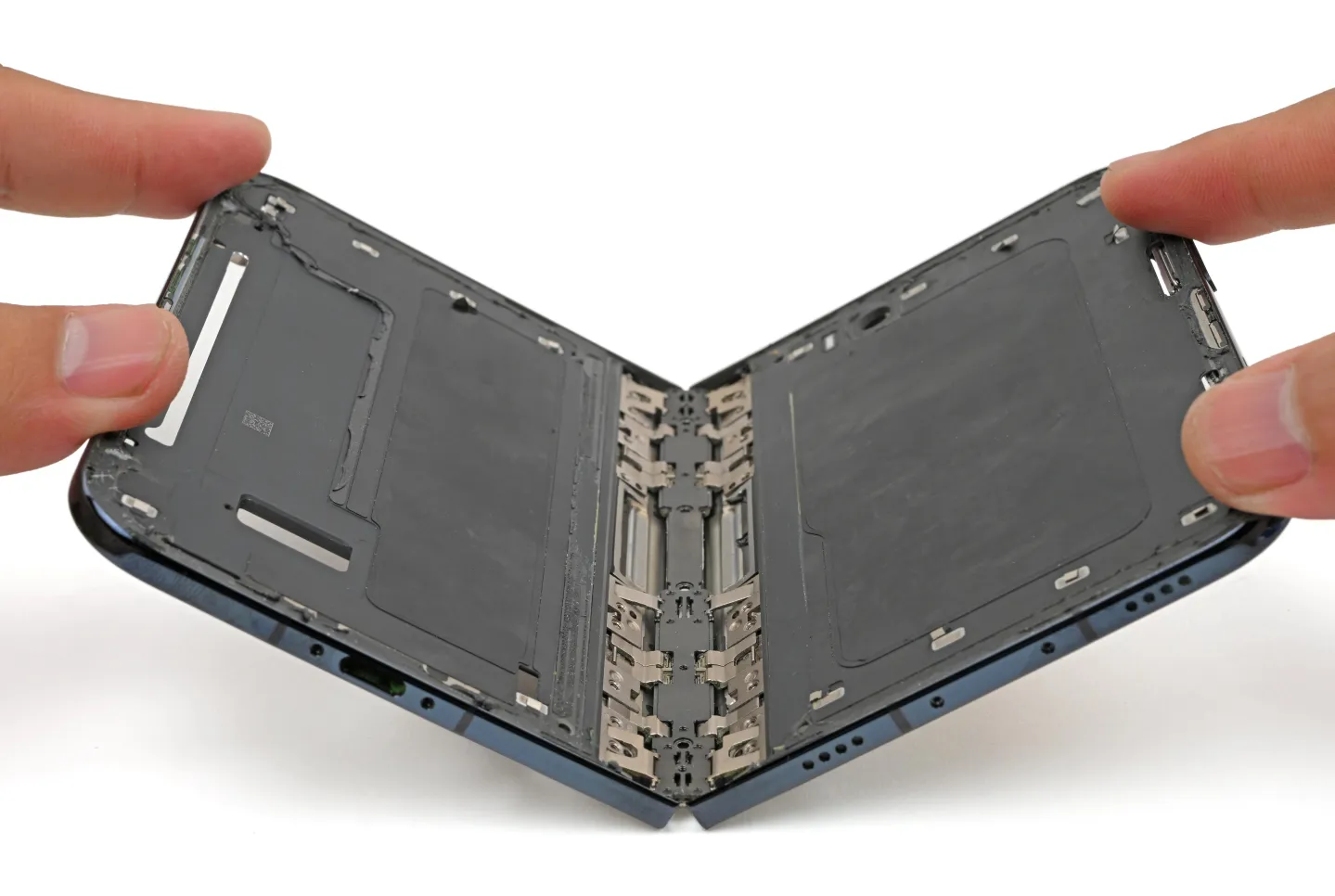
By James Hartley for IT Insights: A crack appearing on an iPhone Duo inner screen may not be a simple panel failure, according to The Verge on October 27. The report centers on a hypothesis from Shahram Mokhtari, iFixit's lead teardown technician, that the fold's hinge mechanism - including how its parts move during opening and closing - could be creating localized damage. Apple has acknowledged that a small number of devices are affected and has directed owners to AppleCare for replacement, while still not disclosing the number of faults or the confirmed root cause.
Damage appears clustered around the fold line
Images shared by owners show a recurring pattern rather than random breakage. In some cases, a dark patch appears near the central folding zone, then bright pixel lines extend toward the right edge of the panel. Other owners say the phone felt as if something was catching near the hinge even while being unfolded normally; after they continued the motion, they heard a clear crack and the screen failed.
That geographic consistency pushed investigators to look beyond the flexible display itself and at the assembly underneath it.
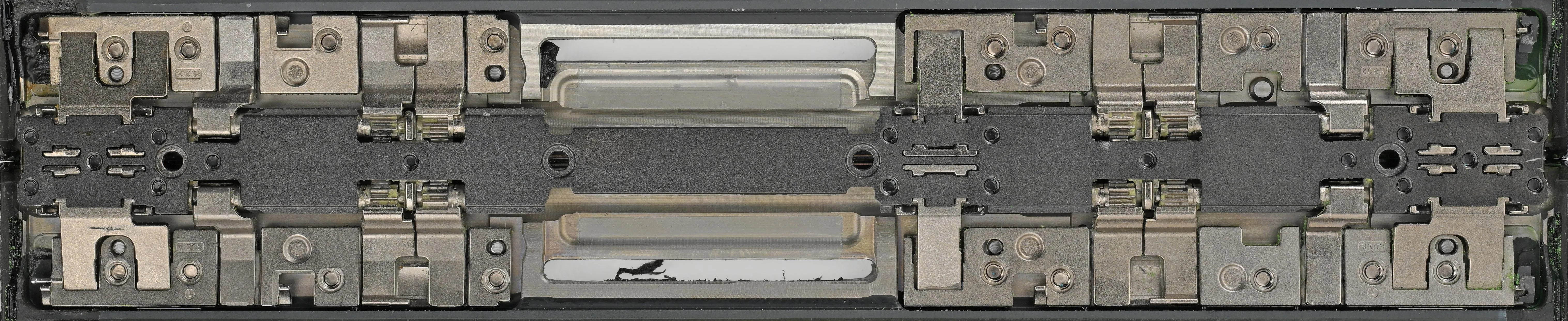
The hinge's support bar becomes the focus
iPhone Duo's hinge is not a single rotating axis. It combines gears, springs, connectors and support structures, and must both keep the device closed tightly and preserve enough bending room for the flexible display so the crease does not become overly visible. That requires close coordination among many internal parts.
iFixit's teardown information indicates that the central hinge support structure must also leave clearance for the flexible ribbon passing through it. The resulting edges and structural junctions may become weak points when mechanical load is applied.
Mokhtari's concern centers on a support bar near the middle of the hinge. In normal operation, the bar should retract downward when the phone folds, giving the curved display space. If it does not fully clear the panel, metal components could touch a bent flexible display.
That contact would not spread pressure evenly across the screen. Instead, stress would concentrate in a tiny area - what the researchers described as a stress hotspot. Repeated exposure, or a sudden increase while unfolding, could damage the internal display layers and produce black spots, bright lines, or visible cracks.
Sudden failures and teardown evidence point inward
The hypothesis also helps explain why some faults appear without warning. One user said the hinge felt abnormal while showing the phone to a friend; when the display was opened further, the screen cracked audibly. Because damage can originate in the internal folding zone, the absence of scratches or impact marks on the outside does not rule out a mechanical cause inside.
YouTube creator CuriousHagi offered another clue. During a demanding durability test, the iPhone Duo's display ruptured in the folding area. A subsequent teardown found a hinge component connected to the central support bar had broken, and its location resembled regions described by users experiencing screen failures.
These observations are not proof of a universal defect. The durability sample was subjected to extra stress and environmental conditions beyond typical use, and one disassembly cannot show that every crack came from the same mechanism. Apple still needs to examine a large set of failed units to distinguish among parts tolerance deviations, assembly variation, uneven hinge motion, or insufficient flexibility in the display itself.

Apple's position: a small number, no recall
Apple currently frames the issue as inner-screen faults affecting a small number of iPhone Duo devices, and tells affected users to contact AppleCare for a replacement. It has not announced a recall, nor confirmed that a final corrective design change is ready.
Analysts at iFixit note that foldable displays and their hinges are among the most delicate elements in a phone: the panel must bend repeatedly within a very compact space, while the hinge depends on many coordinated moving parts. Some failures at the start of a new product line are therefore not completely unexpected. The more telling signal would be if cracks keep appearing in the same location over the next months, which could point to a broader design or manufacturing problem rather than isolated units.
Mokhtari suggested Apple's engineers will likely revisit the hinge's problematic structures using real-world data from the first-generation iPhone Duo, and may improve the design in later models. Because this is Apple's first foldable iPhone, mass-production experience can reveal mechanical risks that laboratory testing does not easily reproduce.
At present, the failure rate among shipped devices remains unknown, and there is no complete statistic to determine whether a large-scale recall would be required. Social media examples can show how the fault manifests, but they do not prove that every iPhone Duo carries the same defect.
What this means for the Crackgate debate
The episode is becoming a reliability checkpoint for the iPhone Duo and for foldable smartphones more broadly. Competing on size, thinness or crease depth is not enough; the hinge and flexible screen must survive repeated real-world motion. If a central support structure can press the panel under particular positions, swapping damaged devices may not eliminate the risk - Apple may need design or manufacturing changes that remove stress concentration zones.
Until Apple's investigation is complete, the support-bar squeeze theory remains a credible explanation based on teardown logic and user reports, not an officially confirmed conclusion. Whether the episode ends as early, individual faults or develops into a wider design problem will depend on how failure patterns evolve and whether Apple changes the hinge structure in response. For now, Crackgate stays an open question.