
China vs. US iPhone Duo: What Apple Has Said and What Buyers Should Actually Trade Off
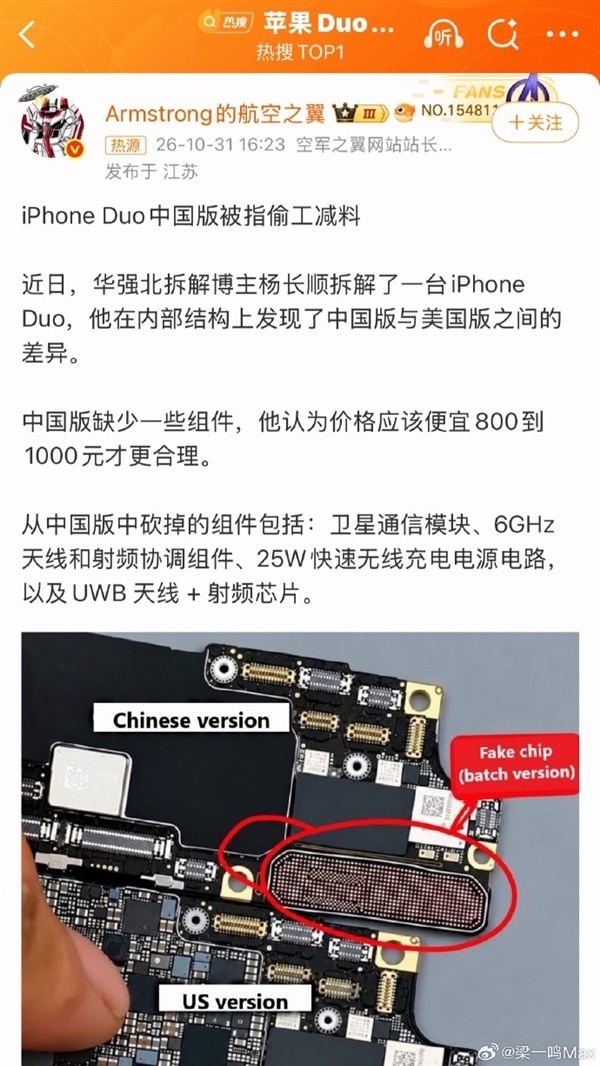
Recently, a teardown video from Huaqiangbei content creator Yang Changshun turned a niche hardware comparison into a broad consumer debate: is the China version of iPhone Duo materially worse than the US version? Based on the available public parameters and Apple's response, the answer is not a simple yes. Apple's technical personnel said they currently cannot directly verify the third-party teardown; the company also noted that different regional versions may have minor adaptation differences in parts procurement and production, while official parts-level details are not available for disclosure. The practical question is not whether every component is identical, but which functions are legally usable where the phone is used.
Previously, early online claims said the China version lacked a satellite-communication module, a 6GHz Wi-Fi antenna, a 25W wireless-charging circuit and related radio components. From those assumptions, many users derived a hardware difference of roughly 800 to 1,000 yuan range and said the China model was overpriced. The most repeated rumor, however, was about UWB. Apple China's official website directly lists the China iPhone Duo as using a second-generation Ultra Wideband chip, with distance measurement and spatial awareness features intact, so the claim that Apple removed the UWB chip does not match the public specification.
Verdict before the details
For a general reader, the controversy can be read as a compliance split rather than a clean price-cut story. A device sold in mainland China must operate inside domestic radio, telecom and product-certification rules. A US model can expose capabilities that require spectrum access, service licensing or certification in the United States. That does not mean one version is universally better; it means the two versions answer different legal environments.
| Capability | US version | China version | What it means in real use |
|---|---|---|---|
| Satellite SOS and location sharing | Can be used when ground-cell coverage is absent | Corresponding module is reported as present but the service cannot be enabled under domestic rules | The difference is mainly service access, not a visible everyday feature inside most cities |
| Wi-Fi 7 in 6GHz | Can use the higher-frequency 6GHz band where permitted | Limited by domestic radio-management rules to 2.4GHz and 5GHz | Peak Wi-Fi throughput may look lower on benchmarks, especially on routers with broad 6GHz availability |
| MagSafe wireless charging | Can reach up to 25W in supported configurations | Top wireless-charging output is reported at 15W | Charging speed differs, but daily charging with a cable or certified pad remains practical |
| UWB ranging and spatial awareness | Second-generation Ultra Wideband chip | Apple China's specification page also lists a second-generation Ultra Wideband chip | The rumor of a missing UWB chip is contradicted by public official parameters |
Why a teardown photo can mislead
Teardown content is valuable because it shows physical construction. But it does not always tell the buyer whether a feature is removed, disabled, unlicensed, or simply unnecessary in the local network. A hidden component may exist but remain inactive because the service provider or radio regime does not permit it. Conversely, a visible absence in one board layout may reflect regional compliance engineering, not a secret 1,000 yuan discount.
The UWB example shows why source discipline matters. The claim that the China version was stripped of UWB spread faster than any official document because the story fit a familiar complaint: regional hardware downgrades. Yet Apple China's official website lists the second-generation Ultra Wideband chip, and the public specification shows the relevant ranging and spatial-awareness capability as intact. That makes this one of the easiest rumors to falsify if the reader checks the right page first.
The three feature gaps most discussed
1. Satellite communication: hardware presence versus service permission
The most emotionally loaded point is safety. The US version can send SOS text and share real-time location when ground cellular coverage is unavailable. The China version is described as containing the corresponding hardware module, while the satellite service itself cannot be enabled under domestic communication rules. For buyers, the lesson is to separate a capability that may become useful in remote areas from a capability that is normally hidden by carrier, spectrum and licensing constraints. If a user regularly travels in regions with no cellular coverage, this is not a trivial detail.
2. 6GHz Wi-Fi: spectrum policy before hardware theory
The 6GHz Wi-Fi issue is less about the phone alone and more about the regulatory landscape. The Wi-Fi Alliance's China spectrum requirements material is a useful context for why a device intended for mainland use may not expose the same band structure as a US model. In the iPhone Duo discussion, the China model is limited to the conventional 2.4GHz and 5GHz bands for Wi-Fi 7, while the US model can use the wider 6GHz band where local rules permit. That means a user with a high-end Wi-Fi 7 router may see different throughput results, but it does not mean the phone cannot perform well on domestic networks.
3. MagSafe charging: 25W headline versus 15W local ceiling
Wireless charging is another area where headline numbers can create disappointment. Apple's own MagSafe support documentation describes peak power up to 25W in supported iPhone and charger combinations, so the US figure is not a marketing fiction. In the China iPhone Duo case, the reported ceiling is 15W, tied to domestic wireless-charging frequency and certification requirements. For most users, the difference may show up as longer charging sessions with a magnetic pad, not as a broken phone. But for people who rely on rapid desk charging, it is a concrete trade-off.
Common misconceptions to avoid
- If a component is invisible in a teardown, it must be removed. Not necessarily. Some hardware may be inactive because a licensed service is unavailable, or because regional compliance changes the exposed functionality.
- Because UWB is listed officially, every rumored part is also official. No. The UWB claim is refuted by public specs, but other parts differences remain unverified because Apple says parts-level details are not disclosed.
- 800 to 1,000 yuan range is an official value. It is a user-side estimate based on assumed component cost and market pricing, not an Apple-confirmed savings figure.
- Slower Wi-Fi 7 means the phone is defective. The more plausible explanation is the local band set, router configuration, channel width and testing environment.
- The China version is unusable. The master facts say the domestic regulatory differences explain most functional gaps, and daily use in mainland network environments remains compatible.
FAQ: quick answers for ordinary buyers
Is the China iPhone Duo a cut-price model with missing hardware?
The available official information does not support a blanket yes. The UWB chip is publicly listed. Satellite, 6GHz and MagSafe differences are better described through licensing and domestic frequency rules, while parts-level verification remains incomplete.
Should I import a US iPhone Duo to avoid the difference?
Only after checking warranty, network band compatibility, service availability and the legal status of imported devices. The US model may expose more headline features, but those features are only useful if they are supported in the buyer's actual environment.
Does 6GHz matter for everyday browsing?
It matters most in environments with modern Wi-Fi 7 routers, many concurrent clients, or users who compare peak wireless throughput. For ordinary streaming, browsing and domestic work networks, the 2.4GHz and 5GHz setup is still the practical path for the China model.
Is the 15W MagSafe limitation only an Apple issue?
Not only. Wireless-charging limits are commonly tied to regional radio-frequency rules and certification regimes. Apple's broader MagSafe support documentation shows 25W as a peak capability in supported conditions, which helps readers understand that the phone's headline number is not the whole story.
What should I watch next?
Watch for official parts clarification, long-term repair reports, independent teardown replication, and whether any feature previously described as disabled later receives a licensed service in the domestic market.
Action checklist before making a decision
- Check the official regional specification page first. Compare feature names, supported bands and charging output rather than relying only on teardown thumbnails.
- Write down your actual environment. If your router lacks 6GHz or your daily charging is mostly wired, the Wi-Fi and wireless-charging gap matters less.
- Do not treat the 1,000 yuan rumor as price truth. Use it as a signal to compare total ownership: warranty, accessory support, network service and after-sales convenience.
- Wait for parts-level confirmation before accusing cost-cutting. Apple currently cannot verify third-party teardown details, and the official parts list is not disclosed.
- Judge by use case, not slogan. A remote explorer, a Wi-Fi power user, a magnetic-charging commuter and a city-based mainstream buyer should weigh the gaps differently.
The bottom line is that the iPhone Duo China-versus-US debate is less about one secret discount and more about how regional rules shape what a consumer can access. For readers making a purchase decision, the safest framework is to verify official specifications, separate legal availability from physical hardware, and then decide whether the missing service capabilities actually affect the jobs they need the phone to do.