
Q-Day Compared: IonQ, Google and Oratomic — Which Quantum Timeline Should You Plan Around?
By James Hartley · IT Insights · Contact: contact@itinsights.com
How close is Q-Day? It depends which machine you believe, but three independent estimates published inside twelve months now aim at the same short window. IonQ’s trapped-ion design wants relatively few qubits and a long run; Google Quantum AI’s superconducting design wants far more hardware and finishes almost instantly; Oratomic’s neutral-atom proposal sits between them. Whichever route wins the race, the earliest credible line — not the average of the three — is the number worth budgeting against.
What is Q-Day, and what did IonQ actually publish?
Short answer: Q-Day is the first moment a quantum machine can recover a live private key, and it is a window rather than a calendar date. The most concrete claim that this window opens inside an existing hardware roadmap landed in September this year, when IonQ released a blueprint arguing that a fault-tolerant trapped-ion computer running Shor’s algorithm with 20,000 physical qubits could recover a 256-bit elliptic curve key in less than 26 days.
Two details make that figure worth reading slowly. The arithmetic itself would keep a classical computer busy for billions of years, yet the algorithm is anything but new: Peter Shor, a mathematician at MIT, published it in 1994 to attack factoring and the related problems underneath most public-key cryptography. And the hardware bill has collapsed — earlier resource studies assumed more than one million physical qubits, while IonQ’s estimate now lands at around 20,000.
The schedule attached to the paper is what turns a research result into a planning problem. IonQ’s roadmap calls for a fault-tolerant 10,000 physical qubit computer in 2027, then a 20,000 physical qubit system in 2028 — which, taken at face value, puts the required machine roughly two years away. The same 256-bit elliptic-curve signatures lock down far more than crypto wallets: U.S. government networks and enterprise IT rely on them for authenticated, secure communications, so a cryptographically relevant quantum computer (CRQC) arriving early reads as an alarm bell rather than an engineering milestone.
 Chris Balance
“The important point I want to make when we’re talking about this is to not come across as threatening—we’re not trying to attack cryptography,” Chris Ballance, IonQ president, told EE Times. “Cryptography is black and white—you can either solve or not solve the problem—and we can use this as a benchmark metric for our quantum computers.”
“[You can see] if your compiler stack is doing a good job, if you’re a wizard at developing algorithms—all of these different pieces come together in a black and white answer—and it is very rare to have a benchmark that is so clear in a new compute field,” he added.
Three estimates, one target: the comparison scorecard
The three published designs are not arguing about whether secp256k1 falls. They are arguing about what you must build and how long it must run. That trade — metal versus minutes — is the part most coverage skips, and it is the part that changes what you should do.
| Team and announcement | Hardware route | Physical hardware | Run time | The bet it makes |
|---|---|---|---|---|
| IonQ, September this year | Trapped ion, Walking Cat error correction | 20,000 physical qubits | less than 26 days | Smallest realistic machine, slowest job |
| Oratomic with Caltech, March this year | Neutral atom | as few as 10,000 physical qubits | a few days | Lowest qubit count on paper |
| Google Quantum AI with Ethereum Foundation, University of California Berkeley and Stanford University, On the same day | Superconducting | fewer than 500,000 physical qubits | roughly nine minutes | Most hardware, fastest payoff |
| Iceberg Quantum (RSA-2048 benchmark) | Fault-tolerant architecture, software-first | from 98,000 physical qubits to 72,000 physical qubits | from up to a month to 3.7 days | Algorithms, not fabs, compress the clock |
The neutral-atom case arrived in March this year from Oratomic — a startup founded by researchers from Caltech, Harvard, Berkeley, Google, and Amazon — working with Caltech researchers. Their headline number was the smallest yet: a system with as few as 10,000 physical qubits could crack the encryption in a few days. The authors were careful not to oversell: “Although substantial engineering challenges remain, our theoretical analysis indicates that an appropriately designed neutral-atom architecture could support quantum computation at cryptographically relevant scales.”
On the same day, Google Quantum AI and its academic and Ethereum Foundation collaborators took the opposite trade, showing that a superconducting machine could break that encryption in roughly nine minutes using fewer than 500,000 physical qubits. Their paper closed with an appeal rather than a victory lap: “We urge all vulnerable cryptocurrency communities to join the migration to post-quantum cryptography without delay.”
Here is the practical consequence, and we flag it as analysis rather than a published finding: run time is a defensive variable. A key-recovery job that needs about three weeks leaves a monitored wallet, exchange or certificate authority some chance of rotating or freezing funds inside the attack window. A nine-minute job removes that margin almost completely. A roadmap that buys a smaller machine and accepts a slower attack is therefore not automatically the “less dangerous” option — it is simply the more buildable one.
The three routes also differ in temperament. Superconducting chips switch fastest, trapped ions hold state most cleanly, and neutral atoms are the easiest to multiply in an optical tray — a framing the University of Chicago’s PME group uses to argue that the field is a “prairie” of competing modalities rather than a single-track race. Comparing qubit totals across those platforms without comparing gate speed, fidelity and error-correction overhead is the most common mistake in quantum-risk headlines.
Why IonQ’s number is this small: a fully compiled stack
The result was published as “Computing 256-bit elliptic curve discrete logarithms in 26 days on a fault-tolerant trapped-ion quantum computer with 20,000 qubits”, and the point of the 70-page paper is end-to-end compilation, not a cleverer equation. It maps a complete route to break secp256k1 — the elliptic curve protecting Bitcoin and Ethereum — on a trapped-ion machine built around IonQ’s error-correcting ‘Walking Cat’ architecture, which shuttles ions across a grid and uses Schrödinger-style superpositions called cat states to catch the errors that otherwise multiply and destroy a calculation.
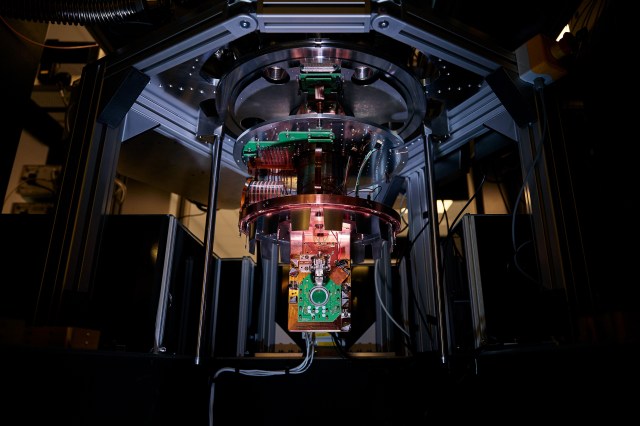 A trapped-ion system from IonQ (Image credit: Fisher Studios)
IonQ attributes the drop in 256-bit elliptic-curve cryptography requirements to co-design: algorithm, compiler, hardware and error-correction layer optimised together, with temporary helper qubits recycled mid-calculation and entangled cat-state resources reused instead of consumed.
“We have every single layer of the stack… and we compiled every operation down to the actual error-correction primitives our architecture runs,” Ballance said. “We haven’t just done mathematical proofs… we have put everything together all the way down to the individual instructions you can run on a quantum computer.”
He also argues the paper lands at the right moment on the calendar. “As we’ve started to see how we can build these 10,000 to 20,000 physical qubit-sized devices, people are going from daydreaming to actually having engineering designs—they’re starting to build and put the different pieces together.” And on intent: “We have shown how each of the necessary elements come together, and also the tradeoffs that you need to make to throw a gauntlet out to the field, to show what a good solution looks like,” he added.
From lasers to silicon: the manufacturing case behind 2028
A qubit count is a claim; a fab schedule is evidence. For years trapped-ion systems leaned on complex free-space laser rigs to steer individual qubits, which capped how far the count could scale. In September 2025 IonQ changed the approach by acquiring Oxford Ionics, an electronic qubit control (EQC) pioneer co-founded by Chris Ballance and Oxford University researcher Tom Harty. Swapping optics for integrated electronics on silicon chips, the company soon demonstrated prototypes with two-qubit gate fidelity in excess of 99.99%; for comparison, Google Quantum AI has reported close to 99.88% two-qubit gate fidelity with superconducting qubits.
“[Our] level of quantum performance has been the industry’s north star for decades,” said Niccolo de Masi, chairman and CEO of IonQ, at the time of that demonstration. Ballance added: “In exceeding the 99.99% threshold on chips built in standard semiconductor fabs, we are now on a clear path to millions of qubits whilst unlocking powerful new commercial applications sooner.”
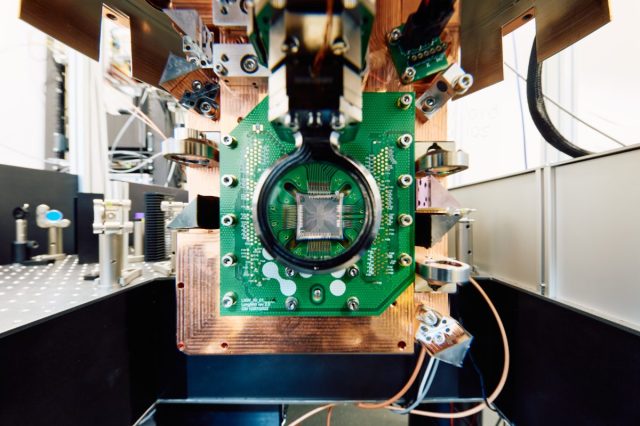 IonQ’s trapped-ion quantum computing processor unit with electronic qubit control (Source: IonQ)
The follow-on moves were supply-chain moves, not lab moves. IonQ acquired U.S. silicon chip maker SkyWater Technology in July this year to lock in scalable hardware fabrication; come September it launched Superion 256, a 256 physical qubit platform using EQC — and published the blockchain-cracking paper the same day.
“Right now, we have chips at the 10,000 [physical] qubit scale designed and these are going into the fab for our next generation products,” Ballance said. “[Large-scale quantum computing] requires a highly manufacturable hardware platform you can scale without dying on complexity hill—you can’t get stuck in a science experiment, building something like the Large Hadron Collider. The Superion platform allows us to scale out these chips.”
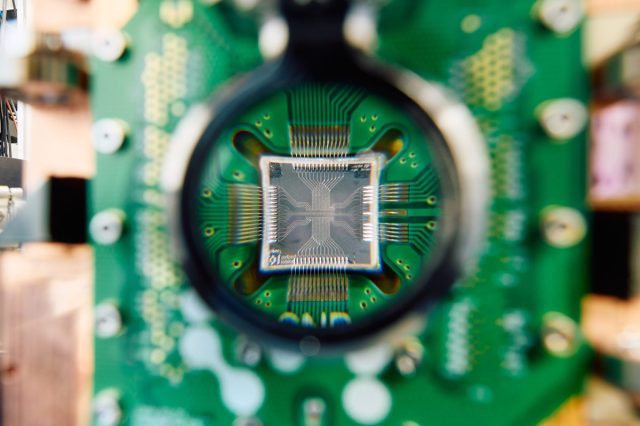 IonQ chip, manufactured with standard silicon facilities and processes (Source: IonQ)
Two independent experts, two different levels of urgency
Both specialists read the new papers as real progress — and as no reason to relax the calendar. Thomas Prest is a senior cryptographic researcher at PQShield, the U.K.-based cybersecurity firm specialising in post-quantum cryptography (PQC) — algorithms designed to stay secure against quantum attacks — which works with governments, financial institutions and other organisations moving to quantum-safe standards. Prest has also tracked progress toward CRQC.
“Cryptocurrencies [Bitcoin and Ethereum] are very vulnerable right now as they are using digital signatures that are not quantum-resistant,” he said. “They are aware of this, and Ethereum at least, already has a solid plan to move to post-quantum signatures.”
“But from my point of view, quantum computers represent a threat to not only cryptocurrencies but entire industries that rely on cryptography,” he added. “We’re in discussions with the defense sector and large companies that work with routers, anything that needs encryption at scale—these organizations are most concerned with quantum computing.”
Prest reads the Oratomic and Google work as movement toward CRQC and toward future attacks on live systems, while insisting more breakthrough results are still needed — and that the right response is a PQC transition as soon as possible, preferably with a 2030 deadline. “This migration takes years, not months, as protocols, software, and hardware implementations all need to be updated,” he said.
Professor Jungsang Kim, chief science and technology strategist for the Provost at Duke University in the U.S., offers the more deliberately cautious reading. Kim co-founded IonQ in 2015 and served as CTO until 2024, when he left the company, which makes his caution about an imminent threat unusually well informed.
“I’m not sure if there’s any fundamental physics or fundamental questions that are left unresolved,” he said. “I think this is now all about the execution… and this will still require substantial technology development and innovation to pose a real threat.”
Kim, like Prest, doubts blockchain elliptic-curve cryptography will be broken by the late 2020s rather than on a longer 2030-plus timeline — while noting that quantum progress resists forecasting, and that heavier investment, bigger teams and more collaboration could land results early. “I’m still quite optimistic that we won’t be able to crack these codes by the late 2020s, but [the latest results] all point to us needing to go to post-quantum cryptography as quickly as possible—you don’t want to have the slightest chance of taking that risk.”
Deadline dashboard: who has committed to what, and when
Government deadlines are, in effect, official bets on Q-Day. The U.S. National Institute of Standards and Technology (NIST) published a PQC migration roadmap in late October this year stating that federal high-value and high-impact systems should adopt PQC standards by the end of 2030, with the broader federal transition targeting 2035. Canada, Japan and the U.K. governments stipulate migration by 2035; the Australian government suggests 2030 or sooner; Microsoft has opted for 2033. Cloudflare set a 2029 deadline, and so did Google, which has an insider’s view of quantum progress.
| Who set the date | Target | What it signals for planners |
|---|---|---|
| NIST roadmap, late October this year | by the end of 2030 for high-value federal systems; 2035 for the wider transition | The reference date most other schedules copy |
| Canada, Japan, U.K. governments | 2035 | Aligned with NIST’s outer bound |
| Australian government | 2030 or sooner | More conservative than peers |
| Microsoft | 2033 | Vendor roadmap for cloud estates |
| Cloudflare and Google | 2029 | Two internet operators with visibility into quantum hardware |
| U.S. NSA, CNSA 2.0 requirements | New national-security acquisitions must be quantum-safe by default from 2027, with full transition by 2035 | Procurement pressure arrives before the cryptographic deadline |
| IonQ’s own read | Q-Day toward the end of the decade | Ballance: “A lot of this comes down to how you care about your security posture… But we’re seeing a lot of organizations around the world re-guiding toward 2028.” |
Read together, the public schedules cluster at 2030 or later, while the operators closest to quantum hardware — Google, Cloudflare, IonQ — have moved their internal markers to 2029 or 2028. That gap between official deadlines and vendor deadlines is where most organisations are exposed today, and it is why procurement, not just cryptography, should drive your timeline.
Why the estimates keep falling — and why that shrinks your runway
Every revision has pointed in one direction: cheaper attacks. At the time of writing, Sydney-based Iceberg Quantum had updated its early-2026 estimates to say its fault-tolerant quantum architecture could factor the widely used public-key algorithm RSA-2048 using around 98,000 physical qubits in up to a month. Those early-2026 figures were then reduced by estimates out last month to 72,000 physical qubits and an expected runtime of just 3.7 days. Iceberg published its results in a blog rather than a detailed paper, but the RSA-2048 revision still adds to the evidence that the resources needed to break public-key cryptography are dropping quickly — and that the preparation window is narrowing.
“In 2025, I flagged that the Q-Day time horizon was shifting from the 2030s to the 2020s… Our findings clearly define the risk to elliptic-curve-secured systems,” de Masi said when the firm released its blueprint to break the elliptic curve protecting Bitcoin and Ethereum.
Policy money is pulling in the same direction as the physics. The U.S. awards $1B to Anderon for quantum wafer manufacturing and has injected $2B into quantum computing companies, effectively subsidising the hardware side of the problem. Meanwhile the demand side is being priced in: the U.S. federal government has put the migration of prioritised civilian systems to PQC at roughly $7.1 billion across 2025–2035, according to the White House report on post-quantum cryptography, and the Cloud Security Alliance maps enterprise migration into phases running through 2028–2030. Cheaper to build, mandatory to migrate, expensive to delay — that combination is what makes the earlier of the two dates the planning date.
Who is actually exposed, and who is not (yet)
Exposure is a property of an address, not of a cryptocurrency. A wallet becomes a plausible target only once its public key has been revealed — which happens whenever coins are spent from an address, because the spend exposes the key for verification. Analyses citing research from Ledger’s Donjon team estimate that roughly 25% of Bitcoin’s supply by value sits behind already-exposed public keys, including long-dormant coins; fresh receiving addresses that never spend keep the key hidden and are far less urgent.
- Reused addresses, exchanged keys and custodial hot wallets: highest priority — the key material is already public.
- Self-custody with modern, spend-then-change behaviour: lower exposure, but it disappears the moment you sign a transaction from a legacy address.
- Enterprise TLS, code signing, VPNs and PKI: vulnerable for a different reason — “harvest now, decrypt later” means traffic captured today can be decrypted when a CRQC arrives, regardless of when Q-Day lands.
- Everything with a long field life: routers, industrial controllers, medical devices and vehicle firmware still running in 2035 need crypto-agility now, not a patch later.
Five misreadings of the Q-Day debate
- “Q-Day is a date on a calendar.” It is a window that opens when an attack becomes cheaper than the value it protects, and it will be reached machine by machine, curve by curve.
- “20,000 qubits means the whole blockchain economy falls.” The paper describes one signature scheme at one hardware scale; dormant, exposed keys are the soft target, not the protocol as a whole.
- “Fewer qubits always equals lower risk.” IonQ’s estimate buys a smaller machine by accepting a longer run; Google’s buys speed with far more hardware. Risk depends on which of the two an adversary can actually operate.
- “Governments have until 2035, so there is no rush.” NIST’s roadmap puts high-value federal systems at 2030, and Prest’s point stands: the migration itself takes years.
- “The loudest forecaster is the most reliable one.” IonQ sells quantum computers and, as its own president says, treats cryptography as a benchmark. Useful signal — but read it alongside Kim’s execution caveat.
FAQ: the questions readers actually ask
Is Bitcoin going to zero if IonQ hits its 2028 roadmap?
No. A machine that can recover exposed keys pressures a subset of coins and forces a hard conversation about signature migration; it does not erase the ledger. Prest’s view — that Ethereum at least already has a solid plan to move to post-quantum signatures — is one reason most analysts treat this as a transition problem rather than a terminal one.
Which year should I actually plan for: 2028, 2030 or 2035?
Start the work now, finish by 2030, and treat 2028 as the risk case for anything you operate on behalf of others. That is the gap between the vendor deadlines (Cloudflare and Google at 2029), the national roadmaps (NIST’s by the end of 2030 for high-value systems) and the outer compliance dates many governments chose.
What is the difference between physical qubits and the qubits in the headline?
Physical qubits are the atoms, ions or chips in the machine; a single error-corrected logical qubit consumes many of them. The number that really moves Q-Day is the ratio between the two, along with gate fidelity — which is why IonQ’s 99.99% demonstration, its Superion 256 product and its 70-page paper were published as one story.
Should a private user change wallets today?
If you hold coins in an address you have already spent from, moving to a fresh, modern address is cheap insurance and worth doing now. Otherwise the honest advice matches Kim’s for institutions: do not take “the slightest chance” of the risk, but do not panic-replace hardware you cannot yet swap.
What should a small business without a security team do first?
Inventory encryption, not code. Write down where certificates, VPNs, signed software and long-lived credentials live, then ask each vendor for its PQC roadmap and date. Whoever cannot answer is the risk worth tracking, not the qubit count.
Action checklist: the next 12 months
- Build a cryptographic inventory. Identify every dependency on elliptic-curve or RSA key exchange, including firmware, IoT and contractual integrations.
- Set one internal deadline and defend it. Adopt the earliest credible date affecting your sector; treat government 2035 dates as backstops, not targets.
- Hybridise first, replace second. Deploy PQC alongside existing algorithms in TLS and VPN gateways before attempting a clean cut.
- Buy crypto-agility, not just algorithms. Require updatable stacks and signing-key rotation from every vendor whose product will live past 2030.
- Freeze and rotate exposed keys. Retire reused addresses, shorten certificate lifetimes, and prioritise long-dormant key material in your risk register.
- Re-run the comparison every quarter. The IonQ, Oratomic, Google and Iceberg Quantum figures have each moved within months; your plan should move with them.
Sources cited
- IonQ newsroom on the fully compiled secp256k1 blueprint: https://www.ionq.com/news/ionq-publishes-worlds-first-fully-compiled-end-to-end-blueprint-for-breaking-256-bit-elliptic-curve-signatures
- U.S. NSA, CNSA 2.0 algorithm and transition requirements: https://media.defense.gov/2025/May/30/2003728741/-1/-1/0/CSA_CNSA_2.0_ALGORITHMS.PDF
- University of Chicago PME on comparing quantum modalities: https://pme.uchicago.edu/news-events/news/why-quantum-computing-competition-quantum-prairie-strength
- The Quantum Insider on the $7.1 billion White House PQC migration estimate and why timing drives cost: https://thequantuminsider.com/2026-05-15/why-timing-affects-the-cost-of-post-quantum-migration/
- The Quantum Insider roundup of government and industry migration deadlines: https://thequantuminsider.com/2026-05-08/post-quantum-migration-timelines-government-industry-impact/
- Cloud Security Alliance research on phased enterprise PQC migration: https://labs.cloudsecurityalliance.org/research/strategic-post-quantum-cryptography-migration-enterprise-roa/
- Exposure analysis of Bitcoin addresses with revealed public keys, citing Ledger’s Donjon research team: https://onrampbitcoin.com/knowledge-center/which-bitcoin-is-vulnerable-to-quantum-computing-address-types-exposure-tiers-and-what-you-can-do
Prepared by the IT Insights editorial team. Corrections and reader questions: contact@itinsights.com.