
ItInsightsWorld Report: Intel Entry-Level Chips Point to Efficiency-Only Moon Lake and a Core-Heavy Wildcat Lake Refresh
Rumored Moon Lake specs signal an all-efficiency approach
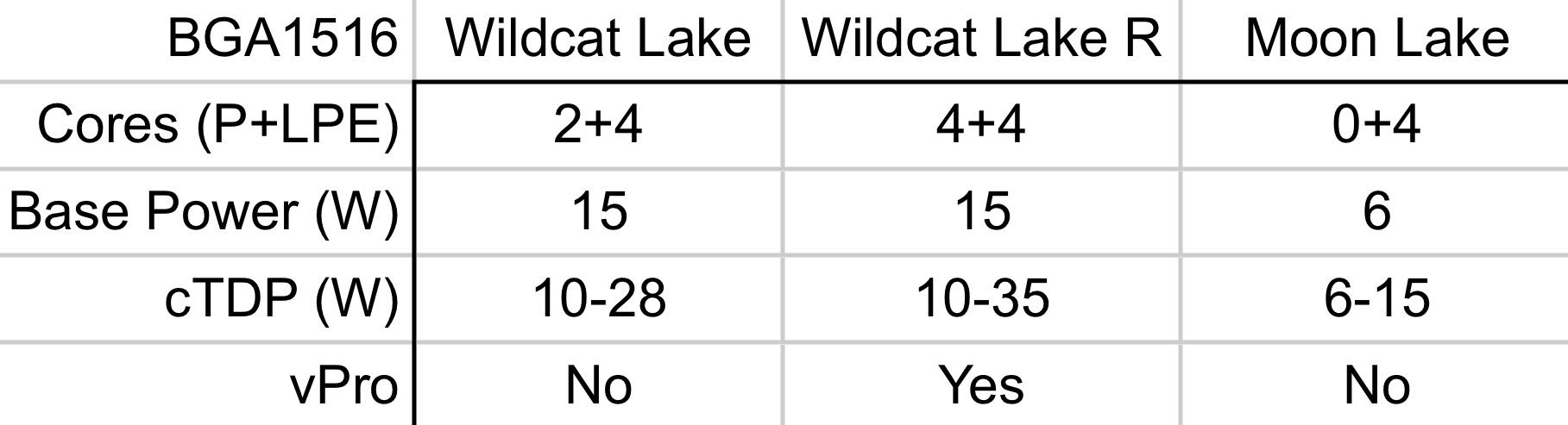
According to a leak shared by Jaykihn on October 29, Intel's entry-level Moon Lake is expected to reuse the same BGA 1516 packaging as Wildcat Lake and follow a disaggregated chip design. The compute chip is said to be built on the Intel 18A process, with up to four Darkmont low-power efficient cores and no conventional performance cores. Its base power is reported at about 6 W, while configurable power may reach up to 15 W.
That would make Moon Lake one of the most unusual Intel client chips in recent years, because mainstream laptop processors normally pair performance cores with efficient cores, assigning heavy work to the former and background or lightweight tasks to the latter. An all-efficiency design could shrink die area, reduce power draw and help lower system cost.
Where the core mix may fit and where it may fall short
The trade-off points toward entry-level notebooks, Chromebook-class devices and lightweight machines that are not expected to sustain demanding workloads. Web browsing, document editing, streaming video and basic office software can often be handled by low-power cores, while lower thermal pressure and longer battery life may improve the user experience.
The absence of performance cores could still limit sustained high-load work. Compiling complex software, editing large images, running multiple productivity applications at once, or any task that relies heavily on strong single-threaded speed may trail behind processors that include performance cores. Final results will depend on clock speeds, cache capacity, memory bandwidth and OS scheduling.
Graphics details are less certain. The leak suggests an Xe3 integrated GPU, but core count has not been confirmed. If Moon Lake sits below current Wildcat Lake parts, graphics throughput and media capabilities may also be constrained.
Wildcat Lake Refresh leans toward more performance cores
In contrast, Wildcat Lake Refresh appears to be an incremental upgrade to the existing Wildcat Lake family. Available specifications say the new lineup may include up to four Cougar Cove performance cores and four Darkmont low-power efficient cores, whereas current Wildcat Lake configurations are described as up to two performance cores and four efficient cores.
The central improvement is therefore likely to be the addition of performance cores rather than a wholesale architecture change. More performance cores should benefit multithreaded workloads and give budget laptops more headroom for demanding office tasks, multitasking and light creative work.
Power specifications are said to broaden upward. The refresh's base power range is expected to run from 10 to 35 W, higher than current Wildcat Lake's 10 to 28 W. A larger ceiling can allow laptop makers to extract more CPU performance when cooling permits, but it may add thermal-design pressure and affect battery life.
The refreshed parts are expected to keep Xe3 integrated graphics, and the GPU core count may not change dramatically, so graphics gains may be smaller than CPU gains. For thin-and-light notebooks that rely on iGPUs, practical gaming and compute graphics remain limited by GPU size, memory configuration and power constraints.
vPro support and disaggregated chip design
Wildcat Lake Refresh is also rumored to support vPro, Intel's platform technology for business devices that covers remote management, security features and enterprise device management. If implemented, vPro could expand the chips beyond consumer budget machines into more corporate notebooks and commercial endpoints.
Both processors are expected to use disaggregated chip design. Instead of placing all functions on a single die, the design separates compute, input-output and other functions into different chips connected by inter-die links. That allows different product tiers to adjust each block and may reduce manufacturing cost.
Wildcat Lake already follows a similar model, combining an Intel 18A compute chip with an I/O chip made on another process. By mixing process nodes, Intel can avoid requiring every function to use its most advanced node, helping control costs for lower-priced processors.
What Intel 18A does and does not guarantee
Intel 18A is an advanced node and a key part of Intel's effort to build leading-edge semiconductor manufacturing at home. It introduces RibbonFET gate-all-around transistors and PowerVia backside power delivery, aiming to improve transistor density, power delivery efficiency and performance. Bringing the 18A advanced process to entry-level processors suggests Intel wants to extend leading-edge manufacturing into cheaper product segments.
Advanced process alone does not guarantee stronger real-world performance in low-cost chips. Price targets, core count, cache, memory bandwidth, packaging and laptop thermals still matter. Even with the Intel 18A process, Moon Lake could remain slower than higher-tier processors because it has fewer cores and tighter power limits.
Segmentation of the budget PC market and open questions
The rumored lineup suggests Intel is further dividing budget notebook silicon. Wildcat Lake targets affordable laptops, student devices and lightweight commercial systems; Wildcat Lake Refresh appears to aim at buyers who need stronger CPU throughput; Moon Lake reaches lower still, serving ultra-low-power and low-cost devices such as Chromebook and other entry-level products.
This segmentation is happening as competition intensifies. Once Apple MacBook Neo, Qualcomm-powered Windows laptops and other low-cost machines enter the market, entry-level notebooks can no longer rely solely on older processors and cheaper manufacturing. Intel appears to be using the 18A advanced process, disaggregated design and different core mixes to preserve competitiveness while controlling cost.
At this stage, Moon Lake and Wildcat Lake Refresh specifications come from leaks, and Intel has not formally confirmed complete parameters, final names, prices or launch dates. Current information says Wildcat Lake Refresh may arrive in the first half of 2027, but the timing still needs official confirmation.
If the plans materialize, Intel would have a clearer entry-level hierarchy: Moon Lake prioritizing very low power and cost, while Wildcat Lake Refresh raises capability through more performance cores. Budget laptop shoppers may need to look beyond model names and check performance core counts, actual power limits, integrated graphics configuration and system cooling design to judge whether a device fits their needs.