
ItInsightsWorld | Intel's Valuation Gap: Foundry Timeline Still Missing as Stock Falls Nearly 30% After Earnings
Hours ago, Bank of America skipped the income statement and went straight to the missing input: when Intel's external foundry income can be modeled. Lip-Bu Tan gave no customer detail. Packaging produced a window—someone will be ready to announce in the next two quarters—but for 18A and 14A the response stayed later, with no formal tape-out timing and no forecastable number.
The current quarter's numbers were not the main shock; the next quarter's guide was. Revenue and EPS guidance ran well under consensus as PCs met memory pricing pressure. A separate operational hit came from Israel: Fab 28 in Kiryat Gat, once central to early 10 nm mass production and still supporting server 10 nm output, stopped for about two weeks after an explosion early this month.
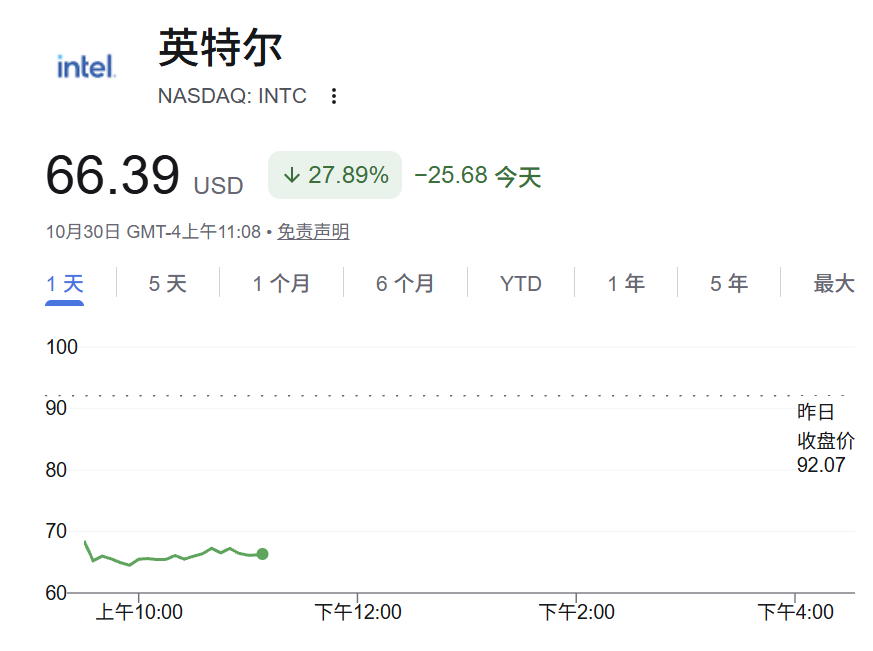
Capital-spending questions then moved to cash. Dave Zinsner said next year's capex was not finalized, called next year an investment year and said the company is probably not a positive free cash flow year. The shares fell nearly 30% on PC softness, gross-margin decline, and the unresolved external-foundry clock.
A ledger for the quarter and the guide
The table below separates what this quarter reported from what the next quarter guided.
| Signal | Number | Comparison | Why it matters |
|---|---|---|---|
| Reported revenue | $16.513 billion | up 21% year over year; almost exactly consensus of about $16.5 billion | the print itself was not the problem. |
| Next-quarter revenue guide | $15.0 to $16.0 billion | about $1.8 billion below consensus around $17.1 billion | before earnings, optimistic models had reached $17.1 to $17.5 billion. |
| Non-GAAP EPS | $0.52 | versus consensus about $0.40 and company guidance about $0.38 | Q4 guide $0.25 versus consensus around $0.43. |
| CCPG | $8.097 billion | down 5% year over year, down 9% quarter over quarter; operating profit $2.285 billion, margin about 28% | largest revenue block, but volume fell first; fourth quarter sequential decline expected more than 20%. |
| DCAI | $7.318 billion | up 78% year over year, up 17% quarter over quarter; operating profit $3.039 billion, margin about 42% | profit exceeded CCPG; server outlook could be about $10 billion above beginning of year expectations. |
| Foundry | $6.697 billion total | external revenue $411 million, up $118 million quarter over quarter, operating loss $1.853 billion | mostly internal orders; external timing remained later. |
| Israel incident | about $300 million | fourth-quarter revenue hit, about 200 basis points of gross-margin pressure | first quarter may see a similar hit; most scrapped wafers were recognized in the fourth quarter. |
The table does not remove the core uncertainty. The next quarter's weakness has two visible sources: PC demand and the 10 nm disruption. Management assigned the smaller explicit slice to the Israeli plant and the larger one to PC sales.
PC demand is the visible brake
- CCPG's weakness is immediate: PCs and laptops, $8.097 billion revenue, -5% year over year, -9% quarter over quarter. The fourth quarter is expected to fall more than 20% sequentially.
- Dave Zinsner warned, “Looking ahead, we expect the PC slowdown to continue at least until the first half of next year,” and said destocking will last at least into the first quarter.
- Intel's industry view is colder still: PC unit TAM down about 12% in 2026, with second-half decline more than 20%; 2027 down about 10% more.
- Memory pricing is the common thread. Data centers can bid up the same memory, while PC buyers resist higher system bills; the CPU vendor absorbs the shortfall.
- Morgan Stanley puts the client-business pressure into a $3 to $4 billion hit on consensus revenue.
Foundry is still the valuation engine, not a large external income line
Intel's earlier story leaned on PCs. After process leadership slipped, former chief executive Pat Gelsinger built out IDM 2.0, asking internal fabs to serve outside customers while funding new plants and advanced-node catch-up.
A year and a half into Lip-Bu Tan's tenure, that priority was not reduced. Around August, Intel raised about $23 billion. The balance sheet then looked more like support for a long investment case: the market wanted to fund “shortages will ease, 18A ramps, external customers pay.”
Yet the external line remains small: $411 million, up $118 million quarter over quarter, mostly one-time customer projects, inside a foundry unit that lost $1.853 billion. TSMC is still the yardstick because customers pay repeatedly for advanced nodes, not once.
SemiAnalysis said 18A has shipped, but density does not lead TSMC's same-generation process, and premium GPU and I/O parts still require mixed TSMC capacity. Morgan Stanley put the market's hope on 14A landing in 2028 or 2029, warned that large external commitments are still small, and argued that failure to serve internal demand would be the worst advertisement.
Data-center demand meets substrate and packaging constraints
The server side provided the brightest number. DCAI grew 78% year over year to $7.318 billion, and its operating profit of $3.039 billion was larger than CCPG's. Lip-Bu Tan said, “Despite near-term PC industry headwinds, demand for CPUs remains strong... the priority is to open additional supply to meet unusually strong demand for the Xeon family.”
The bottleneck is layered. Intel 3 output is rising, but industry-wide advanced organic substrate shortages limit EMIB advanced packaging. In practice, a wafer may exist while packaging materials do not, leaving server CPUs undelivered.
Management expects server-CPU shipments to rise more than 30% in each of 2026 and 2027, with tightness possibly lasting into the end of 2027 and even 2028. The company also suggested full-year DCAI could come in about $10 billion above what was expected at the beginning of year.
Morgan Stanley still discounted that strength: the numbers depend on shortage economics, and Intel's flagship products remain weaker than peers. A caller noted AMD's server-related revenue guidance was about 70% higher, while Arm architectures are also taking server share. Intel's reply was supply-contingent: share moves only as far as supply improves. No specific share point was given.
Cash is available; the model still needs a foundry date
After the August raise, Intel held about $54 billion in cash and short-term investments at the end of the quarter. Share and debt detail framed the dilution risk: about 5.3 billion shares diluted, fourth-quarter guidance on about 5.44 billion fully diluted shares, and interest-bearing debt of about $50.1 billion.
Gross capital spending in 2026 remains about $20 billion, and 2027 is described as rising sharply. The company did not lock an absolute number, so rounder estimates outside Intel should not be treated as guidance. Dave Zinsner's message on free cash flow was direct: next year is probably not a positive free cash flow year.
The quarter still produced $1.6 billion of adjusted free cash flow—operating cash flow about $5.1 billion, gross capex about $4.2 billion, plus adjustments tied to government incentives and partner funding. That positive print is not a pattern for next year. Operating collections and the raise are being absorbed by wafer lines, packaging lines and a foundry business still in the red. Morgan Stanley's view was that even upside revisions may not matter much because the stock is already priced close to full.
Server queues and AI appetite have not disappeared. The reset is about timing and cost: PCs are constrained by memory inflation, margin guidance moves lower, external foundry remains outside the model, and next-year free cash flow probably turns negative again. A market waiting for a foundry calendar is now pricing a gap, not a ramp.