
ItInsightsWorld: Infineon OktoberTech 2026 Links Edge AI, SDVs, and 800 VDC to Physical AI
The limiting factor for physical AI is less a single algorithm than a sequence of enabling layers. ItInsightsWorld’s takeaway from Oct. 22 is that Infineon’s 10th annual OktoberTech treated edge compute, automotive architecture, and data-center power as one dependency stack.
The venue was the Computer History Museum in Mountain View, California, and the organizer was Infineon. Executive briefings addressed robotics, automotive systems, and power systems, while physical AI remained the organizing theme.
Before the keynote block, Michio Kaku spoke. Kaku is a theoretical physicist, a professor at City College of New York, and a best-selling author. His innovation-wave framing sits close to Joseph Schumpeter’s creative-destruction logic, in which newer inventions displace older systems.
Kaku started with steam during the Industrial Revolution, moved through the transistor and the Information Age, and placed AI in the current wave. He then looked forward to quantum computing and brain-computer interfaces (BCIs), suggesting they could create new industries and alter everyday life. The session was more conceptual than prescriptive.
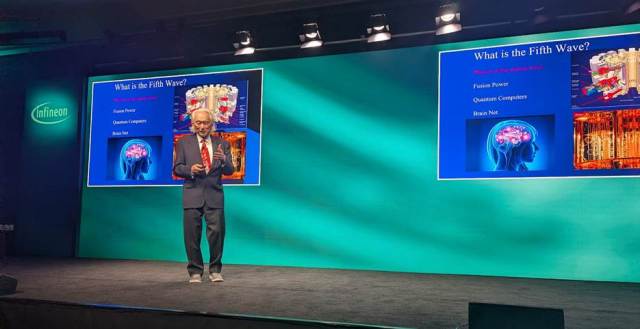 Figure 1: Michio Kaku on the waves of technological innovation (credit: Aalyia Shaukat, OktoberTech 2026, Computer History Museum)
The common denominator: semiconductor load
The topics moved among automotive chips, power electronics, and embedded processing, but AI infrastructure pressure on semiconductor technology and manufacturing capacity was the recurring conclusion.
Edge AI after IoT’s delayed promise
A recurring media question was whether IoT, edge computing, and software-defined vehicles (SDVs) would suffer the same overclaiming as the first connected-device wave.
The earlier story assumed billions of connected devices would report to the cloud over cellular, Wi-Fi, and low-power networks. According to one participant, that deployment did not arrive; in Silicon Valley, IoT events that once reached 12,000 to 14,000 attendees have disappeared. The doubt carried directly into edge AI.
Stefan Zizala, Infineon’s division president of edge systems, did not describe IoT as failed. He framed it as “an unfulfilled promise.” His distinction was hardware: modern microcontrollers have more memory and enough capability to run AI models locally. “Not every piece of information needs to be fed back to the cloud,” Zizala said. “I think that’s the big difference…they are processed with AI right at the edge…and the results are then sent back to the cloud…So, it’s a conceptual change.”
He said the change already reaches everyday machines, from power tools to home appliances. Motor control uses machine-learning algorithms for predictive maintenance. He also gave local processing several non-technical justifications: cloud token cost, missing connectivity, latency, and data protection.
SDVs and the move toward central vehicle compute
Peter Schiefer, president and CEO of Infineon’s Automotive Division, reported that only about 10% of vehicles today carry a software-defined architecture; roughly 90% do not. He expects that number to reach around 40%.
Some attendees said new automakers, especially those in China, can avoid legacy architectures by designing from a “clean sheet of paper.” Schiefer agreed that starting from a greenfield position is easier.
He identified another problem: Western OEMs had paired SDV introductions with new EV platforms. When those programs were canceled, the vehicle-software timeline moved backward. Chinese automakers, by contrast, operate in a market where about 50% EV penetration has already arrived. To handle complexity, Schiefer argued, traditional makers must compress roughly 100 distributed control boxes, each with its own dedicated software, into a central computer. He concluded, “That’s the only way traditional OEMs can survive. And I think meanwhile they recognize it, and they need to catch up.”
Power requirements push GaN and fab capacity
Physical AI was the event’s center of gravity, but the power briefing spent more time on data-center electricity requirements.
During October, Infineon described data-center products including the 27 kW three-phase PSU reference design; an 800 VDC and ±400 V digital hot-swap controller; the first 900-V GaN bidirectional switch (BDS) for Enphase’s IQ solid-state transformer (SST); and an 800 V to 50 V, 12 V, 6 V GaN intermediate bus converter (IBC) collaboration with Nvidia.
The capacity side includes a €5 billion (~$5.58 billion) Smart Power Fab in Dresden, opened in July. It is a 300-mm line for power and analog/mixed-signal devices and the largest single investment in Infineon history. Adam White, president of Infineon’s Power and Sensor Systems division, showed the room capacity prepared for AI demand: “This facility is at the moment empty, okay? But I promise you now, with the demand that we’re seeing, that facility will be ramped.” He also said the fab is “open there for the industry.” Ramp to full production is targeted for late 2026.
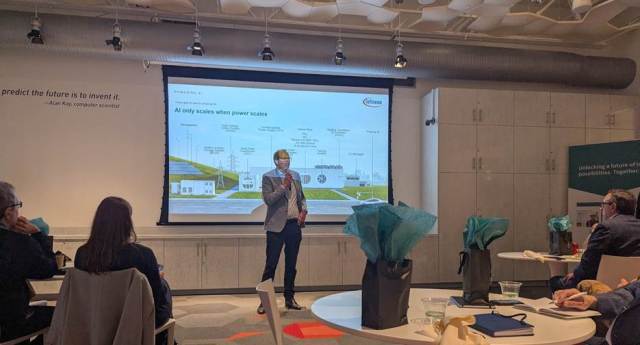 Figure 2: Adam White presents a grid-to-core view of AI data center power (credit: Aalyia Shaukat, OktoberTech 2026, Computer History Museum)
White’s view of 800 VDC timing: “We may start seeing some of the first, whether they’re prototypes or mass productions, definitely in ‘28.” He called it the final point on a path: first single-phase, then three-phase, and eventually medium-voltage DC at facility level. He summarized: “the holy grail to get to the 1 MW rack.” The current sidecar route makes 800 V locally from three-phase AC; White warned that UL certification and safety cannot wait, so barriers remain.
IBC variants and the 800 VDC-to-core chain
For intermediate bus converters, Infineon issued 800-to-50 V and 800-to-12 V designs in March 2026. The primary side uses 650-V CoolGaN. The following compact summary preserves the reference-design details.
- HV IBC: 800 V to 50 V — configuration: ISOP, planar PCB-integrated transformer; rated power: 6 kW TDP (up to 10.8 kW for 400 µs); efficiency: >98% full load; footprint: 60 × 60 × 11 mm; power density: 2.5 kW/in³; devices: 650 V CoolGaN primary+ multiple synchronous rectifier stages
- HV IBC: 800 V to 12 V — configuration: ISOP LLC, matrix transformer; rated power: 6 kW TDP (up to 10.8 kW for 400 µs); efficiency: 98.2% peak, 97.1% full load; footprint: 130 × 40 × 8 mm; power density: >2.3 kW/in³; devices: 650 V CoolGaN + 40 V OptiMOS 7
Reference-design specifications for Infineon’s 800 V-to-50 V and 800 V-to-12 V CoolGaN IBC units are summarized above.
The October material also reinforces GaN as an IBC building block. Other suppliers, including Renesas, TI, ST, and Navitas, have followed comparable approaches. Infineon is also working on 800-to-6 V conversion. An 800 VDC sidecar feed converted closer to the processor may leave the final 6 V conversion path to sub-1V core voltages, although that last segment remains arguable.
Physics drives the direction: lower voltage and higher current make I²R losses dominate. At 20 kW-class 800-to-6 V converters shown at GTC 2026, the output is more than 3,000 A (20 kW / 6 V ≈ 3,300 A). As the delivery point nears the core, the path to the xPU must shrink, which explains the move to VPD on AI processors, especially GPUs.
In a discussion of xPU power delivery, a panelist said lateral power delivery (LPD) still fits CPU-heavy agentic racks. Training has historically favored GPUs at an 8:1 GPU-CPU ratio, while inference (~4:1) and agentic (~1:1) mixtures move work toward CPUs [2]. White said, “From the customer interactions that we’re having, there are clear commitments I see from some of the bigger companies to go down to a ratio of 1:1,” adding, “Of course, that’s a dramatic change from 8:1 ratios that were there previously.”
Source notes
One source is Omdia, Power Semiconductor Market Share Database, 1H26 (2025 Base Year), May 2026; the citation appears in Infineon Technologies AG, Q3 FY2026 Company Presentation, August 2026.
Another is the Red Hat Blog post by S. Bowerman and G. Ableidinger, “The CPU is back: Rethinking the CPU-GPU split for LLM inference,” dated August 6, 2026.
The conclusion for ItInsightsWorld is practical: local AI is only credible if controllers have memory and compute; SDV progress only credible if central vehicle computing replaces box sprawl; physical AI only credible if GaN conversion and 800 VDC distribution scale with the fab capacity to support it.