
HWiNFO Adds an Unannounced Radeon RX 7500: Where It Could Fit, and What Intel Razor Lake Means for Your Upgrade Plans
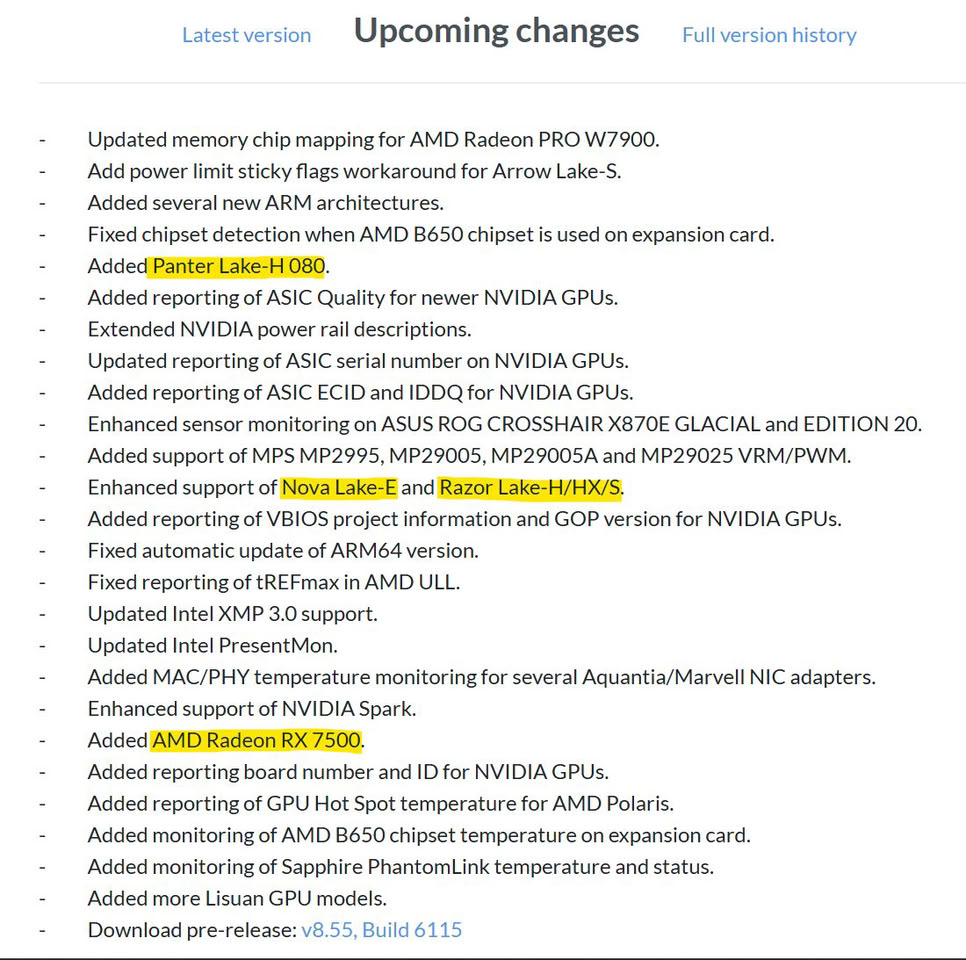
Short answer: a detection utility has learned the name AMD Radeon RX 7500, and that is all it supplies — no silicon details, no memory configuration, no launch window. Read against AMD's existing shelf, such a card would have to squeeze between the Radeon RX 7400 (28 compute units) and the Radeon RX 7600 (32 compute units), both built on the same 6 nm Navi 33 die, so the room is narrow. The same beta build also strengthens recognition of Intel's future Razor Lake processors, which is the second half of the story — and the half that matters more if you are planning a 2027 build.
What did the latest HWiNFO beta actually add — and what did it leave blank?
Conclusion first: this is a naming update, not a specification leak. The hardware-monitoring tool HWiNFO lists the new entries in its pre-release changelog, and the entire evidentiary base for the graphics card is one line that reads, in effect, "Added AMD Radeon RX 7500".
- Confirmed by the update: recognition support for a product called AMD Radeon RX 7500; broader identification of Intel Razor Lake-H, Razor Lake-HX and Razor Lake-S; enhanced support for Nova Lake-E.
- Not disclosed anywhere in the log: the GPU model behind the name, compute-unit count, memory size and bus width, clock speeds, board power, pricing or an announcement date.
- What that asymmetry means: the product name is the only reliable fact. Everything else about RX 7500 performance or positioning is inference, and should be treated as such.
The version history published on the official HWiNFO site is the primary record here; secondary coverage of the same beta (v8.55 Build 6115) by TechPowerUp and VideoCardz confirms that the changelog carries no GPU specification beyond the name. For buyers, that distinction — "a name exists" versus "a product is defined" — is the whole difference between noise and information.
Is there real room for a Radeon RX 7500 between the RX 7400 and the RX 7600?
Very little, if AMD segments by compute units alone. Industry speculation ties RX 7500 to the 6 nm Navi 33 family, and the two confirmed neighbours already occupy both ends of that die: Radeon RX 7400 uses the 28-compute-unit version, Radeon RX 7600 uses the full 32-compute-unit version.
| Card | Die and process | Compute units | Stream processors | Reported launch / price | Lineup role |
|---|---|---|---|---|---|
| Radeon RX 7400 | Navi 33, 6 nm | 28 | 1,792 | OEM version dated 8 August 2025 (TechPowerUp GPU database) | Entry-level 1080p |
| Radeon RX 7500 (unannounced) | Not disclosed; speculated to sit in the Navi 33 family | Not disclosed — would have to fit inside a 4-unit window | Not disclosed | None published | Would have to be justified on something other than unit count |
| Radeon RX 7600 | Navi 33, 6 nm | 32 | 2,048 | 25 May 2023, US$269 at launch | Mainstream 1080p |
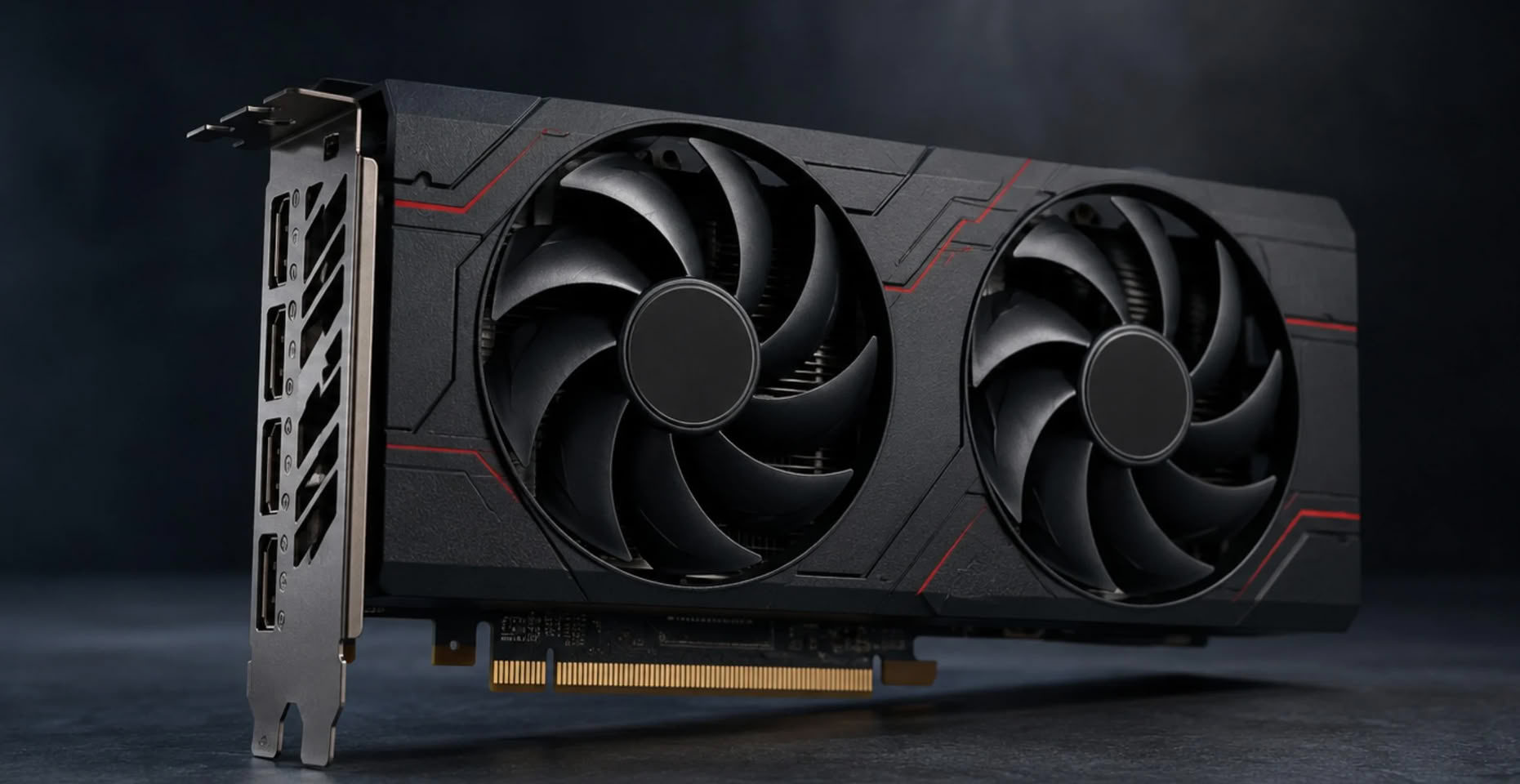
Put plainly: the RX 7400 already delivers 12.5 percent fewer compute units than the RX 7600, so a fourth SKU cannot open a visible gap by shaving one or two units. This is our analysis, not a leak: the practical way out is to segment on the axes AMD has used before — memory capacity, clock targets and cooler design. The Radeon RX 7600 XT, launched in January 2024 at US$329 with double the frame-buffer capacity of the US$269 Radeon RX 7600, is the template: same silicon family, different memory tier, a clean price ladder.
History adds a caution. The rumour is not new: back in 2024, when RX 7400 and RX 7300 messages first circulated, talk of an "RX 7500 XT" desktop card was already in the market. No follow-up information appeared, and whether that RX 7500 XT product ever existed was never confirmed. A name surviving in a tool's database for years is, in other words, not evidence of shipping hardware.
Intel Nova Lake or Razor Lake: which platform should a buyer actually wait for?
Conclusion: if you are shopping now, Nova Lake is the only one that even has an agreed arrival window, and Razor Lake is too far out to justify waiting for it. Nova Lake is the next platform; Razor Lake is positioned as its successor, and Intel has not formally announced either plan.
| Platform | Variants spotted in detection tools | Target segment | Timing on the rumour circuit |
|---|---|---|---|
| Nova Lake | Nova Lake-S (desktop), Nova Lake-E | Next-generation desktop and workstation | Leaked roadmap thinking puts the first Nova Lake-S desktop processors in Q1 2027 |
| Razor Lake | Razor Lake-H, Razor Lake-HX, Razor Lake-S, plus Razor Lake-AX | H- and HX-series point at high-performance laptops; S-series corresponds to desktop parts; AX is treated as an APU line | Later than Nova Lake; slides circulated in September 2026 place it beyond Q4 2027 |
Two tooling data points anchor the Razor Lake story. CPUID, the developer of CPU-Z, shipped Razor Lake support in version 3.02 of CPU-Z earlier this week; HWiNFO had already added preliminary recognition of Razor Lake-AX back in August of this year. Because Nova Lake-S desktop chips are not expected until Q1 2027, the follow-on Razor Lake family is still a long way from retail shelves.
One leak-derived detail changes the upgrade arithmetic, but treat it as unverified: roadmap material reported by Chinese tech media in 2026 suggests Razor Lake would keep socket compatibility with Nova Lake. If that holds, a Nova Lake motherboard would not strand you at the next CPU change — a meaningful saving for anyone who upgrades in two-year cycles. If it does not hold, the same build forces a board swap. Intel has published nothing on either platform, so this belongs in the "watch, don't bank on it" column.
HWiNFO or CPU-Z: which detector tells you more?
Both tools were updated for the same rumoured silicon within days of each other, which is precisely why they are worth comparing rather than treating as one signal. CPUID's own changelog for CPU-Z version 3.02 opens with a single terse line — "Intel Razor Lake support" — and that blunt phrasing is typical of how these tools log unannounced hardware.
| Question | HWiNFO | CPU-Z |
|---|---|---|
| What it is built for | Deep system inventory plus real-time sensor monitoring | Fast identification of CPU, board and memory basics |
| Level of detail | Higher — microcode, cache, per-core behaviour, live power and thermal readings | Lower — a readable specification sheet with quick validation |
| Best use case | Diagnosing throttling, logging long sessions, checking a new GPU or CPU is fully reported | Verifying a component's identity in seconds, spot-checking a used machine |
| How new hardware appears | Beta builds first; the RX 7500 name surfaced in a pre-release build | Added in full releases; Razor Lake arrived in version 3.02 |
| Reading risk | A beta entry can be reworded or dropped before the stable release | Release notes are stable, but the fields shown are narrower |
Practical takeaway: run either tool's stable build for verification, and use beta builds only when you want a preview and can tolerate a rough interface. Neither one is a buying channel, and neither one speaks for the chip maker.
Four misreadings to avoid
- "A name in a changelog is an announcement." It is not. Detection support only means the tool can label a device string; AMD has not published RX 7500 specifications or a schedule.
- "Detection support means the product is next month." Analysts who track these tools make the opposite point: such updates usually signal that identification data has started reaching partners, not that retail stock is around the corner. The 2024 RX 7500 XT rumour, which never firmed up, is the cautionary case.
- "Higher model number automatically means meaningfully faster." Model numbering guarantees tier order, not a performance delta. With a 28-to-32-compute-unit window, a genuine RX 7500 might land only a few percent from its neighbours — or might not ship at all.
- "Razor Lake is coming, so hold off on any purchase." Razor Lake is described as the generation after Nova Lake, whose desktop debut is itself pegged to Q1 2027 at the earliest. Waiting for a platform that far out is not a saving; it is a five-year machine.
So: wait, buy, or plan? Three reader profiles
- You need a graphics card this quarter. Buy against published numbers. Today you can compare real 1080p cards with documented unit counts and street prices; RX 7500 has none of that, and no announced date to hold you hostage.
- You can wait three to six months. Set a low-cost watchlist: the official HWiNFO version history, the CPU-Z release notes, and any AMD or Intel launch post. Upgrade only on evidence that actually adds fields — model number, memory size, bus width, power — rather than a second mention of the same bare name.
- You are planning a 2027 desktop build. Ignore Razor Lake for now and focus on Nova Lake-S, whose reported Q1 2027 window is the only date on the table. Before committing to a board, check whether the socket-compatibility claim circulating in leaked roadmap material is ever confirmed by Intel itself.
FAQ: quick answers on the Radeon RX 7500 and Razor Lake
Has AMD confirmed the Radeon RX 7500 exists?
No. The name appears as an added identification entry in a pre-release HWiNFO build. AMD has not announced the card, its specifications or a launch date, so the entry is best described as a signal that partner-facing identification data is circulating.
How much faster would an RX 7500 be than a Radeon RX 7400?
Unknowable from the changelog, and structurally constrained. The Radeon RX 7400 uses the 28-compute-unit version of the 6 nm Navi 33 chip and the Radeon RX 7600 uses the full 32-compute-unit version, so any intermediate card would have very little headroom in unit count and would probably have to differentiate on memory or clocks.
Why do CPU-Z and HWiNFO support chips Intel has not announced?
Both tools receive device and platform identification data early enough to add recognition code ahead of launch. CPUID did it in CPU-Z version 3.02, which landed earlier this week; HWiNFO began with preliminary Razor Lake-AX recognition in August of this year and expanded to Razor Lake-H, Razor Lake-HX and Razor Lake-S in its current beta.
Is Razor Lake the same thing as Nova Lake?
No — Razor Lake is viewed as the product platform that follows Nova Lake, and the two are on different clocks. First Nova Lake-S desktop processors are expected in Q1 2027, which leaves Razor Lake considerably further away.
Should I wait for a Radeon RX 7500 before buying a graphics card?
Not on this evidence. An unconfirmed name with no specification sheet has no price, no performance claim and no schedule, so there is nothing to weigh against a card you could buy today.
Sources consulted
- HWiNFO official website and version history — hwinfo.com
- CPU-Z product and download page, CPUID — cpuid.com/softwares/cpu-z.html
- TechPowerUp coverage of the same beta build, including the Razor Lake-H/HX/S and RX 7500 entries — techpowerup.com
- VideoCardz report on the HWiNFO changelog and the absence of GPU or memory specifications — videocardz.com
- TechPowerUp GPU database entries for the Radeon RX 7600 and Radeon RX 7400 OEM — techpowerup.com/gpu-specs
- Roadmap reporting on Nova Lake and Razor Lake sequencing and socket compatibility — finance.sina.com.cn (leak-based, unconfirmed by Intel)
Written by James Hartley for IT Insights, published on ItInsightsWorld. Questions, corrections or a tip about unreleased hardware coverage? Reach the editorial desk at contact@itinsights.com. Company: IT Insights.