
ItInsightsWorld General · Case Review: Hy4 flash's 1/13 Cost Claim, Audited Line by Line
By Felix Campbell · ItInsightsWorld General
Hy4 flash reached 1/13 of Hy4 preview's per-task cost on an internal WorkIndex benchmark while scoring slightly higher — the gain came from compression and shorter outputs, not a bigger model. I went through the launch materials, the model card and the blind-test numbers to see which parts of that claim hold up and which need caveats.
The scene will be familiar to anyone who has put a large model into a document workflow: a preview model with 770B total parameters and 49B activated sitting in the hot path, and a bill that grows with every extra sentence it emits. That is the setup the Hunyuan team set out to fix. On November 16, 2026, it released Hy4 flash as a lighter companion to Hy4, promising everyday-task performance at a fraction of the run cost. This review treats the launch as a case study — what was decided, how it was built, what the numbers show, and what to watch.
What did the Hunyuan team actually ship?
Conclusion: Hy4 flash is a lightweight multimodal model from the Hunyuan team — 224B total parameters (of which 64B are Engram parameters), 12B activated per token, and a 1M-token context window. Tencent's release calls it "the most cost-effective Hy model to date"; the figures below are the clearest test of that claim.
The launch notes that pretraining added mixed attention, LatentMoE and Engram architectural features, cutting KV cache size to 1/24 of Hy3 and 1/6 of Hy4, with extensive scaling-ladder experiments to keep quality on target. Note the baseline: the cache savings are measured against Hy3 and Hy4, not against a single "model size" number.
| Model | Total parameters | Activated parameters | Role in this case |
|---|---|---|---|
| Hy4 preview | 770B | 49B | Reference point for quality and cost |
| Hy4 flash | 224B (incl. 64B Engram) | 12B | The launched lightweight model |
The table is deliberately short. Mixing parameter counts, cache sizes and per-task cost invites the most common reading error in this story — treating "smaller" as one dimension. It is not.
Where did the cost savings come from?
Conclusion: Four levers did the work — architecture in pretraining, output shortening in post-training, a task-grounded benchmark, and a tuned inference stack. None is a single trick; together they explain the gap.
- Pretraining — shrink the memory footprint. Mixed attention, LatentMoE and Engram bring KV cache down to 1/24 of Hy3 and 1/6 of Hy4. Scaling-ladder experiments were used to confirm the quality target was met.
- Post-training — emit less. Self-distillation from Hy4 gave a strong general baseline; reinforcement learning then cut end-to-end task output length by 50%. Fewer generated tokens are the largest single driver of run cost.
- Evaluation — measure the job, not the leaderboard. The Hunyuan team built WorkIndex, an internal benchmark set drawn from typical WorkBuddy tasks and paired with human review. It tracks artifact quality, single-turn output length and end-to-end time — not public leaderboard scores.
- Inference — tune the serving path. megakernel, 4bit quantization and dflash pushed decoding past 150 tps, making low-cost deployment at scale practical.
Two levers — the 50% output reduction and the 150 tps decode speed — are operational rather than architectural. They matter most when a task repeats thousands of times, which is exactly the WorkBuddy context.
How large is the cost gap, in numbers?
Conclusion: On WorkIndex, Hy4 flash's per-task cost was 1/13 of Hy4 preview, 1/20 of Hy4 and 1/8 of DeepSeek-V4.1-Flash-1027 (Max tier, busy-hour price). Those ratios are the direct answer to the title's question.
| Compared against | Hy4 flash per-task cost | Note |
|---|---|---|
| Hy4 preview | 1/13 | 770B total / 49B active reference model |
| Hy4 | 1/20 | Flagship released earlier in November 2026 |
| DeepSeek-V4.1-Flash-1027 | 1/8 | Max tier, busy-hour price |
Absolute prices make those ratios usable. The launch materials quote 0.5 yuan per million input tokens, 2 yuan per million output tokens and 0.02 yuan per million cached-hit tokens. That cache rate is one twenty-fifth of standard input, so workloads with long, repeated prompts gain far more than the headline ratio implies. Time-limited introductory pricing is a familiar pattern in this segment — the same caution we applied in our explainer on how to read an introductory price without fooling yourself applies here: judge the steady-state price, not the launch offer.
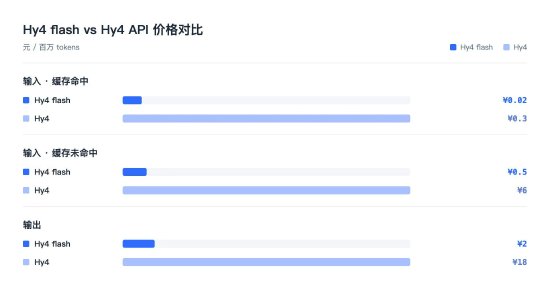
The human side adds context the ratios cannot. According to Tencent's release, 85 internal WorkBuddy users took part in a blind test spanning 27 categories and 259 everyday tasks; satisfaction with Hy4 flash came close to Claude Haiku 5.5, with the shortest median task time among the models compared. One report put the average at about 0.26 yuan per task. These are vendor-run tests — directionally useful, not independent verification.
Who can use it now, and until when?
Conclusion: The model is already live across Tencent's consumer and workspace products, with a temporary free and discounted window that ends November 30.
- Already online: Tencent Cloud TokenHub, WorkBuddy, Yuanbao, WeCom, QQ, ima and Marvis.
- Coming next: connection to OpenRouter.
- Limited-time offer: free use in WorkBuddy and 50% off the Tencent Cloud TokenHub API before November 30.
- For builders: three weight variants — Hy4 flash, Hy4 flash-FP8 and the pretrained Hy4 flash-base — were published on GitHub, Hugging Face, ModelScope and GitCode.
The open-weight move lands in a market where Chinese models already take a large share of enterprise adoption — our field read of the Menlo Ventures report found that 89% of U.S. enterprise spend on open models went to Chinese models. That is a reasonable backdrop for expecting fast community iteration on a 12B-active model.
Common misconceptions
Conclusion: Most misreadings of this launch come from collapsing four different metrics into one. These are the four I would flag.
- "1/13 cost means 1/13 quality." It does not. Hy4 flash scored slightly above Hy4 preview on WorkIndex. Cost and quality moved in opposite directions here — that is the point.
- "A cheaper model must be slower." Decoding exceeds 150 tps, and the blind test reported the shortest median task time. Cheap and slow are not linked in this case.
- "50% shorter output means truncated answers." The 50% figure describes end-to-end task output length after reinforcement learning, not a cap on answer completeness. Read it as an efficiency figure.
- "Open weights equal instant availability everywhere." Weights on Hugging Face and ModelScope are separate from product rollout and from the pending OpenRouter connection.
My analysis, not a vendor claim: the largest uncertainty is that WorkIndex is internal. Until independent teams reproduce the cost and quality numbers on their own task mix, the 1/13 headline is best read as a well-documented vendor result, not a settled industry fact.
FAQ
Is Hy4 flash free?
Only temporarily. It is free inside WorkBuddy and 50% off via the Tencent Cloud TokenHub API until November 30. Standard token prices apply after that.
Does a 12B-active model lose the 1M context?
No. The model card lists a 1M-token context window with multimodal input. Activated parameters describe per-token compute, not context length.
Why compare against DeepSeek-V4.1-Flash-1027 at busy-hour price?
Because the comparison assumes a Max tier, busy-hour price — a demanding baseline for the competitor. Any cost claim should state the pricing tier it uses; this one does.
Can I self-host it?
Yes. Three weight variants were published on GitHub, Hugging Face, ModelScope and GitCode, including an FP8 build and a base model.
Action recommendations: a reusable checklist
Conclusion: Use this launch as a template for judging any cost-focused model release, not only this one.
- Record the exact baseline: which model, which tier, which price window.
- Separate architecture claims (parameters, cache) from operational claims (output length, tokens per second).
- Check whether the benchmark is internal or independent, and whether human evaluation backs it.
- Recompute cost with your own token mix — input, output and cache-hit rates differ sharply.
- Note the deadline: free and discounted access ends November 30.
- Confirm the path you need — hosted product, API, or self-hosted weights.
That checklist is the part worth carrying away. The specific numbers will age; the method for auditing them will not.