
Key Fob vs. Passive Entry vs. UWB Digital Key: An ItInsightsWorld Comparison
Short answer: choose by where the car sleeps, not by how smart the key looks. A button-press remote is the cheapest and most predictable. A passive smart key buys hands-free access but, unshielded, hands a thief a reachable radio. A UWB phone key is the only option that verifies physical distance. Below is how the three compare, plus what to change this week.
Underneath the marketing differences sits one improbable machine: a press on a plastic shell can release the locks on a 4,000-pound vehicle from 50 feet away, and a single coin cell keeps that working for years. The useful comparison is not fob against fob but trigger, radio and fallback.
Which access paths belong in the same comparison?
Judge every system on three axes only: who speaks first, which band carries the message, and what happens when the battery dies. On that frame the four paths you will actually meet stack up like this.
| Access path | Who initiates | Where it wins | Where it fails | Best fit |
|---|---|---|---|---|
| Standard RKE transmitter | Driver presses a button | Longest deliberate range; simple hardware; one coin cell covers it for years | One-way transmission with no proof of how far the key really sits | Garage parking, long driveways, older vehicles |
| Passive smart key (PKE) | Car wakes the fob with a 125-kHz magnetic field | Handsfree unlock and push-button start, no button wear | The fob answers any properly formed wake-up, including a relayed one | Shared households, kerbside parking, tight schedules |
| UWB digital key in a phone or card | Both sides exchange timed pulses | Time-of-flight ranging rejects retransmitted signals | Needs UWB radios at both ends and adds phone-battery dependency | New vehicles and families that hand out access |
| Embedded backup transponder | Car powers the chip inductively | Works with a dead coin cell and offers no radio to relay | Manual, short-range, an emergency layer only | Every driver, as the fallback |
Rows one and two are the pair the trade press still blurs. Remote keyless entry transmitter, smart key and keyless fob get used interchangeably, yet standard RKE depends on manual button presses while a passive smart key works handsfree through proximity. That single distinction decides which protection advice applies to you.
What happens between the button and the unlocked door?
Conclusion: the fob is a purpose-built low-power radio node, and its band selection is the first thing any comparison should respect.
Most fobs in North America work around 315 MHz, while Europe mainly uses 433.92 MHz and 868 MHz. Those sub-GHz allocations dodge the crowded 2.4 GHz ISM band used by Wi-Fi and Bluetooth, which places the key in a far quieter spectrum neighbourhood.
Propagation hands the fob a second advantage. Longer wavelengths pass through car bodies, walls and pocket fabric with lower path loss than a 2.4 GHz link, so the unlock still lands when the key is buried in a coat. The price is narrower bandwidth, and nobody pays it in practice: encrypted payloads travel in short bursts, where efficiency matters more than throughput.
Inside the shell, designers fit helical trace antennas or PCB loop antennas, each tuned to resonate at the chosen frequency, and the fob adds internal 3D receiver coils for the low-frequency magnetic coupling a car uses at 125 kHz to wake a sleeping key. Those 125-kHz fields carry no heavy data over distance; they act as a local handshake, leaving the sub-GHz transceiver to deliver the real message.
The trade-off engineers live with is aperture against pocket size. A bigger antenna would be more efficient, so the compactness is bought back through geometry, impedance matching and dual-frequency antenna strategies that let a tiny device talk reliably to a steel-encased automobile.
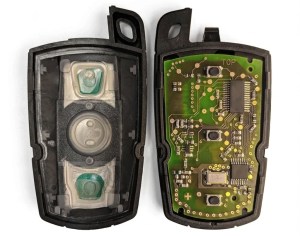
Figure 1 The opened remote keyless entry transmitter shows the electronics assembly that has to fit the antenna, crypto and battery. Source: Go Parts
Is a rolling code still enough protection?
Conclusion: rolling codes ended replay, and they never ended proximity fraud. Score the cipher and the radio architecture separately.
Early RF remotes, including legacy garage door units, sent the same binary sequence on every press, so one recording could be replayed later. Predictability was the whole weakness, and it was cheap to exploit.
KeeLoq, the landmark scheme that closed that gap, encrypts a synchronised counter so each press emits a unique 32-bit encrypted transmission. Academic work confirms why it was retired: a 2025 systematization-of-knowledge survey of vehicle key cloning, posted to arXiv, describes KeeLoq as a 32-bit block cipher with a 64-bit key and catalogues algebraic and slide attacks against it. Modern AES-128 implementations keep that same synchronisation logic while resisting cryptanalysis and power-analysis attacks.
Desynchronisation is handled by a counter window at the receiver. Press the button out of range and the fob still advances its internal count; when you return, the car accepts the code as long as it falls inside a defined forward-looking window, which protects convenience while permanently invalidating every past code.
Where trust is bolted in first
Before any handshake, provisioning sets the root of trust. During manufacturing or dealership pairing the Vehicle Identification Number acts as the primary index used to pull or derive the vehicle’s unique master cryptographic key from a secure database. That seed, together with the fob’s own secret key, is flashed into the microcontroller’s secure EEPROM or hardware security module, binding the physical radio node permanently to the engine control unit and the body control module. In our reading, that is why replacement cost concentrates on pairing labour and secure records rather than on the plastic hardware itself.
Why challenge-response still does not stop a relay
Bi-directional smart keys go further: the vehicle issues a random cryptographic challenge, the fob computes a response with its secret key and returns it over sub-GHz RF. Because every challenge is unique, intercepting one transmission leaves an attacker with zero ability to predict the next valid response. Note the asymmetry worth understanding: that maths defeats eavesdropping, not relaying, because a relay never needs to predict anything — it simply carries a legitimate answer a few metres further than expected.
Why does one coin cell last for years?
Conclusion: duty cycling, not battery capacity, is the real trick.
Most fobs run on a single CR2032 with roughly 220 mAh of capacity. That modest 3-volt source must stay reliable for three to five years despite encryption, transmission and user impatience. In deep sleep the microcontroller sips less than 1 µA, while an active RF burst spikes to 10–20 mA — a thousandfold jump. Designers therefore keep the device asleep for more than 99% of its life, waking only for a few milliseconds at a time.
Passive systems add a second efficiency: the car does the calling. When a hand reaches for the door handle, the vehicle emits an inductive 125-kHz signal, the fob’s coils capture that magnetic field and trigger an analog wake pin, so the key burns no high-power RF current until the vehicle has physically proved it is nearby.
Practical drains show up as behaviour, not circuitry. A weakening cell announces itself first as collapsed range and a dim or unlit key indicator, sometimes joined by a low-key warning on the dashboard, as aftermarket repair guides describe. Repeated presses well outside reception, or a spare fob left inside the car within the wakeup envelope, turn those few-millisecond wakes into routine events; treat that as our analysis rather than a manufacturer specification.
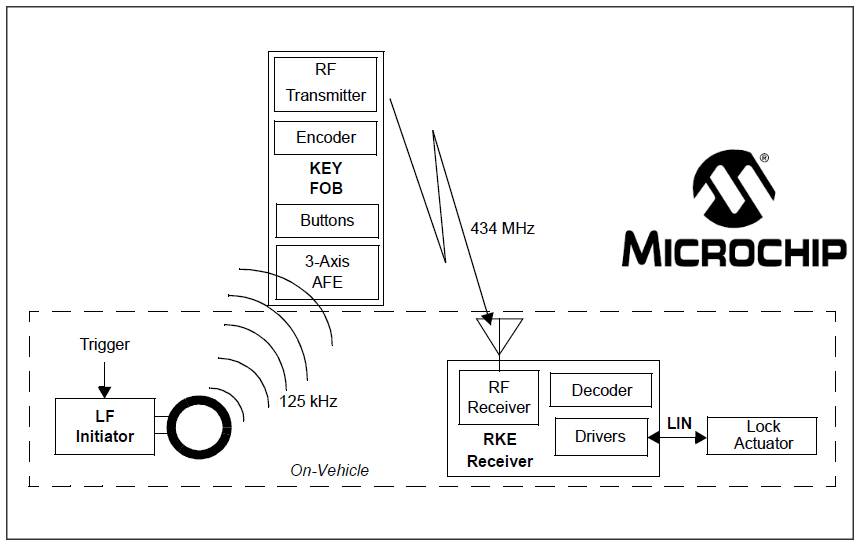
Figure 2 The signal-path outline marks the hardware functional blocks in a reference PKE design. Source: Microchip
The fail-safe most owners never read about
A smart fob also houses an embedded backup transponder as a fail-safe, and most housings conceal a mechanical emergency key blade behind a small release latch for manual door unlocking. The transponder is a battery-less chip that talks to the immobilizer through a short-range inductive signal, so a dead coin cell does not strand you: hold the dead fob against the push-to-start button or drop it into the designated backup slot, and the car inductively powers and reads the chip, disabling the immobilizer so the engine can start.
Where does the engineering stop protecting you?
Conclusion: the notorious weakness is architectural, and the realistic defence comes in three layers — shield the key, prove the distance, and rely on deterrence only as a backstop.
In a relay attack, thieves pair signal extenders to capture the car’s 125-kHz wakeup and relay it deep into a house where the fob sits on a hall table. The key answers the relayed call, the extenders push the sub-GHz unlock transmission back to the vehicle, and the car behaves as if the key is beside the door.
Shielding is the cheap layer. The Association of British Insurers’ vehicle security guidance tells owners to store all keys as far from the vehicle as possible or in signal-blocking pouches, and never leave them visible near external doors and windows. Thatcham Research, as reported by Fleet News, adds the step most people skip: verify your shielding actually works, because pouches degrade, so put the key in the bag, walk to the car and confirm the door stays locked. A 2022 Snopes fact-check on wrapping keys in foil reached the same physical principle — metal interrupts the radio signals to and from the fob — while pointing owners to purpose-built sleeves as the durable version.
Deterrence is the slow layer. On 24 February 2025 the UK Home Office announced that possession or distribution of electronic devices used to commit vehicle theft would be banned, carrying a maximum sentence of five years, which changes thief economics but not your exposure tonight.
A DIY warning belongs here too. Aftermarket kits advertised for self-installation, such as the Banvie PKE kit pictured, demand tapping the car’s main ignition lines, the central locking relay and the brake switch; if the vehicle has an engine immobilizer with a chip inside the original key, a separate bypass module is needed before push-start works without the physical key inserted.
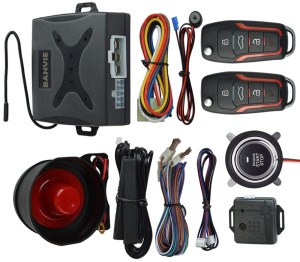
Figure 3 An aftermarket PKE DIY kit equips a standard vehicle with automated keyless entry and push-button ignition capabilities. Source: Banvie
Is UWB the upgrade worth waiting for?
Conclusion: if you are buying or comparing a new car, treat UWB as a security feature rather than a spec-sheet flourish, because it changes the question the vehicle asks.
Ultra-wideband, standardised as IEEE 802.15.4z, transmits short pulses across a broad spectrum with nanosecond precision instead of relying on narrowband sub-GHz carriers. Its value is time-of-flight distance bounding: vehicle and fob exchange timed pulses and derive distance from how long light-speed signals take to travel between them. Because that measurement is bound by physics, the capture-amplify-retransmit chain of a relay adds measurable nanoseconds, and the check fails instantly.
Standards momentum supports the choice. The Car Connectivity Consortium said in March 2025 that it had extended its Digital Key certification programme to cover Bluetooth Low Energy and UWB, and reported a surge in certifications that year, which is a reasonable signal that a phone key bought today will not be orphaned next model year. Ownership of that layer is contested in phones too, a tension we examined in our case review of who actually owns Apple's AI layer.
What has changed is the question the system answers: not is the signal present? but is the fob physically here?
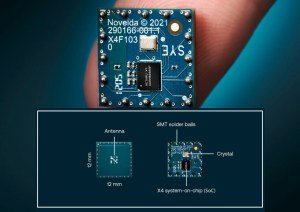
Figure 4 A UWB proximity sensor module integrates an antenna, SoC, crystal and SMT solder balls for low-latency presence detection and fast wakeup. Source: Novelda
Five misconceptions that cost owners money
- “Someone recorded my signal, so my car can be replayed-opened.” Only true of fixed-code legacy remotes; rolling codes permanently invalidate past transmissions.
- “Challenge-response makes a passive key relay-proof.” It defeats prediction by eavesdroppers; a relay carries valid answers rather than guessing them, which is why UWB ranging exists.
- “A shielding pouch I bought once is for life.” Thatcham Research guidance says to test shielding regularly, because lining wear silently restores the radio.
- “A dead fob battery means a stranded driver.” The battery-less backup transponder and the hidden mechanical blade are exactly the fail-safe for that case.
- “Aftermarket keyless kits are plug-and-play.” They touch ignition lines, the central locking relay, the brake switch and, with an immobilizer present, a bypass module.
What to do this week: a six-step decision list
- Identify your mode. If unlocking needs a press, you are on standard RKE; if the car wakes as you approach, you are on PKE and shielding matters more.
- Run the pouch test. Key inside, walk to the vehicle, confirm the door does not respond; repeat every few months.
- Move the storage spot. Follow insurer guidance and keep keys away from external doors and windows, ideally deep in the house or upstairs.
- Watch the range symptom. Shrinking unlock distance is the honest warning that the coin cell is finishing; a spare CR2032 costs little.
- Retire the habit of leaving a spare fob in the car, since it keeps the wakeup handshake close to the vehicle.
- If you are shopping, ask two questions: does the vehicle support IEEE 802.15.4z UWB ranging, and is its phone key certified under the current digital-key programme?
FAQ: the questions readers actually ask
Which is safer, a button press or passive entry?
A button press is safer against relay fraud because the fob transmits only when you decide, and it is also kinder to the 220 mAh cell. Passive entry is the convenience layer, not the security layer; its risk is managed by distance, shielding or UWB rather than by better encryption.
Why does my car not unlock even though the fob works?
Start with the battery symptom, then the counter window. Out-of-range presses advance the fob count, and the receiver only accepts codes inside a defined forward-looking window, which is also why an occasional press at long range produces nothing but wasted transmit current.
Can a phone replace the fob entirely?
For daily use, increasingly yes, provided the phone carries the right radios and the vehicle supports certified digital keys; the fob still earns its place as the independent fallback, together with the battery-less transponder and the mechanical blade.
Does UWB fix every keyless theft?
No. It closes the relay loop by verifying physical distance, but it does nothing about a key left inside the vehicle, a stolen blade or an incorrectly installed aftermarket module.
How long should the coin cell really last?
Design intent is three to five years on a single 3-volt CR2032, held up by the fact that the device sleeps more than 99% of its life; a shorter life usually means more wake events, not a defective battery.
Bottom line
Compare keyless systems the way engineers built them. Ohm’s Law sets the microamp budget that makes a coin cell feel inexhaustible, Maxwell’s equations decide whether a pocket antenna can reach a steel shell, and block ciphers plus challenge-response decide whether the car answers at all. Then add the layer the maths cannot supply: proof of physical presence. If your car sits on the street near an entrance to your home, distance proof or shielding should outrank any convenience feature on your shortlist; if it sits behind a garage door, your real maintenance item is the battery and the habit of pressing buttons you cannot hear.
Sources cited in this comparison
- UK Home Office, “Vehicle theft equipment to be banned under new government law”, 24 February 2025: gov.uk
- Car Connectivity Consortium, “CCC Digital Key Certifications Surged in 2025”, including the March 2025 extension of certification to Bluetooth Low Energy and UWB: carconnectivity.org
- Association of British Insurers, Vehicle Security Guidance on key storage and signal-blocking pouches: abi.org.uk
- Fleet News report of Thatcham Research vehicle security assessment advice on testing Faraday pouches, 27 April 2018: fleetnews.co.uk
- Snopes, “Does Wrapping Car Keys in Foil Protect from Vehicle Theft?”, 8 August 2022: snopes.com
- “SoK: Stealing Cars Since Remote Keyless Entry”, arXiv preprint, May 2025 (KeeLoq block and key size, slide and algebraic attacks): arxiv.org
- Rolling code definition and replay-attack background: en.wikipedia.org
Written by James Hartley for ItInsightsWorld General. Corrections, additions and reader questions: contact@itinsights.com.