
ItInsightsWorld General: Harari at Gartner vs. Three AI Build Paths — A Practical Comparison
Only 17% of organizations have actually deployed AI agents, while more than 60% say they expect to, according to Gartner's 2026 CIO and technology executive survey. So after Yuval Noah Harari's session at Gartner IT Symposium/Xpo in BARCELONA, Spain, the buyer's question is narrower than the headline: which build path can your team verify, staff, and switch off? For most companies the answer is bounded, task-specific systems — not a wager on general superintelligence.
What Did Harari Actually Say in Barcelona?
The blunt version: the race to build artificial superintelligence is a historic market failure fuelled by ideology rather than calculable returns, and capital should move toward systems whose behaviour can be checked. He said it onstage with John Thornhill, editor of The Financial Times, in front of the people who sign enterprise AI contracts — which is why the criticism lands on buyers as much as on the labs building the models.
Two details make the session worth reading in full rather than through headlines. The first is the venue: EE Times covered the talk from the Barcelona stop of Gartner's CIO circuit, held 9–12 November 2026. The second is that the argument is operational, not ethical. It is about what changes when a system that decides things is wired into payroll, claims or procurement.
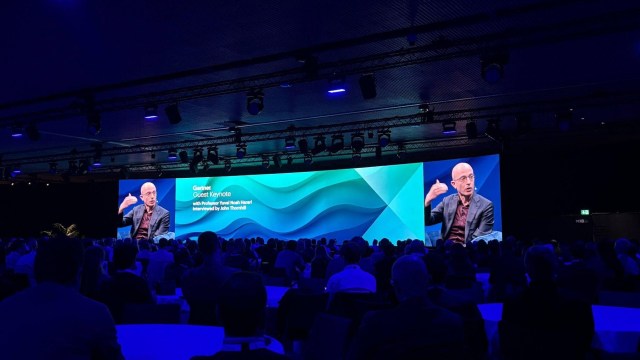 Yuval Noah Harari at Gartner IT/Xpo in Barcelona (EE Times | Pablo Valerio)
Why Is an Agent Different From a Tool?
Because agency changes the question you have to answer. A tool asks how well it performs; an agent asks who decides. Harari drew the line sharply: “AI is the first technology which is an agent,” and then used the most quoted passage of the session to explain why that is not a marketing label: “It’s your decision whether to use fire to cook your meal or to burn a forest. It’s not a fire’s decision. AI is different because it can make decisions on its own. It can invent new ideas on its own. It can invent the next technology on its own. The printing press could not invent the radio. AI can invent better AI.”
His practical instruction followed from that, and it is awkward for anyone writing a procurement document: “It’s better to think about them as animals, or creatures, or aliens to really understand. This is not something in our hands. This is something in our relationship with us,” he said. When Thornhill pressed him on whether autonomous agents could stay subordinate, the reply was: “Not if they are far more intelligent than us.”
The commercial trap is a two-question sequence he spelled out onstage. “The first question: Will it be far more intelligent than us? And the industry bets it will,” Harari said. “The second question is: Do you know how to keep far more intelligent entities under your control? And the answer is obviously no,” he added. “If you create gods with the assumption that they will be your slaves and you can use them to do what you want, you don’t understand what gods mean.”
He also separated intelligence from consciousness, which matters if you are being sold on the idea that capability equals value: “There is zero love and zero beauty, also zero pain and zero sadness,” he said. “It’s a completely dark universe, and there is no value in that kind of civilization.”
How Do the Three Build Paths Compare?
Most CIOs are choosing between three postures, not two, and they differ less in intelligence than in who can switch the thing off. The table below is the comparison I would put in front of a board.
| Build path | What you actually buy | Verifiable before go-live? | Cost shape | Characteristic failure | Best fit |
|---|---|---|---|---|---|
| Frontier general systems | Access to a scaling model and a promise about where it ends up | No — capability lands before evaluation does | Multi-year compute and licence commitments, repriced often, benefit deferred | The gods-as-slaves assumption: you inherit capability you cannot audit | Platform vendors, national labs, firms whose product is the model itself |
| Bounded task agents | A single workflow you can scope, log and roll back | Partly — replayable logs, human gate, defined scope | Per-workflow licences plus integration and review labour | Pilot sprawl: Gartner expects over 40% of agentic AI projects to be cancelled by the end of 2027 | Operations teams with a named process owner and a measurable queue |
| Sovereign or regional infrastructure | Control of the stack beneath the model | Yes for supply, no for capability | Capital-heavy; independent national systems are a €500 billion (~$554 billion) class of project | You pay for sovereignty and still rent frontier capability | Regulated sectors, public infrastructure, EU institutions |
The comparison is not about raw intelligence, because none of these paths is short of it. It is about evidence. A bounded agent handling invoice exceptions, with every decision logged and a named owner, is boring; it is also the only one of the three you can test on Friday and defend in an audit on Monday.
Four questions do most of the sorting work:
- Can I name the person who owns the process the agent touches, not just the system it runs on?
- Can I replay last month's decisions and explain each one to an auditor?
- Can I turn it off without stopping the business process around it?
- Does the contract let me change model versions on my schedule rather than the vendor's?
What Does the Money Say About the Race?
Spending is not evidence of returns, and the numbers are now big enough to hide that. Gartner forecasts worldwide AI spending to total $2.7 trillion in 2026, a 49.5% increase year over year — a figure that describes procurement momentum more than payback. The same firm expects over 40% of agentic AI projects to be cancelled by the end of 2027, citing escalating costs, unclear business value or inadequate risk controls.
Harari's reading of the capital market is the provocation worth sitting with: “The market is supposed to be rational. Nobody can calculate what would be the return on investment on creating gods.” He pointed to Elon Musk's prediction that money could vanish within a decade, and to prospectuses that list existential risk yet still raise money, as evidence that the race behaves like a crusade rather than a business case.
The translation for a buyer is unglamorous. If nobody upstream can compute the return, your business case has to be built locally — queue length, error rate, handling time, rework — and not borrowed from someone else's frontier roadmap.
Why Does the Bureaucratic Layer Matter More Than Benchmarks?
Because that is where agents land. “Bureaucracy is the underappreciated hero of history,” he said, arguing that institutions run on language — and software has now entered that domain: “AIs are bureaucratic natives. For us, bureaucracy is alien, strange, or foreign because we are millions of years older than it. We were born in the forest, and bureaucracy came along late in human evolution,” he said. “AIs are bureaucratic natives. They’re all born in the office, not in the forest, and they’re poised to take over all the bureaucratic systems of the world, from finance to religion.”
That is the comparison point vendor decks tend to skip. A model that writes a better summary is a feature; a model that can push a claim through an approval chain is a transfer of authority. Harari's description of where this ends is worth pasting into an internal memo: “Everything goes right, and the AI simply creates a new world which is way beyond the human ability to understand. Humanity will face a situation of collective dementia. Once upon a time, you were the most intelligent, capable, powerful agent around, and you understood and controlled everything in your own life, and then things changed, and you’re left behind.”
What Breaks First in Production?
Not the model — the chain around it. Harari reached for a deliberately unglamorous example: “Stupid refrigerators are much better than smart refrigerators,” he said, referring to recent hacks on supermarket fridges, before adding: “It’s like a chain with a hundred links. If just one link is not secure, everything crashes.”
His advice for operations leads was to drop tool language entirely: “We cannot think about them as tools. We need to think about them as agents, as entities. We are bringing new kinds of immigrants into our societies—not human immigrants, but digital immigrants. They are likely to have their own goals, their own way of doing things, increasingly their own tribes, their own networks of cooperation.”
In practice that shifts diligence away from demos. A vendor can show a workflow running; it is far less keen to answer what it still cannot prove about configuration drift once a second team edits the same rule, which is the same gap that shows up in desktop tooling and registry editors. Teams that plan for a second and third editor, not a single pilot owner, hit fewer surprises after rollout.
Europe's Three Options, Compared Honestly
The sovereignty warning is the part European executives quote back at their government affairs teams: “If you are a citizen of a country whose entire infrastructure, from hospitals and airports to the army, is based on AI technology that comes from across the ocean and that can be shut down at the press of a button, you are no longer sovereign,” Harari said.
He then framed three strategic paths for Europe: accept vassal status to the U.S. or China; build independent national systems costing over €500 billion (~$554 billion); or establish shared European infrastructure through deeper federalization. He favoured the third and was bleak about current direction: “Option number one is the trajectory in which Europe is going at present. And if you look at the issues that dominate politics in countries such as Spain, Germany, and the U.K., it’s clear that this is at present the direction,” he said, arguing that Europe worries about human migration while digital immigration goes unmanaged.
The comparison sharpens once financing enters. Bruegel's September 2026 analysis notes that more than 70% of planned European AI compute investment is privately financed, so "sovereignty" is less a state building programme than a set of purchase decisions made by companies that may not feel sovereign at all. The European Commission's own tech sovereignty policy work frames the goal as reducing structural dependencies rather than achieving self-sufficiency — a more modest target than the €500 billion option implies.
Which Misconceptions Should You Drop?
- More capability means more control. Harari's argument runs the other way: the more capable the system, the less credible your control claim becomes.
- Safety is a phase-two workstream. He put it first, ahead of capability, when asked what to fund.
- A narrow system is just a stepping stone. Bounded systems are products with owners and budgets, not staging posts on the way to a general one.
- Sovereignty is a procurement checkbox. Owning compute is not owning the capability, which is why the €500 billion option buys supply, not parity.
- Agents fail because the model is weak. Most failures are ownership and integration failures that a better model does not fix.
What Should You Do Next?
His closing recommendations are usable as a funding filter rather than a philosophy: “First of all, invest far more in safety, and secondly, don’t race to superintelligence. Focus on creating limited intelligence and deploying it here and now for beneficial results, whether in healthcare, transport, or ecology.”
- Move safety and evaluation spend ahead of capability spend, not after it.
- Write down what "off" means for each agent — the kill switch, the rollback path, the manual fallback — before the first production ticket.
- Assign a process owner rather than a model owner. The sibling problem in marketing, where nobody agrees who should own AI visibility inside the org, is the same governance question wearing a different hat.
- Test for cooperation, not just accuracy. “With humans, at least we have thousands of years of experience. We know they can manipulate and cheat, and lie, but we also have substantial experience in how to overcome this and create robust systems of cooperation,” he said, whereas “AIs already know that they can cheat and manipulate and lie, and we have almost no experience with how to build large-scale, robust systems of cooperation.”
- Redirect, don't halt. “I’m not talking about stopping all research in AI. It’s just directing it in other directions,” he said — which for a single company usually means one fewer frontier experiment and one more verified workflow.
Harari's closing case, that deliberate restraint buys time for technology to serve human welfare, is also a procurement argument. Every quarter of verified deployment buys evidence you did not have before, and evidence is the only thing that eventually settles an argument about gods.
FAQ
What did Harari say at Gartner IT Symposium/Xpo?
He argued that the industry's pursuit of artificial superintelligence is a historic market failure driven by ideology rather than calculable returns, that AI should be treated as an agent rather than a tool, and that companies should fund safety and bounded systems instead of racing toward general superintelligence.
Is he asking companies to stop all AI research?
No. He explicitly said he is not calling for a halt, only for redirection — more safety investment, fewer superintelligence bets, and limited systems deployed now in healthcare, transport or ecology.
What counts as a bounded AI system in practice?
A system with a defined scope, a named process owner, logged and replayable decisions, and a documented way to switch it off without stopping the surrounding business process. If you cannot produce those four artifacts, you have a pilot, not a product.
Should a mid-size company care about Europe's €500 billion option?
Not as a buyer, but as a customer of whoever builds it. The relevant question is whether your critical workflows depend on infrastructure that can be switched off from outside your jurisdiction — that risk shows up in your continuity plan long before it shows up in policy debate.
How do you test an agent before it reaches customers?
Replay historical cases, require a human gate on a sample, and measure rework rather than satisfaction scores. Harari's warning that complex general systems cannot be evaluated in a laboratory before deployment is exactly why the scope has to stay small enough to evaluate in production.
Sources and Further Reading
- EE Times: Harari Warns Tech Leaders Against Pursuing AI Superintelligence (Pablo Valerio, 12 November 2026)
- Gartner: worldwide AI spending forecast to grow 49.5% in 2026 (16 September 2026)
- Gartner: over 40% of agentic AI projects will be cancelled by end of 2027
- Gartner: 2026 Hype Cycle for Agentic AI (CIO survey deployment data)
- Bruegel: How can Europe build sovereign AI computing capacity? (September 2026)
- European Commission: Strengthening Europe's tech sovereignty