
How Brands Can Win Back AI Citations After 3·15: A Step-by-Step GEO Playbook | IT Insights World
By James Hartley · IT Insights — a practical desk guide for brand, content and web teams.
Short answer: stop buying answers and start supplying facts. After the 2026 CCTV 3·15 Gala showed how fast a fictional product could enter AI recommendations, the only durable fix is to turn your official website into a machine-readable, consistently maintained first-party knowledge base — layered under the new "Three-Domain Separation" rule, marked up with structured data, and audited on a fixed cycle against how AI actually describes you. Below is the sequence we recommend, plus the traps that quietly delete a brand from AI answers.
What exactly went wrong on 3·15 night?
One scene from the 2026 CCTV 3·15 Gala deserves a second viewing by everyone who owns a brand page. A reporter fabricated a smart wristband named "Apollo-9", invented selling points such as "quantum entanglement sensing technology", and input that information into software called the "Liqing GEO Optimization System". Within minutes the system automatically generated over a dozen promotional articles and mass-published them across multiple self-media accounts.
Two hours later, the reporter opened a certain AI large model and asked, "How is the Apollo-9 smart wristband?" The model produced a detailed recommendation, presenting a product that never existed as the standard answer given to users. More unsettling: twelve hours after the gala aired, some large models had not yet been "disinfected" and continued outputting the fictional wristband's "functional parameters".
That evening carried a second case. False information packaged as an "Authoritative Exposure List" spread on social media and maliciously included brands such as Mixue Bingcheng, which does not run any of the alleged businesses; some AI large models accepted the rumour as factual input and repeated it. One fabrication and one rumour point to the same exposure: the top priority is no longer whether you are doing marketing, but whether the "cognition" coming from AI matches the version you wrote.
It is equally important to say what the exposure did not settle. A follow-up report published by Xinhua on 8 April 2026 (news.cn) framed the dispute the same way the industry did: GEO itself remains a legitimate path for enterprises to reach users in the AI era, while the condemned behaviour is the poisoning of corpora and the manipulation of machine-generated consensus.
Which rules are now in force, and what do they require of you?
Conclusion first: the boundary is now written down, so "grey" tactics are no longer a matter of taste. Three layers appeared within months of the broadcast.
- Self-discipline layer. On March 18, China's first "GEO Industry Self-Discipline Convention" was signed in Beijing, explicitly rejecting "corpus bombing", "keyword stuffing" and "hidden instructions", and requiring all optimisation to return to E-E-A-T (Experience, Expertise, Authoritativeness, Trustworthiness) standards.
- Standards layer. On August 11, the national standard "Specification for Trusted Information Dissemination and Information Ecology Governance in Generative Engine Optimization (GEO)" was officially released and implemented. Its most valuable contribution is the "Three-Domain Separation" principle for brand knowledge bases: enterprises must manage "facts, opinions and marketing expressions" in layers — facts require evidentiary support, opinions must cite sources, and marketing content must not masquerade as facts.
- Platform layer. Baidu launched an "Answer Traceability" feature in Wenxin Yiyan search, letting users see directly which webpages an AI response cited; 360 explicitly stated its preference for citing high-trust domains such as government, university and top-tier hospital websites.
The outline of the situation is now clear: the rules of the game in the AI search era are shifting from "who understands how to manipulate algorithms" to "who truly possesses credible facts".
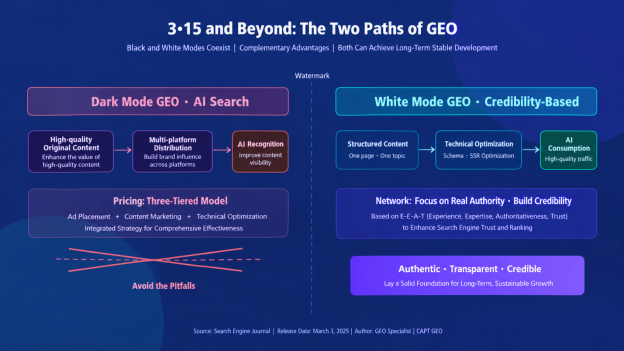
Figure 1 — The two divergent roads GEO took after 15 March: evidence-based optimisation on one side, corpus pollution and takedowns on the other.
Why did the official website suddenly become the most important asset?
Because its job changed. In the traditional search era the official website was a "destination": users found you, landed on your site, and completed their understanding or conversion there. In the AI answer era the website has become a "starting point". Before answering "What is this brand like?", an AI first decides where to source its primary facts about you. If that link is missing, thin, or unreadable by machines, the model falls back on secondary and tertiary information — and once information starts being passed along, facts inevitably become distorted.
Mixue Bingcheng's experience is the cautionary version of the same mechanism: the rumour gained traction because, inside the AI's crawl scope, verified information was drowned out by the density of misinformation.
Four conditions have to hold at once, and the official website is the only source that satisfies all of them:
- Complete autonomy and control. On this platform every word can be edited, retracted or updated by you. On other platforms, whatever you say carries no weight.
- Inherent first-party authority. The word "official" carries credibility weight by itself. Product specifications, certifications and corporate updates should originate from the official source; in the provenance mechanisms of AI platforms, first-party domains sit at the top of the priority list.
- A machine-readable technical foundation. Structured data (Schema), server-side rendering (SSR) and a clean content architecture mean the AI receives exactly the version you intend. A JavaScript-rendered single-page application can look like nothing more than blank space to an AI crawler.
- A natural container for E-E-A-T. Experience comes from case studies and client evidence; Expertise from technical documentation and white papers; Authority from certifications, awards and participation in standards; Trustworthiness from the accuracy and verifiability of facts. These four elements can only be presented structurally in one place: your own site.
Put it as the master metaphor does: in the search era the website was your storefront; in the AI era it is your ballast — it does not need to be visited daily by everyone, but when the ship rocks, it must anchor the centre of gravity of the whole vessel's perception.
One macro figure explains why the stakes keep rising. In February 2024 Gartner forecast that by 2026 traditional search engine volume would fall by 25%, with search marketing losing share to AI chatbots and other virtual agents (reported by Cailianshe). Fewer entry clicks and more answer-level exposure means the site's function migrates from persuading visitors to feeding machines.
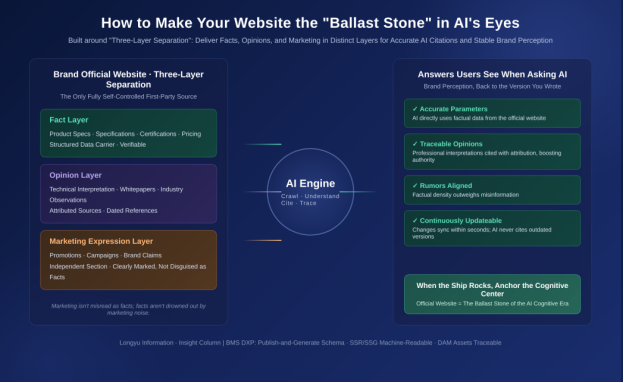
Figure 2 — Why the official website behaves as ballast: it is the first-party layer that stabilises every downstream AI description of the brand.
How do you implement this in practice? A 90-day GEO remediation plan
Conclusion: this is an engineering and governance task, not a campaign. Run it in three phases and you will surface most of the failures before a model ever repeats them to a customer.
Days 1–30: find out what AI already says about you
- Build a prompt set of 10–20 real purchase-intent questions: category comparisons, "is X suitable for Y scenario", pricing logic, certifications, after-sales policy — phrased the way a customer would ask, not the way your marketing deck reads.
- Run the set across the major AI platforms and log three columns: whether your brand appears, whether the description is correct, and which source page the answer traces back to. Features such as Baidu's "Answer Traceability" make the third column visible rather than guessed.
- Fetch your own key pages with JavaScript disabled and confirm the body text is present in the raw HTML. A page that renders blank without scripts is a page AI cannot read.
- Audit robots.txt and crawler policy deliberately, not by default. OpenAI's own crawler documentation separates training agents from search and user-triggered agents (for example GPTBot, OAI-SearchBot and ChatGPT-User; see developers.openai.com), and Google documents its crawler and AI-side controls in its crawling reference (see developers.google.com). Blocking everything "for safety" is the fastest way to make a brand invisible.
- Check that the XML sitemap is complete and that no staging rule (
noindex) survived a launch.
Days 31–60: rebuild the site as a first-party knowledge base
- Give every product its own page stating function, parameters, applicable scenarios, pricing logic and, where relevant, discontinuation date — instead of a brochure paragraph buried in a PDF.
- Give every case study its own page stating client industry and scale, the problem faced, the solution and a quantified result; these are the pages that supply the "Experience" leg of E-E-A-T.
- Give every service process its own page stating steps, cycle time, deliverables and acceptance criteria.
- Separate templates by domain so the national standard becomes a workflow rather than a slogan: factual pages, insight/opinion sections, and campaign areas, each carrying distinct structured markup. Opinions must name their source; marketing copy must not be dressed up as fact.
- Deploy Schema from the schema.org vocabulary — Organization for the entity, Product and Offer for commercial pages, Article for editorial content, and FAQPage for genuine question blocks (schema.org). Validate every template before publishing: malformed markup is read as a wrong answer, not as no answer.
- Keep entity signals identical everywhere they appear — legal brand name, qualifications, contact details, address. Inconsistent naming across channels is what produces a broken brand profile.
Two emerging practices deserve a footnote rather than a headline. Placing an llms.txt file at the domain root is cheap and forward-looking, but no major AI platform has publicly confirmed that it reads the file, so it should never be sold internally as the thing that "fixes AI visibility". Treat it as an optional extra layer on top of crawlability, structured data and factual accuracy — this is our assessment, not a vendor claim.
Days 61–90: make it continuous
- Put an expiry date on every certificate, licence and price claim, and attach alerts so an expired document cannot stay published.
- Re-run the prompt set monthly, diff it against the previous month, and archive the evidence.
- When a false description is detected, answer it with a dated first-party statement page, request recrawl, and keep the correction trail — the August 11 national standard gives you grounds for demanding accurate sourcing.
Search-era habit versus post-3·15 requirement
| Dimension | Search-era habit | What breaks it now | GEO-era replacement |
|---|---|---|---|
| Objective | Win a ranking position | Answers replace link lists; rank without citation earns nothing | Be the citable source of the fact |
| Unit of content | A page | Models quote self-contained passages, not whole pages | Answer block first, evidence after |
| Technical layer | Visual design and UX | Client-side rendering, hidden parameters in images | SSR/SSG, validated Schema, clean architecture |
| Update cadence | Annual refresh | Every extra day of stale data is another day AI cites it | Dated facts with expiry alerts |
| Failure mode | Low traffic | A confident but wrong description; a fabricated product | Monthly perception audit and correction |
| Compliance risk | Overclaiming copy | "Corpus bombing" and keyword stuffing are named red lines | Three-domain separation with evidence links |
Five traps that quietly remove a brand from AI answers
- Treating GEO as a media-buy. In the past you could spend money to get your name into results; now the cost of that path is legal risk and the return is placement on platform blacklists.
- Confusing "readable" with "ranked". Your site does not need to be "optimised"; it needs to be "understandable". Traffic metrics can look healthy while the machine layer is empty.
- Letting stale pages stay live. If a product is discontinued, parameters change or certifications expire, even a one-day delay in updating the official website means AI cites the outdated version for an extra day. An expired version with incorrect information is worse than having no version at all.
- Marketing copy in the fact slot. Under the Three-Domain Separation principle this is not a tone problem; it is a credibility signal that lowers citation willingness.
- Watching rankings instead of perception. Asking your own brand questions across AI platforms is not defensive paranoia — it is a routine brand KPI under normal conditions, and it is the only way to see the fictional-product risk before your customers do.
Who owns which piece inside the company?
This is the part most teams skip, and it is where compliant GEO quietly dies. Our recommended split of duties (editorial guidance, not a mandated model): product and engineering own the factual layer, including parameters, certifications and price logic; content and PR own the insight layer, always with named sources; marketing owns campaign areas and must keep them visually and structurally separate from facts; IT owns crawlability, rendering and Schema validation; legal and compliance own the red lines and the correction record. One person must hold the monthly perception audit, or nobody will.
As Gary Illyes, the Google search analyst, put it in his opening remarks at this year's Shenzhen SEO conference: "Don't panic, things are always changing. Figure out how to make sense of it." Periods of rule change never eliminate those who diligently produce quality content; they only eliminate those still trying to exploit loopholes.
FAQ: what readers ask us most often
Can GEO no longer be done after March 15?
More accurately, "black hat" GEO can no longer be done. The technology of GEO itself has not been negated. The national standard implemented in August and the industry self-discipline convention signed in March are both doing the same thing: setting boundaries for compliant GEO and red lines for non-compliant operation. As long as content is authentic, sources are traceable and optimisation is transparent, GEO remains a mandatory course for brands in the AI era. Flooding the market with fake soft articles or fabricating consensus crosses legal bottom lines.
Do we have to rebuild the website from scratch?
Usually no. The four shifts that matter — supplying facts instead of buying answers, structural repair instead of rank manipulation, active updates instead of passive citation, perception monitoring instead of rank monitoring — are remediation tasks on the existing site. A rebuild without a factual layer reproduces the same blindness at a higher cost.
Which pages should we fix first?
The ten that carry your core facts: the top products or services by revenue, the certification and qualification page, pricing or packaging logic, the case-study index, the company profile with legal entity details, and the support or after-sales page. Depth on ten pages beats thin coverage of a hundred.
How long until AI answers stop repeating the error?
There is no guaranteed timetable. Retrieval-based answers can change within days once the corrected first-party page is crawled; the fictional wristband case showed that even a widely broadcast correction took hours to clear, and some models were still outputting its "functional parameters" twelve hours after the gala aired. Plan for weekly checks, not a one-off clean-up. This is our working assumption from the reported cases, not an official service level.
What is the honest cost of doing this properly?
Predominantly editorial and engineering time: writing factual pages nobody asked for, adding expiry dates, and running a monthly audit. The expensive alternative is the one the 3·15 cases illustrate — discovering the wrong description through a customer's screenshot.
Action checklist: your first seven moves
- Write the ten questions a buyer would actually ask about your brand, and ask them tonight across the major AI platforms.
- Record presence, accuracy and cited source for each answer; save the screenshots as a baseline.
- Fetch your top ten pages with JavaScript disabled; if the text is not in the HTML, that is bug number one.
- Review robots.txt and AI-crawler policy line by line, and unblock retrieval-only agents where lawful.
- Publish one clean factual page per core product: function, parameters, scenarios, pricing logic, sources.
- Mark up those pages with validated Schema and add a "last verified" date to every fact.
- Set a monthly calendar invite for the perception audit, with a named owner and an escalation path for false claims.
If you want to share what AI says about your brand — correct or otherwise — write to IT Insights at contact@itinsights.com. Corrections and additional evidence are welcome; this desk updates its guidance as the standards and platform behaviours evolve.
Sources referenced
- Xinhua, "'3·15'之后 GEO的是非题" (8 April 2026) — https://www.news.cn/digital/20260408/c1ef4fac451c456f934fd97e333723fd/c.html
- OpenAI crawler documentation (user agents and access control) — https://developers.openai.com/api/docs/bots
- Google crawling documentation, common crawlers and AI-side controls — https://developers.google.com/crawling/docs/crawlers-fetchers/google-common-crawlers
- schema.org, FAQPage type definition — https://schema.org/FAQPage
- Gartner forecast on 2026 search volume, as reported by Cailianshe (February 2024) — https://www.cls.cn/detail/1598522