
How Gucci’s Mariah Carey Hotel Arrival Becomes a Practical 2026 Holiday Marketing Checklist
The practical answer is simple: Gucci uses Mariah Carey’s 1994 Christmas cue as a ready-made signal, then lets a hotel-arrival film carry the season without lengthy setup. Directed by Harmony Korine and released on YouTube on November 2, the 2026 campaign turns recognition into structure. For a general reader, that matters because it shows how brands can borrow cultural timing without pretending the product alone creates the holiday.
Many companies face the same awkward position each year. They want the season’s goodwill, but the creative does not have to explain the whole cultural moment. Every November, Mariah Carey’s track returns, and the return becomes a public clock. The campaign that understands this clock saves itself a lot of setup; the one that ignores it can look late, generic, or too eager.
What did Gucci actually build in the 2026 holiday film?
The film is built as an arrival story. A vehicle stops outside a hotel, a bellboy informs colleagues about a special guest, and employees move through the property carrying Gucci gift boxes. The suspense grows before Mariah Carey enters, while the song does the emotional work that copy normally has to do alone.
By choosing a hotel, the brand creates a sequence rather than a poster. The gift boxes are not placed in a sterile display; they travel through service corridors, reception spaces and event rooms. That makes gifting feel operational, like something moving toward a destination. The audience is not told “this is a gift edit”; it watches a ritual prepare for the guest whose entrance marks the season.
A trade summary from ContentGrip notes that the film is titled Gucci Gift with Mariah Carey and “was released on Gucci's official YouTube channel on November 2.” That matters for practical readers because the asset has a clear platform and date, not a vague seasonal mood. A dated release on an owned channel lets a campaign enter the conversation when the calendar cue is already active.
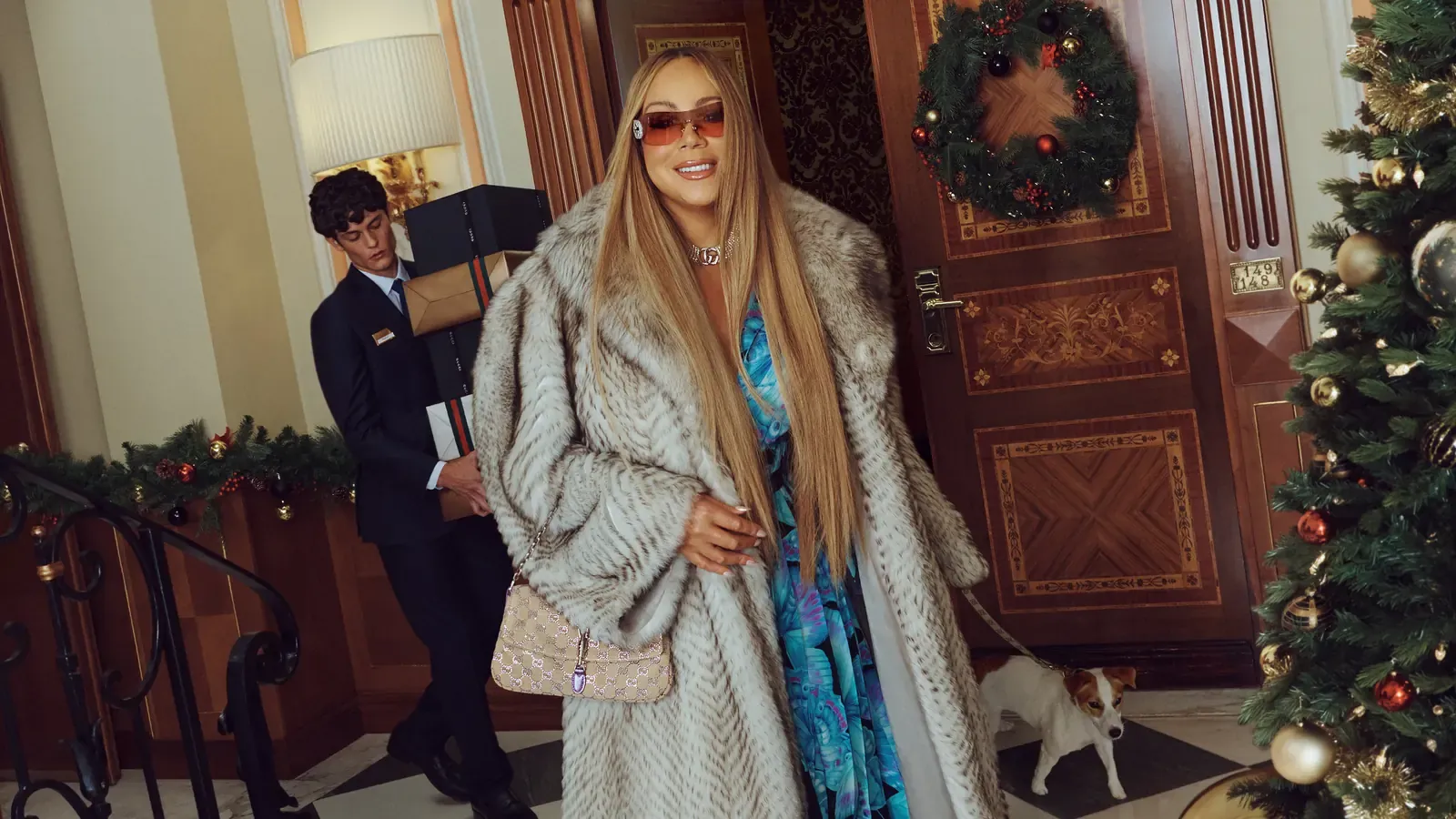
The 2026 Gucci holiday film builds anticipation around Mariah Carey's hotel arrival; image via Haute Living.
How does the Butterfly collection turn celebrity into product context?
A celebrity can carry mood, but products need a reason to appear. FashionNetwork reports that the Butterfly special collection draws on Carey's butterfly motif and the 1997 album of the same name. That is more specific than a generic snow-and-lights theme. The campaign uses the motif to connect singer, song, season and shelf product in one thread: a personal symbol becomes a gift edit.
For a general reader, the practical point is not luxury trivia. It is that product context should be tied to the cultural cue, not stapled to the end. When a collection motif has a clear relationship to the artist's identity, the campaign does not have to switch abruptly from film to merchandise.
What does Sephora’s It's time! treatment add to the comparison?
Sephora previously used Carey in its 2025 holiday campaign, playing on her familiar annual It's time! moment. The difference is tonal. Sephora interrupted the Christmas ritual with comedy and social meme energy. Gucci presents the singer's arrival as an elegant, theatrical event. Both use the same cultural shortcut, but each asks the audience to behave differently: laugh along, or enter a staged countdown.
| Campaign move | What it does | Why it matters to readers |
|---|---|---|
| Gucci hotel arrival | Builds suspense through staff, gift boxes and arrival | Shows how structure can replace explanation |
| Carey as seasonal shorthand | Lets one 1994 song set the premise | Helps brands decide whether to explain or borrow |
| Sephora It's time! angle | Uses playful announcement energy | Shows the same celebrity can support different brand tones |
| Butterfly collection link | Connects artist symbol to product | Keeps campaign and merchandise in the same story |
For marketers, the comparison is not about which brand is better. It is about fit. A mass beauty retailer can amplify a meme. A luxury house can stage a ritual. The cultural cue is shared; the creative contract is different.
Where does this sit in the cost reality of a seasonal campaign?
This is an operational reading, not a sourced budget. A hotel set, a director, an artist association, a special collection and an owned-channel release imply a scale of coordination that most small businesses cannot copy literally. The useful cost lesson is narrower: the expensive part is not necessarily the celebrity name itself, but the production system required to make the name feel inevitable.
For readers comparing options, a smaller brand can use a lower-cost version of the same logic: one location, one ritual, one calendar cue, and one product role. The question is not whether you can recreate a fashion film. The question is whether your campaign can make the season feel like it is already starting without you explaining it.
Which mistakes should a practical marketer avoid when copying this format?
- Do not confuse recognition with permission. A song may be culturally familiar, but brand use still depends on rights, platform context and the artist's own positioning.
- Do not make the celebrity the whole story. If the product thread disappears, the campaign becomes a music-video cameo rather than a campaign.
- Do not release without a timing job. Every November only works if the date, channel and creative sequence match the expected cultural clock.
- Do not infer sales from aesthetics. Sources reviewed indicate Gucci has not provided campaign conversion figures, so the lesson is creative, not performance proof.
What should a reader do next if building a seasonal campaign checklist?
- Name the cultural cue before naming the product: Is there an event, song, habit or meme that already marks the season?
- Choose the creative job: Explain why the brand belongs, or stage a moment the audience already recognizes?
- Build one physical sequence: an entrance, delivery, preparation or arrival that can carry the story without voiceover.
- Tie products to the cue: a motif, a gift role, a color, or a collection reason should be traceable to the artist or moment.
- Set a verification layer: record the release date, channel, platform asset and whether performance data exists. If data is absent, label the claim as analysis rather than proof.
Frequently asked questions
Why does Mariah Carey's song matter more than a new holiday jingle?
Because the track has accumulated years of calendar association. Every November, the song signals the start of holiday conversation for many audiences, so the brand does not need to create the feeling from scratch.
Is Gucci claiming Mariah Carey's arrival sells products?
No. The reviewed coverage describes the creative and the release, while not showing conversion figures. The useful reading is about storytelling and timing, not sales proof.
Can smaller brands use the same idea without a famous artist?
They can use a public calendar moment, a long-running customer ritual or a recurring seasonal need, but they must avoid implying rights or ownership where none exist. A public moment is not the same as licensed content.
What is the simplest way to judge whether a seasonal campaign is credible?
Check whether the campaign gives the audience a reason to recognize the timing before it asks the audience to consider the product. If the brand must explain the holiday from zero, the seasonal cue is weak.
References
- Gucci Gift with Mariah Carey on YouTube
- ContentGrip: Mariah Carey brings Christmas to Gucci's holiday campaign
- FashionNetwork: Gucci holiday campaign and Butterfly special collection
- Haute Living: Gucci Holiday Campaign
- Sephora Newsroom: Mariah Carey declares It's time!