
Google vs DuckDuckGo for United States K-12 Schools: A Trade-Off Guide to AI Search Policies
For United States K-12 leaders, the real issue is not whether AI should exist in classrooms, but whether schools must accept an AI-linked search experience as the price of Google Search. Google's recent policy gives administrators more default-off controls, yet still bundles search access with AI settings. DuckDuckGo counters with an opt-in approach. The comparison below weighs control, instructional fit, switching effort and risk.
What changed in Google’s K-12 AI policy?
Google's new approach for K-12 education users gives schools more explicit control but preserves a central trade-off. Administrators can disable Gemini and other AI tools; however, if a school rejects AI altogether, student accounts may lose access to Google Search. Google's position is that search and AI are “deeply integrated,” so a completely AI-free Search version is not practical (The New York Times, Nov. 3, 2026). The same coverage says the default-off changes are expected to take effect early next year.
AP and CBS News reported that Gemini, Gemini Notebook and Search would be off by default, with schools able to turn each product on individually. Google's own education blog also says administrators can enable or disable AI products for K-12 student accounts and highlights Guided Learning as part of its responsible-AI-for-schools update.
Why are schools suddenly comparing Google with DuckDuckGo?
The argument is not about one feature; it is about who controls the default. AI Overviews, Google's generative summaries in Search, launched for all U.S. users on May 14, 2024, according to Google's Search blog. Since then, search pages have increasingly moved from a list of links toward machine-generated answers, then links. For schools, that shift touches pedagogy: students may get an answer before they learn to test it.
Teachers and administrators often want a traditional search layer for source discovery, citation checking and comparison. Critics argue that if AI summaries become unavoidable, students may weaken independent research and critical-thinking habits. That is the opening DuckDuckGo is trying to fill. TechCrunch reported on Nov. 4, 2026 that DuckDuckGo is courting schools frustrated by Google's restrictions and pointing educators to options for disabling AI features.
What does DuckDuckGo actually put on the table?
DuckDuckGo founder and CEO Gabriel Weinberg used social media to show schools how to make the service a default search engine and offered help with migration and deployment. Kamyl Bazbaz, a senior DuckDuckGo executive, framed forced AI as a market-dominance problem and urged schools to demonstrate that choice still exists. The company has also said in media interviews that Google could offer a no-AI school Search version but has chosen not to.
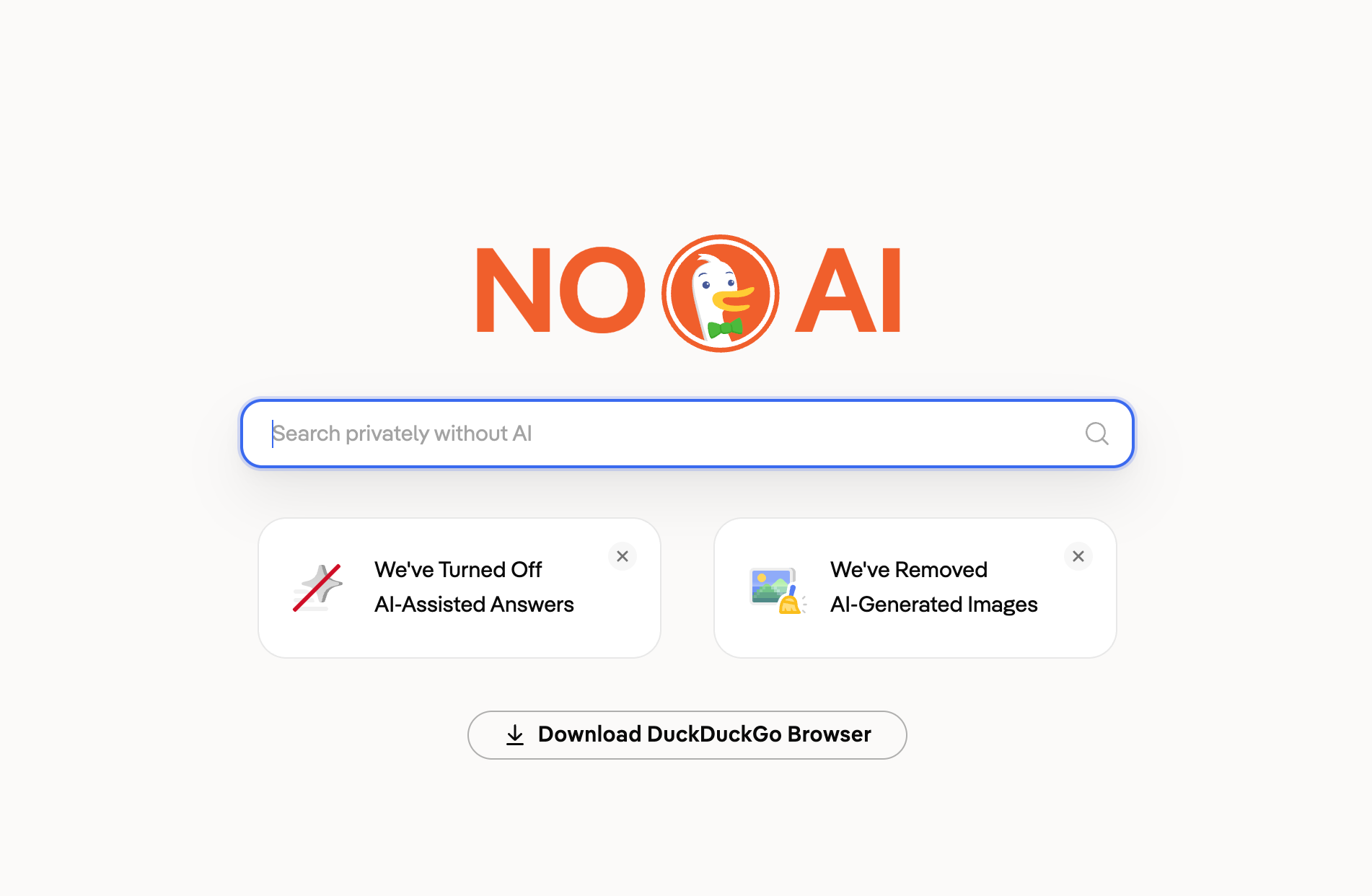
For basic information retrieval, DuckDuckGo argues, students do not need AI summaries, chatbots or automatically generated content. Its pitch is simple: keep search stable, make AI optional, and do not remove the underlying search service when a user disables AI. A concrete example is the company's noai.duckduckgo.com page, which turns off AI-assisted answers and AI-generated images by default, giving a traditional search experience without losing search itself (TechCrunch).
Google vs DuckDuckGo: where the trade-offs differ
| Comparison dimension | Google school stack | DuckDuckGo school option | What it means for decision-makers |
|---|---|---|---|
| Search and AI coupling | Search can be off by default, but reporting says rejecting AI entirely may remove Google Search for student accounts. | Search remains available while AI features can be disabled, including through a dedicated no-AI page. | If “AI off” means “no search,” Google requires a workaround; if it means “no AI layer,” DuckDuckGo aligns more closely. |
| Administrative control | Gemini, Gemini Notebook and Search can be enabled item by item, giving districts granular permission. | AI choice is clearer at the browser or search-entry level, but school management may require separate policy. | Granular controls are better where districts have device management; simple opt-out is better where teachers want a stable link-only workflow. |
| Instructional fit | Guided Learning is intended to scaffold reasoning step by step instead of presenting a direct answer. | Traditional links encourage students to identify sources first, then synthesize. | Choose by teaching goal: guided AI tutoring with AI present, or source-hunting practice with optional AI. |
| Ecosystem integration | Strong fit with Google Classroom, Workspace and Chromebook environments already common in U.S. schools. | Works as a search or browser setting, but does not replace assignment, grading or device administration layers. | Migration effort depends on whether search is a convenience or the operating backbone of classroom work. |
| Public-risk narrative | Critics frame the policy as forcing AI adoption because search and AI are treated as inseparable. | DuckDuckGo positions itself as a choice-first alternative, not a ban on AI. | Communications matter: parents may judge AI integration less by product quality than by whether it was optional. |
Which option fits which school?
- Google Search remains reasonable where Chromebooks, Classroom and Workspace are the core workflow, provided administrators set Gemini and Gemini Notebook defaults carefully and pilot Guided Learning before scaling it.
- DuckDuckGo is worth testing where the priority is an AI-free research entry point, especially for library portals, writing tasks or grades where teachers want students to compare sources before asking an assistant to summarize.
- A dual-path model may suit mixed-use districts: keep Google tools for assignments that require school-managed workflows, while offering noai.duckduckgo.com as a controlled research shortcut when students need links without AI framing.
Common misunderstandings in the AI search debate
- Default off does not mean AI cannot appear. The issue is what happens when search is enabled and which AI layers come with it.
- Guided Learning is not an AI-off switch. It changes the answer style, not the underlying presence of AI.
- DuckDuckGo is not simply anti-AI. It offers AI-optional paths, which is why its pitch is control rather than prohibition.
- Changing the search engine does not solve classroom policy. Teachers still need rules for citations, AI disclosure and verification.
Action checklist: before a school changes its default search engine
- Inventory where search begins: browser, Chromebook, Classroom assignment link, library portal or student device.
- Define whether “no AI” means no AI answer summary, no chatbot access, no AI-generated images or all three.
- Test one grade or course with both Google Search and DuckDuckGo noai.duckduckgo.com for the same assignment.
- Record friction points: slower source finding, missing filters, accessibility tools, citation quality and teacher workload.
- Give parents a plain-language note explaining the setting, the reason and the review date.
- Set a 30-day review so the decision remains policy-led, not platform-led.
FAQ: what general readers should ask
Does Google force schools to choose between search and AI?
Not in a simple yes-or-no way. Schools may turn each tool on or off, but the reported policy means that if AI is rejected completely, student accounts may lose Google Search. Default-off settings do not automatically produce a fully AI-free Google Search once search is turned on.
Is DuckDuckGo a completely AI-free search engine?
Not necessarily. DuckDuckGo promotes the ability to disable AI features and keep search available. Its no-AI page is designed to turn off AI-assisted answers and AI-generated images, while other DuckDuckGo services can offer AI on an opt-in basis.
Does Guided Learning solve the criticism that AI gives answers too directly?
Only partially. It is meant to guide students through reasoning step by step instead of presenting a direct answer, but it remains an AI-enabled option, not a guarantee of AI-free study.
What should parents care about if they do not know education technology?
They should ask three practical questions: What does the school default search page show? Can students see original sources without asking a chatbot? Is the choice documented, reversible and reviewed with teachers?
Bottom line: choose control, not branding
The dispute is less about one company's AI model than about the boundary between search utility and AI product distribution. For United States K-12 schools, a prudent comparison review should not start with “is AI good?” but with “what happens when AI is off?” Google provides scale and classroom integration, with an unresolved coupling between search access and AI settings. DuckDuckGo offers a clearer choice-first message, but it cannot replace all school management functions built around Google's ecosystem. The best decision is testable, documented and reversible.
Reference sources
- Google Blog: AI Overviews launched in the United States in May 2024
- Google Blog: Responsible AI for schools with Guided Learning
- The New York Times: Google Will Turn Off Search for Schools That Reject A.I.
- AP reporting: Gemini, Gemini Notebook and Search off by default
- TechCrunch: DuckDuckGo pitches itself to schools amid Google AI backlash
- DuckDuckGo: no-AI search page