ItInsights World Analysis: Inside Goodram's Validation Workflow at Łaziska Górne for Industrial IoT Memory and Storage
By James Hartley · IT Insights
When a memory module or a solid-state drive misbehaves inside the industrial computer governing a production cell, the bill that arrives is not the price of the part. Production downtime, an engineer dispatched on site and potentially lost critical data land in the same column, pushing Overall Equipment Effectiveness (OEE) and Total Cost of Ownership (TCO) in the wrong direction. The verification chain Goodram operates at its manufacturing facility in Łaziska Górne, Poland, is therefore worth reading closely as a case study in how embedded and Industrial IoT (IIoT) platforms buy predictability: thermal burn-in at 80°C, more than 400 diagnostic platforms, and a chamber-based environmental programme sitting behind them.
What Industrial Integrators Actually Specify
Predictable behaviour under extreme operating conditions is the first requirement on a purchase specification; identical parameters from one production batch to the next is the second.
Standard electrical testing carried out by contract manufacturers tends to satisfy neither fully, because latent defects frequently stay invisible until prolonged stress brings them out. The answer deployed at Goodram's Polish site is a comprehensive, multi-stage functional, thermal and environmental validation regime — one that deliberately treats two silicon technologies as two different problems.
Two Technologies, Two Screening Philosophies
Removing early-life failures, commonly described as infant mortality and clustered in the opening phase of the bathtub curve, is the standing challenge in reliability engineering.
Simply extending test duration for every product on the assembly line is economically inefficient, and flash memory pays a physical penalty for it: surplus testing wears NAND cells before the drive reaches the customer. Goodram consequently matches each methodology to the physical failure mechanisms of DRAM and of SSDs.
| Screening dimension | DRAM modules | SSDs |
|---|---|---|
| Stress applied | Full-load burn-in at 80°C, measured directly on component surfaces | Controller initialization and firmware integrity verification, then full Logical Block Addressing coverage |
| Exposure | Procedures run between 30 and 180 minutes | two complete write-and-read cycles — a 1 TB drive receives approximately 2 TB of written data |
| Platform base | more than 400 computer platforms on Intel and AMD architectures | Customized Linux testing stations |
| Signals captured | Data retention anomalies, marginal timing characteristics, die-level fault attribution | SMART parameters, Developed Bad Blocks (DBB), transfer errors, protocol anomalies, PCIe and SATA stability |
| Design intent | Accelerate charge leakage to expose weak cells quickly | Flag suspect drives without unnecessary NAND wear |
Heat, Assembly Code and Address Mapping: the DRAM Route
Elevated temperature is used here as a diagnostic instrument rather than a brute-force torture test. Higher cell temperatures increase charge leakage, which surfaces data retention anomalies and marginal timing characteristics inside a single test pass instead of years later in service.
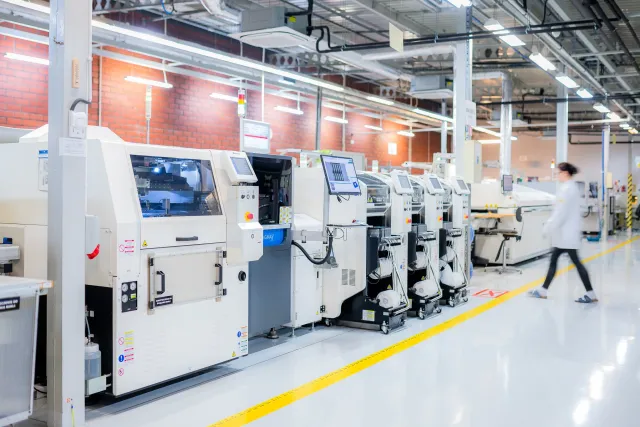
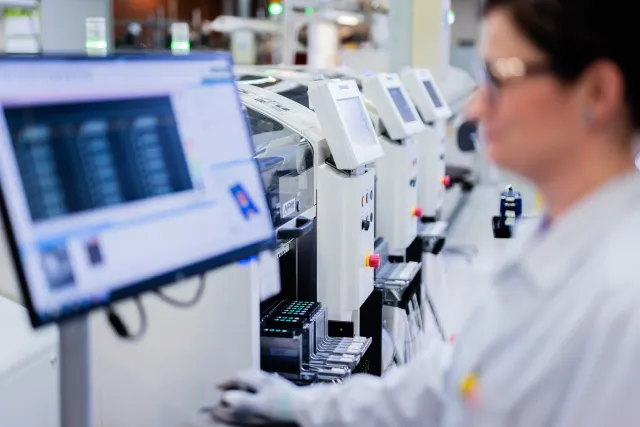
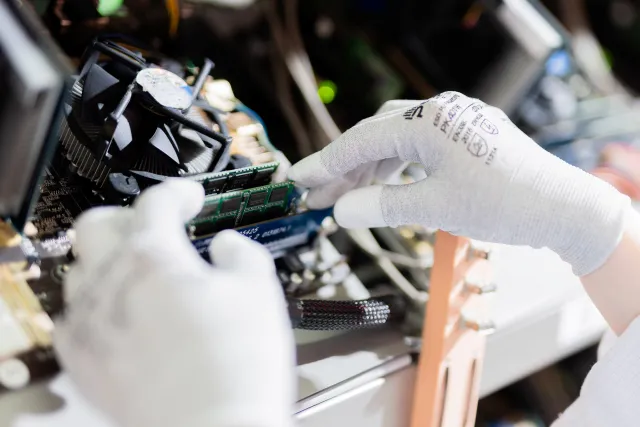
Compatibility breadth carries the rest of the load. The more than 400 computer platforms at Łaziska Górne span Intel and AMD architectures, so functional and compatibility verification is performed against the real-world memory controllers integrators actually ship, across DRAM generations and including ECC and Registered DIMM configurations.
Workload generation is proprietary rather than off-the-shelf. Low-level algorithms written in assembly language by Goodram's in-house R&D team, utilizing SSE/MMX instructions, produce complex read/write patterns built around intensive random and sequential memory access operations.
The same system maps logical memory addresses onto physical silicon structures. When a module fails, engineers can identify the specific DRAM responsible, turning a rejected unit into root-cause analysis and into feedback for the manufacturing process.
Spending the Endurance Budget on Purpose: the SSD Route
Storage validation is built around a constraint DRAM screening never faces: the drive's Total Bytes Written (TBW) endurance budget must not be burned in the factory.
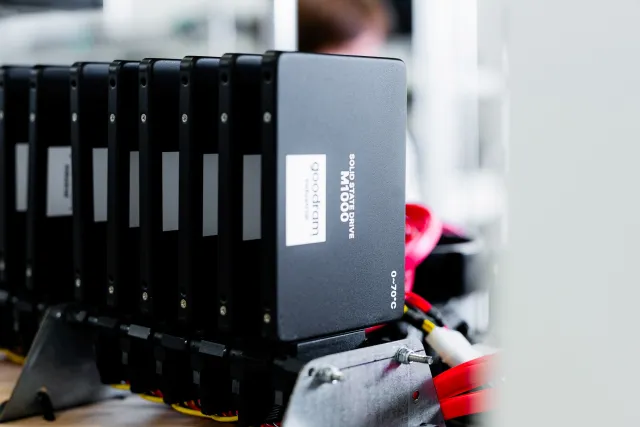
After controller initialization and firmware integrity verification, each SSD undergoes two complete write-and-read cycles covering the entire Logical Block Addressing (LBA) space. On a 1 TB model, that validation volume corresponds to approximately 2 TB of data written.
Test stations operate under a customized Linux environment that continuously monitors Self-Monitoring, Analysis and Reporting Technology (SMART) parameters and the accumulation of Developed Bad Blocks (DBB).
The configuration allows simultaneous detection of data transfer errors, communication protocol anomalies and potential stability issues affecting PCIe and SATA interfaces. Combining full-address-space verification with real-time diagnostics is how Goodram targets potentially defective drives while limiting unnecessary NAND flash wear during production testing.
Climate Qualification and Configuration Control
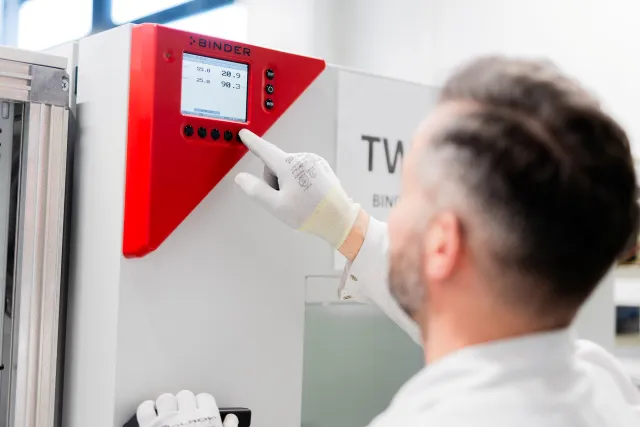
Production-level testing asks whether a part works; environmental validation asks whether its construction survives. A Binder MKTF 240 climatic test chamber, offering a temperature range from −70°C to +180°C with humidity control, assesses the resistance of solder joints, printed circuit boards (PCBs) and electronic components to temperature cycling and humidity exposure. Procedures reference established standards, including the IEC 60068 series — among them IEC 60068-2-14 and IEC 60068-2-30 — and MIL-STD-810.
For embedded system manufacturers, a further capability is at least as consequential: validation can be performed directly on customer-supplied hardware platforms, so memory compatibility and stability are assessed under conditions that more closely reflect the intended application.
Why a Frozen Bill of Materials Matters
Long-term component consistency weighs as heavily for industrial system designers as operational reliability does at first power-up.
An uncontrolled change in controller revision or in memory die process technology can introduce compatibility problems, and real-time systems — where deterministic behaviour and predictable response times are the design premise — absorb that shock first.
Goodram Industrial Solutions responds with a fixed Bill of Materials (BOM freeze) that ensures component consistency across production batches, supported by firmware optimization tailored to application-specific workloads: SSD parameters can, for example, be adjusted to prioritize lower write latency over maximum sequential throughput when the target system requires it.
A Single Polish Site as a Supply-Chain Argument
With electronica 2026 in Munich approaching, the 2026 event has made supply chain resilience and European technological sovereignty increasingly important considerations for industrial electronics manufacturers.
Goodram integrates R&D, testing laboratories and manufacturing operations within one facility at Łaziska Górne. IT Insights reads that co-location as the practical reason memory and storage parameters can be adapted to specific OEM application requirements, and as the reason engineering, quality assurance and production teams communicate directly — accelerating technical issue resolution and supporting consistent manufacturing processes.
European OEMs and industrial system integrators draw the same benefit from geography: access to local engineering expertise, controlled component configurations and manufacturing capacity within the European Union helps reduce the complexity and risk attached to geographically dispersed supply chains.
Company Profile: Goodram S.A.
Goodram S.A., a Polish company, owns the Goodram brand and is the only manufacturer of DRAM memory modules and SSDs in the European Union. Based in Łaziska Górne since its founding in 1991, it designs and manufactures memory and storage solutions for over 40 markets worldwide.
Its own production facilities, R&D capabilities and advanced testing laboratories make it a vital link in the European semiconductor value chain, contributing to technological sovereignty and supply chain resilience; the Goodram Industrial and Goodram Enterprise portfolios serve industrial, embedded, server, data center and AI applications.
As a member of the Polish Technology Platform for Photonics (PPTF) and of the Polish Chamber of Commerce for Electronics and Telecommunications (KIGEiT), the company participates in the European technology ecosystem and supports cooperation between industry, research institutions and technology partners.
Editorial Read-Out: Six Points for a Selection Checklist
Returned to the procurement question that opened this analysis, the case gives integrators six concrete claims to ask any memory or storage supplier to evidence:
- a stated burn-in regime with temperature and duration window — 80°C, and between 30 and 180 minutes for DRAM;
- coverage on real memory controllers, here more than 400 diagnostic platforms rather than bench fixtures alone;
- a flash test path that caps endurance consumption, evidenced by two complete write-and-read cycles across the full LBA space;
- a published chamber specification and the standards its procedures cite — Binder MKTF 240, the IEC 60068 series, MIL-STD-810;
- a contractual BOM freeze and application-tuned firmware, as provided under Goodram Industrial Solutions;
- engineering, laboratories and production under one roof within the European Union, at the single site in Łaziska Górne.
Where the Industrial Portfolio Shows in 2026
For readers who want to test these arguments face to face, Goodram Industrial will be present at electronica 2026 in Munich.