
Worst Q3 Since 2013: Memory Costs and Channel Pullback Cut Global Smartphone Shipments by 20%
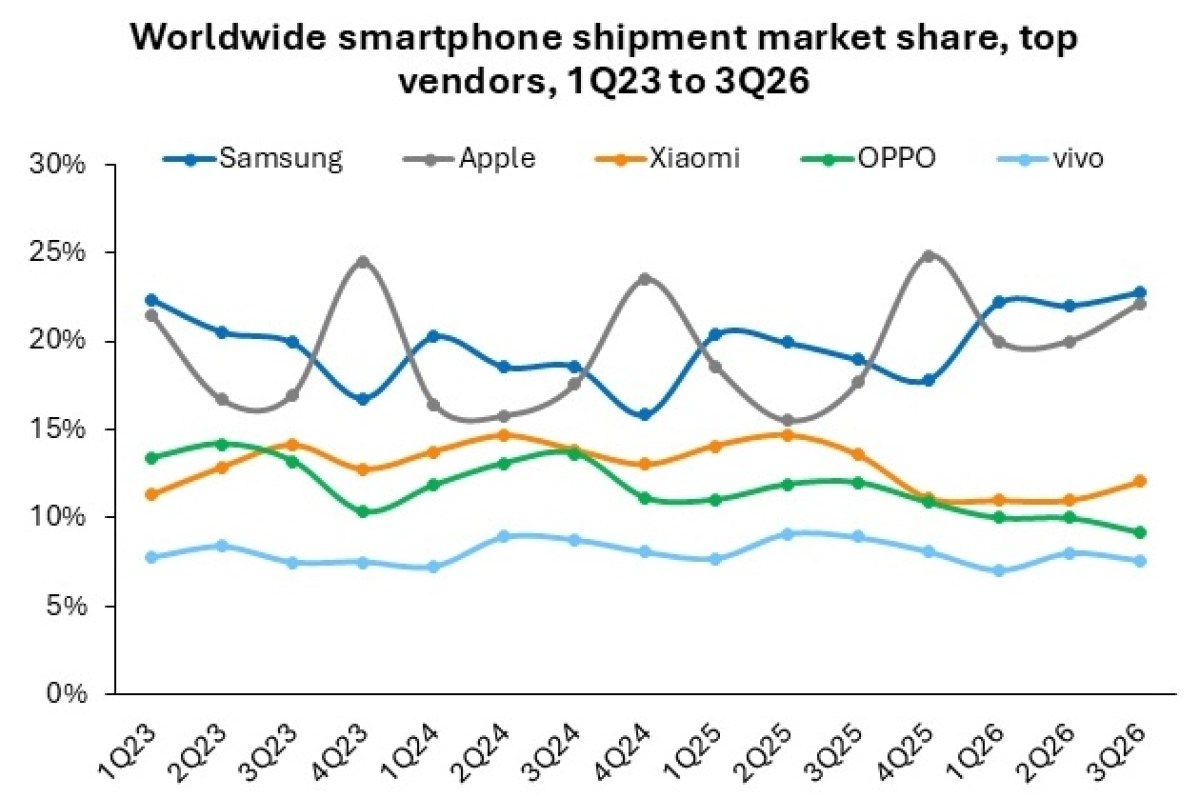
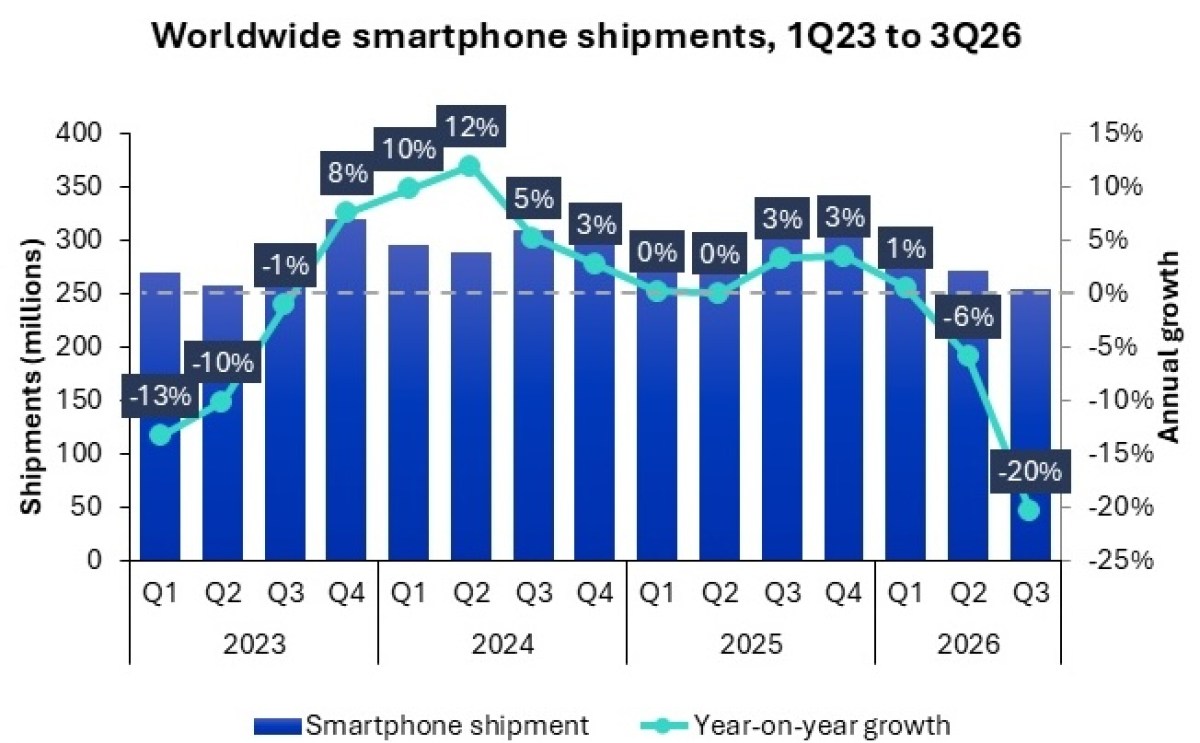
Two brakes were pulled at the same moment this quarter, and the handset industry felt both of them. Research published by Omdia on October 29, 2026 put Q3 global smartphone shipments at 254.7 million units, 20% lower than the same period last year — the least productive third quarter the market has recorded since 2013. Soft consumer demand explains only part of that reading; an equally decisive driver was vendors deliberately trimming the volume they were willing to push into the field.
Where the pressure originated
Bill-of-materials cost
DRAM and NAND flash prices have continued to climb, and because memory is a component no handset can omit, the increase flows directly into the cost of every finished device. Entry-level and mid-range models, which never carried much margin to begin with, are the least equipped to absorb it. Their manufacturers are left with three levers: raise retail prices, rework memory and storage configurations, or ship fewer units in order to defend profitability.
Channel and inventory behaviour
Distributors and retailers have turned cautious at the same time. Since each incoming handset now ties up more capital, inventory carries a heavier cash burden, and many trade partners declined to build the deep stock they would normally assemble ahead of the year-end shopping season. Sell-in volumes from phone makers were compressed further as a direct consequence.
Vendor standings: the top holds, the volume players bend
| Rank | Vendor | Q3 shipments | Year on year | Market share |
|---|---|---|---|---|
| World number one | Samsung | 57.8 million units | down 5% | 23% |
| Second place | Apple | 56.5 million units | roughly flat | 22% |
| Third place | Xiaomi | 30.7 million units | down 29% | — |
| Fourth place | OPPO Group (includes realme and OnePlus) | 23.4 million units | down 39% | — |
| Fifth place | vivo | 19.3 million units | down 33% | — |
Samsung kept its position as the world number one vendor. Third-quarter shipments of 57.8 million units were down 5% year on year, with a market share reaching 23%. Its stability while the overall market fell 20% rests on the competitiveness of the Galaxy A series in the entry-level and mid-range tiers, plus a global supply chain and sales channel network that few rivals can match.
The Galaxy Z8 series unveiled in August also helped Samsung consolidate its footing at the premium end. Combined with trade-in and device-upgrade incentives, those launches stimulated replacement demand among high-end users.
Apple held second place with 56.5 million units shipped, essentially flat against the same period last year, and a market share of 22%. In a quarter when global demand slid 20%, it was one of the few major vendors able to keep its shipment scale intact.
That resilience was underwritten by comparatively solid demand in China and North America and by the sustained sales momentum of the iPhone 17 series. In September Apple introduced the iPhone 18 Pro, the iPhone 18 Pro Max and its first foldable, the iPhone Duo, while pushing the standard iPhone 18 back to 2027. Delaying iPhone 18 extends the selling window of the iPhone 17 series and concentrates launch marketing on the premium models.
Xiaomi remained in third place, but its 30.7 million units represented a sharp year-on-year decline of 29%. Within that, China shipments fell 20% and India fell 28%. Facing continuously higher memory and storage chip costs, Xiaomi has been re-pricing products market by market and giving greater weight to profit margin rather than to shipment scale alone.
Models such as the Redmi A7 Pro and the Redmi 17 offer some support, yet not enough to offset weak overall demand. Price-sensitive markets show the strain most clearly, where a higher retail price immediately erodes purchasing capacity.
OPPO Group ranked fourth with 23.4 million units in the third quarter, down 39% year on year; its reported figures cover the realme and OnePlus brands. Vivo came in fifth with 19.3 million units, down 33% year on year.
OPPO and vivo have both been hit by rising memory costs and have lifted prices on selected products in their major markets. Vendors whose volume depends on the low- and mid-price bands feel the squeeze most acutely: buyers in that range react strongly to price changes, and the products themselves leave little margin to work with.
Regional split: Africa takes the hardest blow, North America stays resilient
Emerging markets absorbed the sharpest shock. Omdia reported that Africa smartphone shipments in the third quarter fell 39% year on year, making it one of the worst-performing major regions globally. Asia-Pacific excluding Greater China, the Middle East and Latin America all recorded shipment declines exceeding 20%.
Currency depreciation, inflation and rising living costs have together weakened local purchasing power. More users are stretching the life of the handset they already own or moving to refurbished devices; in some lower-income markets, consumers have abandoned smartphones altogether and reverted to cheaper traditional feature phones.
North America, by contrast, has been comparatively stable, supported by a high mix of premium handset spending and by carrier instalment, trade-in and device-upgrade programmes. Those financial and sales mechanisms partially offset the effect of higher device prices on consumers.
Strategic reset and outlook: -12% for full-year 2026, a shallower drop in 2027
Phone makers are rewriting product strategy as conditions deteriorate. Beyond price increases, some are pruning low-margin models, adjusting memory and storage capacity configurations, and voluntarily absorbing component inflation on selected devices in order to defend core competitive positions.
Portfolios are also tilting toward the mid-range and premium tiers, with higher average selling prices used to compensate for lost units. For smaller, weaker-capitalised brands that transition is the hardest: they lack supply chain bargaining power and cannot long endure compressed margins.
Omdia expects global smartphone shipments for full-year 2026 to decline 12% year on year. Storage chip prices continue to rise, and promotional discounting is constrained during the year-end shopping season, so fourth-quarter demand remains under significant pressure.
Looking ahead to 2027, the global market is forecast to contract again, though the decline may moderate compared with 2026. Sustained growth in high-bandwidth memory (HBM) demand is consuming a large share of storage chip capacity and has also affected conventional DRAM supply. With memory makers prioritising AI data centre and server requirements, handset manufacturers have little cost relief available in the near term.
Omdia's view is that future rivalry among phone makers will no longer hinge on shipment scale alone. Companies with resilient balance sheets, lean inventory and efficient operations will be best placed to withstand rising component costs, and vendors may also look to software services, after-sales support and other value-added businesses for incremental revenue.
The read-through for 2026 and beyond is that the ranking logic of this industry has changed, not merely its growth rate. Samsung and Apple, backed by premium line-ups, supply chain scale and comparatively loyal user bases, together account for a combined market share that has already reached 45%, while Xiaomi, OPPO and vivo — names anchored in mass-market consumption — are being squeezed by input costs and household budgets at once. Buyers should expect higher device prices, recalibrated entry-level specifications and longer ownership cycles as the new baseline, and the contest between AI infrastructure and mobile handsets for flash and DRAM capacity is only beginning to transmit its consequences through the supply chain, well beyond the data centre.