
Ginux in Practice: What the 11-Day, 139,000-Line AI Kernel Means for Linux Users
By James Hartley, IT Insights
For general readers, the useful takeaway from Ginux is not that it will replace Linux next week. It is a clear signal that one experienced systems engineer can direct an AI coding agent to build a runnable experimental kernel in a very short time. Last week, Kurtzer presented the project on X, and the code appeared on GitHub under Apache 2.0. The name joins Linux, GPT and Greg; the project joke says the G is best read as GPT, so the author does not look too self-important.
Read practically, Ginux answers a different question from most OS news: what happens when a trusted specialist defines goals, constraints, milestones and acceptance tests, then lets a coding agent do much of the implementation work? The answer is a prototype that is technically impressive but not production-ready, and a workflow that may become easier to reuse across system software.
Quick verdict: interesting prototype, not a server drop-in
- Ginux is an independent x86-64 kernel prototype written mainly in Rust, not a Linux distribution and not a Linux kernel fork.
- It shares the Linux application binary interface, or ABI, so some existing Linux binaries can run without source changes.
- Its memory management, scheduler, process model, file systems, networking and device support are written from scratch, rather than copied from Linux.
- Compatibility remains limited. Using Linux 6.12 x86-64 as the reference, 375 system calls are tracked; 82 are fully implemented, 245 are partial, and 48 are deliberately left unavailable.
- The prototype runs inside QEMU. It does not yet boot directly on ordinary physical hardware, does not provide GPU or NVMe support, and has not received independent security audit.
What makes Ginux different from a Linux port or distro
The clearest way to understand Ginux is to separate three ideas that are often mixed together: an operating system distribution, a kernel, and a compatibility target. A Linux distribution packages a Linux kernel with tools and applications. A kernel is the core program that manages memory, CPU scheduling, files, devices and processes. Ginux builds its own kernel and then presents a Linux-like interface above it.
That is why the project talks about Linux as a kind of "personality" rather than a single implementation. If the ABI is faithfully simulated, applications do not need to know which kernel answers their calls. For now, Ginux focuses on Linux compatibility. The project also leaves open the possibility of adding BSD compatibility later, which shows the wider aim: a kernel that can emulate more than one system interface.
The GitHub project page describes Ginux as a prototype that can boot through UEFI without relying on a Linux host kernel. That is important for clarity: it is not a compatibility layer running inside Linux, and it is not a simple container runtime. Still, the published evidence base remains a research setup, with QEMU as the practical test environment, rather than a polished hardware release.
The AI workflow: human-directed agentic engineering in plain language
Kurtzer calls the method human-directed agentic engineering. In this model, the human is not a passive prompt writer. He sets architecture, requirements, constraints, milestones and acceptance criteria. The agent performs implementation, testing, debugging and revisions. In other words, the expert supplies the engineering contract; the AI does much of the repetitive coding under that contract.
The work ran as a continuous OpenAI Codex task using GPT-5.6 Sol. In 11 days, it produced about 139,000 lines of implementation and test material and completed more than 1,000 commits. That number is a speed metric, not a quality metric. It shows how much code was created, not whether the code is secure, portable or maintainable at Linux scale.
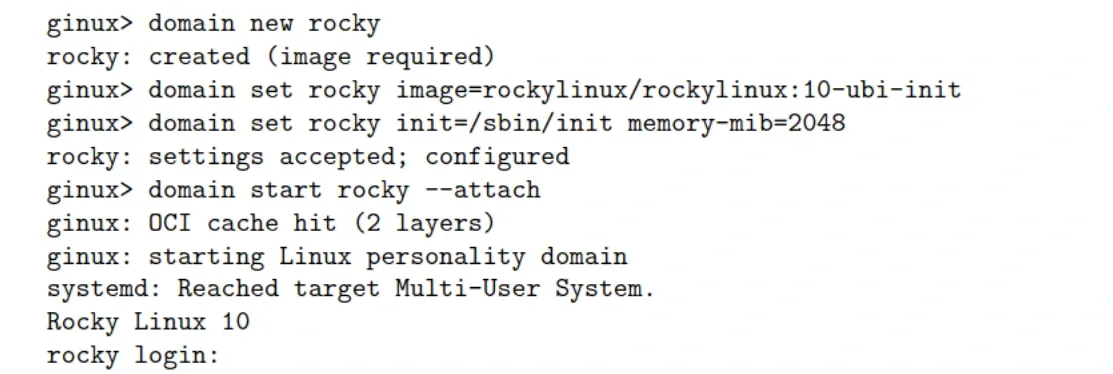
Real-world verification mattered as much as generation. The project used Rocky Linux 10 as a demanding user-space test: Ginux could boot it far enough to reach systemd at the multi-user target. This kind of test is more meaningful than a demo program because init systems, file systems, process management and device interfaces can expose missing behavior quickly. A public Zenodo report, titled "Ginux: Building an Independent Kernel That Runs Linux Userspace through Human-Directed Agentic Engineering", documents the methodology, milestones and acceptance criteria.
Compatibility and isolation: what works, what does not
Ginux includes a mechanism called domains. Each workload runs in a separated environment with its own processes, memory space, file system and related controls. The project presents this as a stronger isolation boundary than ordinary container patterns, while still using standard OCI container images to build domain file systems. That combination is practical: OCI images provide a familiar packaging layer, while domains aim to make workload separation part of the kernel model rather than a bolt-on.
| Dimension | Typical Linux deployment | Ginux prototype |
|---|---|---|
| Core implementation | Linux kernel plus distribution packages | Independent Rust-first kernel with Linux ABI compatibility |
| Compatibility proof | Runs Linux user space because it is Linux | Runs selected Linux user space by emulating the interface, including Rocky Linux 10 to systemd multi-user target |
| Isolation model | Containers, namespaces, cgroups and kernel hardening | Domains as first-class isolated environments, with OCI images used for filesystem assembly |
| Production readiness | Mature, widely audited and hardware-supported | Research prototype; QEMU-based, incomplete system-call coverage, no independent security audit |
Readers should not treat the syscall table as a simple percentage. Compatibility can be uneven. A call may exist but behave differently under load, may miss edge cases, may interact poorly with another call, or may be excluded because the project has not reached that part of the interface. The practical takeaway is that Ginux can demonstrate feasibility without proving broad compatibility.
Practical checklist: how to judge AI-built system software
AI coding tools can make a prototype appear mature quickly. A useful evaluation should start from the artifact and move toward proof. The following checklist applies not only to Ginux, but to any AI-assisted systems project that claims a big result.
- Ask what runs, not only what was written. A kernel that boots an init system and can execute familiar user-space programs gives reviewers a common test frame. In Ginux, Rocky Linux 10 and systemd are central to that evidence.
- Look for the compatibility boundary. The public figures are explicit: 375 reference system calls, 82 complete, 245 partial, and 48 unavailable. That clarity is a strength because it helps engineers assess risk rather than guess.
- Identify the execution environment. If the result runs only inside QEMU, do not infer hardware readiness. Device drivers, firmware interaction, power management, GPU and NVMe behavior are hard engineering problems outside the kernel code itself.
- Check the source of truth. A GitHub repository under Apache 2.0 lets readers inspect code and test scripts. A separate Zenodo technical report gives methodology, not only a news post. These are two different kinds of evidence, and both help.
- Separate code volume from reliability. About 139,000 lines generated in 11 days is not a substitute for audit, fuzz testing, long-duration stability runs, real workload benchmarks or formal review.
- Find who remains responsible. Operating systems live through maintenance, security response and compatibility decisions. Human-directed agentic engineering shifts labor, but it does not remove accountability.
Common misunderstandings
- "It is just another Linux distribution." No. A distribution packages an existing kernel. Ginux is an independent kernel that tries to behave like Linux at the program interface.
- "If AI wrote most of it, human expertise is optional." No. The project's result depends on Kurtzer's systems background, his testing gates and his architectural constraints. AI accelerated implementation; it did not invent the success criteria from nothing.
- "Domains make containers obsolete." No. OCI images are still used for filesystem assembly. Domains propose a different isolation shape, not a finished replacement for the container ecosystem.
- "11 days proves Linux can be replaced." No. The public limitations are too large. Linux's value includes decades of driver enablement, security review, package coordination and community trust.
Why this matters beyond one kernel
The Ginux experiment sits inside a wider change in how software is produced. Last month, Linus Torvalds used Claude Code to work on experimental Linux page-cache patches; reviewers later found a race condition, so the work remained under review. Coverage of that episode reported significant synthetic read-throughput gains, but the bug finding is the better lesson: AI can help produce promising code faster than humans expect, while human review still owns the final decision.
A comparable AI benchmark is Anthropic researcher Nicholas Carlini's compiler experiment, which was reported as using parallel Claude agents to build a large compiler from scratch over many sessions and a significant compute bill. The point is not the headline number, but the method: narrow systems problems with clear tests can be advanced by AI agents. A kernel is much harder to accept as successful because its behavior space is larger, its failure modes are more systemic, and compatibility cannot be verified by a single benchmark.
FAQ: the questions general readers ask first
Is Ginux meant to replace Linux?
No. The project is better understood as an evidence experiment. It shows what AI-directed system coding can achieve in a compressed timeline, while the real gaps remain in hardware support, compatibility completeness and long-term audit.
Why would anyone build a kernel that imitates Linux?
Because applications usually depend on the interface, not the identity of the kernel underneath. If a kernel can present Linux ABI behavior, existing programs may run without modification. That reframes Linux as a compatibility environment, or "personality", and makes future BSD-style compatibility plausible.
Can developers use the code as a learning resource?
Yes, as a study object. The public repository and Apache 2.0 license make it easier to inspect the design. But learning from the code is different from deploying it. Anyone exploring it should assume no security warranty and should run it only in a controlled lab.
What should IT teams tell leadership?
Tell leadership that Ginux is a signal about AI-assisted engineering workflows, not an immediate procurement alternative. The useful business lesson is to adopt AI with clear acceptance tests, independent review and risk management, rather than treating generated code as automatically trustworthy.
Action guide by reader type
- General technology readers: Use Ginux as a mental model for the new software-development split: humans define intent and acceptance; AI handles repetitive implementation and debugging. Watch for security audits before assuming production value.
- Linux users: Do not migrate servers or desktops. If you want to test curiosity, use QEMU only, isolate snapshots and never attach valuable data. Treat the system-call coverage numbers as a warning label.
- Developers: Read the GitHub repository and Zenodo report together. Ask which parts came from AI, which tests caught failures, and how the domains mechanism differs from namespace and cgroup patterns.
- Security-minded teams: Compare AI output to established engineering controls. Require independent review, threat modeling, patch policy and accountability. The absence of audit should block production use.
Bottom line: the kernel is evidence, not the product
Ginux is not the future operating system for ordinary users. It is a future operating-system prototype, and that distinction matters. The 11-day result, the roughly 139,000-line total and the OpenAI Codex workflow show that AI can move large, complex codebases from idea to executable evidence more quickly than traditional teams might expect. But compatibility, NVMe and GPU enablement, QEMU-only operation, incomplete system-call coverage and missing independent audit show that the hard part of infrastructure remains the hard part.
For ItInsightsWorld readers, the practical decision is simple: do not treat Ginux as a replacement for Linux; treat it as a well-documented warning about how fast coding capacity is changing, and as a template for evaluating AI-built software through test gates, source transparency, compatibility limits and real operational risk.