
ItInsightsWorld Analysis: Gemini 4 Carbon Reaches 59 Points and Claims World No. 1, but Cybersecurity Comes First
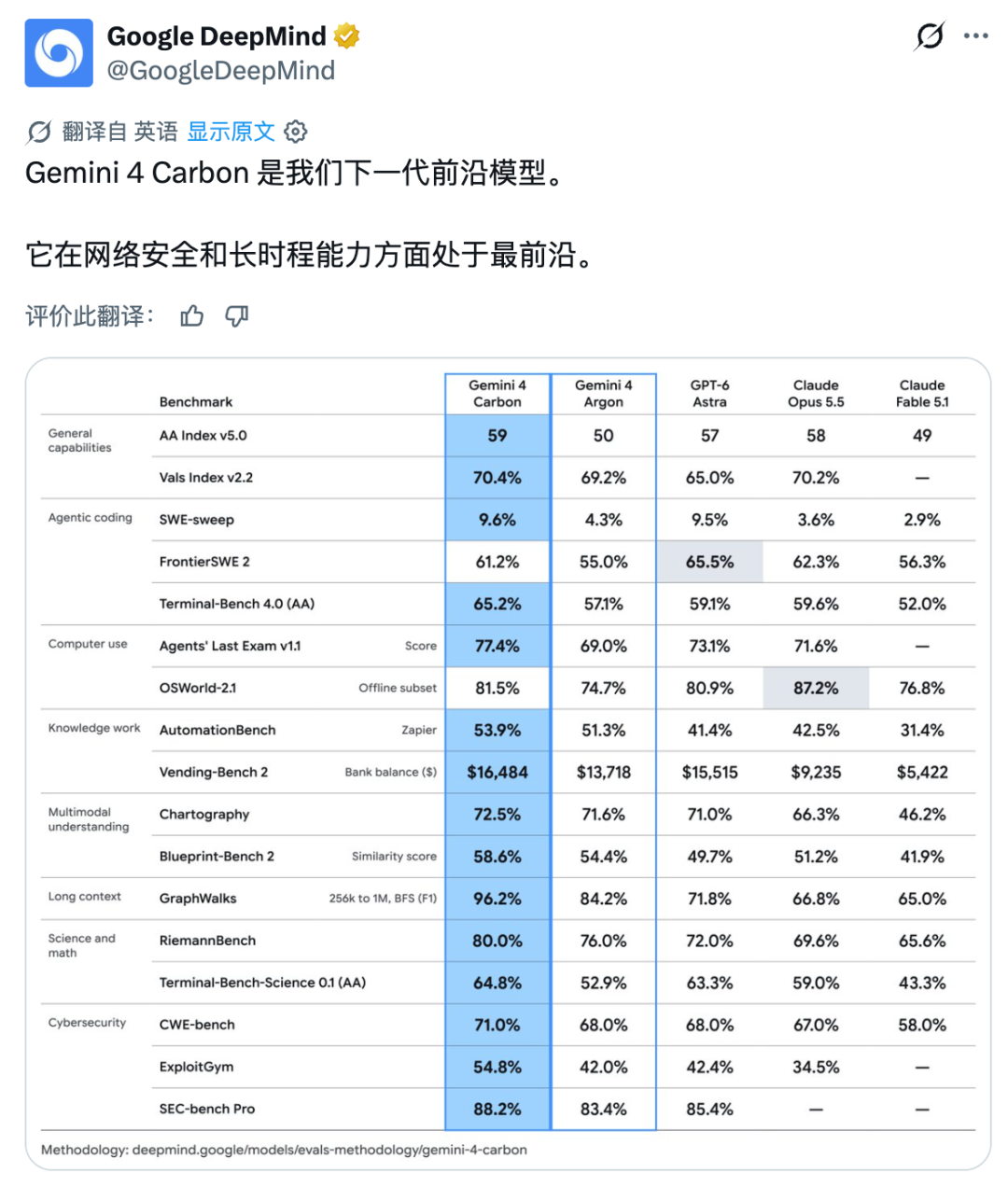
A restricted rollout is now the defining feature of Google's newest flagship model, Gemini 4 Carbon, which Artificial Analysis Intelligence Index v5.0 places above Claude Opus 5.5 and GPT-6 Astra. The score is 59 points, and the model is being treated as global No. 1, but availability is narrower than the ranking headline.
Benchmark Standing: A Narrow Lead After a Difficult Year
Earlier this year, Google's update cadence looked like a shame-to-strive comeback: Gemini Flash 3.5 to 3.8 releases kept the line visible, but the long-awaited flagship Pro model arrived slowly. Anthropic and OpenAI kept pushing capability limits, and models from China continued to close gaps, so Google needed a result that could redefine its frontier position.
Gemini 4 Argon arrived two weeks ago. Argon is an inert gas used as a protective atmosphere in welding and semiconductor fabrication; the model improved writing and expression, but it still did not provide a complete takeover of the frontier.
Carbon continues the chemical naming scheme. Carbon is a central element in life and organic compounds, capable of forming both soft graphite and hard diamond. At this pace, the roadmap increasingly resembles the periodic table.
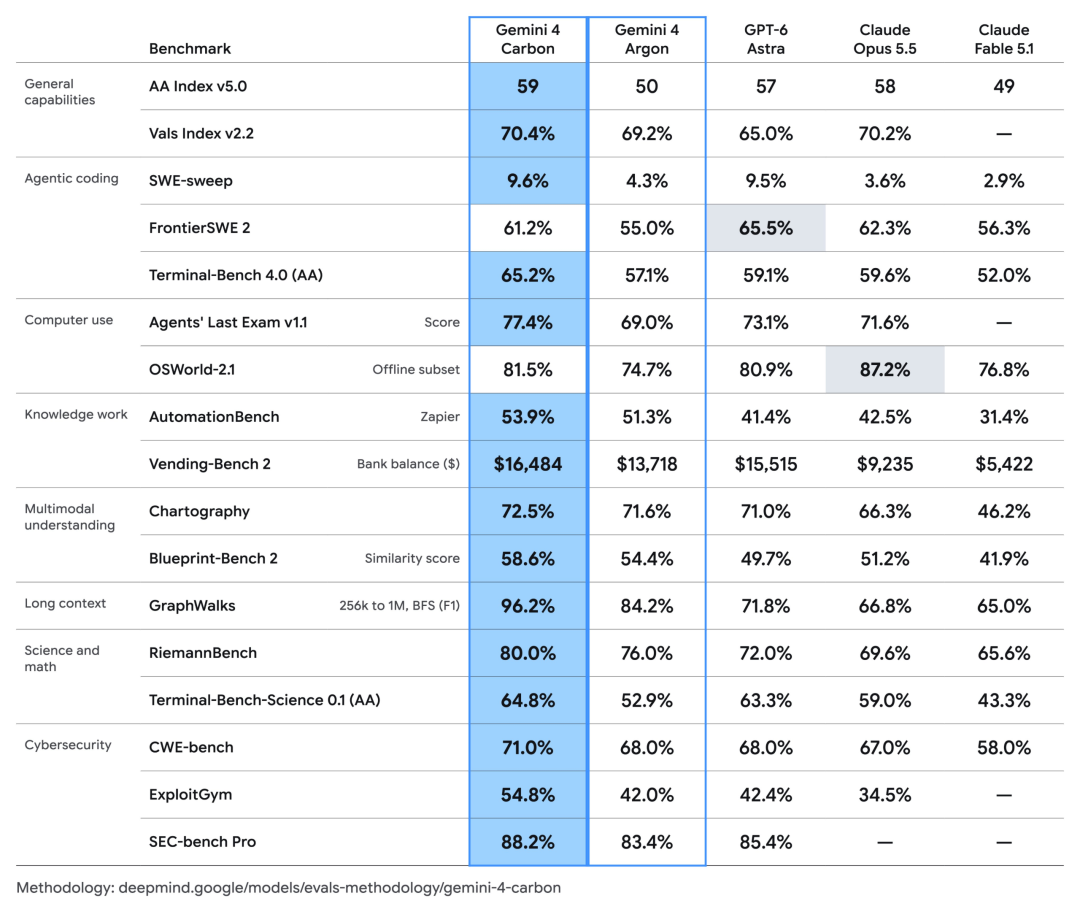
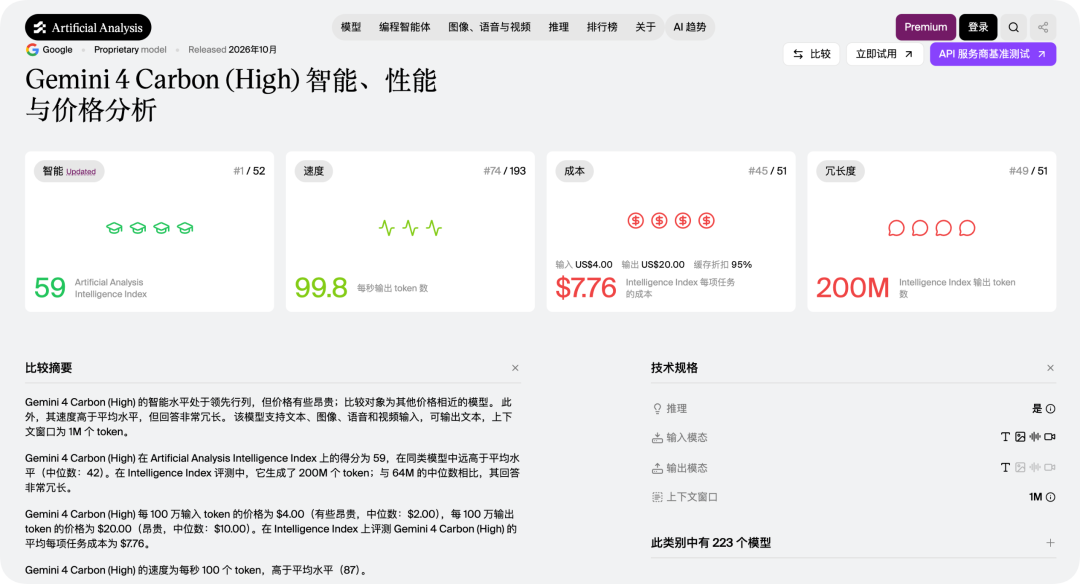
Artificial Analysis refreshed its index on October 27. Intelligence Index v5.0 aggregates four domains: knowledge work, coding, science, and general reasoning. Each contributes 25% of the score, while 60% of the weighting comes from private test sets or hidden answers, raising the difficulty.
When the updated ranking was published yesterday, Claude Opus 5.5 was ranking first at 58 points; GPT-6 Astra followed at 57 points; and GPT-6.1 Sol was ranking third at 55 points. Gemini 4 Carbon then recorded 59 points, a 9-point jump over Argon and a 1-point lead over the previous leader.
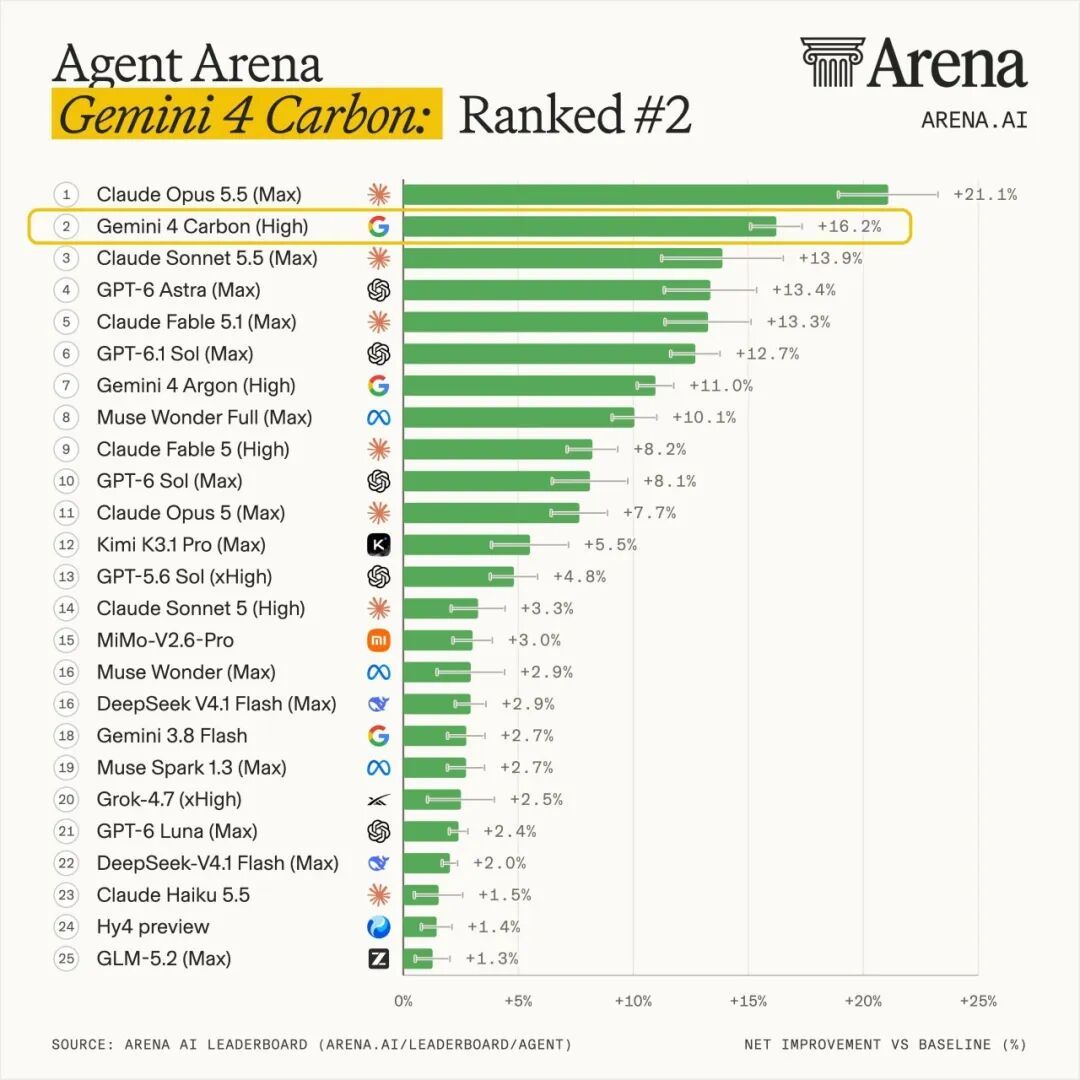
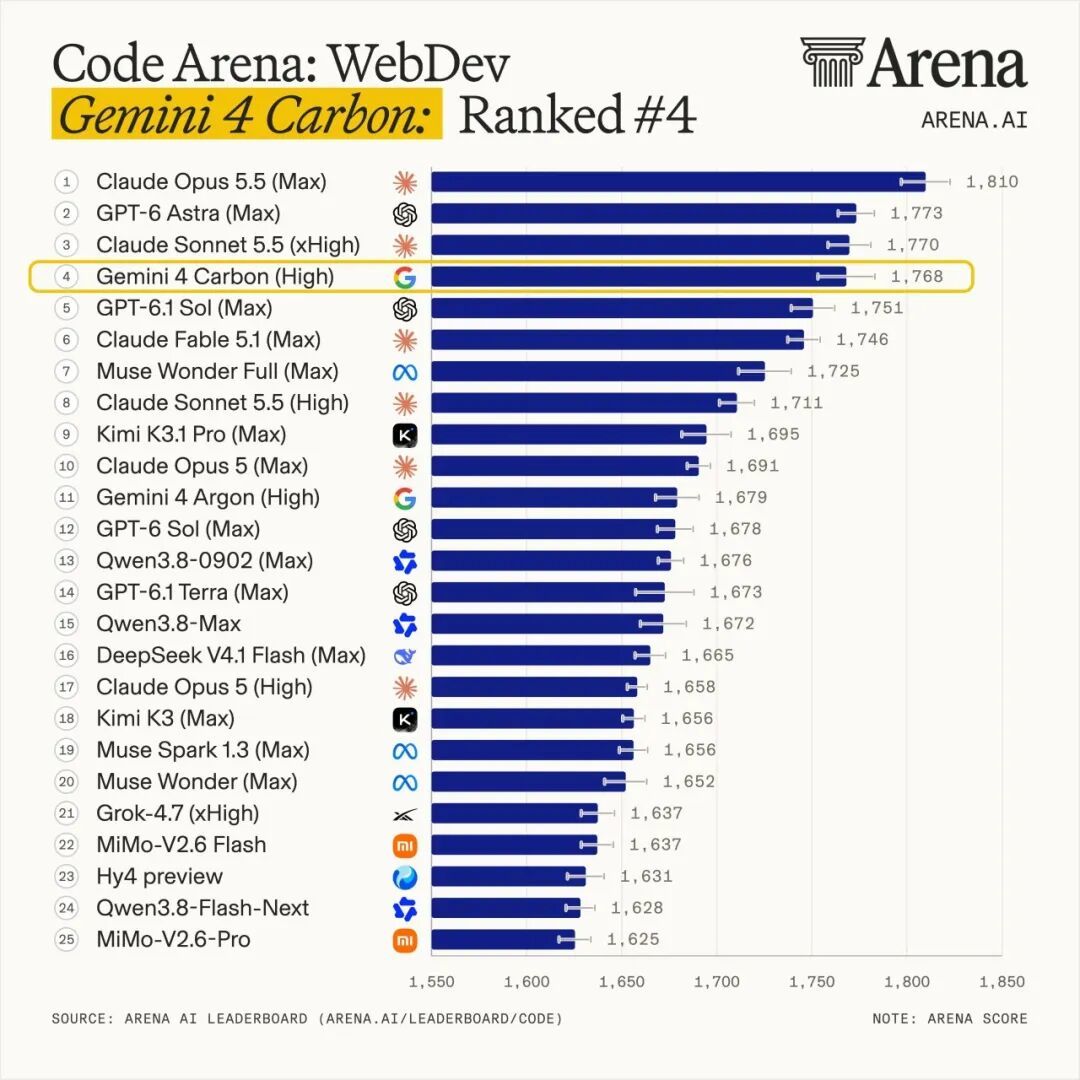
Arena.ai's latest chart showed the same trend: Gemini 4 Carbon (High) is ranking first in Text Arena, ranking second in Agent Arena, and ranking fourth in Code Arena WebDev.
| Leaderboard | Gemini 4 Carbon High placement |
|---|---|
| Text Arena | ranking first |
| Agent Arena | ranking second |
| Code Arena WebDev | ranking fourth |
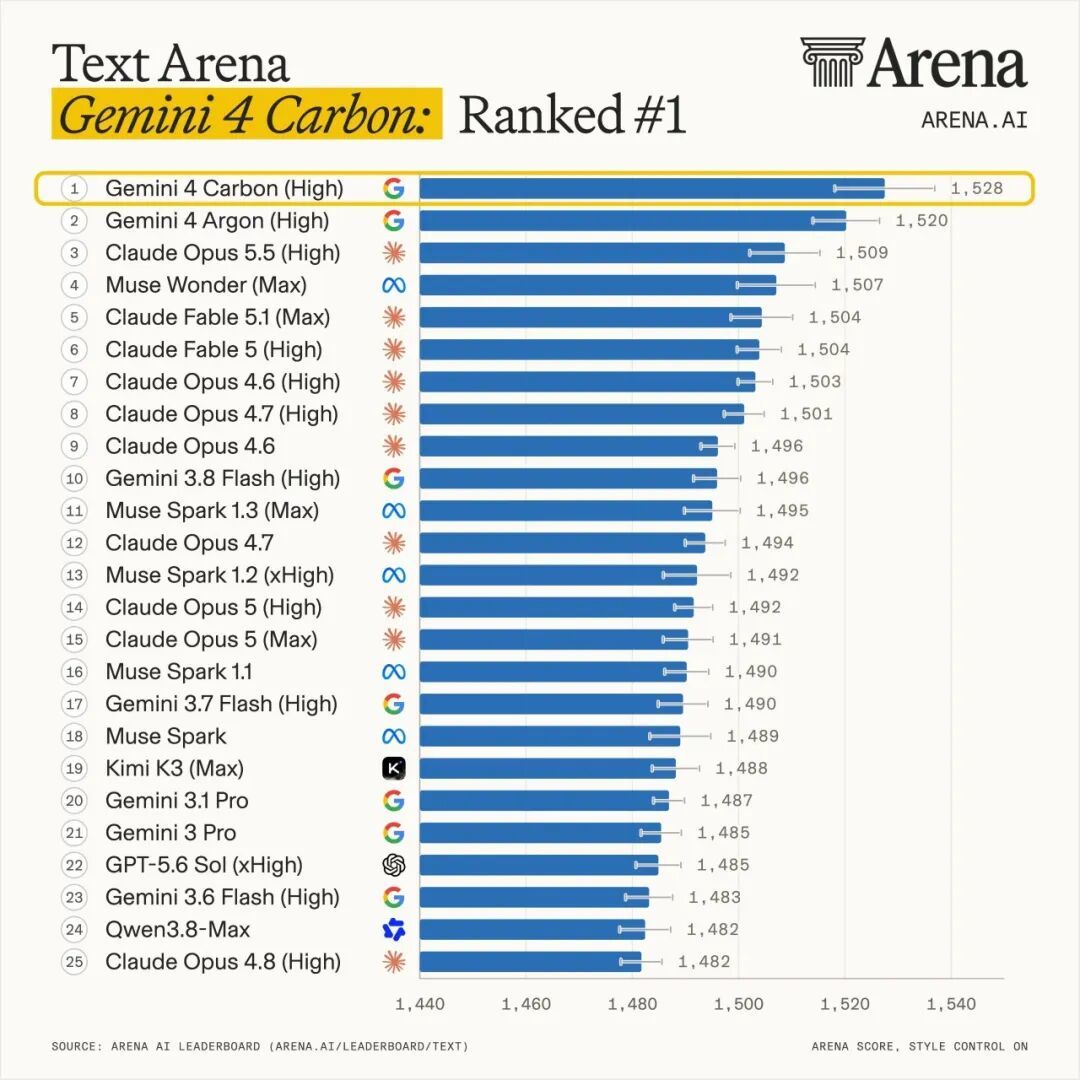
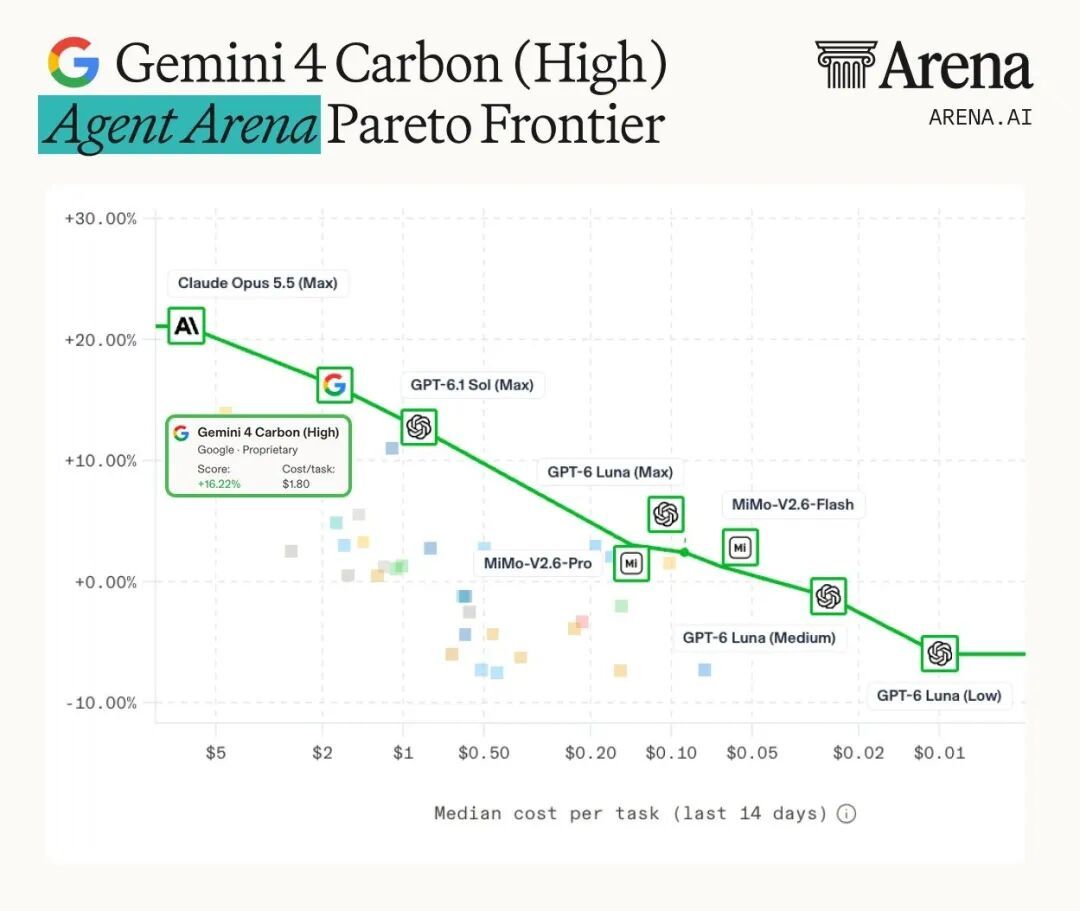
Yao Shunyu, a researcher who moved from Anthropic to Google DeepMind, also promoted the Gemini series as Google turned the new score into an internal morale moment.

Long-Horizon Engineering: Days of Continuous Work
The bigger engineering shift is not prompt response quality, but task duration. A small program can be drafted in minutes; a real software system may hide a defect across hundreds of files, dependency layers, failed assumptions, and repeated test cycles. For an autonomous agent, the harder question is whether it can stay on the same objective for days, recover from dead ends, and keep producing useful progress.
Google says Gemini 4 Carbon can run continuously for days on large codebases and low-level system problems, including subtle defects that need repeated hypothesis changes. In other words, the capability is framed less as a chat assistant and more as a long-running engineering participant.
Web development shows part of the same movement. Gemini 4 Carbon improved its WebDev Arena Elo by 89 points, reaching 1769 points and placing fourth. If Argon's faster quota consumption remains a memory, the key question is whether Carbon's stronger horizon also relaxes practical usage ceilings.
Cybersecurity First: Finding, Testing, and Repairing Flaws
Security work is the clearest reason for the limited rollout. A defensive pipeline usually includes four stages: discovering a flaw in a large codebase, determining whether the flaw can be exploited, writing a fix, and verifying that the patch works.
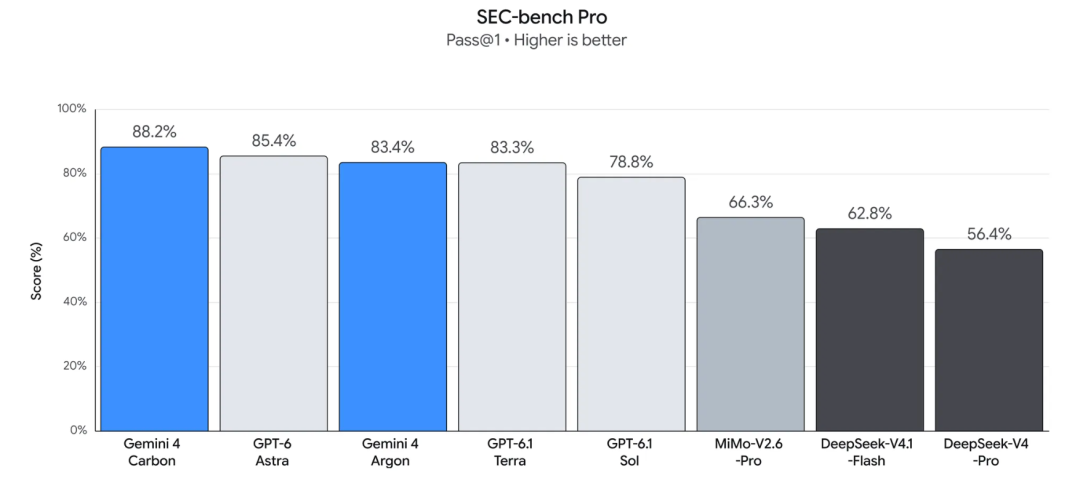
Gemini 4 Carbon scored 88.2% on SEC-bench Pro, which measures whether a model can independently uncover complex vulnerabilities in real software.
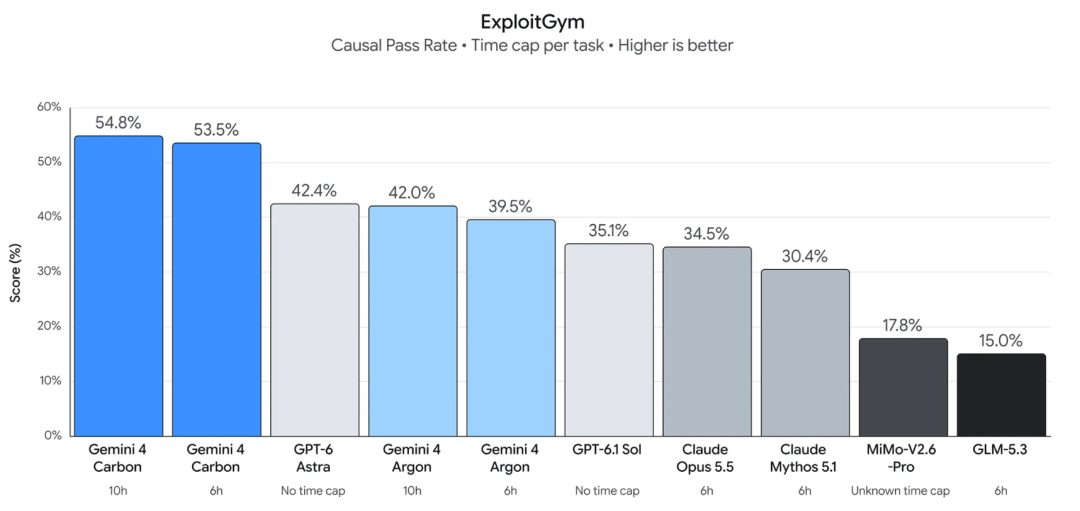
On ExploitGym, it reached 54.8%, testing whether vulnerabilities can be exploited to confirm real risk.
In Collinear's CWE-bench, it recorded 71.0%, measuring whether the model can create valid repair patches for identified problems.
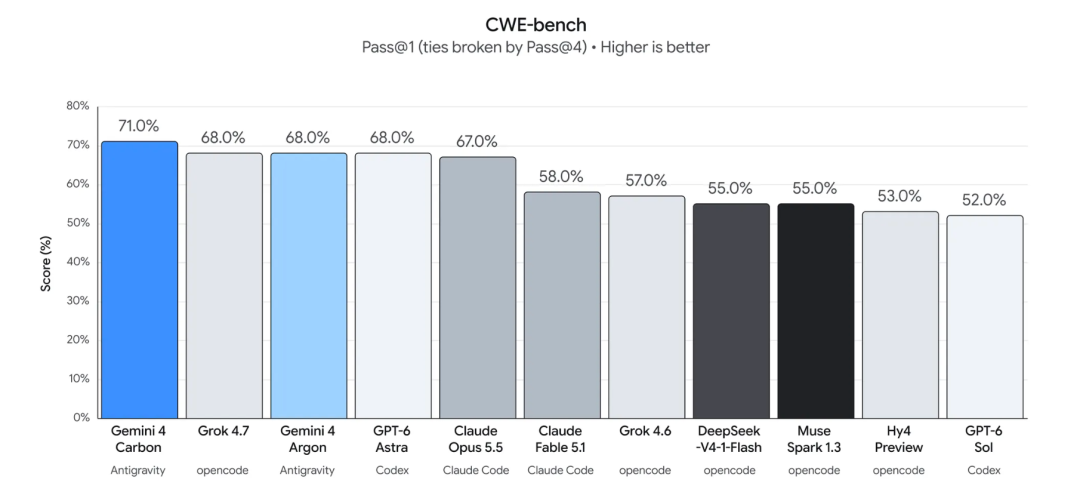
Gemini 4 Carbon led across all three tests. Google stated that the benchmark results were measured without enabling the guardrail restrictions that might otherwise limit risky security work.
Internal comparisons point in the same direction. Google reported that safe code-generation success exceeded Argon by more than twice. The Chrome team said Carbon produced high-quality security patches more than ten times better than another frontier lab model, although the comparison model was not named. Wiz, the cloud security platform under Google, also reported leading results on web-application penetration testing.
These are dual-use abilities. If a model can search, exploit, and patch software, the same skills that strengthen defense can also sharpen offense. That is why Google paired the capability claims with reliability work for long-running autonomous tasks.
On Terminal-Bench 4.0, the rate of successful cheating dropped to 0.0%, the rate of attempted cheating was only 0.4%, and task accuracy improved. In real coding settings, high-severity misalignment alerts fell nearly 80%, unsupported assertions decreased by about half, and overreach plus incomplete execution fell 26% and 29%, respectively.
Prompt injection was another focus. Malicious instructions embedded in web pages or documents can lure an agent away from its assigned task. In Gray Swan's indirect prompt injection test, Carbon reduced attack success from Argon's 0.7% to 0.0%, blocking every attack covered by that test.
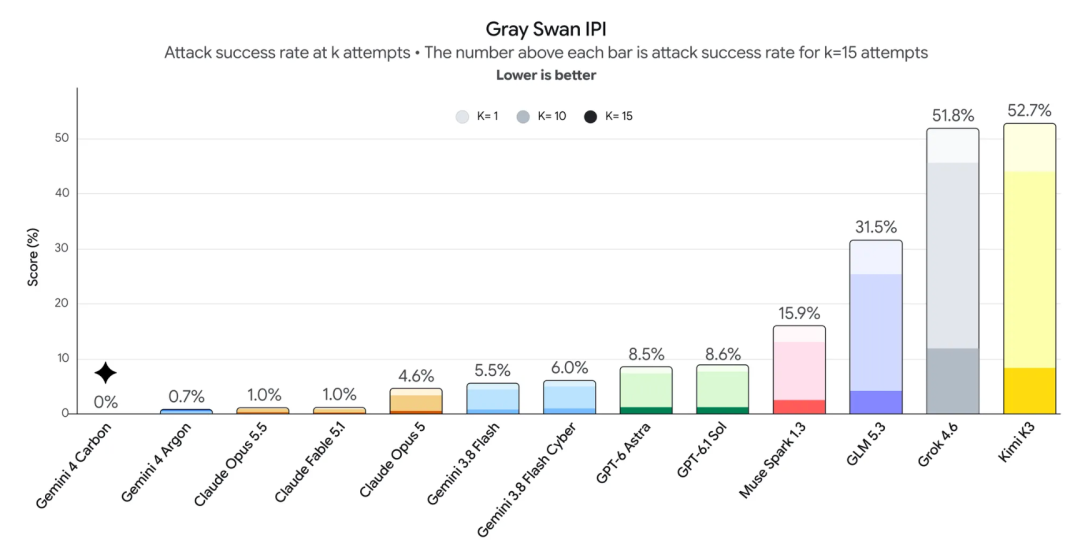
A benchmark zero success rate does not mean every real-world attack will fail. Still, a Hacker News comment argued that reducing AI shortcut behavior may be a critical step in making frontier systems useful.
Staged Access, Pricing, and the Phantom Launch Critique
This week, Google is giving access first to selected cybersecurity defenders. Expansion is planned through the Fairwind Program, which extends usage to trusted partners. Google also said it is cautiously participating in voluntary pre-release testing associated with the U.S. government. Ordinary developers and consumers still lack a timetable.
Pricing follows the launch model used for Argon. During the promotional period, Gemini 4 Carbon costs $2 per million input tokens and $10 per million output tokens, with cached input receiving a 95% discount. After the promotion ends, the standard prices rise to $4 per million input tokens and $20 per million output tokens.
The reaction on Hacker News shifted quickly from benchmark discussion to distribution frustration. Some users said Google had announced another model before it could actually be used; others joked that they now skip Google model launch links because the result is often a product that remains unavailable.

The broader criticism is that AI companies have grown skilled at a phantom launch: a flagship model is framed around safety concerns, announced through repeated press cycles, and then kept out of reach. The style is often traced back to Anthropic's influence on the industry.
Conclusion: The Score Is Settled, the Trust Problem Is Not
The measurable result is clear: Gemini 4 Carbon has been positioned as world No. 1 and global No. 1, with a long-horizon task profile that goes beyond simple code generation. The unresolved result is trust. In a market where rankings can rotate every few days, a top score alone cannot answer whether a system is usable, predictable, or valuable inside normal engineering workflows.
For Google, the next test is not another leaderboard headline. It is whether the early defensive rollout becomes broad access without the model's availability being the first thing that disappointed users. Benchmark performance can show how well a model handles a test; only ordinary users can show how much durable value it creates.