
ItInsightsWorld General: Hyperspectral vs Multispectral Crop Scouting — Which Band Count Pays for Itself?
Short answer: for a named disease on a named crop, a multispectral camera carrying a handful of bands is the sensible purchase, while hyperspectral imaging is the instrument you borrow, rent or co-fund with a research partner. The number that decides the purchase is not how many wavelengths a sensor can capture — it is how few you can prove you need.
The awkward part is who signs the order. A farm business gets a quote for a hyperspectral rig at tens or hundreds of thousands of dollars, and nobody in the room can say which of those slices will still carry a signal in August, under haze, on heavier soil, with three problems showing in the same paddock. Most operations are not short of imaging options; they are short of a person able to approve the two-band version and close the door on everything else.
What does hyperspectral imaging see that an ordinary camera misses?
It keeps the spectrum instead of averaging it. An ordinary camera collapses reflected light into three broad bands — red, green and blue — while a hyperspectral instrument records dozens or hundreds of narrow slices, so small shifts in a plant's chemistry or water status can surface before the leaf visibly changes.
The cleanest public demonstration came from a greenhouse rather than a field. Twelve days after soybean seeds were planted at North Dakota State University, hyperspectral imaging separated plants hit by sudden-death syndrome from healthy neighbours that still looked identical to a human eye. Xin "Rex" Sun, director of the Peltier Institute for Advancement in Agricultural Technology at North Dakota State University, put the warning window at several days to roughly a week ahead of visible symptoms. Field validation is still outstanding, a caveat worth holding onto because sensor pitches tend to drop it.
His lab's newest tool shows why research needs the wide net: a short-wave infrared (SWIR) camera spanning approximately 1,000 to 2,500 nm, with more than 200 spectral bands. Nobody knows in advance which slices carry the signal, so the instrument captures everything and the sorting happens afterwards.
"That's the beauty of using hyperspectral imaging technology," Sun said. "It's all about selecting the bands."
Read that as a business model, not just a technical remark. The expensive instrument generates the shortlist; the product is the shortlist. In the case Sun sketches, if two or three wavelengths reliably separate infected plants from healthy ones, a camera built around those bands takes over from the research hardware.
Which route is cheaper, and how wide is the gap?
The hardware gap runs to roughly two orders of magnitude, and it widens again once you count storage and the analyst who interprets the output. Anything that keeps the full spectrum sits in the six-figure zone; a sensor built around a short band list lands in the hundreds or thousands of dollars.
| Option | Bands | Price signal | Data and skills load | Best fit |
|---|---|---|---|---|
| Research hyperspectral | Dozens of narrow slices up to 200+ | tens or hundreds of thousands of dollars | hundreds of gigabytes or more per campaign; trained analyst required | Finding out which wavelengths carry the signal |
| SWIR research camera (Sun's lab) | more than 200 spectral bands, approximately 1,000 to 2,500 nm | the costliest detector class; SWIR parts stay well above ordinary silicon sensors | heavy calibration burden | Plant chemistry and water-stress questions |
| Standardised multispectral part | nine, 16, or 25 spectral bands | hundreds or thousands of dollars | moderate; edge processing is realistic | Several crops or problems sharing one sensor |
| Disease-specific multispectral | two or three wavelengths up to four to 10 bands | lowest hardware cost of the four | light; small processors can cope | One disease, one crop, repeated passes |
Independent price guides land in a similar place. Surface Optics' 2026 camera-pricing guide puts fixed-band multispectral units at roughly $1,500–$5,000 and higher-precision scientific cameras at $7,500–$16,000, with hyperspectral systems quoted per project. Use a guide like that as a sanity check on a quotation, not as the quotation itself.
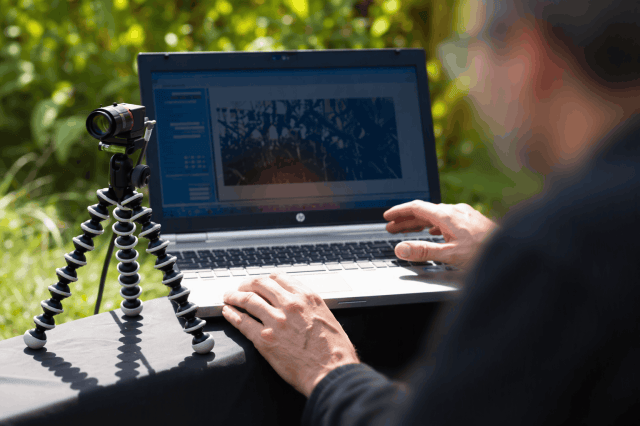
A snapshot multispectral camera used in the field (Source: imec)
Band count also drives the computing bill. Wide-spectrum campaigns can throw off hundreds of gigabytes or more of imagery per site, which means either a workstation or a cloud contract. Trim the input and the analysis can move onto the machine itself: "If we can find three or four bands out of the hyperspectral imaging, those small processors can process them," Sun said. "Then it can be fast enough in the field to give you a good result."
Where does each option break first?
Cheap multispectral fails on ambiguity; hyperspectral fails on logistics. Neither failure is fatal, but they surface at different points in the season.
- Disease looks like drought. Sun warns that disease and other stresses can produce similar spectral shifts, especially before symptoms appear, so a rule that holds in one field can mislabel stress as infection in the next.
- Light and soil keep moving. Changing sunlight, soil colour and other environmental factors alter the measurement, which is why his team has been collecting imagery across varied conditions rather than one greenhouse.
- Motion smears scans. Scanning cameras build an image line by line, so a moving tractor, a drone or wind in the canopy leaves artefacts. Snapshot sensors that capture spatial and spectral data in a single exposure dodge much of that.
- SWIR resists cheap integration. Short-wave infrared detectors remain costlier than ordinary silicon sensors, and imec's Klaas Tack notes that combining them with spectral filters is more complicated, so that cost curve moves more slowly.
There is a quieter risk too: a sufficiently validated wavelength set for field diagnosis of soybean sudden-death syndrome does not exist yet. As of the work described here, the models have not been proven outside controlled conditions.
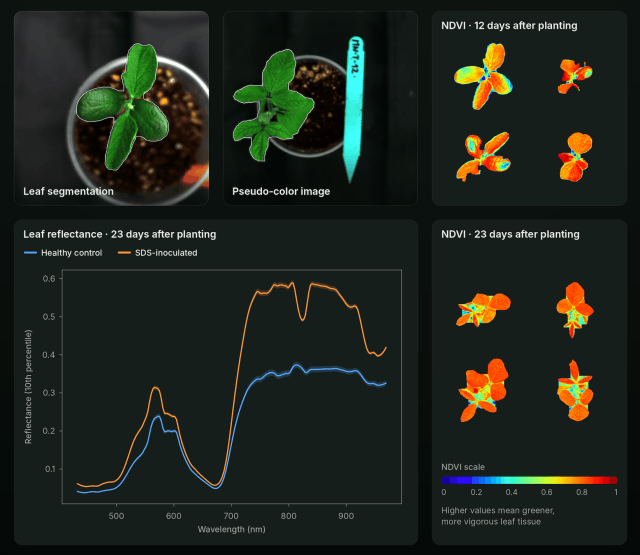
Soybean sudden-death syndrome detection using hyperspectral imaging technology (Source: Rex Sun and Febina Mathew | North Dakota State University)
Who is actually pushing the sensor price down?
A semiconductor fab, not an agronomy firm. At imec, the Belgian research organisation, senior researcher Carolina Blanch, who works on hyperspectral applications, agrees that most users do not need the full spectrum.
"We typically start with high-resolution spectral cameras that capture around 100 bands, then identify which ones are most relevant," she said. "For most applications, 10 or fewer bands are sufficient."
Building a bespoke sensor for every crop disease is not economic, though. imec's compromise is a family of standardised parts with nine, 16, or 25 spectral bands, each covering several problems at once so that tooling costs are spread across a larger market.

Imec's Carolina Blanch
Klaas Tack, technical lead for hyperspectral imaging at imec, explains where the money goes. Conventional cameras rely on separate optical parts to split incoming light; imec's approach prints the filters onto the detector during fabrication, which is what makes volume manufacturing plausible.
"We developed a process in our fab where we integrate the filters with the detector," Tack said. "Because we're doing this at wafer level, we're manufacturing many detectors at the same time."
That removes components, shrinks the package and eliminates alignment work, and it yields snapshot sensors that need no scanning motion. The remaining hurdle is volume: a fab is expensive to start and cheap per unit once it runs. Tack points to Spectricity, an imec spinoff selling low-cost snapshot multispectral sensors into smartphones, as evidence that the economics can flip. Those parts are not built for crop disease, but they show what high volume does to price.
"When the volume is high enough, you can dramatically reduce the cost," he said.
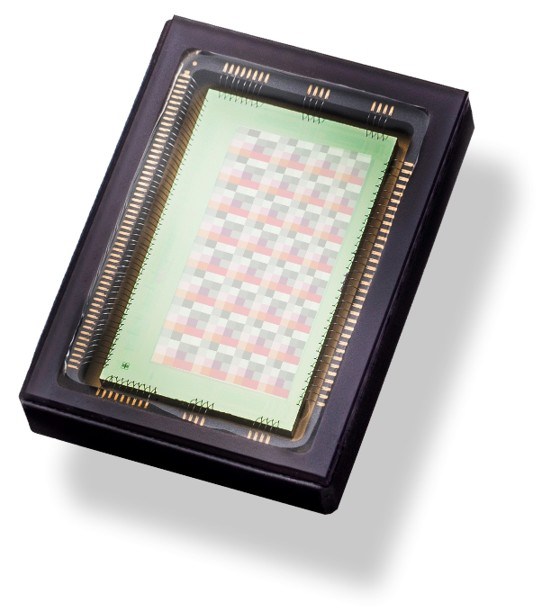
A snapshot multispectral detector with 25 bands organized in 5 × 5 patterns of pixels. Because of the small size of the pixels, the picture shows an artistic impression of this layout. (Source: imec)
Nor is this only a laboratory claim. imec snapshot multispectral cameras have been trialled for fire blight detection in apple and pear orchards within the Smartfarming 4.0 project, according to SPIE proceedings published by Blanch-Perez-del-Notario and colleagues in 2023 — an early look at farm-grade multispectral work rather than greenhouse screens.
How would a farm test this without wasting a season?
Run it as a four-step filter, cheapest first, and stop at whichever step fails.
- Pick one disease with a number attached. Sudden-death syndrome is a defensible starting point: Iowa State University's extension survey attributed 57 million bushels of 2024 soybean yield loss to sudden-death syndrome and Phytophthora root and stem rot combined.
- Rent the discovery step. Pay a university lab or a service provider for hyperspectral passes over ground-truthed strips; nobody needs to own a six-figure camera to learn which bands matter.
- Buy the shortlist, not the spectrum. Once a partner narrows the answer to two or three wavelengths, specify a multispectral sensor in the four to 10 bands range and insist on paired strips, imaged the same day.
- Write the decision rule before planting. Who acts, on what threshold, with which intervention, at what cost per acre? Maps nobody acts on are an expensive hobby.
The same discipline applies to any supplier claim. On this site we published a field checklist for vetting water, land and chemical promises around Paraguay's first pulp mill, and the logic transfers: ask for ground-truthed numbers, written methods and a named person accountable for the result.
What does the cost account look like from the farm's side?
Disease pressure is the revenue line the sensor has to protect. The Crop Protection Network's annual survey put soybean disease losses across the United States and Ontario at 250.9 million bushels in 2024, or 5.4 percent of potential production in 29 states, with its 2025 estimate at 171.0 million bushels. AgWeb reported that the 2025 season brought the heaviest sudden-death syndrome losses since 2014.
On the other side of the ledger sit delivery costs. Aerial scouting services commonly quote in the $5–$15 per acre range, and an AgWeb cost analysis published in 2026 estimated that a $5,000-class scouting drone would break even in about four years against a $10-per-acre custom scouting rate. Those figures cover flying and mapping, not diagnosing a specific pathogen — which is exactly the gap a band-specific sensor is meant to close.
Sun is blunt about the payback test. "If you're a farmer, you need to think twice," he said of buying an expensive hyperspectral system. "If I spend that much money, I want to know how soon I get my money back."
His team is meanwhile building a field-based platform meant to carry sensors through crops, diagnose problems and eventually support interventions, replacing laboratory analysis with affordable sensing on farm machinery. Tack argues the underlying visible and near-infrared technology is no longer the bottleneck — "I think today we can provide them with the technology that is required," he said — while declining to forecast when farm products ship in volume. Sun's working horizon is meaningful progress over the next five or six years, with field validation as the gate.

Imec's Klaas Tack
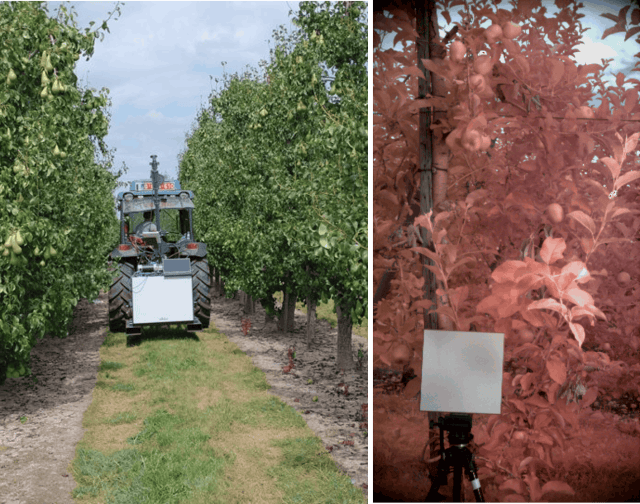
In-field demonstration of a multispectral camera used to detect fire blight in orchards (Source: imec)
Which mistakes keep repeating?
- Buying band count instead of a decision rule.
- Assuming greenhouse accuracy survives wind, haze and a different soil type.
- Forgetting the service layer: someone has to fly, calibrate, process and re-train the model every season.
- Specifying 200 bands "just in case", then paying for storage and analysts.
- Treating one disease's wavelength set as a universal kit — a rule trained on sudden-death syndrome will not transfer to fire blight or to water stress.
FAQ: what readers keep asking about spectral crop scouting
Can multispectral imaging catch disease before symptoms appear?
In controlled conditions, yes — the North Dakota State University greenhouse trial separated infected from healthy plants with a lead of several days to about a week. Whether that lead holds in a real field, for a specific pathogen, is the open question.
How many bands do I actually need?
Fewer than the brochure implies. imec starts around 100 bands for discovery and ends at 10 or fewer for most applications; Sun's lab works with four to 10 bands, and his target for a disease-specific device is two or three. If a supplier cannot explain what each band is for, the specification is guesswork.
Is a smartphone-based sensor realistic yet?
Not as a diagnostic instrument for a named pathogen. Spectricity's sensors target consumer devices, and imec cites them only as evidence about manufacturing economics.
How soon will this be standard farm equipment?
Nobody quoted here will give a date. Sun's horizon is five or six years; Tack says the sensor technology exists, and that volumes and field validation decide the timing.
What is the cheapest first step?
Rent the discovery pass. Buy hyperspectral imagery over ground-truthed strips once, get the shortlist, then spend on a multispectral unit rather than a lab instrument.
What to do next
Three moves, in order. First, write down the crop, the disease and the loss figure you are trying to move; a scouting tool with no economic target cannot be judged. Second, book a hyperspectral pass through a university or service partner over paired strips and ask for ground-truthed labels, not just processed maps. Third, put the purchasing decision to whoever holds the budget in two columns — the camera, and the annual cost of converting its images into an action. If the second column is empty, the first one is premature.
Keep the scepticism and keep the receipts. The useful comparison is not megapixels or band counts; it is how quickly each option turns a spectral difference into a decision a grower will actually make before the season runs out.
Sources and further reading
- Crop Protection Network — Soybean disease loss estimates, United States and Ontario, 2025
- Iowa State University Integrated Crop Management — Soybean stem disease survey
- Blanch-Perez-del-Notario et al., SPIE proceedings on imec snapshot multispectral cameras for fire blight detection
- Surface Optics — Hyperspectral camera price guide
- AgWeb — The $5,000 question: will a drone actually save you money?
- EE Times — Can machines see a sick plant before a farmer can?