
Scarce NOR Flash Boosts Everspin MRAM Prospects for AI and Space
As AI workloads raise the bar for faster persistent memory, Everspin Technologies is steering MRAM beyond its industrial base toward AI servers, data centers and satellite systems. President and CEO Sanjeev Aggarwal framed the argument to EE Times: “If you care for performance, I think that MRAM is the only solution we have,” he said.

Scarcity pulls MRAM into the design conversation
Buyers evaluate MRAM on speed, reliability and cost, but Aggarwal also pointed to availability problems: particular NOR flash products are now difficult to obtain. TrendForce estimates pegged cumulative NOR flash contract-price gains at 100% to 120% in the first half of 2026, adding that AI-related demand took much of constrained output, NOR flash was an early casualty to extended lead times and allocation, and suppliers had not disclosed major capacity expansion.
Aggarwal sized the substitution opening at $3 billion in 2028 or 2029, and said the company has been preparing a product around TSMC manufacturing.
“Now people cannot buy NOR flash,” he said. “Most of the fabs in Asia have converted from NOR flash to DRAM. Much better profit margins. Then what is the alternative? MRAM is the only alternative for standalone or discrete products. And that is where they approach us.”
Cost has shifted alongside supply: MRAM once stood at about three times the price of NOR flash, then moved closer to about 1.5 times as flash shortages pushed prices upward. “If you are going to use two NOR flash chips, you might as well just use one MRAM and be more cost-effective,” he said.
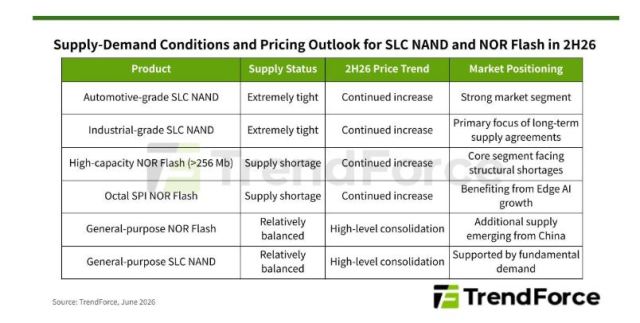
TrendForce's June 2026 chart maps SLC NAND and NOR Flash supply-demand and pricing prospects for second half of 2026.
Aggarwal described the choice as application-specific, turning on chip count and performance-reliability requirements. Distributors have begun requesting cross-reference information, he said, so customers can spot MRAM substitutes when certain NOR flash components are unavailable.
- Ferroelectric RAM (FRAM): lower available densities in the products described.
- Non-volatile static random-access memory (NVSRAM): possible reliability and operating-condition tradeoffs.
For the parts discussed, Everspin specifies minus 40°C to 125°C operation, and Aggarwal cited reliability, SRAM- and DRAM-like performance, and read-write endurance as selection drivers.
Revenue baseline from the latest disclosure:
| Measure | Figure |
|---|---|
| 2025 revenue | $55.2 million |
| 2024 revenue | $50.4 million |
| Change | 9.5% |
According to an annual report filed with the U.S. Securities and SEC, those figures accompany Aggarwal's goal of doubling revenue in three to four years. NOR-flash replacement plus data centers, aerospace and defense, low-Earth-orbit (LEO) satellites and industrial automation underpin that target.
CXL demo places MRAM between DRAM and NAND
At the Storage Networking Industry Association (SNIA) Developer Conference in Santa Clara, California, Everspin showed MRAM modules paired with a Compute Express Link (CXL) controller, creating a pool of persistent memory reachable through CXL.mem, a protocol for accessing memory over a CXL connection.
The exhibit illustrated an intermediate tier, Aggarwal said: DRAM works as working memory, NAND flash serves storage, and moving data between compute and slower storage can slow jobs. NAND access can take hundreds of microseconds, he contrasted, while DRAM operates at nanoseconds.
“Our memory is 20 to 30 nanoseconds,” he said. “You can use it for storage as well as compute, reducing the gap between NAND storage and DRAM working memory.”
In AI workloads, Aggarwal described a temporary-holding role before longer-term storage: KV caches, checkpoints and buffers awaiting writes. KV caches retain information a model reuses while answering; checkpoints allow failed jobs to resume.
- Current Everspin density: one gigabit.
- Stacked-device possibility: 8 Gb or 16 Gb.
- Limitation: capacity, though short-lived intermediate data may not require NAND-scale totals.
The roadmap also covers denser memory and newer interfaces. Everspin has supplied IBM's FlashCore Modules and wants broader data-center entry beyond the current DDR4 interface.
“Our demonstration of the CXL protocol with our existing DDR4 chip will start getting us some entry into the data center market,” he said. “And by the time we have a good foothold, we will have a 4-Gb DDR6 part ready to go right behind it.” Aggarwal put that development path at about three years.
At edge devices, Aggarwal said MRAM can cut transfers between devices and central servers for processing. OpenMV is an example, where the firm replaced SRAM and added MRAM for configuration.
Satellite boot memory and space reliability
Earlier this year, Astro Digital chose Everspin's 64Mb PERSYST spin-transfer torque MRAM (STT-MRAM), part number EM064LXQADG13IS1T, as the primary fail-safe boot memory for its Raven satellite bus in a geosynchronous Earth orbit (GEO) mission. That boot memory holds code needed to begin spacecraft electronics and support system recovery.
“What Astro Digital did recently was, they took our part and sent it into geosynchronous orbit,” Aggarwal said. “So, not low Earth, but they sent those to geosynchronous orbit.”
Radiation tolerance is a benefit in orbit, Aggarwal noted, though surrounding silicon may still be vulnerable; in the configuration he described, backup memory gives added protection if nearby circuitry is harmed.
He also pointed to write speed and reliability versus NOR flash, saying the memory can be written almost three orders of magnitude faster than NOR flash and uses less power in those applications.
PERSYST offerings listed: 64-Mb, 128-Mb and 256-Mb capacities on a quad serial peripheral interface (QSPI).
Aggarwal's chip-count example was general, he cautioned, and not a description of Astro Digital's actual satellite configuration.
MaxLinear partnership examines AI-server workloads
Everspin and MaxLinear have signed a memorandum of understanding (MoU) to test MRAM next to MaxLinear's AI-server platform for storage compression, encryption and hardware acceleration. The collaboration will examine metadata management, log data, write buffering, cache and other data-heavy workloads.
- Validation and market development aim at hyperscale cloud providers, AI infrastructure developers and enterprise-server buyers.
- Scope includes possible longer-term manufacturing, supply and commercialization opportunities.
- The MoU is an evaluation framework, not a finished product or volume commitment.
Aggarwal said MaxLinear was first because accelerator technology mattered. “They have accelerators, so they were very interested in the technology,” he said. “We are working with them to find the first use case.”
Two-source manufacturing, TMR sensors and rival MRAM
The portfolio includes field-switched, or toggle, MRAM and STT-MRAM. Toggle MRAM is made at the 8-inch plant in Chandler, Arizona. Densities run from 128 kilobits to 1 Gb across multiple interfaces. Aggarwal said shipments topped more than 200 million units over 20 years, with only a few returns.
The firm signed an initial 10-year foundry services agreement with Microchip Technology covering an 8-inch MRAM and tunnelling magnetoresistance (TMR) sensor line at Microchip Technology's Fab 4 in Gresham, Oregon. The arrangement adds a second U.S. manufacturing source for toggle MRAM, and a U.S. SEC filing placed first-product shipment in second half of 2027.
“We signed a foundry services agreement with Microchip, which allows me to manufacture twice the amount of toggle MRAM that I could manufacture in Chandler,” Aggarwal said.
It is tied to a $40 million U.S. government contract awarded through Amentum Services, with Everspin as subcontractor. Aggarwal said the work will qualify the Microchip process and give the government access to company intellectual property and a second manufacturing line for future government products.
For STT-MRAM, Everspin has used GlobalFoundries 12-inch wafers since 2016; it also plans a TSMC 16-nm tapeout to diversify supply. Aggarwal described dual sourcing as the aim: Chandler and Oregon for toggle MRAM, plus GlobalFoundries and TSMC for STT-MRAM. Capacity is not currently a constraint, he said.
Commercial rivalry exists too. Netsol, a South Korean company using Samsung Foundry, offers a 16-Mb product, Aggarwal said. He expects a competitor 1-Gb part to appear in 2028 or 2029.
India: defense, EVs, railways and distribution
India is a potential growth market, especially aerospace and defense, electric vehicles and railways. Aggarwal said contacts are being sought with the Defence Research and Development Organisation (DRDO), the Indian Space Research Organisation (ISRO) and Indian satellite companies.
Possible uses include battery management systems, vehicle data recorders and flight-control systems. The firm is expanding Indian distribution and exploring local partnerships, including talks with Indian distributors and possible outsourced semiconductor assembly and test (OSAT) arrangements.
Indian automotive groups and rail applications are also under discussion, he said. Existing rail deployments in Europe, Japan and China store operational data in memory.
“We are always in discussions about these potential opportunities,” he said of Indian railway opportunities. “There is nothing that I can talk about openly, but obviously the conversations are ongoing.”
The remaining hurdle is adoption: translating MRAM's speed, endurance and availability advantages into wider AI, space and industrial use, while Aggarwal expects demand to rise as manufacturing efficiencies reduce cost per bit.