
Cairo, Malaysia and Brazil Billboard Breaches Compared: What Digital Screen Owners Should Decide Now
Digital billboards are usually judged by reach, brightness and price. The breach that hit a large digital billboard on the July 26 Axis in the western districts of Cairo, Egypt, changes that ranking. The Egyptian Ministry of Interior confirmed that unauthorized content reached advertising display systems in multiple countries after an international advertising content distribution platform was attacked. For anyone who buys outdoor media, runs city screens or depends on third-party content tools, the practical question is no longer “Did one screen fail?” It is “Where does shared remote management turn a single vendor problem into a public incident?” This piece compares the Cairo case with reports from Kluang city, Johor state, Malaysia, and Campo Maior city, Piauí state, Brazil, then turns the pattern into a decision framework for general readers and media managers.
Conclusion first: the shared control path matters more than the billboard itself
The incident became hard to ignore because the screen on the July 26 Axis in Giza Governorate switched to inappropriate video while traffic moved. The road name includes the date July 26, but the public lesson is not about the name; it is about exposure. Drivers stopped to record, and the clip spread quickly. In the footage, attackers left signature text and a Telegram channel name, which helped investigators connect the stunt to a wider claim. Arabiya United Advertising Company said it closed the affected screen after abnormal access was detected and cooperated with authorities. The company described the event as unauthorized external intrusion.
That local response, however, did not contain the story. Because the operator used an international advertising content distribution platform, the breach became a cross-border display-system issue, not just a Cairo signage fault. The comparison matters: one billboard was the visible symptom; the management chain was the likely disease.
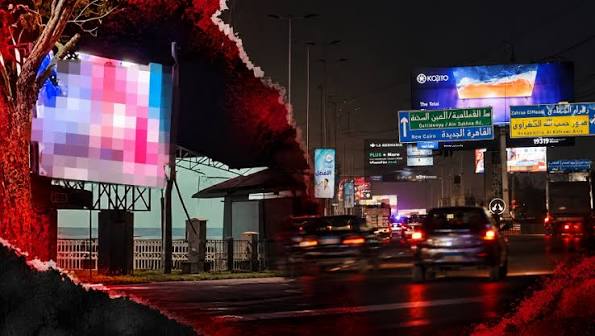
Three cases, one common weakness
Malaysia and Brazil gave the same warning pattern in different settings. In Kluang city, Johor state, Malaysia, the local city council reported that multiple public LED screens were invaded and used to display improper content. The council closed the screens while the government and vendor investigated safety measures. In Campo Maior city, Piauí state, Brazil, an LED advertising screen near a main road was controlled by hackers and showed obscene video. The operator cut power, apologized and filed a police report.
Claims that more countries were affected circulated online, but only some have broad official confirmation. The group named Leakers$ later said it had claimed responsibility. According to its public account, it did not attack each billboard separately; it exploited a software vulnerability in a software platform used to remotely manage LED display content. It also said automated scanning found thousands of systems exposed to the internet in about two hours, and described the issue as a real software vulnerability rather than an advanced state operation.
Comparison table: what each incident tells you
| Case | What was confirmed | What the case reveals | How to weigh it |
|---|---|---|---|
| Cairo and Giza | A large digital billboard on the July 26 Axis played inappropriate video; a Telegram channel name appeared in the footage. | Public road screens can create safety risk, traffic distraction and reputational shock in minutes. | Treat this as a shared-platform incident, not a one-screen malfunction. |
| Kluang, Malaysia | The local city council said multiple public LED screens were invaded and shut down for safety. | Municipal screens are often managed through small vendors or older public systems with limited security review. | Ask who holds admin access, who tests software updates and who can pause all screens. |
| Campo Maior, Brazil | An LED advertising screen near a main road was controlled and used to display obscene video. | Commercial operators may react quickly but lack a documented response process. | Compare vendors by emergency capability, not only by display quality or ad reach. |
| Leakers$ claim | The attacker said a software vulnerability in a remote LED management platform was used, and thousands of systems were found in about two hours. | The attack model favors scanning exposed administrative interfaces and reused vendor paths. | Use the claim as a warning checklist even where official investigations are still incomplete. |
Common misconceptions that lead to bad decisions
- Misconception: “Only the screen is at risk.” Correction: the management layer matters most. If a remote platform has weak access control, many screens can be affected at once.
- Misconception: “Public screens are too small to target.” Correction: attackers described finding thousands of systems in about two hours through scanning. Exposure, not glamour, drives target value.
- Misconception: “A shutdown is a full fix.” Correction: closing the screen stops the display, but it does not prove that credentials, updates, vendor accounts or shared templates were not compromised.
- Misconception: “This is only an advertising problem.” Correction: these devices sit at the edge of public safety, municipal communication and commercial media. The risk is mixed and often underestimated.
Why security teams now treat signage software like a website
The broader lesson is that digital signage is not “a TV with a cable.” It is an internet-connected system that may include web dashboards, client applications, credentials, content libraries and support channels. HKCERT, the Hong Kong computer emergency response team, published a digital signage security study that reported high-risk findings in management platforms, including insufficient access control, sensitive data exposure, weak password hashing, outdated code libraries and SQL injection. Its practical message is simple: if the management portal can be reached and authenticated weakly, the screen is only the last step.
U.S. government security guidance reinforces the same point. CISA has warned that default credentials are usually readily available on the internet and that changing default usernames and passwords can prevent attacks that rely on those credentials. For digital billboards, this matters because many municipal and small-operator deployments are built quickly, with shared vendor logins, remote support accounts or forgotten testing portals. AVIXA’s digital signage security guide also places network vulnerability, tampering and improper access among common threats, while Harvard’s privacy and security best-practice note states that poorly secured systems can be hacked to display inappropriate, false or offensive content that damages reputation and causes alarm.
Decision framework for buyers, cities and operators
Compare these dimensions before buying or renewing signage software
- Isolation: Can one vendor breach affect screens across cities or countries? Ask for architecture diagrams and segmentation plans.
- Authentication: Are default credentials banned? Is multi-factor authentication available for admin, scheduling and vendor accounts?
- Update path: Are content management servers, player apps and APIs patched on a written schedule, with evidence logs?
- Emergency response: Is there a kill switch that disconnects content without damaging hardware? Can an operator shut affected screens through an audited process?
- Contract evidence: Does the vendor allow incident reporting, credential rotation and third-party security review?
For general readers, use a quick public-screen trust test
- Check whether the screen belongs to a city agency, transport hub or commercial operator.
- Look for a visible content owner or contact method; public information boards should be more accountable than ad frames.
- Treat unusual, sensational or adult-adjacent content as a security incident until authorities confirm it.
- Do not photograph while driving; report the location to local authorities instead.
What general readers should take away
For a general audience, the Cairo case is not primarily a scandal about one obscene video. It is a visible example of how fragile public digital infrastructure can become when convenience outranks control. A screen on the July 26 Axis in Giza Governorate is a road-safety object, a commercial asset and a municipal information channel at the same time. When attackers leave a Telegram channel name and a claim of responsibility, the incident moves from technical curiosity to public trust.
The practical judgment is to expect more such events wherever systems expose a remote path for content delivery. The action advice is straightforward. Buyers should compare vendors on control, not creativity. Cities should require kill switches and reporting timelines. Operators should verify that every admin account is unique, updated and least-privileged. Readers should assume that a public screen can be wrong, and should check local authorities before treating on-screen “news” as official.
FAQ: the questions most people ask after a billboard hack
Was the problem caused by the billboard hardware?
Not necessarily. The attacker’s account centered on a real software vulnerability in remote LED management software, plus exposed systems found by scanning. The hardware displayed the content, but the software and administrative path are the likely weak points.
Why did Malaysia and Brazil get mentioned in the same conversation?
Because the Egyptian Ministry of Interior linked the event to an international advertising content distribution platform and said advertising display systems in multiple countries were affected. Malaysia and Brazil provided separate confirmed examples that show the risk is not confined to one city or one market.
Should companies stop using digital outdoor advertising?
No. The sensible response is to compare operators and tighten governance. Digital signage still offers useful communication value, but buyers should evaluate isolation, update practices, default credential policy and emergency shutdown capability before signing a contract.
What is the single best question to ask a vendor?
“If your remote management platform is compromised, which of our screens are affected, who sees the evidence, and how fast can we cut content delivery without turning every city screen into a blank board?” That question forces the vendor to reveal the blast radius, not just sell a screen.